What is a Vendor Management System (VMS)? 2026 Guide
- October 03
- 12 min

Definition: Vendor management system compliance involves using a VMS to ensure suppliers meet all legal and industry-specific regulations. As regulatory pressure increases across all sectors and regions, maintaining this compliance has become a complex challenge for many organizations.
This article explains how a modern VMS can simplify this process. You will learn about core system capabilities that map directly to regulatory controls, from supplier qualification and document control to audit management and quality integration. A VMS provides a central system for documentation, standardized workflows, and complete audit trails, helping you meet compliance requirements with greater efficiency and control.
Suppliers today operate within a complex web of rules that change depending on industry and location. Achieving supplier compliance management calls for a clear understanding of these requirements. Failing to meet these obligations can lead to operational issues, penalties, or a damaged reputation. Because such requirements vary, a centralized approach matters.
Each sector faces its own set of regulations, making compliance a moving target. Here are some of the most important standards and rules suppliers must manage:
| Industry | Key regulatory requirements |
| Manufacturing | ISO 9001, ISO 13485, IATF 16949, REACH, RoHS |
| Life sciences | FDA cGMP, 21 CFR Part 11, ISO 13485 |
| Food and beverage | HACCP, FSMA, GFSI |
| Aerospace and defense | AS9100, ITAR, EAR |
| ESG and trade | Conflict minerals, modern slavery, trade sanctions, country of origin verification, ESG compliance |
A modern Vendor Management System (VMS) is a tool for enforcing regulatory compliance. Its features are designed to create a structured, auditable framework for managing suppliers. These capabilities map directly to the controls required by major industry standards, transforming compliance from a manual burden into an automated, integrated process.
| VMS feature | How it supports regulatory compliance? |
| Supplier qualification & risk scoring | Automates prequalification, due diligence, and risk flagging to ensure only compliant vendors are onboarded and periodically requalified. |
| Document control & record management | Creates a central, auditable repository for certifications and records with version control, e-signatures, and expiry tracking. |
| Audit & assessment management | Simplifies the audit lifecycle with standardized checklists, findings logs, and automated tracking of Corrective/Preventive Actions (CAPA). |
| Traceability & lot/batch linkage | Provides end-to-end visibility by connecting POs, deliveries, and inspections to create a full history for rapid recalls and source tracing. |
| Change control | Manages modifications to specifications or processes through structured workflows, ensuring all changes are documented, assessed, and approved. |
| Training & competency | Assigns and tracks required compliance training for supplier personnel, storing completion records to verify workforce competency. |
Before you even onboard a new supplier, a VMS helps you mitigate risk. The system automates the distribution of prequalification questionnaires tailored to specific risk profiles or commodities. It manages due diligence checks, tracks approvals through standardized workflows, and flags any high-risk vendors.
A VMS also schedules and manages periodic requalification to ensure suppliers remain compliant over time, providing a solid foundation for your supplier compliance management program.
Regulatory compliance depends on accurate and accessible documentation. A VMS serves as a central repository for all supplier-related records, from certifications to contracts. It supports document control, including versioning, ensuring everyone is working from the latest file.
The system can manage approvals with electronic signatures, track effective and expiry dates to prevent lapses, and even record read acknowledgments to confirm that suppliers have reviewed critical information.
A VMS simplifies the entire audit lifecycle. You can create comprehensive audit plans and use standards-based checklists to ensure consistency across all assessments. Auditors can log findings directly into the system, which then automates the creation and tracking of Corrective and Preventive Actions (CAPA).
This closed-loop process ensures that non-conformances are addressed and provides a clear audit trail for regulators. The system also helps manage re-audit tracking to verify that corrective actions were practical.
For industries where traceability is critical, a VMS provides end-to-end visibility. It connects the dots between purchase orders (POs), deliveries, quality inspections, and any nonconformances. By linking every step, the system creates a complete history for each lot or batch.
This allows you to quickly trace a component back to its source in the event of a quality issue or recall, a key requirement for standards in the life sciences, food, and aerospace sectors.
Uncontrolled changes can introduce significant compliance risks. A VMS offers structured change-control workflows to manage modifications to specifications, processes, or approved suppliers. Proposed changes are routed for review and approval, allowing for proper impact assessments before implementation.
This ensures that all changes are documented, vetted, and communicated, maintaining the integrity of your quality system.
Ensuring your suppliers’ personnel are properly trained is another crucial aspect of compliance. A VMS can be used to assign required compliance training to key supplier contacts. The system tracks completion rates and stores training certificates and records.
This capability helps you verify that your suppliers have a competent workforce that understands and adheres to your quality and regulatory expectations.
Effective compliance goes beyond initial qualification; it requires integrating quality and safety processes directly into your supplier management framework. A vendor management system (VMS) achieves this by creating a closed-loop system for handling issues.
When a problem arises, the VMS initiates structured workflows for complaints and Non-Conformance Reports (NCRs), ensuring every issue is documented, assigned, and tracked to resolution.
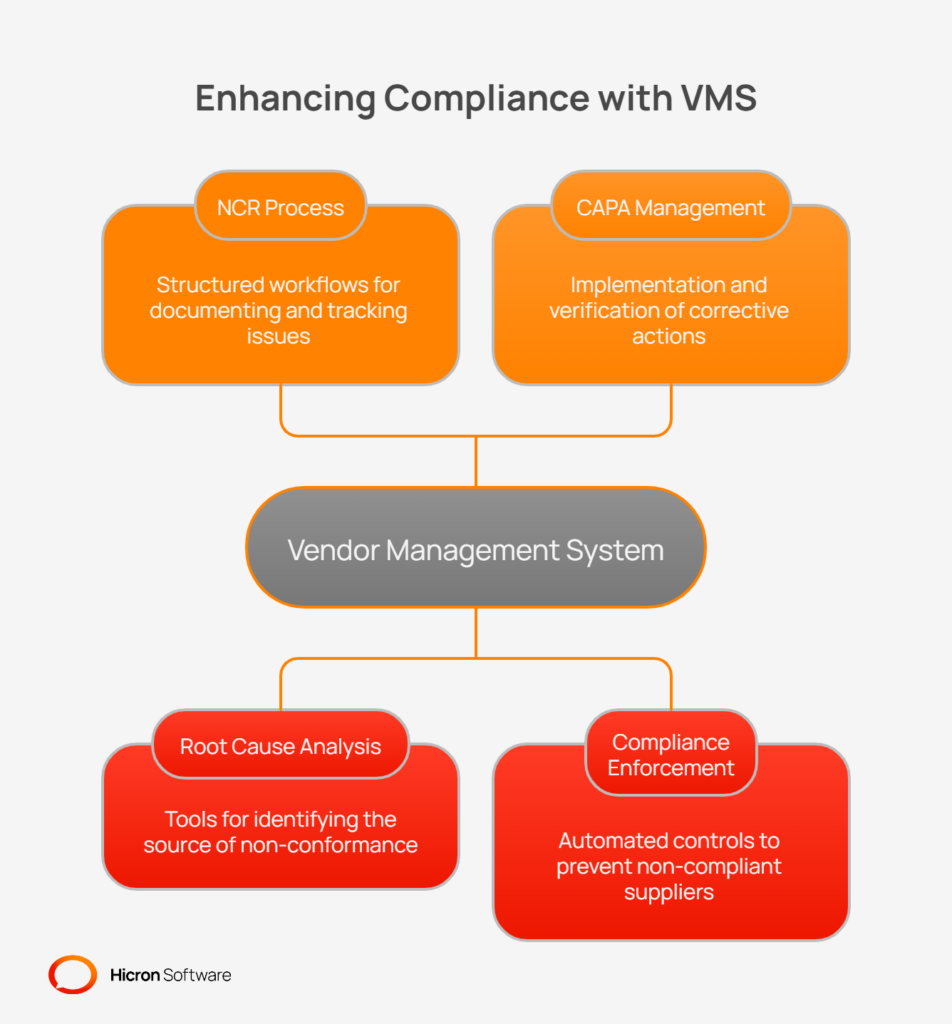
This process is not just about logging problems. A VMS provides built-in tools to guide teams through root cause analysis, using established methods like the 5 Whys or Fishbone diagrams. By identifying the trustworthy source of a non-conformance, you can develop meaningful Corrective and Preventive Actions (CAPA).
The system then manages the implementation of these CAPAs and includes effectiveness checks to verify that the solution worked and to prevent the issue from recurring. This entire process creates a detailed, auditable record that demonstrates proactive quality management to regulators.
Furthermore, a VMS can automatically enforce compliance by placing holds or blocks on suppliers when critical quality or documentation gates fail.
For instance, if a required certification expires or a shipment fails inspection, the system can prevent further orders or payments until the issue is resolved.
This automated control mechanism is a tool for mitigating risk, ensuring that non-compliant suppliers cannot proceed in the supply chain, and safeguarding your organization’s commitment to quality and safety.
In an era of stringent data privacy laws and increasing cyber threats, protecting regulated information is a non-negotiable aspect of supplier compliance. A Vendor Management System (VMS) handles a vast amount of sensitive data, including supplier financial records, quality audits, and intellectual property.
Therefore, data security and access governance are fundamental capabilities that ensure this information remains confidential, integral, and available only to authorized personnel.
A modern VMS employs a multi-layered security strategy to safeguard regulated data. This begins with controlling who can see and do what within the system. Access controls are essential for enforcing the principle of least privilege, which grants users only the minimum permissions necessary to perform their job functions. This is critical for preventing both accidental data leaks and malicious activity.
Furthermore, protecting data as it moves and while it is stored is vital for meeting regulatory requirements and maintaining trust with suppliers.
The table below outlines key security features that a VMS provides to protect your regulated data.
| Security feature | Description |
| RBAC / ABAC | Role-based access control (RBAC) and attribute-based access control (ABAC) restrict user access based on their role, department, or other attributes, ensuring users only see relevant information. |
| SSO / MFA | Single sign-on (SSO) simplifies user authentication, while multi-factor authentication (MFA) adds a critical layer of security to verify user identity and prevent unauthorized access. |
| Data segmentation | The system can partition data by division, plant, or region, creating virtual walls that prevent users from one business unit from accessing the sensitive data of another. |
| Encryption | Data is protected through encryption both “at rest” (when stored on servers) and “in transit” (as it moves across networks), making it unreadable to unauthorized parties. |
Beyond these access and protection controls, a VMS provides comprehensive audit logs that track all user actions and data modifications. These logs record who accessed what data, what changes were made, and when those actions occurred.
This complete, unalterable history is essential for forensic readiness. In the event of a security incident or a regulatory audit, you can quickly reconstruct events, identify the scope of the issue, and demonstrate compliance with data-handling standards. This level of transparency is crucial for building a secure and trustworthy supplier compliance management ecosystem.
One of the most stressful parts of compliance is preparing for an audit. Gathering documents, proving adherence to procedures, and demonstrating corrective actions can be time-consuming and manual. A Vendor Management System (VMS) transforms this experience by making audit preparation faster, more accurate, and significantly less painful. The system automates the collection and organization of critical compliance data, keeping you audit-ready at all times.
Instead of scrambling to find information buried in spreadsheets and email chains, a VMS provides better reporting and analytics. With just a few clicks, you can generate comprehensive reports that give a clear picture of your compliance posture.
This instant access to organized, real-time data enables you to respond to auditor requests quickly and confidently, demonstrating a well-controlled, transparent operation.
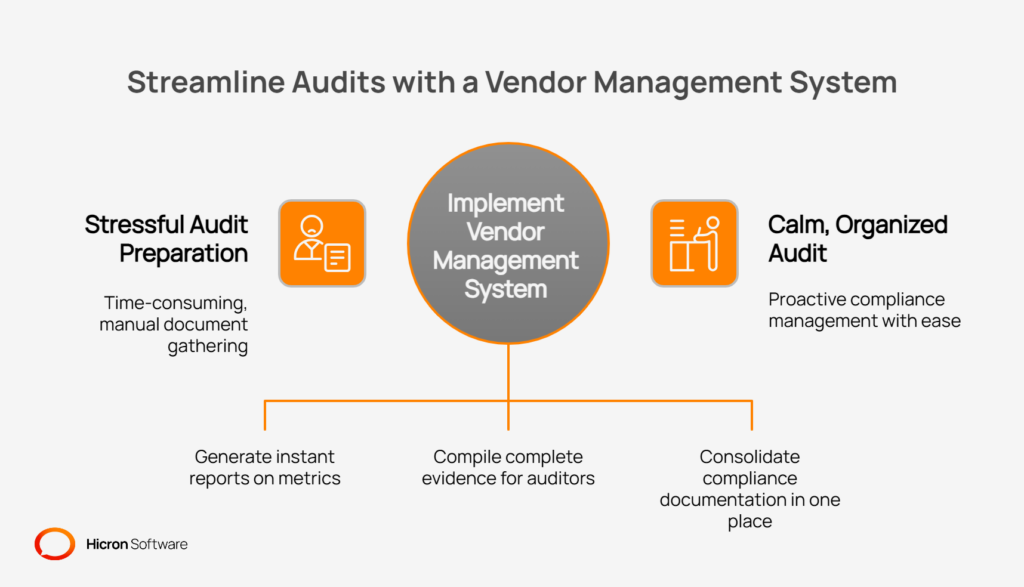
A VMS streamlines audit preparation through several key features:
Ultimately, a VMS turns audit preparation from a reactive, fire-drill exercise into a calm, organized process. By providing tools to generate detailed reports and evidence packs on demand, it helps you demonstrate control over your supply chain and prove regulatory compliance with ease.
Modern supply chains face increasing scrutiny over ethical and environmental performance. Beyond traditional quality and safety regulations, companies are now responsible for collecting and validating a wide range of supplier declarations related to Environmental, Social, and Governance (ESG) criteria.
A Vendor Management System (VMS) is essential for systematically managing these complex attestations, ensuring your organization meets its ethical commitments and complies with global regulations.
A VMS automates the process of sending out declaration requests, tracking their completion, and validating the information provided. This structured approach ensures that you have the necessary documentation to prove due diligence across your entire supply base. It transforms ESG compliance from a logistical challenge into a manageable, transparent, and auditable process.
This capability is critical for mitigating reputational risk and demonstrating a commitment to responsible sourcing.
The table below outlines some of the key attestations that a VMS helps collect and manage.
| Attestation / declaration | Description |
| Conflict minerals | Collects supplier declarations to ensure that minerals like tin, tantalum, tungsten, and gold are not sourced from conflict-affected regions. |
| REACH / RoHS | Manages compliance with regulations restricting hazardous substances in products, requiring suppliers to provide evidence of adherence. |
| Human rights | Gathers attestations related to fair labor practices and adherence to regulations like the Modern Slavery Act, ensuring ethical treatment of workers. |
| Anti-bribery | Documents supplier commitment to anti-corruption policies, a critical component of corporate governance and risk management. |
| Sustainability metrics | Tracks and validates supplier-provided data on carbon emissions, water usage, waste reduction, and other key sustainability performance indicators. |
One of the most important features of a VMS in this context is its ability to automate reminders. The system automatically tracks expiry dates for all attestations and certificates. It sends proactive notifications to both your team and the supplier well in advance of expiration, ensuring there are no lapses in compliance.
This automated oversight is crucial for maintaining up-to-date records and proving ongoing ESG compliance without constant manual intervention.
A vendor management system (VMS) delivers maximum value when it operates as part of a connected enterprise ecosystem. Integrating your VMS with other critical business systems, such as enterprise resource planning (ERP), product lifecycle management (PLM), manufacturing execution systems (MES), and quality management systems (QMS), creates a single, cohesive source of truth that strengthens your entire compliance framework.
This connectivity breaks down data silos and ensures that compliance is embedded in every stage of the procurement and production lifecycle. By synchronizing data across platforms, you can ensure consistency and accuracy.
For example, integrating with your PLM allows the VMS to pull the latest item masters and specifications, ensuring suppliers are constantly working with the correct versions.
Likewise, connecting with an MES or QMS enables the transfer of inspection results and quality data, providing real-time visibility into supplier performance directly within the VMS.
A key architectural advantage of a modern VMS is its ability to integrate without creating data chaos. It can use an “anti-corruption layer” that acts as a sophisticated translator between systems. This allows the VMS to map and use data from an ERP without having to mirror the ERP’s complex data model 1:1, simplifying integration and maintaining data integrity.
The main benefit of integration is the ability to enforce compliance at the point of purchase. By pushing a vendor’s real-time compliance status from the VMS directly to your ERP or purchasing system, you can build automated controls. If a vendor is non-compliant, due to an expired certificate, a failed audit, or a pending CAPA, the system can automatically block the creation of new purchase orders.
This proactive measure prevents noncompliant buys, safeguarding your operations and ensuring that only qualified, approved suppliers are part of your supply chain.
Maintaining supplier compliance is not a one-time event; it is an ongoing process that requires constant vigilance. A vendor management system (VMS) provides the tools for continuous assurance, helping you stay ahead of noncompliance before it becomes a problem. Through proactive monitoring and automated alerts, the system acts as a vigilant partner, ensuring that standards are consistently met across your entire supply base.
The core of this capability lies in automated, threshold-based alerts. Instead of manually tracking expiration dates or follow-up actions, you can configure the VMS to automatically notify you of potential issues. The system can send alerts for lapsing certifications, missing quality inspections, or overdue audit items, giving your team ample time to address them.
This proactive approach prevents minor oversights from escalating into significant compliance breaches, reducing risk and ensuring operational continuity.
Beyond individual alerts, a VMS offers visualization tools for at-a-glance insights. Customizable dashboards provide a high-level view of your compliance landscape, organized by supplier, plant, commodity, or any other relevant category.
These dashboards often feature risk heatmaps that instantly highlight the most critical areas. A heatmap might highlight suppliers with a history of non-conformance or those operating in high-risk regions, allowing you to focus your resources where they are needed most.
This combination of real-time alerts and strategic dashboards shifts your team from a reactive to a proactive stance. You can move beyond simply fixing problems and start anticipating them, fostering a culture of continuous improvement, and ensuring supplier compliance management day in and day out.
Implementing a comprehensive vendor management system (VMS) is a significant project, but it doesn’t have to be overwhelming. A phased approach allows you to roll out capabilities incrementally, ensuring a smooth transition and maximizing user adoption.
By breaking the implementation into manageable stages, you can deliver value quickly while building a solid foundation for a world-class supplier compliance program.
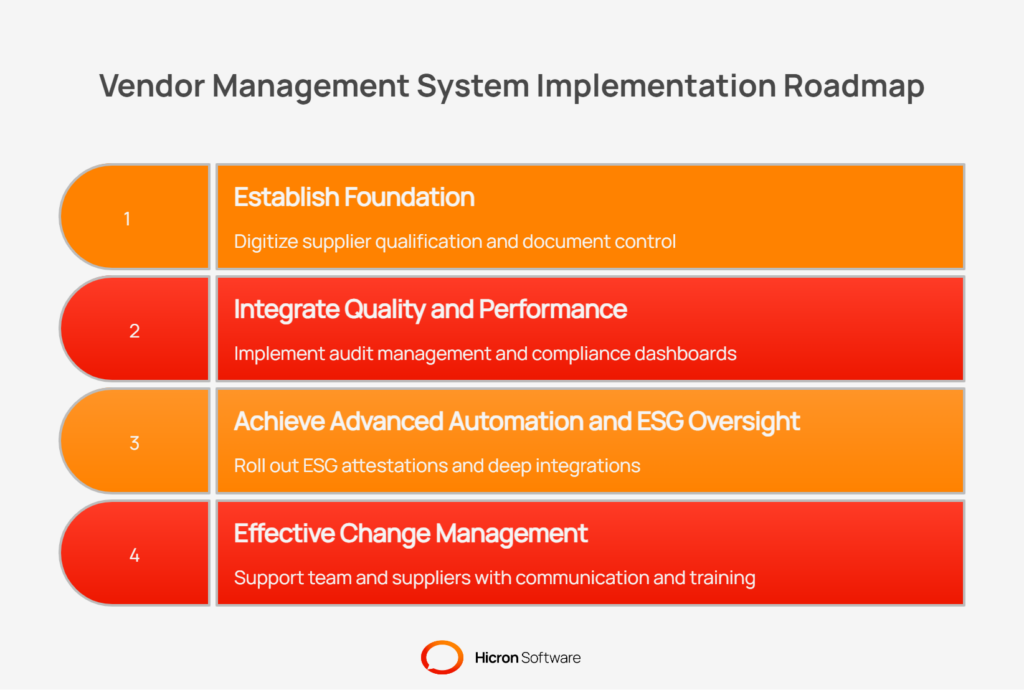
The first phase focuses on establishing core control over your supplier base. This stage is about gaining visibility and centralizing essential data. Key activities include:
Once the foundation is set, the next phase is to integrate quality and performance management into the system. This stage connects compliance to real-world operations. Key activities include:
The final phase focuses on advanced automation and expanding the scope of compliance to include ESG metrics. This stage elevates your program from reactive to strategic. Key activities include:
Throughout every phase, effective change management is crucial. Supporting your team and suppliers with clear communication, standardized templates, comprehensive training, and user-friendly onboarding kits will ensure a successful rollout and drive long-term value.
To effectively manage supplier compliance, you need to measure it. Tracking the right Key Performance Indicators (KPIs) provides clear, data-driven insights into the health of your compliance program. A vendor management system (VMS) makes this easy by automatically capturing data and presenting it in intuitive dashboards.
This allows you to monitor performance, identify trends, and make informed decisions to strengthen your supply chain.
By focusing on what truly matters, you can move beyond simply collecting documents and start actively managing risk. Here are some of the most critical KPIs to track for a healthy compliance program:
Implementing a supplier compliance program comes with its own set of challenges. Even with the right intentions, organizations can fall into common traps that undermine their efforts and expose them to risk. Understanding these pitfalls is the first step toward avoiding them and building a truly effective compliance framework.
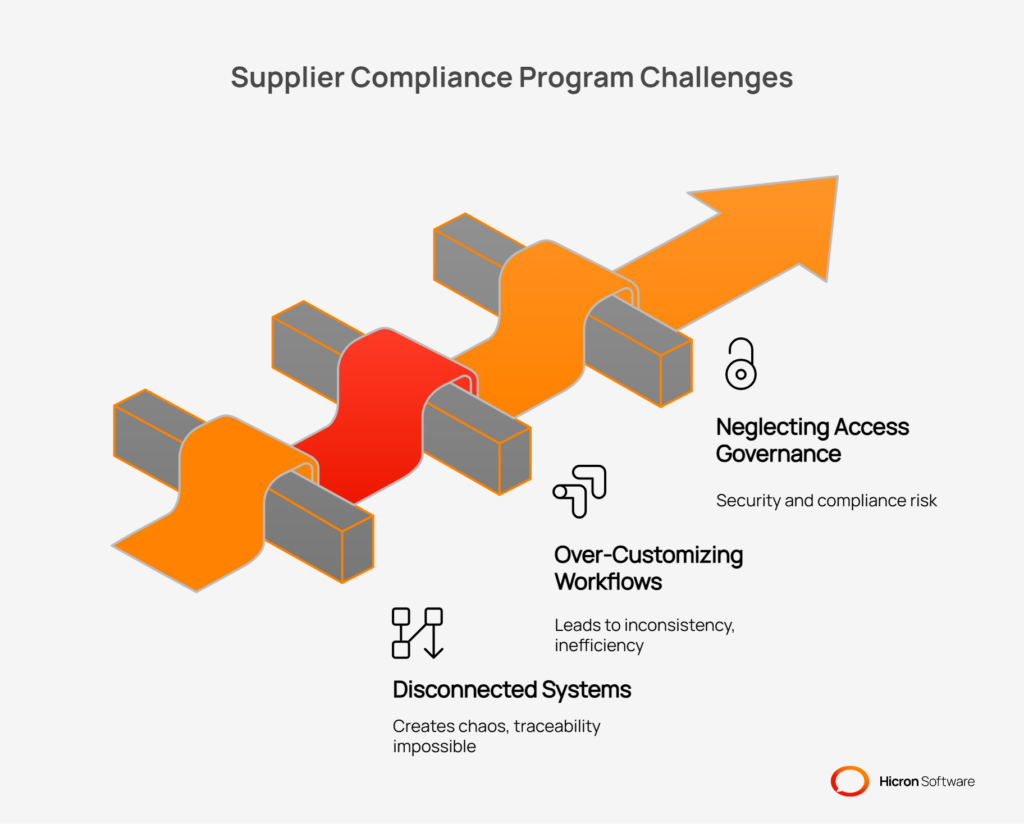
One of the most frequent mistakes is managing compliance using a patchwork of emails, shared drives, and spreadsheets. Storing critical evidence, such as certificates and audit reports, in these siloed systems creates chaos. It becomes nearly impossible to establish a traceability chain, making audit preparation a nightmare and real-time visibility a distant dream.
How to avoid it? Centralize all supplier information and documentation within a single Vendor Management System (VMS). A VMS serves as the single source of truth, linking every document, audit, and communication to the relevant supplier record, creating an unbreakable, easily searchable audit trail.
While flexibility is important, creating unique compliance workflows for every department, site, or team leads to inconsistency and inefficiency. Without standardized processes and checklists, it’s difficult to enforce a consistent quality standard across the organization or to accurately benchmark supplier performance.
How to avoid it? Use the VMS to establish and enforce standardized, best-practice workflows for processes like supplier qualification, auditing, and CAPA management. Start with standard templates and checklists, then configure them for specific risk profiles or commodities rather than reinventing the wheel for each site.
Failing to manage user access properly is a significant security and compliance risk. This includes ignoring the principle of Segregation of Duties (SoD), which can allow for fraudulent activity. It also involves letting supplier accounts become stale, where former employees of a supplier might still have access to your sensitive data long after they’ve left.
How to avoid it? Leverage the security features within your VMS to enforce role-based access control (RBAC) and SoD. Regularly conduct access reviews for both internal users and external supplier contacts. Implement processes to promptly de-provision accounts for users who no longer require access, ensuring your system remains secure.
A modern vendor management system (VMS) is a solution for organizations aiming to simplify and strengthen regulatory compliance. By centralizing all critical documents in one secure platform, a VMS eliminates information silos and ensures that essential records are always accessible and audit-ready.
Standardized workflows replace fragmented, manual processes with consistent, repeatable actions for supplier qualification, document management, and corrective measures. Automated alerts and reminders help your team stay ahead of lapsing certifications, missing records, and compliance deadlines, minimizing the risk of costly oversights.
With comprehensive access controls and continuous monitoring, a VMS makes it easy to maintain accountability, traceability, and security throughout your supply chain. Real-time dashboards and reporting support informed decision-making and provide the transparency required for regulatory audits.
As a result, adopting a VMS improves supplier compliance, enhances operational efficiency, and enables your organization to manage risk proactively, creating a more resilient, competitive, and trustworthy supply base.

Vendor management system compliance refers to using a VMS platform to ensure your suppliers meet all required legal, industry, and organizational regulations. A VMS centralizes documentation, automates workflows for supplier qualification and audits, and tracks records, which simplifies how you manage and prove VMS regulatory compliance across your entire supply chain.
A VMS improves supplier compliance management by replacing manual, error-prone methods, such as spreadsheets, with an automated, centralized system. It standardizes the supplier qualification process, tracks document expirations with automated alerts, manages audit schedules, and provides a complete, traceable audit trail. This ensures consistent enforcement of compliance rules and gives you real-time visibility into your suppliers’ status.
Yes, a VMS is essential for managing Environmental, Social, and Governance (ESG) compliance. It automates the collection, validation, and tracking of critical supplier declarations for regulations concerning conflict minerals, human rights, and other sustainability metrics. The system can also send automated reminders for expiring attestations, keeping your ESG compliance records up to date.
A VMS creates a closed-loop system for managing quality issues. When a non-conformance is reported, the system initiates a structured workflow for a Corrective and Preventive Action (CAPA). It guides teams through root cause analysis, tracks the implementation of the corrective plan, and verifies its effectiveness, ensuring quality issues are resolved and do not recur.
A VMS simplifies audit preparation by keeping all compliance evidence in one accessible location. Instead of manually searching for documents, you can use the system to generate “evidence packs” for auditors with just a few clicks. These packs can include certifications, audit reports, CAPA histories, and training records, making the audit process faster and demonstrating strong regulatory control.
Hicron Software proved to be a trusted partner with unmatched technical expertise, delivering a scalable and user-friendly web application that was pivotal to our successful U.S. market expansion.
Hicron’s contributions have been vital in making our product ready for commercialization. Their commitment to excellence, innovative solutions, and flexible approach were key factors in our successful collaboration.
I wholeheartedly recommend Hicron to any organization seeking a strategic long-term partnership, reliable and skilled partner for their technological needs.
After carefully evaluating suppliers, we decided to try a new approach and start working with a near-shore software house. Cooperation with Hicron Software House was something different, and it turned out to be a great success that brought added value to our company.
With HICRON’s creative ideas and fresh perspective, we reached a new level of our core platform and achieved our business goals.
Many thanks for what you did so far; we are looking forward to more in future!

Hicron is a partner who has provided excellent software development services. Their talented software engineers have a strong focus on collaboration and quality. They have helped us in achieving our goals across our cloud platforms at a good pace, without compromising on the quality of our services. Our partnership is professional and solution-focused!

The IT system supporting the work of retail outlets is the foundation of our business. The ability to optimize and adapt it to the needs of all entities in the PSA Group is of strategic importance and we consider it a step into the future. This project is a huge challenge: not only for us in terms of organization, but also for our partners – including Hicron – in terms of adapting the system to the needs and business models of PSA. Cooperation with Hicron consultants, taking into account their competences in the field of programming and processes specific to the automotive sector, gave us many reasons to be satisfied.