How to Build a Custom Vendor Management System for On-Premises Deployment
- October 08
- 20 min


Definition: Vendor management system (VMS) quality control refers to the processes and tools used to monitor and improve the quality of goods and services provided by third-party suppliers. When these processes are fragmented across different platforms and departments, it often leads to blind spots, costly delays, and quality escapes that damage customer trust.
This article explores how a modern Vendor Management System (VMS) solves these challenges. You will learn how centralizing complaint handling, standardizing supplier audits, and automating performance scoring creates a transparent, closed-loop system for quality improvement.
We will cover the core features that drive better supplier collaboration and help you turn quality data into actionable insights for continuous enhancement.
Vendor management system (VMS) quality control helps organizations closely monitor suppliers. It turns quality from an abstract goal into something you can measure and improve. The main areas covered include:
When you bring all these activities into a VMS, you create a single system that holds every piece of quality information. Centralization means teams no longer chase information through emails or spreadsheets.
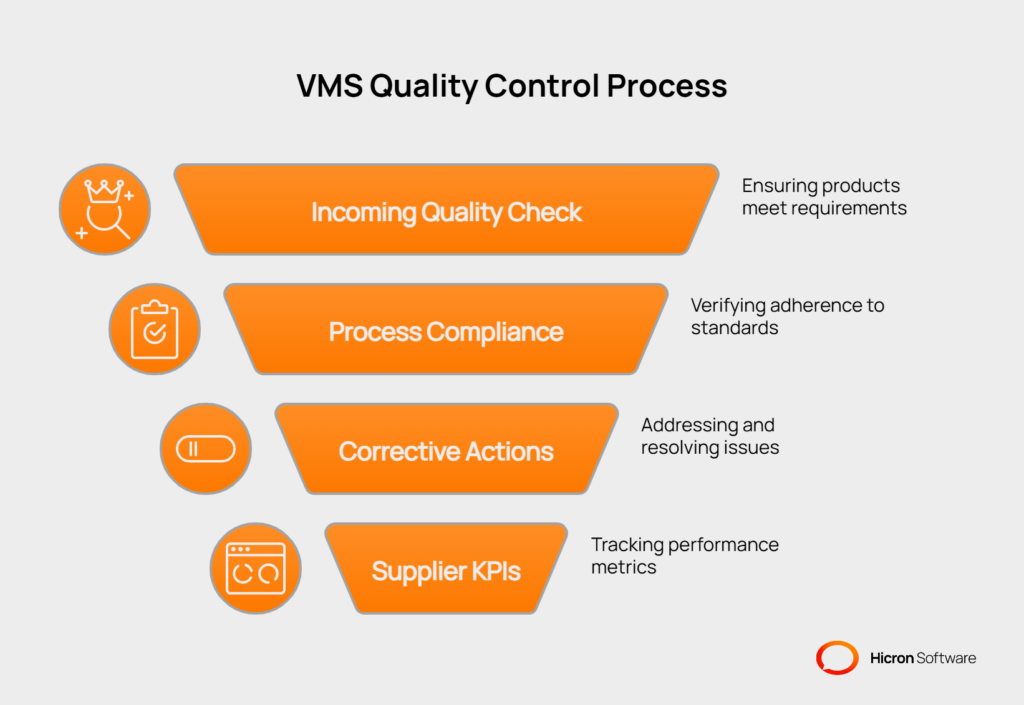
Instead, they use one trusted source to track issues, store evidence, and review results. This setup makes it easier to spot patterns, check that fixes work, and make choices based on real data. In short, a centralized VMS turns scattered tasks into a clear, proactive strategy for quality management.
Vendor management system quality control strategy is built on a foundation of specific, integrated features. These tools move quality management from manual, disjointed efforts to a centralized, automated process. By embedding quality functions directly into the system, organizations gain the visibility and control needed to drive supplier improvement. Here are the three core features that make this possible.
This feature digitizes the entire process of managing quality issues, from initial report to final resolution. It provides a structured workflow to capture, route, and resolve any deviation from quality standards. Instead of relying on emails and spreadsheets, teams use standardized forms to log nonconformances, attach evidence, and assign tasks.
This creates a complete and auditable record for every issue, ensuring accountability and enabling efficient root cause analysis. The system helps manage corrective actions, preventing similar problems from happening again.
| Key features for complaint tracking | Description |
| Standardized forms | Enables consistent data collection for nonconformances. |
| Configurable workflows | Directs the routing, approval, and escalation process. |
| SLA timers | Measures response and resolution times. |
| Evidence attachments | Stores photos, documents, and reports with each case. |
| Audit trails | Maintains a full record of all actions taken. |
A VMS simplifies the complex process of conducting supplier audits and assessments. It allows quality teams to plan and schedule audits, use standardized digital checklists, and capture findings in a consistent format. Whether evaluating for process compliance or a specific certification, the system centralizes all audit-related information.
This makes it easier to identify systemic risks, assign corrective action plans to address findings, and track their completion. The result is a more organized and effective audit program that ensures suppliers consistently meet your standards.
| Key features for audits & assessments | Description |
| Audit plans & schedules | Manages and organizes supplier audit activities. |
| Digital checklists | Provides standard criteria for various audit types. |
| Findings management | Records nonconformities and observations centrally. |
| Corrective action tracking | Links findings to the corresponding follow-up tasks. |
| Re-audit scheduling | Sets reminders for confirming the effectiveness of actions. |
This feature translates raw quality data into actionable business intelligence. A VMS automates the collection and analysis of key performance indicators (supplier KPIs) to create objective supplier scorecards. These dashboards provide at-a-glance insights into critical metrics like defect rates, on-time delivery, and the timeliness of corrective action responses.
By tracking trends and comparing vendor performance, stakeholders can make informed sourcing decisions, reward top-performing suppliers, and work collaboratively with others on targeted improvement plans.
| Key features for performance scoring | Description |
| Automated data collection | Gathers information on OTD, defect rates, and cost variance. |
| Custom scorecards | Uses formulas to generate overall supplier scores. |
| Trend analysis | Shows supplier performance changes over time. |
| Vendor comparison | Compares suppliers using standard metrics. |
| Real-time dashboards | Displays current performance results. |
Corrective and preventive action (CAPA) management addresses the root causes of recurring problems. VMS tools provide frameworks for conducting root cause analysis, such as the 5 Whys or Fishbone diagram.
Responsibilities and deadlines are clearly assigned, and the system tracks progress through completion. Effectiveness checks confirm that the corrective measures have resolved the issue.
| Key features for CAPA management | Description |
| Root cause analysis tools | Provides methods for structured analysis of issues. |
| Task ownership & due dates | Defines responsibility and time frames for corrective actions. |
| Effectiveness checks | Verifies that the chosen approach has resolved issues. |
| Escalation rules | Identifies and flags overdue or incomplete CAPA tasks. |
| Closed-loop tracking | Monitors each step until the problem is fully resolved. |
A modern Vendor Management System (VMS) enables a fundamental shift in how organizations handle quality: moving from a reactive, problem-solving posture to a proactive, prevention-focused strategy.
Instead of simply responding to failures as they occur, a VMS provides the tools to anticipate issues, enforce standards, and use data to drive continuous improvement. This evolution in vendor management system quality control is powered by advanced capabilities that embed quality into every step of the supplier relationship.
Automated alerts and Service Level Agreements (SLAs) act as a digital safety net, ensuring critical tasks and timelines are never overlooked. A VMS can be configured to monitor key milestones and deadlines, from audit follow-ups to corrective action due dates. This functionality allows you to set up:
Robust document control and evidence management features provide an unchangeable, auditable record of compliance. This is essential for regulatory audits and for proving that processes are being followed correctly.
The system ensures that everyone is working from the most current information by providing versioning for all documents, from specifications to compliance certificates. It also facilitates controlled distribution, so suppliers only see the documents relevant to them.
Features like electronic signatures and approval workflows create a digital paper trail, proving that procedures were reviewed and accepted by the right people at the right time.
Advanced analytics and reporting tools transform raw quality data into strategic intelligence. Instead of manually compiling spreadsheets, a VMS provides dynamic dashboards that visualize performance and highlight areas for improvement.
These tools help you spot patterns that would otherwise go unnoticed, allowing you to address systemic issues before they escalate.
| VMS analytic tool | Proactive quality action |
| Pareto charts | Identify the 20% of issues causing 80% of the problems. |
| Supplier heatmaps | Pinpoint risk concentrations by commodity, plant, or region. |
| Recurring defect detection | Flag repeat nonconformances for deeper root cause analysis. |
| Predictive trends | Forecast future performance based on historical quality data. |
Effective quality management requires giving the right people access to the right information. Role-based access control provides secure, contextual visibility across the organization and supply chain.
You can create granular permissions that partition data by division, product line, or even a specific supplier. This ensures that a plant manager in one region only sees the supplier data relevant to their operations, while a corporate quality leader can view performance across the entire enterprise.
This tailored access protects sensitive information while empowering every stakeholder with the specific insights they need to perform their role effectively.
Strong vendor management system quality control goes beyond internal workflows; it depends on building clear, collaborative relationships with suppliers. Trust develops when communication is open, consistent, and accessible.
By moving away from scattered emails and disconnected calls, a VMS offers a unified platform where both your team and suppliers can address issues, share evidence, and track progress together.
With this centralized space, everyone stays informed using the same data. When a quality problem is reported, suppliers aren’t left guessing—they actively participate in the issue resolution process.
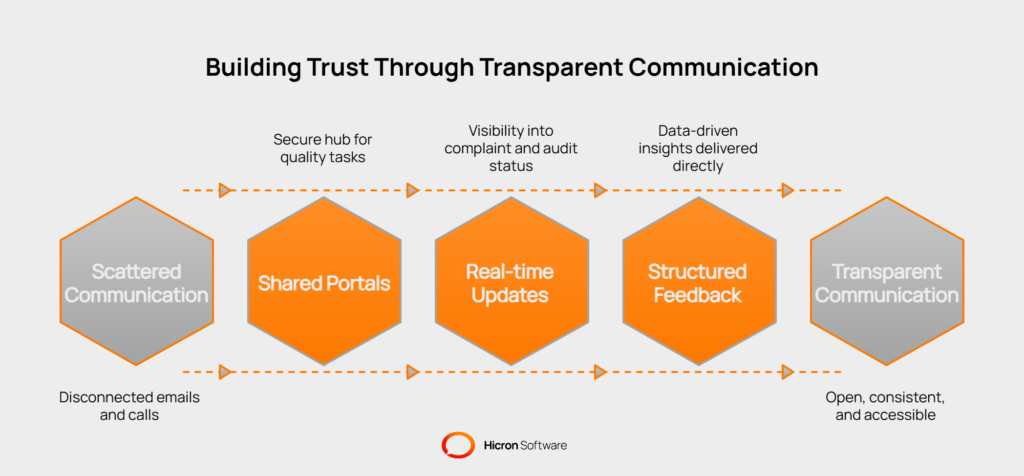
Key features that enable this include:
A cendor management system (VMS) does not operate in isolation. Its true power is unlocked when it connects with your existing technology stack, creating a seamless flow of information that strengthens vendor management system quality control.
This integration breaks down data silos, automates manual processes, and provides a complete picture of supplier performance across the enterprise.
A critical integration point is with your core operational systems, such as ERP, MES, and PLM. Connecting the VMS to these platforms enables automatic synchronization of essential data. Item masters, purchase orders, receiving information, and shop-floor inspection results can flow directly into the VMS.
This ensures that quality issues are tied to specific parts, suppliers, and production runs, providing crucial context for ERP integration and effective issue resolution.
Secure and straightforward supplier access is managed through integration with email and identity management systems. This connection enables single sign-on (SSO) capabilities, making it easy for suppliers to log in to the VMS portal without needing to remember another set of credentials. It also ensures that access is properly authenticated and controlled, protecting sensitive information.
For organizations that want to perform deeper analysis, a VMS should connect with external business intelligence (BI tools). While the native analytics of a VMS are powerful, exporting quality data to a corporate data warehouse allows for advanced cross-functional reporting. An API-first design is essential for this, providing flexible and well-documented endpoints for data exchange.
To ensure compatibility even with older or custom-built platforms, a VMS with an anti-corruption layer can translate data between modern and legacy systems, safeguarding data integrity across the entire technology ecosystem.
Successfully implementing a vendor management system quality control program requires a thoughtful strategy that balances speed with user adoption. A phased implementation approach allows your organization to build a solid foundation and expand capabilities over time, ensuring a smoother transition and delivering value at each stage. This blueprint breaks the rollout into manageable phases.
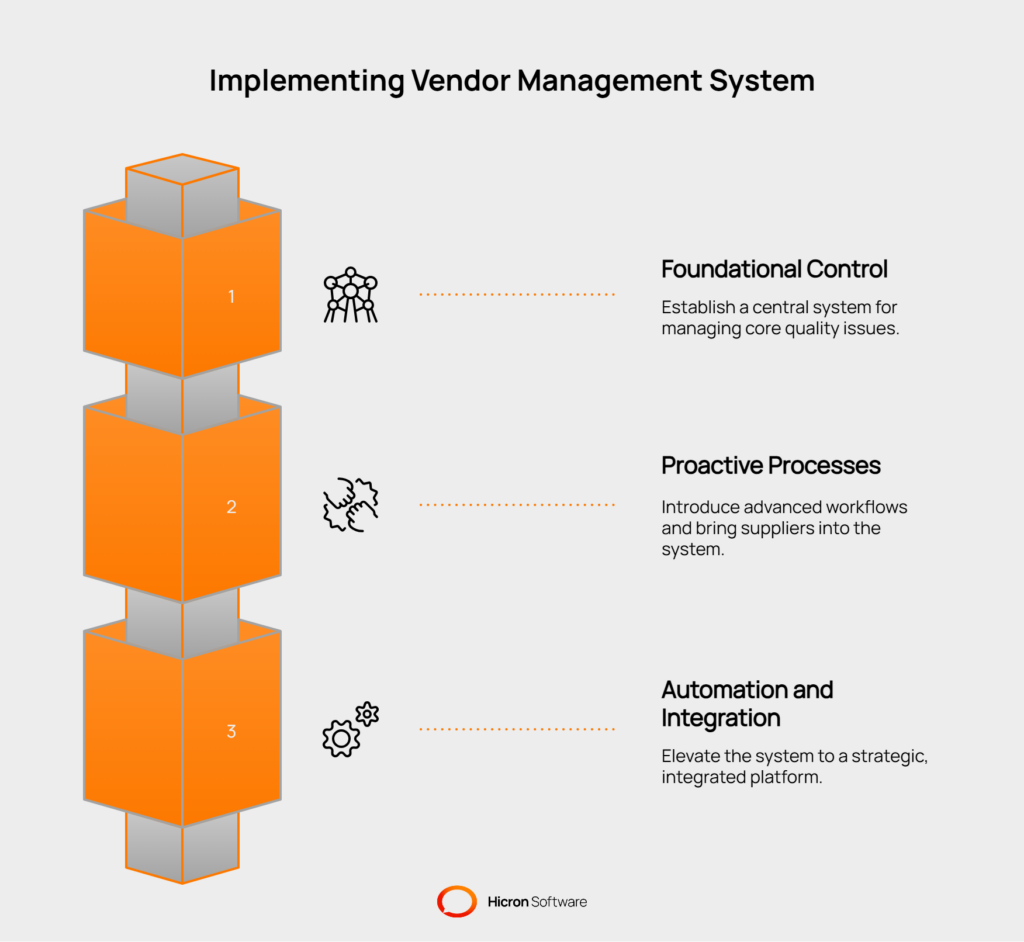
The initial phase focuses on establishing a central system for managing core quality issues. The goal is to move away from spreadsheets and emails to a single source of truth.
With a foundation in place, the second phase introduces more advanced workflows and brings suppliers directly into the system.
The final phase elevates the system from a quality management tool to a strategic, integrated platform.
A successful rollout depends on effective change management. This involves creating standardized templates for forms and checklists, providing comprehensive training for internal teams and suppliers, and establishing KPI baselines before you begin. By managing the human side of the transition, you ensure the technology is adopted effectively and delivers its full potential.
Tracking meaningful metrics is essential for understanding and improving vendor management system quality control. By monitoring key performance indicators (KPIs), organizations gain objective insight into process effectiveness and supplier performance. Important KPIs include:
Achieving sustainable results with a vendor management system quality control program goes beyond the initial implementation. It requires adopting practices that ensure consistency, reliability, and continuous improvement. By embedding these habits into your operations, you can maximize the long-term value of your system and foster stronger supplier relationships.
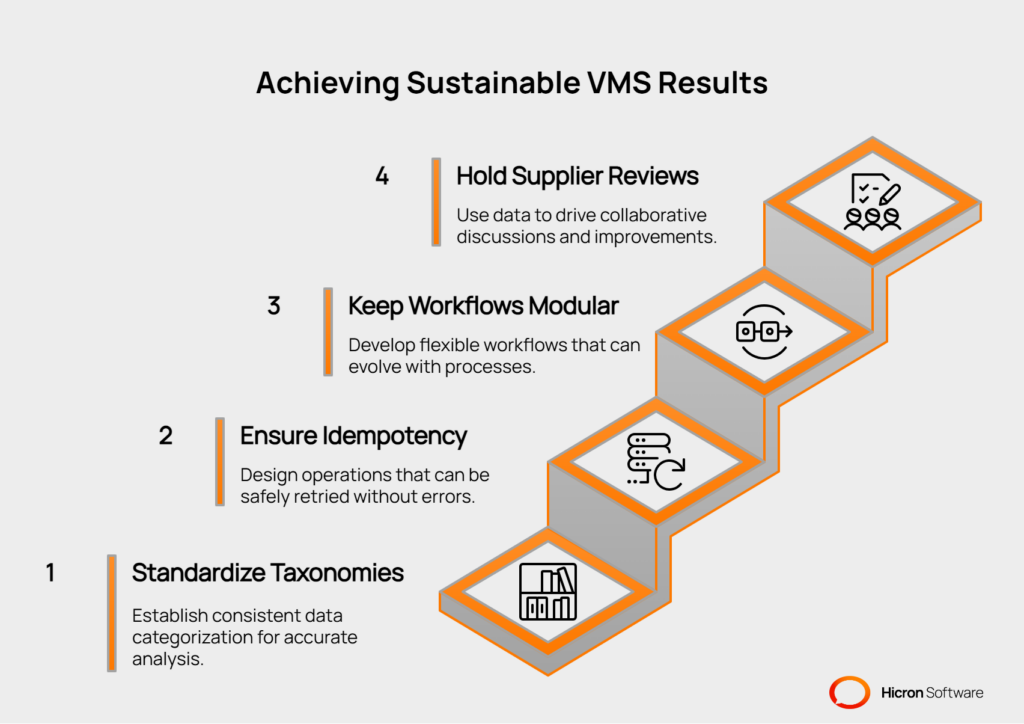
The following practical tips will help you maintain momentum and drive lasting success.
Consistency is key to meaningful data analysis. Before you go live, establish and enforce standardized taxonomies for critical data points like defect codes, nonconformance types, and severity levels.
When everyone categorizes a problem the same way, you can generate accurate reports, spot trends reliably, and compare performance across different suppliers and locations without ambiguity.
In system design, an idempotent operation can be applied multiple times without changing the result beyond the initial application. This is crucial for system integrations and data synchronization, as it allows for safe retries of failed updates without creating duplicate records or corrupting data.
Every action, update, or retry should also be fully auditable, leaving a clear digital trail that shows who did what and when. This ensures data integrity and supports compliance.
Avoid the temptation to build overly complex workflows from day one. Start simple and iterate. Design modular workflows that can be easily adjusted or expanded as your processes mature.
For example, begin with a basic workflow for nonconformance reports and add more complex steps, such as automated approvals or CAPA sub-processes, later.
This approach allows your team to adapt quickly and prevents the system from becoming rigid and difficult to manage.
Use the data you are collecting to facilitate productive conversations. Schedule regular, data-driven supplier reviews; quarterly is a good cadence, using the dashboards directly from your VMS.
Presenting live performance data on metrics like defect rates, CAPA closure times, and audit scores creates a transparent, objective foundation for discussing successes and areas for improvement. This practice transforms the VMS from a simple tracking tool into a central hub for collaborative supplier development.
Transitioning to a modern Vendor Management System marks a strategic shift from reactive problem-solving to proactive quality assurance. By centralizing core processes like complaint tracking, supplier audits, supplier performance management, and performance scorecards, you create a powerful, closed-loop system for continuous improvement.
This integrated approach provides the visibility and data needed to identify issues early, collaborate effectively with suppliers on solutions through structured CAPA management, and track progress over time. Ultimately, an effective vendor management system quality control moves beyond simply managing suppliers to actively developing them into stronger partners.
As a next step, consider where your organization stands today. You can begin by running a quality maturity assessment to identify your biggest gaps and opportunities, starting with VMS complaint tracking.
From there, a practical way to demonstrate value is to pilot the complaint-to-CAPA workflow with one of your top-performing or most strategic suppliers. This focused initiative can quickly showcase the benefits of a centralized system and build momentum for a broader rollout.
Vendor management system quality control refers to using a centralized platform to monitor, measure, and improve the quality of goods and services from third-party suppliers. It is important because it replaces disconnected processes, like emails and spreadsheets, with an integrated system. This provides a single source of truth for tracking issues, managing compliance, and ensuring products consistently meet your standards, which helps reduce defects and protect brand reputation.
A Vendor Management System (VMS) streamlines complaint and nonconformance management with structured digital workflows. When a quality issue is identified, users log it through standardized forms, attach evidence like photos or reports, and assign ownership for resolution. The system provides complete visibility into the status of each complaint, ensuring accountability and creating a fully auditable record for every step, from initial report to final closure.
Yes, a VMS is a powerful tool for managing both supplier audits and Corrective and Preventive Action (CAPA) plans. The system helps you schedule audits, use digital checklists to ensure consistency, and capture findings in a central location. When a nonconformance is identified during an audit, you can launch a formal CAPA management workflow directly in the system, assigning tasks for root cause analysis and tracking the implementation and effectiveness of corrective actions.
Supplier scorecards in a VMS automate the collection and analysis of key performance indicators (KPIs) to provide an objective view of supplier performance. By tracking metrics such as defect rates, on-time delivery, and audit results, the system generates real-time dashboards that highlight trends and compare vendors. This data-driven approach enables you to have more productive conversations with suppliers, reward top performers, and create targeted improvement plans.
A modern VMS is designed to integrate seamlessly with other core business systems, including your Enterprise Resource Planning (ERP) platform. This integration allows for the automatic flow of critical data, such as purchase orders, item masters, and receiving information, into the VMS. Connecting these systems provides essential context for quality issues, reduces manual data entry, and ensures that your vendor management system quality control processes are aligned with your broader operational data.
Hicron Software proved to be a trusted partner with unmatched technical expertise, delivering a scalable and user-friendly web application that was pivotal to our successful U.S. market expansion.
Hicron’s contributions have been vital in making our product ready for commercialization. Their commitment to excellence, innovative solutions, and flexible approach were key factors in our successful collaboration.
I wholeheartedly recommend Hicron to any organization seeking a strategic long-term partnership, reliable and skilled partner for their technological needs.

After carefully evaluating suppliers, we decided to try a new approach and start working with a near-shore software house. Cooperation with Hicron Software House was something different, and it turned out to be a great success that brought added value to our company.
With HICRON’s creative ideas and fresh perspective, we reached a new level of our core platform and achieved our business goals.
Many thanks for what you did so far; we are looking forward to more in future!

Hicron is a partner who has provided excellent software development services. Their talented software engineers have a strong focus on collaboration and quality. They have helped us in achieving our goals across our cloud platforms at a good pace, without compromising on the quality of our services. Our partnership is professional and solution-focused!

The IT system supporting the work of retail outlets is the foundation of our business. The ability to optimize and adapt it to the needs of all entities in the PSA Group is of strategic importance and we consider it a step into the future. This project is a huge challenge: not only for us in terms of organization, but also for our partners – including Hicron – in terms of adapting the system to the needs and business models of PSA. Cooperation with Hicron consultants, taking into account their competences in the field of programming and processes specific to the automotive sector, gave us many reasons to be satisfied.