What is a Vendor Management System (VMS)? 2026 Guide
- October 03
- 12 min


A custom on-premises vendor management system is a software solution deployed within an organization’s local infrastructure, offering complete control over sensitive data and the ability to customize systems.
This article explores the essentials of building a custom on-premises VMS tailored for industries such as healthcare, finance, and manufacturing, where data security and compliance are critical. Readers will learn why businesses choose on-premises deployment, the challenges involved, and the step-by-step process to create a secure, scalable, and high-performing system.
From defining business requirements to ensuring high availability and ERP integration, this guide provides actionable insights for organizations aiming to enhance vendor management while maintaining full control over their infrastructure.
An on-premises vendor management system enables businesses to keep sensitive data close, making it a top choice for industries such as healthcare, finance, and government. With full control over your infrastructure, you can customize the system to fit your exact needs, no compromises.
Plus, if you already have server infrastructure in place, why not make the most of it? On-premises deployment saves on recurring cloud fees and ensures your data stays secure and compliant with industry regulations. It’s about control, security, and building a system that works for you, not the other way around.
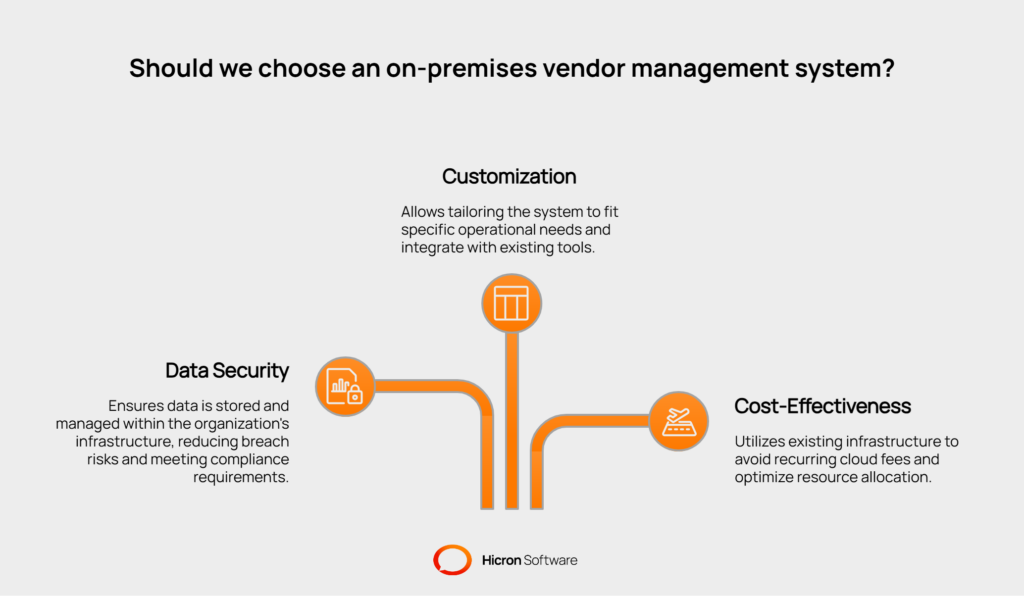
An on-premises vendor management system offers unmatched control over sensitive data, making it a preferred choice for industries with strict compliance requirements, such as healthcare, finance, and government. Unlike cloud-based solutions, on-premises deployment ensures that all data is stored and managed within the organization’s physical infrastructure, reducing the risk of breaches or unauthorized access.
This level of control is critical for meeting regulations such as HIPAA, GDPR, or PCI DSS, where even minor lapses in data security can lead to severe penalties. By keeping data in-house, businesses can implement tailored security protocols, conduct regular audits, and ensure compliance with industry-specific standards.
On-premises systems provide businesses with the ability to fully customize their vendor management system to meet specific operational needs. Unlike off-the-shelf or cloud-based solutions, which often come with limitations, an on-premises VMS can be designed to align with unique workflows, integrate with existing tools, and adapt to industry-specific requirements.
For example, manufacturers can incorporate supply chain tracking, while healthcare organizations can prioritize patient data protection. This level of customization not only enhances efficiency but also ensures that the system evolves alongside the business, offering long-term value and scalability.
For organizations with an established server infrastructure, on-premises deployment is a cost-effective solution. By utilizing existing hardware and IT resources, businesses can significantly reduce upfront costs associated with new infrastructure.
Additionally, maintaining control over the infrastructure allows for better resource allocation and optimization. Companies can avoid recurring cloud subscription fees and instead invest in enhancing their internal systems.
This approach is particularly beneficial for enterprises that already have dedicated IT teams capable of managing updates, backups, and system health, ensuring a reliable and efficient VMS tailored to their needs.
Building an on-premises vendor management system isn’t without its hurdles, but the rewards often outweigh the effort. Yes, there are upfront costs, scalability concerns, and the need for ongoing maintenance, but these challenges come with solutions that put you in control.
Whether it’s leveraging your existing infrastructure, planning for growth, or ensuring high availability, businesses can turn these obstacles into opportunities.
Let’s dive into the key challenges and, more importantly, how to overcome them to create a system that’s secure, scalable, and built to last.
Deploying an on-premises vendor management system comes with higher upfront costs compared to cloud-based solutions. Businesses need to invest in servers, storage, networking equipment, and software licenses, as well as allocate resources for installation and configuration.
While the initial expense may seem steep, it eliminates recurring subscription fees and provides full control over the infrastructure. For industries prioritizing data security and compliance, this investment ensures sensitive information stays in-house, offering peace of mind and long-term value.
Scaling an on-premises system as your business grows can be challenging due to hardware limitations. Unlike cloud solutions that expand on demand, on-premises systems require additional servers, storage, and IT resources to accommodate growth.
However, with proper planning, businesses can design modular systems that allow for expansion. By forecasting future needs and investing in scalable infrastructure, organizations can ensure their VMS grows alongside their operations without disruption.
On-premises systems require ongoing maintenance to stay secure and efficient. Dedicated IT staff are essential for managing updates, applying security patches, performing backups, and monitoring system health.
While this adds operational complexity, it also ensures the system is tailored to the organization’s unique needs. Regular maintenance not only enhances performance but also reduces the risk of downtime or security breaches, making it a worthwhile commitment for businesses that value control.
Maintaining uptime and data redundancy in an on-premises environment can be complex, but it is critical for business continuity. Organizations must invest in failover systems, backup power supplies, and disaster recovery plans to minimize downtime.
For example, implementing redundant servers and storage ensures that operations continue even in the event of hardware failure. While these measures require careful planning and resources, they provide the reliability and control businesses need to protect their operations and data.
| Challenge | Description | Solution |
| Initial setup costs | High upfront investment in hardware, software, and IT resources. | Plan budgets carefully and focus on long-term savings by eliminating recurring cloud fees. |
| Scalability | Scaling requires additional hardware and resources, which can be time-consuming and costly. | Design modular systems and forecast future needs to ensure proper expansion. |
| Maintenance and updates | Requires dedicated IT staff to manage updates, backups, and system health. | Build a skilled IT team or outsource maintenance to ensure the system remains secure and stable. |
| High availability and redundancy | Ensuring uptime and data redundancy can be complex and resource-intensive. | Invest in failover systems, backup power supplies, and disaster recovery continuity plans. |
Creating a custom On-Premises Vendor Management System (VMS) is a strategic process that requires careful planning and execution. By following these key steps, businesses can ensure their system is tailored to their unique needs while maintaining scalability, security, and efficiency.
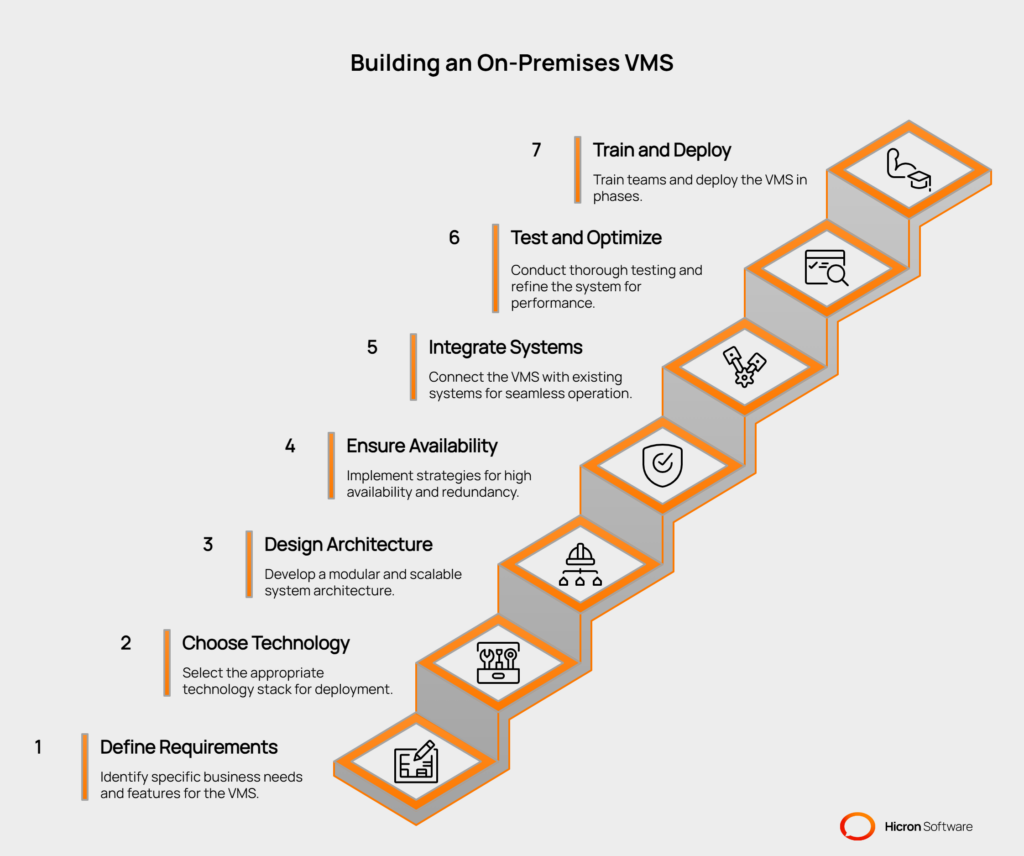
Start by identifying the specific needs of your organization. What problems should the VMS solve? Common requirements include supplier management, order tracking, and quality control. Consider features like:
Clearly defining these requirements will guide the entire development process and ensure the system aligns with your business goals.
Selecting the right technology stack is critical for on-premises deployment. Here are some popular choices:
Ensure the chosen technologies align with your existing IT ecosystem to minimize compatibility issues and maximize efficiency.
A modular architecture is key to building a flexible and scalable VMS. By breaking the system into independent modules, you can:
This approach future-proofs your VMS and simplifies maintenance.
Downtime can be costly, so it’s essential to design for high availability. Strategies include:
These measures ensure your VMS remains operational even during unexpected events.
Proper integration with legacy systems like SAP or other ERPs is crucial for efficiency. Use techniques like:
This step ensures your VMS works harmoniously within your existing IT environment.
Testing is a non-negotiable step to ensure your VMS performs as expected. Focus on:
Optimization based on testing results ensures a smooth and secure deployment.
A successful deployment requires well-trained teams and thorough documentation. Steps include:
Proper training and documentation empower your team to maximize the VMS’s potential.
Custom on-premises vendor management system (VMS) offers businesses unmatched control, security, and efficiency. By tailoring your VMS to your specific needs, you can address unique challenges while reaping long-term benefits.
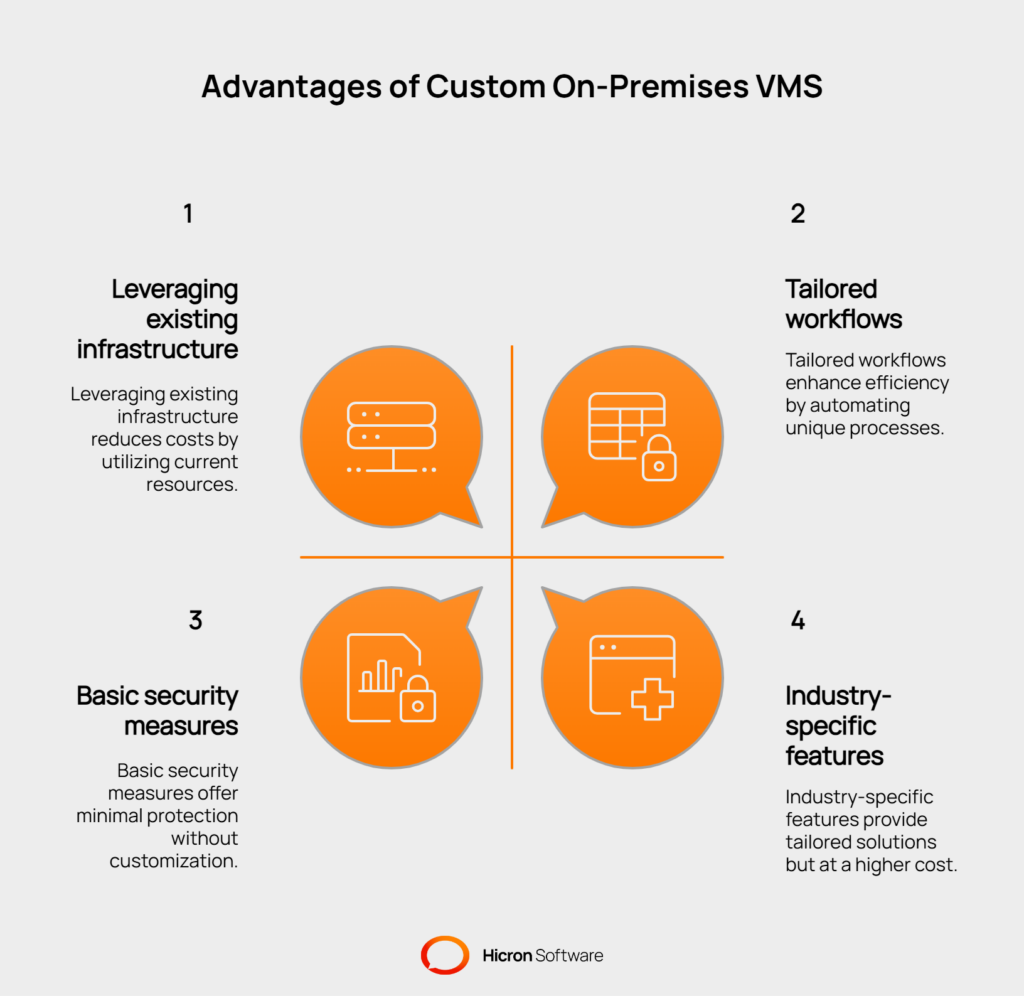
Let’s dive into the key advantages, complete with examples and actionable insights:
Keeping sensitive data under your organization’s physical control is a top priority for industries such as healthcare, finance, and government. A custom on-premises VMS ensures:
Example: A healthcare provider can store patient data securely on-premises, ensuring compliance with HIPAA while preventing unauthorized access.
Unlike off-the-shelf solutions, a custom VMS is designed to fit your business like a glove. It can be tailored to:
Example: A manufacturing company can integrate its VMS with its supply chain software to track vendor performance in real time, ensuring timely deliveries and quality standards.
While the upfront costs of an on-premises VMS may be higher, the long-term savings are significant. Here’s how:
Example: A financial institution with existing server infrastructure can deploy a custom VMS without incurring additional cloud hosting fees, saving thousands annually.
On-premises systems are designed to deliver consistent performance, even in challenging environments. Benefits include:
Example: A logistics company operating in remote areas can rely on an on-premises VMS to manage vendor relationships without worrying about internet outages.
Investing in a tailored on-premises Vendor Management System (VMS) provides businesses with unmatched control, flexibility, and long-term value. Unlike cloud-based solutions, a custom on-premises VMS ensures that your data remains entirely within your organization’s infrastructure, offering complete ownership and reducing reliance on third-party providers.
This level of control is particularly vital for industries that handle sensitive information, such as healthcare, finance, or government, where compliance and data security are non-negotiable.
A custom VMS is designed to grow alongside your business. As your organization evolves, the system can be adapted to meet new demands, whether that involves adding features, integrating with additional tools, or scaling to support increased operations. This flexibility ensures that your VMS remains relevant and practical, no matter how your business changes over time.
While the upfront costs of an on-premises VMS may be higher, the long-term financial benefits are significant. By leveraging your existing infrastructure and eliminating recurring subscription fees, you can achieve substantial cost savings. Additionally, this approach provides predictable expenses and reduces dependency on external vendors, giving you greater financial stability and control over your operations.
For organizations that prioritize security, customization, and reliability, a custom on-premises VMS is the ideal solution. It not only addresses current operational needs but also positions businesses for sustained success by delivering a system that is secure, adaptable, and cost-efficient.
A custom on-premises vendor management system (VMS) is particularly suited for industries that demand high levels of security, compliance, and control. Based on insights from the knowledge base, here are some real-world applications:
Manufacturing industries face the challenge of coordinating vast supply chains while adhering to strict compliance standards. An on-premises VMS offers manufacturers the ability to track vendor performance in real-time, ensuring timely deliveries and consistent quality.
By integrating with ERP systems, it streamlines procurement and inventory management processes. Additionally, centralized documentation helps maintain compliance with ISO standards, reducing the risk of regulatory issues.
| Key benefits | Details |
| Real-time vendor tracking | Ensures timely deliveries and quality assurance. |
| ERP integration | Simplifies procurement and inventory management. |
| Compliance support | Centralized documentation ensures adherence to ISO standards. |
For example, a global automotive manufacturer uses an on-premises VMS to monitor supplier quality metrics. This system ensures compliance with safety standards, reduces production delays, and provides full control over sensitive supply chain data.
The healthcare sector handles highly sensitive patient information, making data security a top priority. On-premises VMS solutions provide full control over data storage, ensuring compliance with regulations like HIPAA.
Role-based access controls limit who can view or edit vendor-related information, while secure integration with hospital management systems streamlines vendor onboarding and contract management.
| Key benefits | Details |
| Data security | Full control over storage ensures compliance with HIPAA. |
| Role-based access | Limits access to sensitive vendor-related information. |
| System integration | Streamlines vendor onboarding and contract management. |
For instance, a hospital network deploys an on-premises VMS to manage relationships with medical equipment suppliers. This approach ensures patient data remains secure and compliant with regulatory standards, minimizing risks associated with third-party data breaches.
Financial institutions must safeguard confidential customer data while complying with strict regulations such as GDPR and PCI DSS. On-premises VMS solutions enhance security by keeping sensitive financial data within the organization’s infrastructure.
Customizable workflows help meet compliance requirements for vendor contracts and audits, while integration with legacy systems ensures smooth operations without compromising security.
| Key benefits | Details |
| Enhanced security | Protects sensitive financial data within the organization. |
| Compliance workflows | Customizable processes meet regulatory requirements. |
| Legacy system integration | Ensures smooth operations without compromising security. |
A multinational bank, for example, uses an on-premises VMS to manage vendor contracts securely. This system ensures compliance with international financial regulations, reduces the risk of data breaches, and enhances operational efficiency.
Government agencies require complete control over their data to ensure national security and compliance with local regulations. On-premises VMS solutions provide data sovereignty by keeping all information within government-controlled infrastructure.
Custom workflows support the management of vendor contracts for public projects, while high availability and redundancy ensure uninterrupted operations.
| Key benefits | Details |
| Data sovereignty | Keeps all information within government-controlled infrastructure. |
| Custom workflows | Supports vendor contract management for public projects. |
| High availability | Ensures uninterrupted operations with redundancy. |
For example, a defense agency uses an on-premises VMS to manage contracts with defense contractors. This system ensures sensitive data remains secure and supports national security priorities while complying with local regulations.
An on-premises Vendor Management System (VMS) is the ultimate solution for businesses that demand control, security, and customization. By deploying a VMS within your local infrastructure, you gain unmatched ownership of your data, ensuring compliance with industry regulations and safeguarding sensitive information.
This approach is particularly valuable for industries like healthcare, finance, manufacturing, and government, where data security and operational control are non-negotiable.
On-premises deployment allows you to tailor the system to your unique workflows, integrate with existing tools like ERP systems, and scale as your business grows. While the initial investment may be higher, the long-term benefits, such as eliminating recurring cloud fees, enhancing reliability, and achieving full customization, make it a strategic choice for forward-thinking organizations.
By leveraging your existing infrastructure, you can reduce costs and optimize resources, all while building a system that evolves alongside your business. Whether it’s ensuring high availability, meeting compliance requirements, or creating a modular architecture for scalability, an on-premises VMS empowers you to take control of your vendor management processes.
Ready to build a custom on-premises VMS? Contact us today to explore how we can help you create a secure, scalable, and high-performing system tailored to your needs!
An on-premises vendor management system (VMS) is a software solution installed and run on an organization’s local servers and IT infrastructure. Unlike cloud-based options, it gives you complete control over your data, making it ideal for industries that require secure vendor management and must adhere to strict compliance standards.
A custom VMS lets you build a solution tailored to your business needs. You can design specific workflows, choose a modular architecture for scalability, and ensure ERP integration with existing systems. This approach provides greater flexibility and control compared to standard, off-the-shelf software.
By hosting the system on your own servers, you maintain full control over sensitive data, which is critical for complying with regulations such as GDPR and HIPAA. An on-premises VMS enables you to implement custom security protocols and role-based access controls, significantly reducing the risk of data breaches associated with third-party providers.
While the initial setup cost for an on-premises vendor management system can be higher, it often proves more cost-effective over time. You eliminate recurring monthly or annual subscription fees associated with cloud services. By leveraging your existing IT infrastructure, you can create a predictable budget and achieve a lower total cost of ownership.
Yes. A well-designed on-premises VMS built with a modular architecture is highly scalable. This approach allows you to add new features, expand storage, or increase user capacity by upgrading specific components of your infrastructure. With proper planning, your scalable on-premises system can evolve to meet growing business demands without major disruptions.
Hicron Software proved to be a trusted partner with unmatched technical expertise, delivering a scalable and user-friendly web application that was pivotal to our successful U.S. market expansion.

Hicron’s contributions have been vital in making our product ready for commercialization. Their commitment to excellence, innovative solutions, and flexible approach were key factors in our successful collaboration.
I wholeheartedly recommend Hicron to any organization seeking a strategic long-term partnership, reliable and skilled partner for their technological needs.

After carefully evaluating suppliers, we decided to try a new approach and start working with a near-shore software house. Cooperation with Hicron Software House was something different, and it turned out to be a great success that brought added value to our company.
With HICRON’s creative ideas and fresh perspective, we reached a new level of our core platform and achieved our business goals.
Many thanks for what you did so far; we are looking forward to more in future!

Hicron is a partner who has provided excellent software development services. Their talented software engineers have a strong focus on collaboration and quality. They have helped us in achieving our goals across our cloud platforms at a good pace, without compromising on the quality of our services. Our partnership is professional and solution-focused!

The IT system supporting the work of retail outlets is the foundation of our business. The ability to optimize and adapt it to the needs of all entities in the PSA Group is of strategic importance and we consider it a step into the future. This project is a huge challenge: not only for us in terms of organization, but also for our partners – including Hicron – in terms of adapting the system to the needs and business models of PSA. Cooperation with Hicron consultants, taking into account their competences in the field of programming and processes specific to the automotive sector, gave us many reasons to be satisfied.