What is a Vendor Management System (VMS)? 2026 Guide
- October 03
- 12 min


Definition: Modular architecture is a design approach that utilizes independent components that can be easily added to or modified. This structure makes it easier to build systems that are both flexible and scalable. As businesses demand more adaptable Vendor Management Systems (VMS), modular design stands out as a solution for evolving needs.
In this article, you’ll discover how a modular approach benefits custom VMS projects, from making updates easier to supporting growth and new features. We’ll explain key principles, highlight practical advantages, and show why modular architecture matters for future-ready vendor management.
Modular architecture is a software design approach where an application is built from a collection of independent, self-contained modules. Each module is responsible for a specific piece of business functionality and can be developed, deployed, and scaled individually.

This approach to software architecture contrasts sharply with traditional monolithic systems. In a monolithic design, all components are interconnected and interdependent, creating a single, large application. Any update or change requires rebuilding and redeploying the entire system, which can be slow and risky.
The core principle of modular design is the division of a complex system into smaller, manageable parts that communicate with each other through well-defined interfaces. Think of it like building with LEGO bricks; each brick is a standardized unit that can be combined with others to create a larger structure. In a custom VMS, one module might handle vendor onboarding, another might manage purchase orders, and a third could oversee invoicing.
Because these modules are loosely coupled, a change to the invoicing module will not break the onboarding process. This separation simplifies development, testing, and maintenance, allowing for more flexible and resilient software solutions.
A custom Vendor Management System built on a modular architecture offers distinct advantages over a monolithic one. By separating functions into independent modules, businesses gain the agility needed to respond to market changes, operational growth, and new technological demands. This approach is not just a structural choice; it is a strategic decision that prepares a VMS for future challenges and opportunities.
One of the primary benefits of modular architecture is enhanced scalability. As your business grows, so do your operational needs. A modular approach allows you to expand your system’s capabilities by adding new feature modules without rebuilding the entire application. This method of scaling software systems is both efficient and cost-effective.
For example, you can introduce a new module for supplier performance evaluation or advanced order tracking as those functions become priorities. This makes for a truly scalable VMS that evolves alongside your organization, ensuring it always meets your requirements.
Business environments are dynamic, and a VMS must be flexible enough to adapt. Modular design gives you the ability to customize the system for unique workflows or specific industry regulations. You can replace or upgrade individual modules without causing widespread disruption.
For instance, if you need to integrate with a new ERP system or comply with updated data privacy laws, you only need to modify the relevant module. This flexibility ensures your vendor management processes remain efficient and compliant, without being locked into a rigid, outdated system.
A modular system simplifies maintenance and reduces downtime. When an issue arises, it is isolated within a specific module, making it faster to identify, troubleshoot, and fix. Developers can work on one component without the risk of creating problems elsewhere in the application.
This streamlined process for modular system updates means that bug fixes and new feature rollouts are quicker and less disruptive. For businesses, this translates into a low-maintenance VMS that is more reliable and requires fewer resources to manage, ensuring operational continuity.
| Benefit | How it works? | Real-world application |
| Scalability | New modules can be added independently, allowing the system to grow with business needs. | A growing retail chain adds a module for vendor performance analytics to track supplier KPIs in real-time. |
| Flexibility | Modules can be replaced or upgraded without disrupting the entire system. | A manufacturing company integrates a new compliance module to meet updated safety regulations. |
| Easier maintenance | Issues are isolated to specific modules, reducing troubleshooting time and system downtime. | A logistics firm quickly fixes a bug in the invoicing module without affecting vendor onboarding processes. |
| Cost efficiency | Modular updates and expansions reduce the need for complete system overhauls. | A startup saves costs by upgrading only the procurement module instead of rebuilding the entire VMS. |
| Future-proofing | Modular systems adapt easily to new technologies and market demands. | A tech company integrates AI-driven supplier evaluation tools into its existing VMS without major rework. |
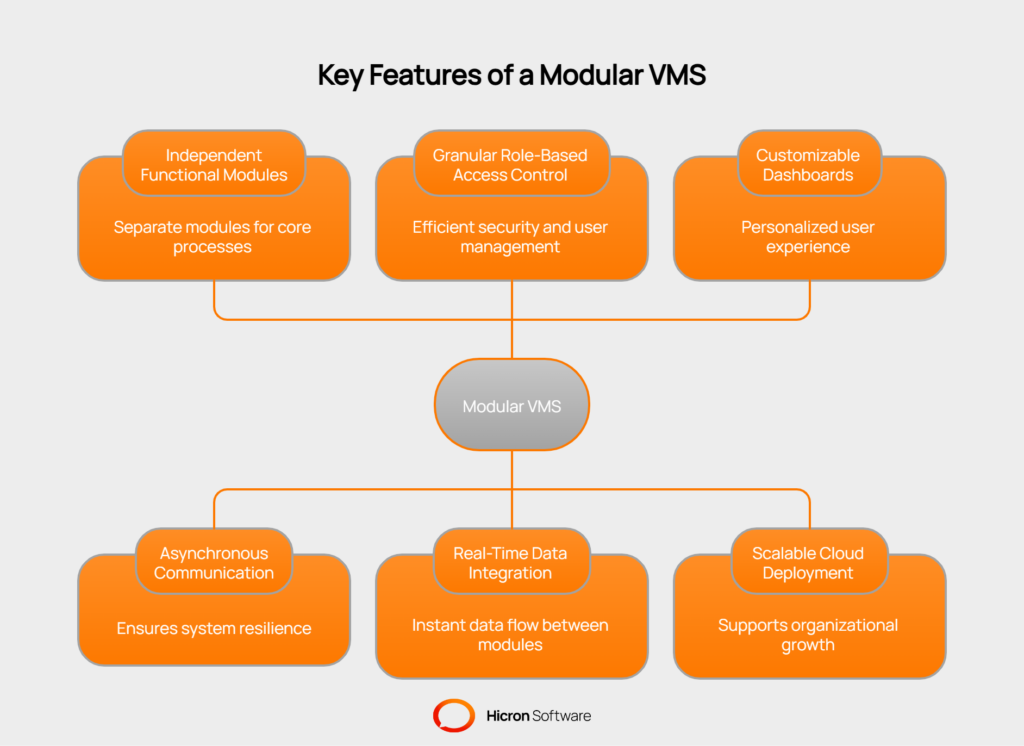
A modular Vendor Management System distinguishes itself through a set of powerful features designed for adaptability and resilience. Unlike rigid, all-in-one platforms, customizable vendor management systems built with a modular approach offer specific functionalities that drive efficiency and prepare the business for future needs. These core modular VMS features are what make the design so effective.
The theoretical benefits of modular architecture come to life when applied to real-world business challenges. A modular Vendor Management System (VMS) provides targeted solutions that a rigid, monolithic system cannot.
From managing complex organizational structures to integrating with legacy software, a modular approach offers practical advantages that drive efficiency and support growth.
Large organizations often struggle to manage the unique workflows, suppliers, and reporting needs of their various divisions. A modular VMS addresses this challenge by offering independent modules tailored to each division’s specific requirements while maintaining a shared core system for consistency. This ensures operational efficiency and a unified executive view across the organization.
| Aspect | Details |
| Challenge | Large organizations have multiple divisions with unique workflows, suppliers, and reporting needs. |
| Solution | Independent modules for each division, tailored to specific needs, with a shared core system. |
| Use case | A manufacturing company with divisions for automotive, aerospace, and consumer goods manages suppliers independently while maintaining a unified executive view. |
Challenge: Large organizations often have multiple divisions, each with unique workflows, suppliers, and reporting needs. A one-size-fits-all VMS fails to accommodate these varied and complex requirements, leading to inefficiency and poor adoption.
Solution with modular VMS: A modular VMS can be configured to meet the distinct needs of each division.
Example use case: A manufacturing conglomerate with separate divisions for automotive, aerospace, and consumer goods can use a modular VMS to manage suppliers for each division independently. This allows each unit to follow its industry-specific compliance standards while executives access consolidated reports for a high-level, unified view of performance.
Key features to highlight:
Legacy systems like SAP are critical for many businesses, but often lack the flexibility needed for modern vendor management. A modular VMS bridges this gap with integration modules and anti-corruption layers, enabling data flow and future-proofing the system. This allows businesses to enhance their vendor management capabilities without overhauling their existing infrastructure.
| Aspect | Details |
| Challenge | Legacy systems like SAP lack flexibility for modern vendor management, creating data silos. |
| Solution | Integration modules act as a bridge, with an anti-corruption layer ensuring flexibility and future-proofing. |
| Use case | A company integrates a modular VMS with SAP for supplier evaluations, ensuring data flow. |
Challenge: Many businesses rely on established legacy systems, such as SAP or other ERPs, for their core operations. These systems often lack the flexibility and modern features required for effective vendor management, creating data silos and process bottlenecks.
Solution with modular VMS: A modular VMS is designed to coexist and communicate with other platforms.
Example use case: A company relies on an older version of SAP for order management. It can integrate a new modular VMS to handle complex supplier evaluations and risk assessments. The integration module ensures that supplier performance data from the VMS is available in SAP, enriching the procurement process without requiring a costly overhaul of the core system.
Key features to highlight:
Small and medium-sized businesses often need a cost-effective solution that grows with them. A modular VMS allows these businesses to start with essential features and gradually add advanced modules as their needs evolve. This pay-as-you-grow model ensures scalability without overwhelming upfront costs.
| Aspect | Details |
| Challenge | Small businesses need a scalable solution without high upfront costs. |
| Solution | Start with essential modules and add advanced features over time using a pay-as-you-grow model. |
| Use case | A startup begins with basic supplier management and order tracking, later adding performance scoring and quality-check modules. |
Challenge: Small or medium-sized businesses may not have the budget for a fully featured VMS at the outset. However, they need a solution that can grow with them rather than a basic tool that will soon be outgrown.
Solution with modular VMS: The modular approach is suited for gradual, cost-effective growth.
Example use case: A startup begins with a basic VMS to manage its initial group of suppliers and track orders. A year later, as its supplier base grows and quality becomes a key differentiator, it adds a supplier performance scoring module and an automated quality-check module to enhance its operations.
Key features to highlight:
The world of software development is always moving forward, and modular VMS design is no exception. As technology evolves, new trends are shaping how these systems are built and managed, pushing the boundaries of what they can achieve.
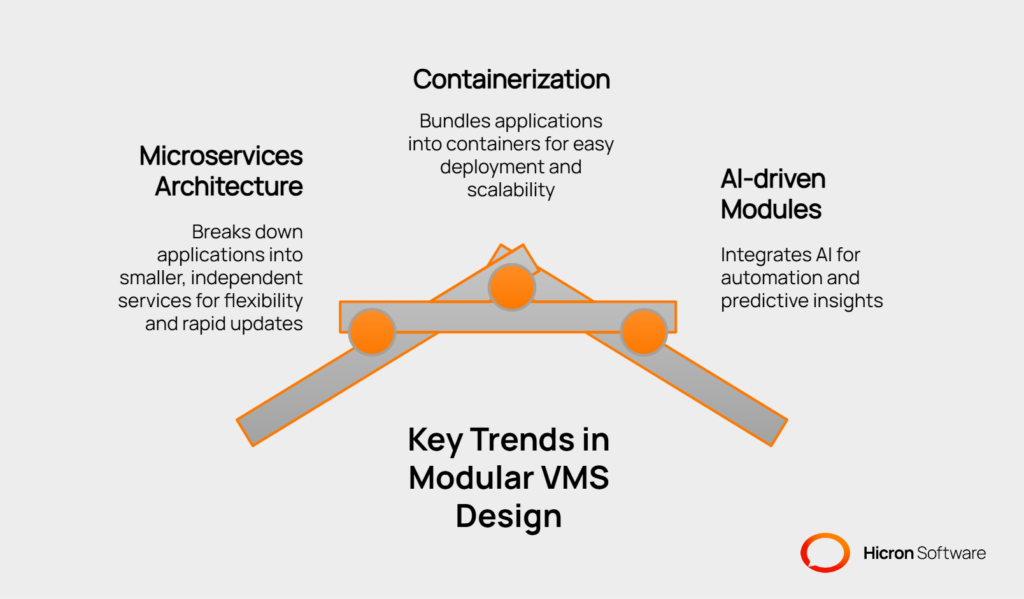
Staying aware of these advancements is key to building or choosing a VMS that is not just effective today but also prepared for the future. Key modular VMS trends are focused on making systems even more powerful, scalable, and intelligent.
This is a more granular evolution of modular design. Instead of building an application with several large modules, a microservices architecture breaks it down into many smaller, independent services. Each service is responsible for a single business function and can be developed, deployed, and scaled on its own.
For a VMS, this could mean separate microservices for user authentication, supplier data validation, and generating reports. This approach dramatically enhances flexibility and allows for continuous, rapid updates without system-wide disruption.
To manage the complexity of microservices, developers are increasingly turning to containerization technologies, such as Docker, and orchestration platforms, like Kubernetes. Containerization involves bundling an application’s code with all the files and libraries it needs to run into a single package, or “container.” This makes it easy to move services between different computing environments. Kubernetes then automates the deployment, scaling, and management of these containers.
For a VMS, this means unparalleled scalability and resilience. If a specific module, like order processing, experiences a surge in traffic, Kubernetes can automatically deploy more containers for that service to handle the load.
Artificial intelligence is no longer a futuristic concept; it has become a practical tool for enhancing business processes. The latest trend is the integration of specialized, AI-driven modules into a VMS. These modules can automate complex tasks and provide predictive insights.
Examples include modules that analyze supplier risk in real-time, predict supply chain disruptions, or utilize machine learning to recommend the best vendors for a specific project based on past performance data. These intelligent components transform a VMS from a simple management tool into a strategic asset.
Choosing the right architecture for a custom vendor management system is a critical business decision. A modular approach offers a clear path to building a system that is not only powerful today but also prepared for tomorrow’s challenges.
By separating functions into independent modules, businesses gain unparalleled scalability to grow, the flexibility to adapt to changing needs, and the simplicity of easier maintenance. This design ensures that your VMS can evolve with your organization, providing lasting value and a strong competitive edge.
Ready to build a modular Vendor Management System tailored to your unique business needs? Contact us today to schedule a consultation and discover how we can help you create a future-proof solution.
Modular architecture is a software design approach where a system is built from independent, self-contained components called modules. Each module handles a specific function and can be developed, updated, or replaced without affecting the rest of the system. This flexible software design contrasts with monolithic systems where all components are tightly interconnected.
The primary modular design benefits for a custom Vendor Management System include:
A modular VMS is composed of separate, independent modules (e.g., supplier onboarding, invoicing, quality control). You can change one module without impacting the others. In contrast, a monolithic VMS is built as a single, unified application where all components are interdependent, making updates and scaling more complex and risky.
Yes, modular architecture is ideal for customizable vendor management systems. Because each function is a separate module, it is much easier to tailor workflows, add unique features, or create specific reports for different departments or business units without disrupting core functionality.
Common modules in a custom Vendor Management System include:
Hicron Software proved to be a trusted partner with unmatched technical expertise, delivering a scalable and user-friendly web application that was pivotal to our successful U.S. market expansion.

Hicron’s contributions have been vital in making our product ready for commercialization. Their commitment to excellence, innovative solutions, and flexible approach were key factors in our successful collaboration.
I wholeheartedly recommend Hicron to any organization seeking a strategic long-term partnership, reliable and skilled partner for their technological needs.

After carefully evaluating suppliers, we decided to try a new approach and start working with a near-shore software house. Cooperation with Hicron Software House was something different, and it turned out to be a great success that brought added value to our company.
With HICRON’s creative ideas and fresh perspective, we reached a new level of our core platform and achieved our business goals.
Many thanks for what you did so far; we are looking forward to more in future!

Hicron is a partner who has provided excellent software development services. Their talented software engineers have a strong focus on collaboration and quality. They have helped us in achieving our goals across our cloud platforms at a good pace, without compromising on the quality of our services. Our partnership is professional and solution-focused!

The IT system supporting the work of retail outlets is the foundation of our business. The ability to optimize and adapt it to the needs of all entities in the PSA Group is of strategic importance and we consider it a step into the future. This project is a huge challenge: not only for us in terms of organization, but also for our partners – including Hicron – in terms of adapting the system to the needs and business models of PSA. Cooperation with Hicron consultants, taking into account their competences in the field of programming and processes specific to the automotive sector, gave us many reasons to be satisfied.