How to Automate Preventive Maintenance in Work Order Management with AI and IoT


Work order management is the process of handling maintenance tasks from creation to completion. Integrating Artificial Intelligence (AI) and the Internet of Things (IoT) into this process is transforming how businesses approach maintenance. Instead of reacting to breakdowns, companies can now predict and prevent them, which helps to reduce downtime and improve efficiency.
Predictive maintenance ensures potential issues are identified early, reducing costly repairs and improving operational efficiency. IoT integration for property management, combined with AI-driven property insights, plays a pivotal role in streamlining workflows and enhancing energy efficiency.
This article explains how AI and IoT are reshaping maintenance strategies. We will look at how this technology helps automate work orders, streamline operations, and minimize costly equipment failures. This guide will show you how to move from a reactive maintenance model to a proactive, predictive one.
Key takeaways:
- Data is Foundational: Real-time data collection through IoT sensors is the starting point for any modern maintenance strategy, providing the necessary information for AI analysis.
- AI Provides Intelligence: AI algorithms analyze sensor data to detect patterns and predict equipment failures before they occur, turning raw data into concrete actions.
- Automation Drives Efficiency: Integrating AI with a CMMS automates the creation and management of work orders, freeing up maintenance teams to focus on more complex tasks.
- Proactive is Better Than Reactive: Shifting from a reactive repair model to a proactive maintenance strategy prevents unexpected downtime, extends the life of assets, and lowers operational costs.
What is the Role of IoT Sensors in Predictive Maintenance?
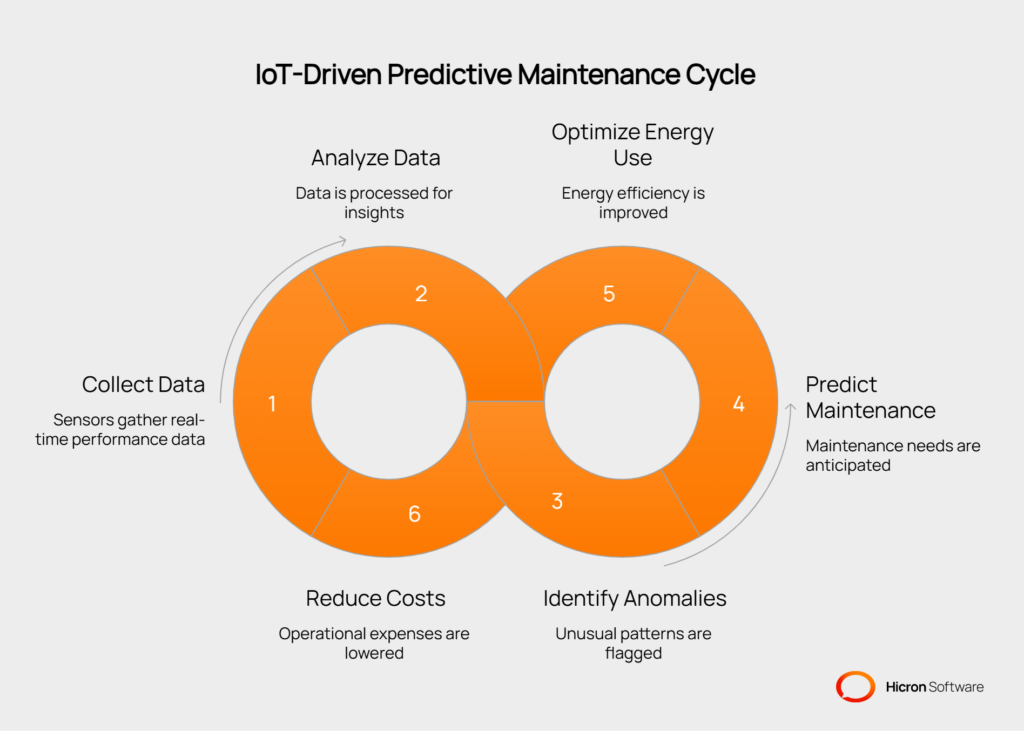
Predictive maintenance cannot exist without data, and the Internet of Things (IoT) is the key to gathering it. IoT sensors are small devices that can be attached to equipment to monitor its condition in real time. These sensors track variables such as temperature, vibration, pressure, and energy use. By collecting this data continuously, IoT provides the raw information AI needs to detect the early signs of wear and potential failure.
The combination of IoT sensors and AI makes true predictive maintenance possible. For instance, a sensor on an HVAC unit might detect a slight increase in vibration. By itself, this data point might not seem important. But when an AI algorithm analyzes this data alongside historical patterns, it can identify it as a sign of a future bearing failure. This allows the system to generate a work order to replace the part before it breaks, preventing a major failure and avoiding costly downtime. This proactive method helps extend asset life and keeps equipment running at peak performance.
How is AI Changing Work Order Management?
AI introduces a new level of intelligence into the maintenance workflow. Instead of performing checks based on a calendar, AI analyzes real-time data to determine when equipment truly needs attention.
AI-Driven property insights leverage advanced algorithms to analyze vast amounts of sensor data in real time, including readings from
- temperature monitors,
- vibration sensors,
- run-time logs,
- automated fault detection codes.
Through continuous monitoring and machine learning, AI can establish a baseline for equipment performance and quickly detect subtle deviations that may signal early signs of wear or impending failure.
By applying predictive analytics for market trends to property management, these platforms can forecast when components like
- HVAC systems,
- elevators, or
- pumps
need preventive maintenance, allowing property managers to plan ahead and avoid disruptive breakdowns. This proactive maintenance strategy extends asset lifespan and reduces unforeseen repair costs, contributing to long-term operational efficiency.
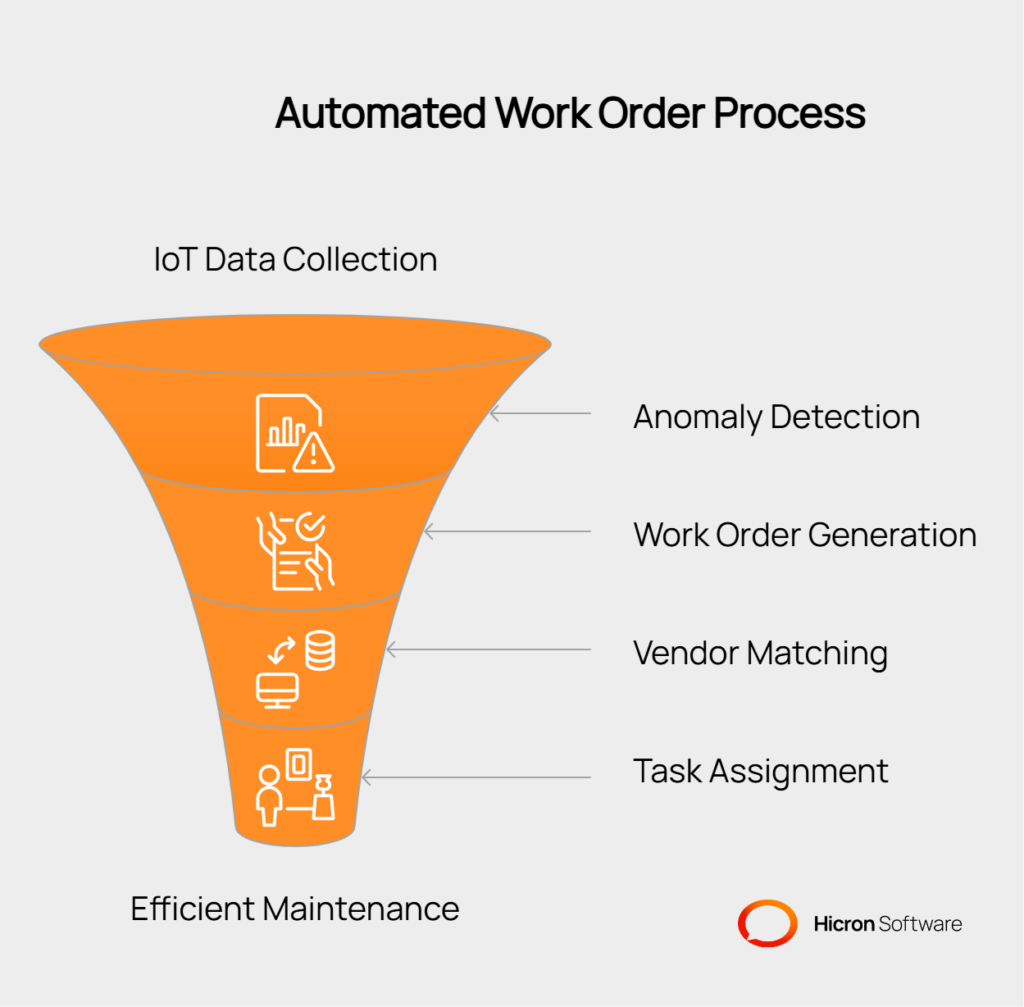
When AI is integrated into a work order management system, it can automate many of the manual steps that slow down operations. For example, if an AI model detects an anomaly in a machine’s performance, the system can automatically create a detailed work order. This order might include a diagnosis, a list of needed parts, and repair instructions. This level of automation ensures maintenance tasks are handled with maximum efficiency. The entire process shifts from being reactive to becoming predictive and proactive.
How Do AI-Powered Insights Streamline Maintenance?
The real strength of AI in maintenance management is its ability to turn raw data into useful insights. An IoT sensor can produce millions of data points, but this information is just noise without AI. AI algorithms analyze this data to find meaningful patterns and anomalies. When the AI detects a potential problem, it does more than just send an alert; it provides context. It can diagnose the likely cause and recommend specific maintenance actions.
This intelligence helps streamline the entire maintenance workflow. When a technician gets an AI-generated work order, they already know what the problem is and how to fix it. This removes the need for long diagnostic sessions. AI can also help optimize maintenance scheduling by prioritizing tasks based on how urgent they are and what resources are available. This data-driven method ensures the right technician is sent to the right job at the right time with the right tools, which greatly improves operational efficiency.
How Do You Integrate AI with a CMMS?
Integrating AI with a Computerized Maintenance Management System (CMMS) is a vital step in modernizing maintenance operations. Most current CMMS platforms have APIs (Application Programming Interfaces) that let them connect with other software. The integration process usually involves linking the AI platform to the CMMS so that data can flow between them.
Once they are integrated, the AI can pull historical maintenance data from the CMMS to train its predictive models. In turn, when the AI identifies a need for maintenance, it can automatically push a new work order into the CMMS. This work order can be filled with all the necessary details, including the asset’s location, a description of the problem, and recommended actions. This integration creates a closed-loop system where data continuously informs maintenance actions, and the results of those actions feed back into the AI to improve its future predictions.
What Are the Benefits of AI-Driven Maintenance?
Adopting an AI-driven maintenance strategy provides many benefits beyond just fixing things faster. The most immediate advantage is a large reduction in unplanned downtime. By identifying potential failures before they happen, companies can avoid the expensive disruptions that come with unexpected breakdowns. This leads to more uptime and greater productivity.
These strategies also extend the life of valuable assets. By performing maintenance only when it is needed, you avoid the unnecessary wear and tear that can come from over-maintaining equipment. This targeted approach improves equipment health and reliability. Over time, this leads to lower capital spending, as assets last longer and need to be replaced less frequently. AI-driven maintenance helps turn the maintenance department from a cost center into a strategic part of the business.
Using AI to Differentiate Emergency and Non-emergency Maintenance
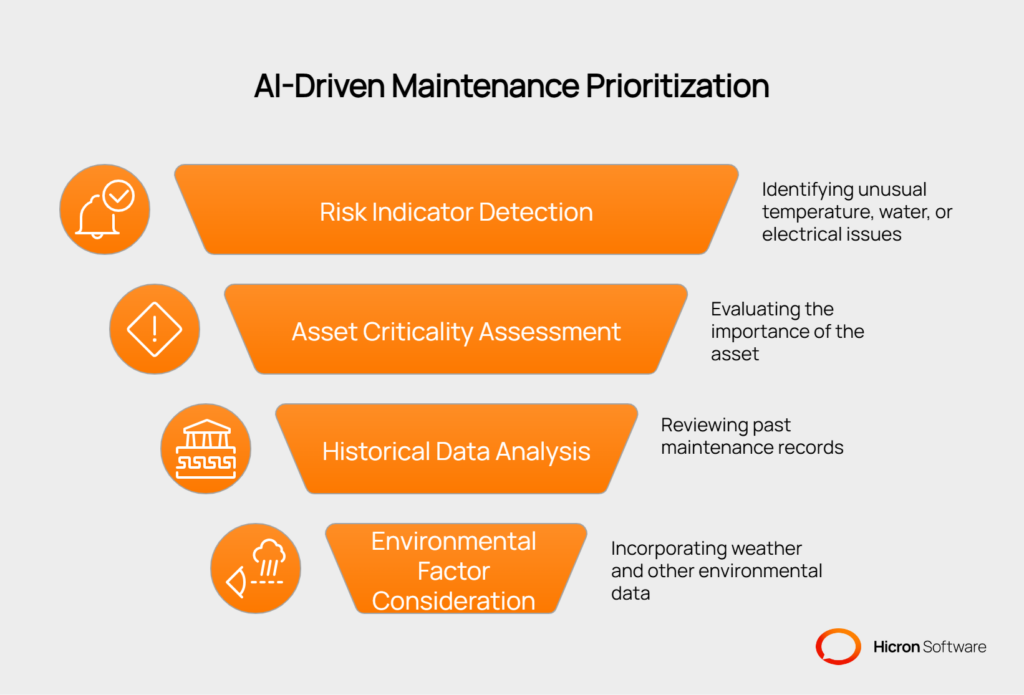
AI-driven maintenance prioritization begins with the continuous processing of real-time data from sensors and work order requests. Each alert is examined for risk indicators, such as
- unusual temperature fluctuations,
- water intrusion, or
- electrical failures.
The system considers multiple factors of asset criticality. The timing of the event, historical maintenance records, and even environmental factors such as weather are considered when assessing urgency.
In high-stakes situations, such as a sudden boiler malfunction during cold months, AI directs immediate attention from both property managers and technical teams. Lower-priority issues, like standard air filter replacements in non-essential areas, are categorized for routine scheduling.
This evaluation relies on a combination of
- predefined escalation rules,
- adaptive machine learning models, and
- continual learning from past case outcomes.
Through this method, AI accurately differentiates safety-urgent maintenance from requests that fit standard cycles. After classification, the system sends out automated notifications containing clear instructions, expected timeframes for resolution, and guidance for next steps.
This type of communication supports tenant experience enhancement by reducing resident uncertainty and downtime. It also improves operational performance through more proactive maintenance scheduling.
Compliance management is maintained throughout the process with detailed audit records, transparent policy checks, and structured approval pathways. By automating these workflows, property managers achieve faster emergency responses, reduce manual triage errors, and ensure tenant needs are met while satisfying regulatory obligations.
Unified Dashboards for Efficient Multi-property Work Order Management
Unified dashboards provide property teams with a single view of work orders, asset health, and technician activity across all sites. Managers can compare KPIs such as response times, first-time fix rates, and open ticket aging, then drill down into a property to identify recurring issues or parts shortages.
Real-time alerts and filters help prioritize high-impact tasks, coordinate vendor schedules, and control costs with data-backed decisions. This clarity sets up the next step of refining workflows and resource allocation across the portfolio.
Benefits of unified dashboards in work order management
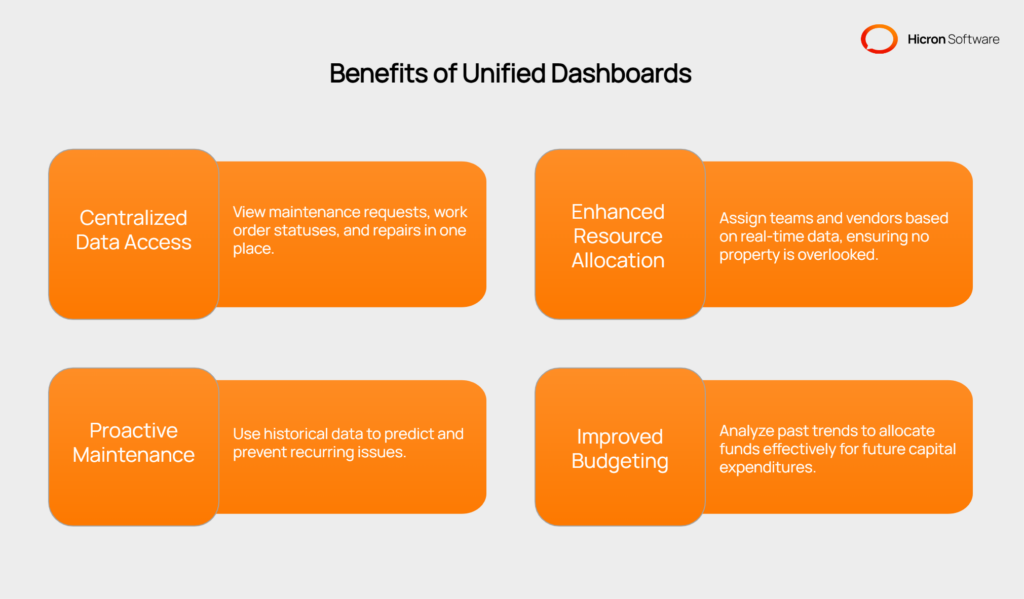
- Centralized data access: View tenant maintenance requests, work order statuses, and ongoing repairs in one place.
- Enhanced resource allocation: Assign teams and vendors based on real-time data, ensuring no property is overlooked.
- Proactive maintenance: Use historical data to predict and prevent recurring issues, such as HVAC failures or plumbing breakdowns.
- Improved budgeting: Analyze past trends to allocate funds effectively for future capital expenditures.
Technologies and development strategies for unified work order
Creating unified dashboards for efficient multi-property work order management requires a combination of modern technologies and a strategic software development approach. Here’s a breakdown of the recommended technologies and development strategies:
| Category | Recommended technologies/approach |
| Frontend technologies |
|
| Backend technologies |
|
| Database solutions |
|
| IoT integration |
|
| AI and analytics |
|
| Cloud infrastructure |
|
| Security and compliance |
|
| Development methodology |
|
| Real-time data processing |
|
| Scalability and performance |
|
| Testing and QA |
|
| CI/CD pipeline |
|
How long does it take to automate preventive maintenance with IoT and AI?
The timeline for automating preventive maintenance with IoT and AI depends on the project’s complexity, the scale of implementation, and the available resources. Below is an estimated timeline broken into key phases:
| Phase | Description | Estimated Duration |
| 1. Discovery and Planning |
|
2-4 weeks |
| 2. Technology Selection |
|
2-3 weeks |
| 3. IoT Sensor Deployment |
|
4-6 weeks |
| 4. Backend Development |
|
6-8 weeks |
| 5. Dashboard and UI Development |
|
4-6 weeks |
| 6. Integration and Automation |
|
4-6 weeks |
| 7. Testing and QA |
|
3-4 weeks |
| 8. Training and Deployment |
|
2-3 weeks |
| 9. Post-Deployment Support |
|
Ongoing (first 4-6 weeks critical) |
Total estimated timeline: 4-6 months for a medium-scale implementation.
Factors that can impact the timeline:
- Project scale: Larger portfolios with multiple properties may require more time for sensor deployment and system integration.
- Complexity of AI models: Developing and training AI models for predictive maintenance can take longer if the data is complex or insufficient.
- Existing infrastructure: If the property management system is outdated, additional time may be needed for upgrades or compatibility adjustments.
- Team expertise: A skilled team with experience in IoT, AI, and software development can significantly reduce the timeline.
- Regulatory compliance: Ensuring compliance with data privacy laws (e.g., GDPR, CCPA) may add time to the planning and testing phases.
The Future of Automating Preventive Maintenance with IoT and AI
Preventive maintenance is about leveraging IoT and AI to automate preventive maintenance in work order management. These technologies are transforming property management by streamlining operations, reducing costs, and driving PropTech innovations, while also promoting sustainability in property management and investing in future-proof technology for real estate.
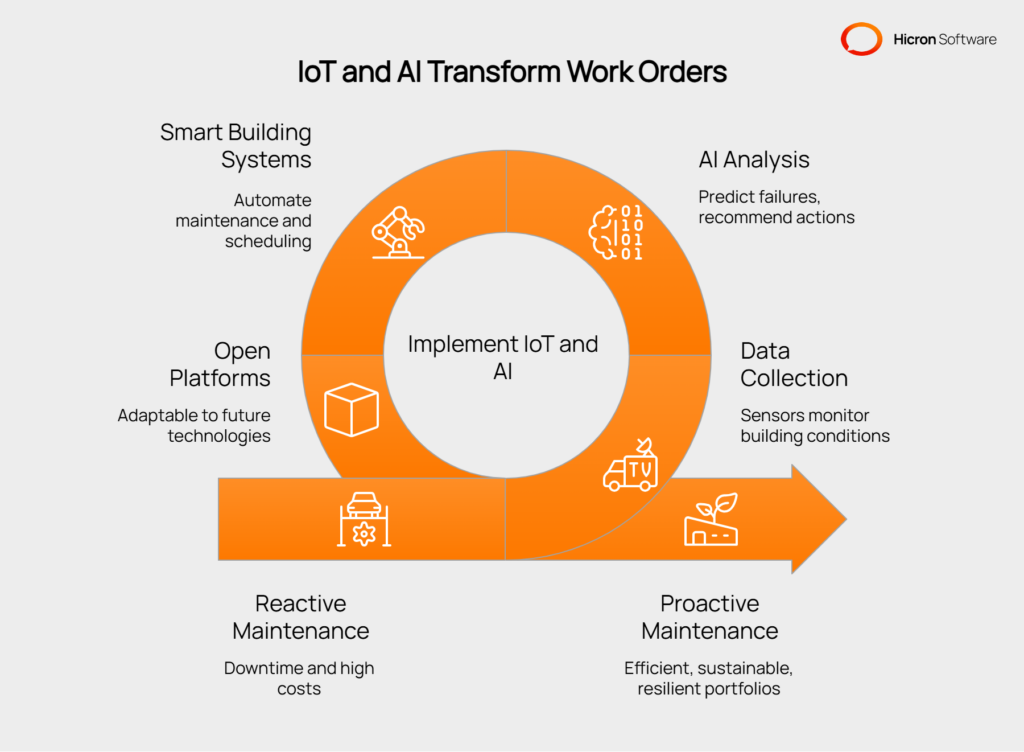
How IoT and AI are driving digital transformation in work order management?
IoT sensors installed throughout buildings continually monitor equipment conditions, energy use, and environmental factors. These devices generate a steady stream of data, giving property managers real-time insights into system health.
AI analyzes this data to detect patterns, predict failures, and recommend maintenance actions before issues escalate. This approach helps reduce equipment downtime and operational costs. It also improves efficiency across entire portfolios.
Next, innovations in PropTech are enabling the development of smart building systems that can automatically identify maintenance needs, schedule service appointments, and even verify that repairs have been completed correctly.
This level of automation helps standardize processes and reduces reliance on manual oversight. As the industry progresses, PropTech innovations will continue to introduce advanced analytics, remote monitoring tools, and machine learning models that further optimize performance.
Sustainability in Property Management is another key benefit of integrating IoT and AI. Predictive maintenance supports more efficient HVAC operation, early leak detection, and demand-based lighting controls. These improvements help lower utility usage and reduce carbon emissions, creating buildings that are more environmentally friendly and cost-effective.
Investing in open, adaptable platforms now ensures that assets can incorporate future-proof technology for the real estate sector. This allows properties to stay ahead of regulatory changes, integrate new sensors and software updates, and accommodate future advancements in predictive analytics without expensive renovations.
Work Order Management: Maximizing ROI and Tenant Satisfaction with Smart Maintenance
IoT and AI have revolutionized how property managers automate preventive maintenance in work order management, delivering key benefits such as improved ROI for property portfolios, reduced operational costs, and enhanced efficiency.
These technologies enable proactive maintenance, minimizing disruptions and creating effective tenant retention strategies by ensuring a seamless tenant experience.
Property managers who integrate these smart solutions can future-proof their portfolios, boost tenant satisfaction, and achieve long-term success.
Start automating preventive maintenance to unlock the full potential of your properties, improve ROI, and lead the way in modern property management.
FAQ
What is preventive maintenance in work order management?
Preventive maintenance in work order management involves proactively monitoring and maintaining building systems, such as HVAC units, plumbing, and elevators, to prevent unexpected failures. This approach ensures equipment runs efficiently, reduces repair costs, minimizes downtime, and extends the lifespan of assets.
How does automating preventive maintenance work?
Automating preventive maintenance utilizes IoT sensors and AI technologies to monitor equipment in real-time, predict potential issues, and schedule maintenance tasks automatically. IoT sensors collect performance data, such as temperature, vibration, and energy usage, while AI analyzes this data to generate work orders and assign tasks to the right technicians.
What are the benefits of automating preventive maintenance?
Automating preventive maintenance offers several advantages, including:
- Improved ROI: Reduced repair costs and extended equipment lifespan.
- Enhanced tenant satisfaction: Proactive issue resolution creates a seamless experience.
- Streamlined workflows: Automated work order generation and task assignments save time.
- Energy efficiency and sustainability: IoT and AI optimize energy usage and reduce waste.
How does IoT help in preventive maintenance?
IoT (Internet of Things) refers to connected devices, such as sensors, that monitor building systems in real-time. In preventive maintenance, IoT sensors collect data on equipment performance, such as temperature, humidity, and energy usage. This data helps property managers detect inefficiencies, predict failures, and schedule maintenance before issues escalate.
How long does it take to implement IoT and AI for preventive maintenance?
The timeline for implementing IoT and AI for preventive maintenance depends on the project’s complexity and scale. On average, it takes 4-6 months for medium-scale implementations, including:
- Planning and technology selection.
- IoT sensor deployment.
- System integration and training.
What are the key technologies used in automating preventive maintenance?
Key technologies include:
- IoT sensors for real-time monitoring.
- AI-driven property insights for predictive analytics.
- Centralized property management systems for workflow automation.
- Cloud platforms for scalability and data storage.
Testimonials
Hicron Software proved to be a trusted partner with unmatched technical expertise, delivering a scalable and user-friendly web application that was pivotal to our successful U.S. market expansion.

Hicron’s contributions have been vital in making our product ready for commercialization. Their commitment to excellence, innovative solutions, and flexible approach were key factors in our successful collaboration.
I wholeheartedly recommend Hicron to any organization seeking a strategic long-term partnership, reliable and skilled partner for their technological needs.

After carefully evaluating suppliers, we decided to try a new approach and start working with a near-shore software house. Cooperation with Hicron Software House was something different, and it turned out to be a great success that brought added value to our company.
With HICRON’s creative ideas and fresh perspective, we reached a new level of our core platform and achieved our business goals.
Many thanks for what you did so far; we are looking forward to more in future!

Hicron is a partner who has provided excellent software development services. Their talented software engineers have a strong focus on collaboration and quality. They have helped us in achieving our goals across our cloud platforms at a good pace, without compromising on the quality of our services. Our partnership is professional and solution-focused!

The IT system supporting the work of retail outlets is the foundation of our business. The ability to optimize and adapt it to the needs of all entities in the PSA Group is of strategic importance and we consider it a step into the future. This project is a huge challenge: not only for us in terms of organization, but also for our partners – including Hicron – in terms of adapting the system to the needs and business models of PSA. Cooperation with Hicron consultants, taking into account their competences in the field of programming and processes specific to the automotive sector, gave us many reasons to be satisfied.

Get in touch
