IT systems validation in the Life Science industry
- March 31
- 4 min

Automation refers to the use of technology that reduces human intervention in processes. Automation is a technological integration of various means, including mechanical, electrical, electronic devices, and computers. Complex systems such as modern manufacturing plants, automotive, and medical centers typically use a mix of engineering and high-tech to provide a more efficient environment. What are the types of automation, use cases, and benefits? About it in our article.
Automation represents the use of technology to perform tasks with limited human assistance. Any industry that encounters repetitive tasks can leverage automation. Automation alongside integration is often a part of Digital Transformation. Most prevalent in the manufacturing, robotics, automotive industries, IT systems and business decision supporting software.
Automation, while aimed at streamlining operations, does not stand for the same thing in every industry and use.
Despite the different terms, uses and approaches, automation aims to increase productivity, reduce costs, optimize processes and free human resources from the most tedious tasks. Automation is part of the digital transformation seeking to improve business performance.
Data searches, manual entry, and duplication of records in multiple systems, as each process has its own software... the list goes on. 90% of employees are often overwhelmed with tedious, repetitive tasks.
Nearly 5 hours employees spend on average duplicating tasks each week. Annually, it is up to 94 days spent doing something that could have been automated.
Automation supports managing, changing, and adapting IT infrastructure and the way business operates. It frees up time and energy and enables focusing on innovation. The primary goal is to get work done faster.
Automation is not intended to replace human resources. Rather, it transforms formerly tedious work into one that is more synapse-stimulating. It eliminates redundant steps, with the main focus and benefits found in productivity, consistency, and efficiency. By making operations more efficiency-enhancing, automation makes human involvement more important and less frequent.
In a retail integration for a large chain with multiple POS stations per store, Hicron Software connected point-of-sale terminals to SAP ERP so end-of-day financial data transfers automatically. The integration removed manual entry of receipts, invoices, and returns that had previously consumed staff time and introduced reconciliation errors.
Check the case study: Up-to-date financial data
automatically transferred from POS to ERP
Automation allows employees to focus on the bigger picture of the business and its surroundings, the problems, and their solutions, rather than on mundane, repetitive tasks.
Based on the search results, here are some recent statistics on automation:
These statistics highlight the rapid growth and adoption of automation across various industries.
Depending on the field, we can distinguish five different general courses:
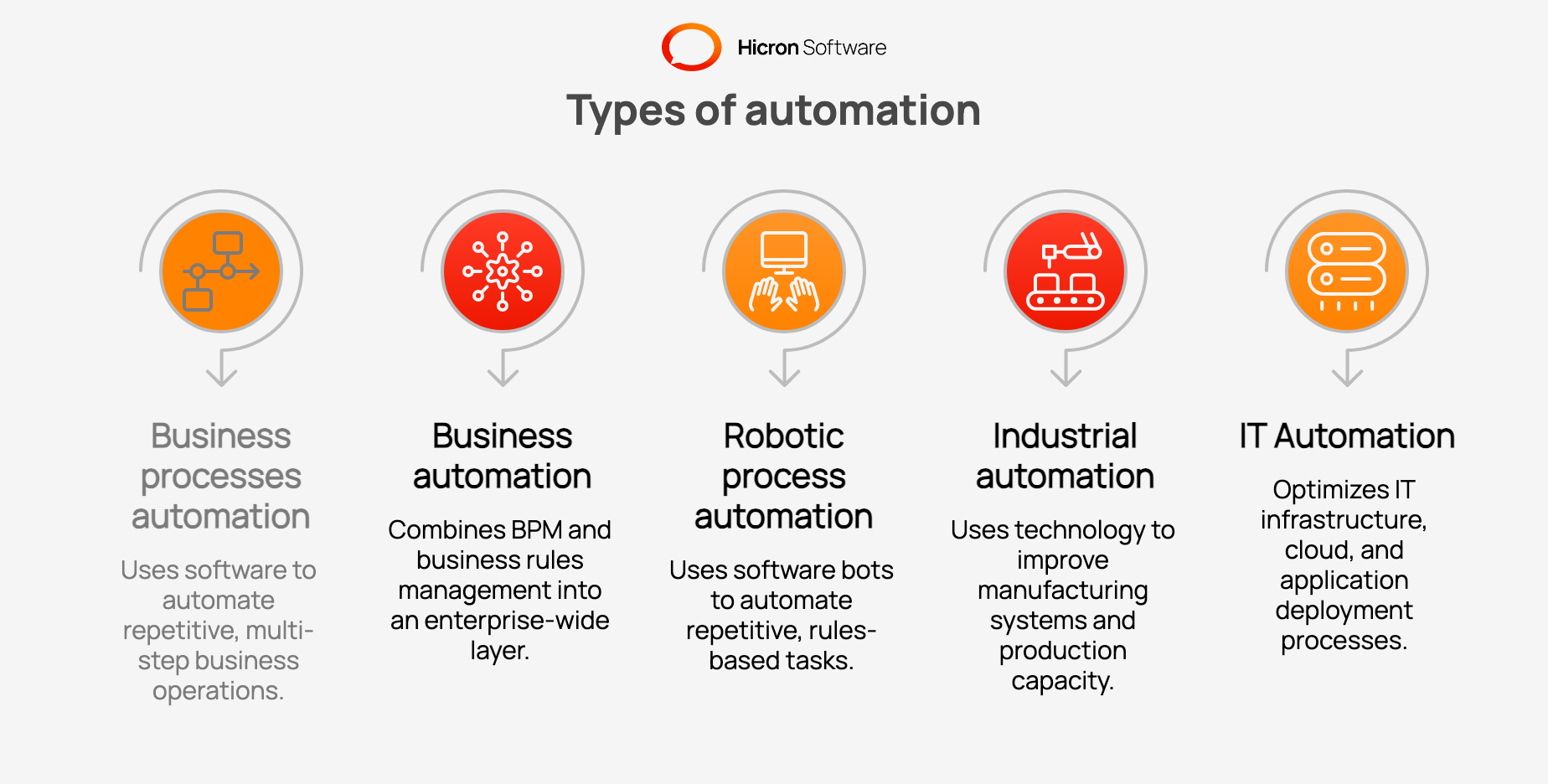
Business process automation (BPA) involves using software to automate repetitive, multi-step business operations. BPA solutions are characterized by high complexity. Their implementation requires a certain amount of knowledge and prior preparation. BPAs are connected to many enterprise IT systems and are tailored to the needs of the organization.
BPAs are often part of a digital transformation strategy to ease workflows, free teams from tedious tasks and operate more efficiently.
Where business process automation (BPA) targets repeatable multi-step workflows inside one process, business automation combines BPM and business rules management (BRM) into an enterprise-wide layer that maps and orchestrates many processes under one governance model.
Business automation is the fusion of business process management (BPM) and business rules management (BRM) to develop an enterprise-ready application optimized for the demands of the market. The need for business automation is a natural consequence of the development and optimization of an organization’s performance.
Digital transformation is the key and overarching strategy to thrive in a constantly changing market. It requires a good understanding and partnership between IT and business leaders.
Multiplying documentation, complex processes and backlogged schedules create frustration and negatively affect task execution. Hence, widely understood (and often abused) agile enters with the help of streamlining and optimizing business operations. Business automation improves processes that are often overcomplicated so that effort, time, and responsibility are not wasted.
The right approach to business automation allows an organization to better understand end-to-end operations. Automation with strategic thinking outlines and provides an architecture for all business processes to be mapped and automated. While this approach may seem time-consuming to implement at first, proper preparation and mapping of processes allow for a smoother end-to-end process, better matching of technology stack and prediction of potential risks.
Get an Expert View on how to succeed in business transformation!
Robotic process automation (RPA) uses software bots to automate repetitive tasks. From basic chores such as inputting forms and preparing invoices, to more complex work such as customer service and troubleshooting.
Most RPA tools are programmed to perform tedious, rules-based tasks, such as moving rows of data from a database to a spreadsheet, answering inquiries on chat. A bot does tedious but necessary work – 24 hours a day – at a very low cost. RPAs are low-risk and high return on investment.
Platforms such as UiPath illustrate how organizations deploy software bots for rules-based data movement, form handling, and chat triage without rewriting core systems.
RPAs are a part of a larger business automation strategy.
Reducing human labor, eliminating workplace risks in manufacturing processes are all a part of industry automation efforts and Industry 4.0 solutions. In manufacturing, the goal is to use automation technology to improve systems or processes. The ultimate goal is to drive greater efficiency by improving production capacity, reducing costs, or both.
Industrial automation has become linked to electromechanical systems that are programmed to perform various processes. While automation may not be right for every factory, most companies can benefit from fixed, programmed or flexible approach to automation in manufacturing or universal processes automation.
In a nine-month manufacturing program for a global enterprise, Hicron Software integrated shop-floor machines with SAP ERP through Modbus. Operators read ERP data on machine screens instead of re-keying production information manually, which digitized previously manual line-side work.
Check our well-oiled implementation on the production line!
Automation is the key to IT optimization and digital transformation. Matching the IT infrastructure to the modern, dynamic environment is a challenge that many companies face. Today, there is a need to scale and perform faster than ever. Legacy updates are unavoidable, and IT automation is an essential part of modern IT infrastructure development.
Automation can integrate and address everything from the cloud, and infrastructure optimization, to application deployment and configuration management.
After modernizing a monolith application for a product company, Hicron automated release pipelines and schema upgrades so production deployments no longer required stopping the application server. Release frequency moved from roughly one major drop per year to continuous delivery every two weeks, a 26× increase cited in the case study below.
Case study:
The release cycle speeded up 26 times
with IT automation
The capabilities of automation can range from specific technologies such as containers, to methodologies such as DevOps, and to broader areas like cloud, security, testing, and monitoring.
IT automation also extends into configuration and deployment tooling. Teams use platforms such as Ansible to automate server provisioning, patch rollout, and environment consistency across cloud and on-premise estates.
Advanced stacks combine AI, machine learning, and deep learning with the BPM and RPA patterns described above under intelligent automation: rule-based workflows plus machine learning for decisions that vary by context. Hyperautomation fuses together many of these modern solutions into one coordinated program.
Benefits are experienced by organizations both right away and over the long term, and include:
Check the case study: From manual to complete automation.
Stock status always updated!
As with any venture, there are some challenges. The most important of these relate to the cost and scope of work. Costs, because building an effective automation strategy takes time and energy. That’s why it’s important to choose the right IT partner to avoid budget burn.
Scope of work, because automation requires the right approach. You need to verify which areas may be at risk and decide on their ultimate scope. Automation is effective and efficient with a proper plan, mindset, and strategy for its implementation.
Common implementation barriers include:
Get in touch to discuss further our business-driven approach to software development and automation!

Hicron Software proved to be a trusted partner with unmatched technical expertise, delivering a scalable and user-friendly web application that was pivotal to our successful U.S. market expansion.

Hicron’s contributions have been vital in making our product ready for commercialization. Their commitment to excellence, innovative solutions, and flexible approach were key factors in our successful collaboration.
I wholeheartedly recommend Hicron to any organization seeking a strategic long-term partnership, reliable and skilled partner for their technological needs.
After carefully evaluating suppliers, we decided to try a new approach and start working with a near-shore software house. Cooperation with Hicron Software House was something different, and it turned out to be a great success that brought added value to our company.
With HICRON’s creative ideas and fresh perspective, we reached a new level of our core platform and achieved our business goals.
Many thanks for what you did so far; we are looking forward to more in future!

Hicron is a partner who has provided excellent software development services. Their talented software engineers have a strong focus on collaboration and quality. They have helped us in achieving our goals across our cloud platforms at a good pace, without compromising on the quality of our services. Our partnership is professional and solution-focused!

The IT system supporting the work of retail outlets is the foundation of our business. The ability to optimize and adapt it to the needs of all entities in the PSA Group is of strategic importance and we consider it a step into the future. This project is a huge challenge: not only for us in terms of organization, but also for our partners – including Hicron – in terms of adapting the system to the needs and business models of PSA. Cooperation with Hicron consultants, taking into account their competences in the field of programming and processes specific to the automotive sector, gave us many reasons to be satisfied.