
.NET
Stock status always up to date with .NET application
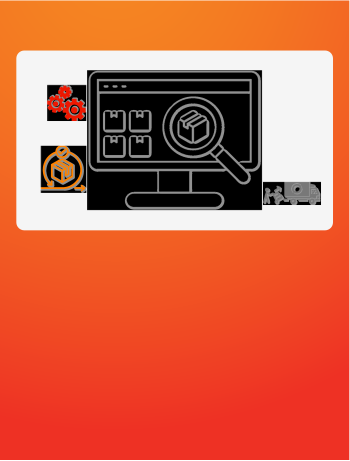


Keep track of your inventory with precision, ensuring optimal stock levels and reduced downtime.
Enhance your maintenance processes with efficient spare parts management, ensuring quick and reliable access to necessary components.

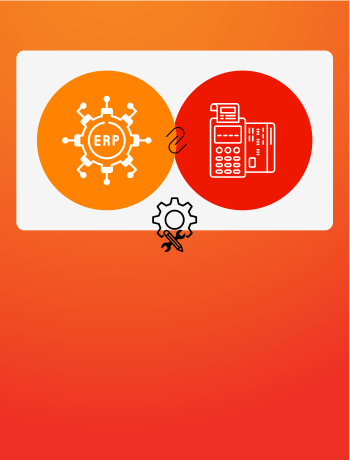
Seamlessly integrate your existing systems with our automotive parts inventory management software for improved data flow and operational synergy.

Utilize data-driven insights to make informed decisions and improve your spare parts management process.
Transform your automotive parts management strategy with Hicron Software and stay ahead in the competitive market. Build or upgrade your auto parts management system with industry experts. Contact us today to learn more about our services and how we can support your inventory management needs.
Automotive parts management software helps organizations manage their inventory, procurement, and logistics for automotive parts, ensuring efficient operations and minimal downtime.
We provide comprehensive solutions, including custom auto parts inventory management software, to optimize your inventory processes, reduce costs, and enhance efficiency.
Benefits include improved inventory accuracy, reduced carrying costs, enhanced maintenance efficiency, streamlined procurement, and data-driven decision-making.
Our platform integrates seamlessly with existing systems, offering advanced analytics and tools to enhance both digital retail and parts management operations.
Yes, our solutions are versatile and can be tailored to manage used auto parts inventory effectively.
Data analytics provides valuable insights into inventory trends, supplier performance, and operational efficiency, enabling informed decision-making and continuous improvement.
Spare parts management is the process of ensuring the right parts are available at the right time and place to support maintenance and repair activities. It involves forecasting demand, maintaining inventory, and optimizing supply chains to minimize downtime and ensure smooth operations.
A spare parts manager oversees the procurement, storage, and distribution of spare parts. Key responsibilities include:
Managing inventory levels and ensuring availability of critical parts.
Coordinating with suppliers to purchase required components.
Monitoring the performance of spare parts operations.
Reducing excess inventory and minimizing stock costs.
A spare parts control system is a software or process used to manage the inventory, sourcing, and delivery of spare parts. It helps track parts in real time, automate reordering, and prevent overstocking or shortages. These systems improve efficiency and ensure parts are readily available when needed.
Key Performance Indicators (KPIs) in spare parts management help measure and improve operational efficiency. Common KPIs include:
Inventory turnover rate.
Fill rate (percentage of orders fulfilled on time).
Stock accuracy.
Downtime due to part unavailability.
Perfect order rate (ensuring orders are complete, accurate, and timely).
Becoming a parts manager requires a mix of skills and experience:
Gain industry knowledge: Understand spare parts operations and supply chain processes.
Develop relevant skills: Build expertise in inventory management, customer service, and negotiation.
Pursue education: While not always required, degrees or certifications in supply chain, logistics, or business management can be helpful.
Start in entry-level roles: Work as an assistant or technician to gain hands-on experience before advancing to a manager role.
A spare part is a replacement component used to repair or maintain machinery, equipment, or vehicles. Its job is to ensure uninterrupted operation by replacing worn-out or damaged parts. Spare parts are designed for compatibility and are often kept in inventory for quick availability during repairs.
Strategic spare parts are components that are critical to maintaining operations and preventing extended downtime. They are typically high-value, long-lead items or parts that are essential for key equipment. These parts are stocked proactively to ensure availability in case of unexpected failures.
The perfect order rate measures the percentage of orders delivered without errors. A perfect order is complete, accurate, undamaged, and delivered on time. Achieving a high perfect order rate ensures customer satisfaction and operational efficiency.
Hicron Software proved to be a trusted partner with unmatched technical expertise, delivering a scalable and user-friendly web application that was pivotal to our successful U.S. market expansion.

Hicron’s contributions have been vital in making our product ready for commercialization. Their commitment to excellence, innovative solutions, and flexible approach were key factors in our successful collaboration.
I wholeheartedly recommend Hicron to any organization seeking a strategic long-term partnership, reliable and skilled partner for their technological needs.

After carefully evaluating suppliers, we decided to try a new approach and start working with a near-shore software house. Cooperation with Hicron Software House was something different, and it turned out to be a great success that brought added value to our company.
With HICRON’s creative ideas and fresh perspective, we reached a new level of our core platform and achieved our business goals.
Many thanks for what you did so far; we are looking forward to more in future!

Hicron is a partner who has provided excellent software development services. Their talented software engineers have a strong focus on collaboration and quality. They have helped us in achieving our goals across our cloud platforms at a good pace, without compromising on the quality of our services. Our partnership is professional and solution-focused!

The IT system supporting the work of retail outlets is the foundation of our business. The ability to optimize and adapt it to the needs of all entities in the PSA Group is of strategic importance and we consider it a step into the future. This project is a huge challenge: not only for us in terms of organization, but also for our partners – including Hicron – in terms of adapting the system to the needs and business models of PSA. Cooperation with Hicron consultants, taking into account their competences in the field of programming and processes specific to the automotive sector, gave us many reasons to be satisfied.