Common Data Model in Automotive industry
- January 03
- 7 min


The automotive after-sales industry has experienced a profound transformation over the years, largely thanks to digitization. This merging of technology and digitization has revolutionized the aftersales service experience, eliminating the discomfort that customers may have previously encountered. As a result, digitization has become a driving force behind the significant changes in sales, value chains, and after-sales services, ushering in a whole new era of customer interaction.
However, the market still faces a range of challenges, including intense competition among dealers, the emergence of revolutionary technologies, a shrinking customer base, and lower profit margins. Despite these hurdles, global players in the industry have made substantial investments in their after-sales businesses, leading to notable improvements in customer satisfaction levels and service quality. Additionally, automakers have expanded their offerings into new areas such as tire replacement and other services, aiming to capture and retain customers.
Top players in after-sales services of the automotive industry
The Global Automotive After-Sales Service market is a dynamic industry that offers lucrative opportunities for growth and innovation. According to the comprehensive analysis presented in the renowned Market Growth Report, this market has been divided into segments based on Type (Software, Hardware) and Application (OEMs, Aftermarket). Such segmentation enables businesses to strategically target their offerings and cater to the diverse needs of customers.
In today’s competitive landscape, implementing effective business tactics is crucial for companies to boost their market sales and gain a sustainable competitive advantage. Fortunately, there are several widely used strategies that have proven successful in this domain. These strategies include market segmentation, allowing companies to tailor their services to specific customer groups; product differentiation, enabling companies to stand out by offering unique features and benefits; cost leadership, allowing companies to provide competitive prices without compromising quality; and divergence, which encourages companies to explore new and untapped areas of the market.
Read our case study about optimized quality control of after-sales services for automotive giant.
Looking ahead, the forecast period predicts significant growth for the Global Automotive After-Sales Service market between 2023 and 2030. With advancements in technology, evolving customer expectations, and increasing demand for automotive services, the market is poised for continuous expansion. Notably, key players in the industry are actively implementing strategic initiatives, further fueling the market’s upward trajectory.
As we delve into the industry’s key players, it’s worth highlighting some of the leading names shaping the Automotive After-Sales Service market:
The Global Automotive After-Sales Service market is brimming with potential, and forward-thinking companies are well-positioned to capitalize on this growth. By leveraging effective business strategies, embracing innovation, and prioritizing customer satisfaction, businesses can carve a successful path in this dynamic industry.
Possible automotive after-sales service market in 2030
The latest research indicates that the global automotive aftermarket still holds substantial scale over the next decade. According to Market Research Future, the market reached an estimated USD 497.40 billion in 2025 and is projected to grow to USD 733.41 billion by 2035 at a CAGR of 3.96% (forecast period 2026 to 2035). That range sits with other independent market studies that place global aftermarket value in the high hundreds of billions of dollars, rather than in the multi trillion range.
The automotive landscape has undergone a significant transformation, giving rise to new services and players such as car centers and online trade-ins. In this changing environment, customer loyalty at the point of sale has become important for retention and future sales. After-sales services play an integral role in fostering good customer relations and preventing buyer volatility.
Traditionally, dealerships primarily focused on selling new and used vehicles, often sidelining the importance of after-sales services. This approach has gradually eroded the attachment of car owners to a specific point of sale, as alternative after-sales solutions emerged.
A common occurrence is for customers to seek alternatives outside the brand’s network once their vehicle warranty expires. This poses a considerable problem, as car owners who turn elsewhere may not return to the same dealership for their next vehicle purchase.
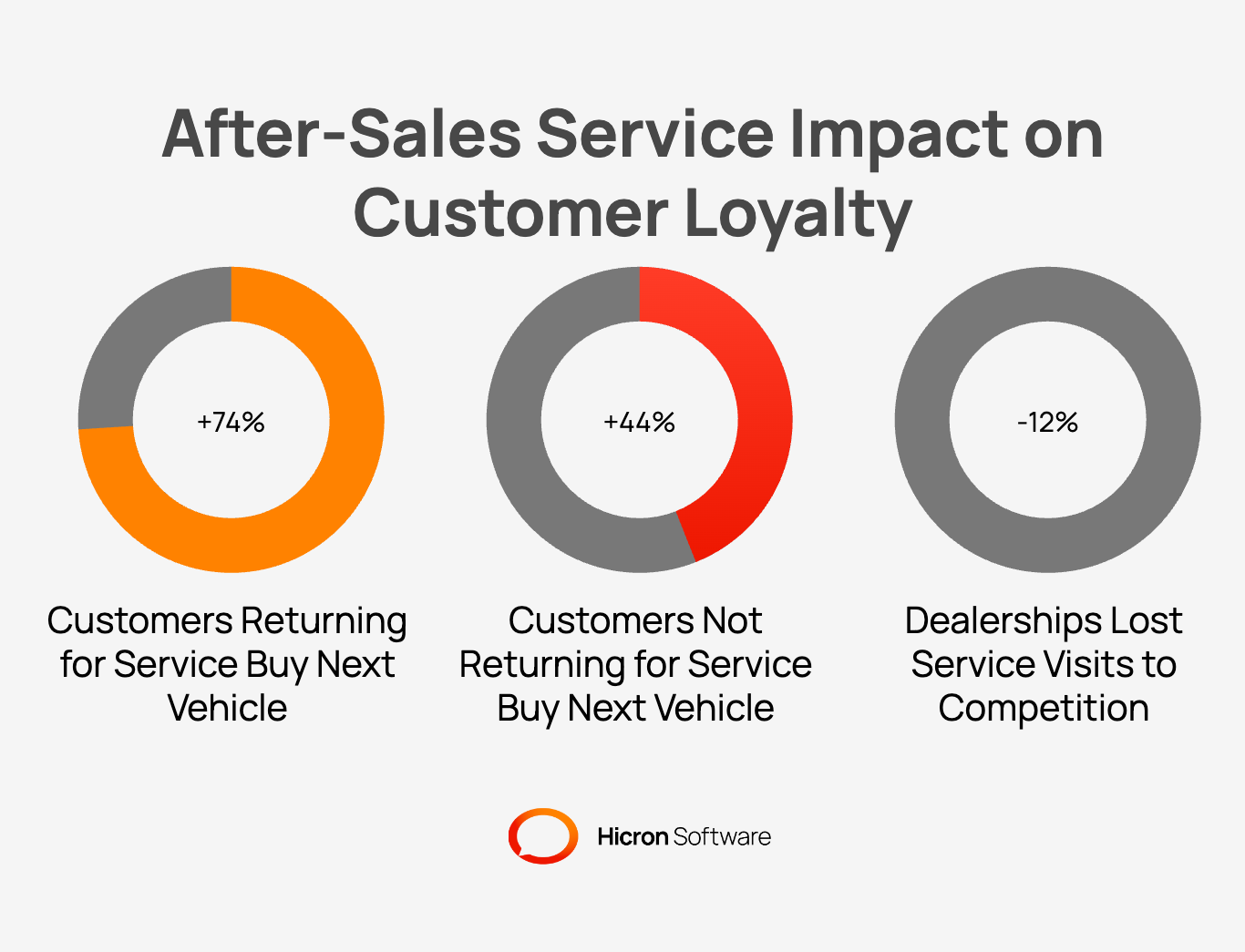
That loyalty link shows up clearly in dealer data. The Cox Automotive Service Industry Study (April to May 2025, 1,974 U.S. vehicle owners) found that customers who return to the selling dealership for service are 74% likely to buy their next vehicle there, compared with 44% among those who do not return for service.
Interestingly, it is widely recognized that after-sales services generate higher margins for dealerships compared to new vehicles. Therefore, the first step is to prioritize customer loyalty at the point of sale. Enhancing the quality of after-sales services, including offers, prices, and technical advice, is imperative. Additionally, reinventing customer relationships through the implementation of customer relationship management (CRM) solutions is essential.
Check our automotive industry software solutions services.
1. Repair services
Repair services refer to the activities involved in restoring, fixing, or maintaining a product, machine, equipment, or asset that has been damaged or is not functioning properly. It encompasses the process of identifying, diagnosing, and rectifying issues to bring the item back to its optimal working condition.
Aging fleets keep that repair demand high. S&P Global Mobility reports that the average age of U.S. light vehicles reached 12.8 years in 2025, a record that extends the window in which cars need repair work after the first sale.
The significance of repair services lies in their ability to extend the lifespan of products, machinery, and equipment, ensuring their continued functionality and performance. Repair services help to minimize downtime, reduce costs associated with replacement, and contribute to sustainability by promoting the reuse and refurbishment of existing assets.
Leading manufacturers in the automotive industry
Leading manufacturers such as Denso, Würth Group, or Bosch play a great role in the repair services industry. These manufacturers are known for producing high-quality parts, components, and tools that are essential for repairs and maintenance.
Denso Corporation, for example, is a renowned global supplier of automotive technology, providing a wide range of repair solutions for vehicles. Syncron specializes in providing after-sales service solutions that optimize repair processes and enhance efficiency. Würth Group offers a comprehensive range of professional-grade repair and maintenance products, including fasteners, tools, and adhesives.
Bosch, a multinational engineering and technology company, offers a diverse portfolio of repair solutions across various industries, including automotive, power tools, and household appliances. ACDelco, a subsidiary of General Motors, supplies a range of automotive replacement parts and repair services.
These leading manufacturers ensure that repair professionals have access to reliable and high-quality components, tools, and resources. Their products contribute to the effectiveness and efficiency of repair services, enabling technicians to deliver optimal results and customer satisfaction.
2. Maintenance services
Maintenance services encompass a range of activities aimed at preserving, protecting, and sustaining the functionality, performance, and longevity of products, equipment, systems, or assets. It involves routine inspections, repairs, and proactive measures to prevent potential failures or breakdowns.
The importance of maintenance services in the automotive industry cannot be overstated. Regular maintenance helps identify and address mechanical and electrical issues before they escalate, reducing the risk of breakdowns and accidents on the road. It also ensures that vehicles meet safety standards and regulatory requirements.
Proper maintenance enhances the performance and fuel efficiency of vehicles, maximizing their lifespan and resale value. It also helps prevent premature wear and tear, saving vehicle owners from costly repairs or replacement of major components.
Moreover, maintenance services contribute to the overall reliability and customer satisfaction in the automotive industry. When vehicles are well-maintained, customers can rely on them for daily commutes, long trips, and transportation needs, resulting in a positive ownership experience.
Customer maintenance and management
In the automotive industry, customer maintenance and management refer to the practices and strategies employed by manufacturers and service providers to cultivate long-term relationships with vehicle owners. It involves providing ongoing support, personalized service, and proactive communication throughout the ownership lifecycle.
Effective customer maintenance and management in the automotive industry involve activities such as regular reminders for scheduled maintenance, prompt response to inquiries or concerns, and providing value-added services like roadside assistance or warranty coverage.
By prioritizing customer maintenance and management, automotive businesses can build loyalty, trust, and brand advocacy. Satisfied customers are more likely to become repeat buyers and recommend the brand to others, thereby contributing to the growth and success of the business.
How can you get more of the maintenance and management?
You can provide a holistic approach to maintenance services through the use of interactive repair and service quality tools. This can help to systematically analyze operations, contributing to a better understanding of maintenance needs.
The system can facilitate customer maintenance by providing tools for analysis and process improvement. It can help develop customized methods to meet specific customer needs, increasing overall customer satisfaction.
Predictive maintenance now sits inside that same maintenance stack. Sensor and telematics data from the vehicle feed workshop planning tools so dealers can schedule service before a failure shows up on the road. Dealer Management Systems (DMS) and CRM platforms turn those signals into booked visits, parts reservations, and outreach to the owner. McKinsey research on monetizing car data found that 73% of consumers globally are willing to pay for predictive maintenance services.
3. Rescue services
Rescue services in automotive after-sales refer to the specialized assistance provided to individuals and vehicles in emergency situations, such as accidents, breakdowns, or other critical incidents on the road. These services are designed to provide immediate help, ensuring the safety and well-being of customers and their vehicles.
Rescue services may include activities such as roadside assistance, emergency towing, jump-starting a vehicle, fuel delivery, tire changes, lockout assistance, and arranging alternative transportation. They aim to address urgent needs and provide timely support to customers facing unexpected challenges while driving.
Roadside volume makes the scale of rescue work concrete. In 2024, AAA received over 27 million emergency roadside service calls in the United States. Roughly 13 million of those calls required towing and about 7 million involved battery issues, together about 74% of total calls.
In the automotive industry, rescue services are often offered as part of after-sales service packages by manufacturers, authorized dealerships, or third-party service providers. These services can be tailored to meet specific customer requirements, offering convenience and peace of mind.
The impact on customer satisfaction in the automotive industry
Rescue services have a significant impact on customer satisfaction in the automotive industry. When customers face emergencies or unexpected breakdowns, prompt and effective rescue services can make a difference in their overall experience and perception of the brand.
Timely assistance and support in critical situations enhance customer trust and loyalty. Knowing that help is readily available when needed can alleviate stress and anxiety for vehicle owners. It demonstrates a commitment to customer care and contributes to building a positive relationship between customers and automotive service providers.
Furthermore, reliable rescue services can minimize disruptions to customers’ daily lives and routines. By swiftly addressing issues, such as providing roadside repairs or arranging alternative transportation, customers can resume their activities with minimal inconvenience. This leads to greater satisfaction and a positive image of the automotive brand or service provider.
4. Information consulting services
Information consulting services in the automotive industry involve providing expert advice, guidance, and solutions to individuals and businesses seeking information related to vehicles, automotive technologies, regulations, market trends, and industry-specific challenges.
These services aim to bridge the knowledge gap and empower customers with accurate, up-to-date information. Information consulting providers leverage their expertise and industry insights to assist customers in making informed decisions, solving problems, and optimizing their operations within the automotive sector.
In the automotive industry, information consulting services can cover a wide range of areas, such as vehicle selection, maintenance best practices, fuel efficiency strategies, electric and autonomous vehicle technologies, regulatory compliance, and market analysis. They cater to various stakeholders, including consumers, manufacturers, suppliers, fleet operators, and automotive service providers.
By offering reliable information and insights, information consulting services contribute to improved decision-making, enhanced operational efficiency, and better overall performance within the automotive industry.
How do information consulting services enhance customer experience?
Information consulting services have a positive impact on customer experience within the automotive industry by providing valuable knowledge, support, and personalized guidance.
How can you get more of the information consulting?
The application can act as a “digital consultant” by continuously capturing snippets of data and promoting self-reflection. It can serve as a valuable source of consulting services, offering insights and recommendations based on real-time and historical data.
The system’s knowledge resource can be a go-to for dealers and importers, providing them with valuable information. This information can help identify areas of focus and specific potential for improvement, contributing to a better customer experience.
What are the potential benefits of cooperation?
Process improvement: The system’s networking capabilities can enable collaborative analysis, leading to continuous process improvement within the company.
Improving individual performance: By promoting self-reflection and providing tools for individual methods, the system can contribute to the professional development of employees, ultimately benefiting the company.
Knowledge sharing: The knowledge pool can serve as a centralized repository, supporting information sharing and joint problem-solving among dealers and importers.
Customer-focused approach: The emphasis on customer retention and management, along with information guidance, reflects the customer-centric approach that is key to sustained success in the automotive industry.
5. Spare part services
Spare parts play a big role in after-sales service within the automotive industry. They are essential for maintaining, repairing, and replacing components in vehicles, ensuring their optimal performance, safety, and longevity.
Parts and service throughput at U.S. dealerships shows how large this channel already is. According to the same Cox Automotive study, dealerships offering service and parts generated over USD 156 billion in 2024 across more than 270 million repair orders.
The importance of spare parts in after-sales service:
How do manufacturers and dealerships manage spare parts services?
Manufacturers and dealerships employ various strategies and practices to manage spare parts effectively:
By effectively managing spare parts services, manufacturers and dealerships can streamline after-sales operations, improve customer satisfaction, and maintain the integrity of their products.
6. Used car services
The market for used cars has experienced significant growth in recent years.
That growth has a named market size behind it. Grand View Research estimates the global used car market at USD 1.90 trillion in 2024, rising to USD 2.70 trillion by 2030 at a CAGR of 6.0% from 2025 to 2030.
There are several reasons fueling this trend:
The role of after-sales services in the used car segment
After-sales services play a crucial role in the used car segment, contributing to customer satisfaction, vehicle maintenance, and overall ownership experience. Here are some key aspects:
By providing comprehensive after-sales services, dealerships and service centers enhance the overall ownership experience for used car buyers. These services instill confidence, ensure vehicle reliability, and contribute to customer satisfaction within the thriving market for used cars.
More to uncover in this webinar: Automotive Restoration: Sustaining Growth and Revenue Security in Unpredictable Times
Having covered the core service categories, the next section looks at the market wide trends that will reshape how these after-sales services are delivered in the years ahead.
The Automotive After-Sales Service market has experienced remarkable growth in recent years, and independent market forecasts such as the Market Research Future outlook above still project expansion through 2035. A separate analytical horizon appears in Deloitte’s Future of Automotive Sales and Aftersales study (2021), which models OEM revenues and profits through 2035. Digitization of the global after-sales business remains a shared driver across both horizons. Figures in the trend sections below that cite a proxy OEM or a 2035 outlook follow the Deloitte study unless another source is named.
Looking ahead, the automotive industry will undergo profound transformations as it is influenced by multiple technological, economic, and societal trends. The shift towards new powertrains, such as electric cars, will reduce the reliance on after-sales services, which have traditionally been a significant source of profitability for Original Equipment Manufacturers (OEMs). Currently, the automotive after-sales service market boasts profit margins of over 20%, significantly higher than margins for new vehicle sales. However, trends like autonomous driving, shared mobility, and long-term leasing are reshaping the importance of individual car ownership, leading to a decrease in the number of OEM Business-to-Consumer (B2C) customers. Consequently, customer touchpoints for OEMs will undergo a transformation, and some may even disappear altogether.
To thrive in this evolving landscape, OEMs must anticipate these changes and adapt their strategies accordingly. Embracing emerging technologies, nurturing strong customer relationships, and providing exceptional after-sales experiences will be critical for OEMs to maintain their competitive edge. Transforming after-sales services into value-added solutions that meet customer expectations, while leveraging data analytics and digital platforms, will be key to sustaining growth and profitability in the automotive after-sales service market.
According to the same Deloitte study, the automotive industry until 2035 will be shaped by four main trends: connectivity, alternative drivetrains, shared mobility, and autonomous driving. The figures that follow describe scenario outcomes for a modeled proxy OEM, not a guaranteed result for every manufacturer.
Connectivity
It is predicted that by 2035, every car will be connected, with around one-third operating at complete connectivity. Connected services are expected to become more valuable to consumers, resulting in a notable shift towards online buying. Connectivity encompasses the interconnection of cars and consumers with each other and their surroundings.
The extent of car and consumer connectivity relies heavily on the progress of smart infrastructure, the efficiency of back-end data processing systems, and the availability of user-friendly interfaces for consumers and third parties. The introduction of 5G connectivity in Germany is expected to lead to a surge in emerging trends, though discrepancies between urban and rural areas may persist.
In terms of hardware, innovative products are transitioning from the research and development phase to the market on a larger scale. However, widespread adoption is primarily hindered by cost factors, including expenses related to hardware components such as LiDAR, radar, cameras, SoCs, and sensors, as well as software elements like perception and object analysis algorithms and HD on-board maps.
A gradual increase in production and economies of scale is anticipated driven by the growing demand for connected services use cases, such as predictive maintenance and mobility fleet services. Consumer connectivity, in particular, is expected to expand, accompanied by a preference for online purchasing.
Consumers have become accustomed to seamless online transactions for various goods and services and have transferred their expectations to the automotive industry. Moreover, the majority of consumers in Germany value connected technologies and are willing to pay for them. For instance, 61% of consumers would pay for sensors in the vehicle’s cockpit to detect and address health and wellness issues, while 60% would pay for communication technology to optimize traffic flow.
To provide a clearer understanding of this trend, connectivity levels are defined based on six categories of vehicle connectivity and functionality, extending to vehicle-to-everything (V2X) connectivity. V2X encompasses vehicle-to-infrastructure, vehicle-to-network, vehicle-to-vehicle, vehicle-to-pedestrian, vehicle-to-device, and vehicle-to-grid communications. While all vehicles are expected to have basic connectivity by 2035, only 32% are projected to possess full V2X connectivity, primarily due to elevated hardware costs which will position V2X as a premium option in the passenger car segment.
For after-sales teams, that connectivity feed supports remote diagnostics, predictive workshop scheduling, and parts planning based on real vehicle status rather than calendar only service intervals.
Alternative drivetrains
In the future, a variety of drivetrains will coexist, with battery-electric vehicles (BEVs) taking the lead. The growing popularity of alternative drivetrains is driven by factors such as decreasing production costs, regulations, charging infrastructure improvements, and enhanced performance. These alternative drivetrains are expected to gain an increasing share in the overall drivetrain mix.
In Germany, emerging alternative drivetrains primarily include BEVs, some hybrid electric vehicles (Hybrids), and a small fraction of fuel cell vehicles (FCVs). This trend is highly certain and will significantly impact the current value chain of Original Equipment Manufacturers (OEMs). Many OEMs and suppliers are dedicating substantial efforts to the research and development of alternative drivetrains. Stricter environmental regulations have also affected the internal combustion engine (ICE) manufacturing industry.
Of course, there is potential for enhancing gasoline and diesel engines through technologies such as downsizing/upsizing and incremental component improvements, the overall trend suggests that the growth of internal combustion engines (ICEs) will not continue. This is reinforced by emission regulations and planned bans on ICE sales in certain countries. The expansion of charging infrastructure will expedite the adoption of electric drivetrains. Nevertheless, a complete elimination of all ICE sales in Germany is improbable, and some providers may identify business prospects in a consolidated market.
Although material costs for alternative drivetrains are currently relatively high, we anticipate a change over time that will drive the emergence of this trend, for example:
Electric engines without rare earth elements can reduce production costs by 20-30% in the near to midterm.
Making engines smaller and lighter, using technologies like silicon carbide transistors for engine electronics, can also result in cost reductions.
Market volume and demand for electronic parts like power electronics, converters/inverters, and electric motors are projected to experience significant growth.
For after-sales, higher BEV and hybrid shares change the mix of maintenance and repair work: fewer traditional ICE service jobs, and more demand for high voltage safety procedures, battery related diagnostics, and software updates.
Shared mobility
Shared mobility is expected to increase vehicle utilization and shift ownership from private customers to fleet operators. The growth of mobility services will be further accelerated by the emergence of autonomous driving. This trend will reduce personal vehicle ownership and increase the utilization rate per vehicle, particularly in urban areas.
Innovative technology will enable better coordination and connectivity between cars, consumers, and fleet service providers, contributing to the rise of shared mobility. The development of efficient micro-payment systems and improved infrastructure for financing will facilitate this trend. Consumer preference for flexibility, increased availability of services, and the economic benefits of asset sharing will also play a significant role. Urbanization will further amplify the economic advantage for consumers, while the tech-savvy generation continues to embrace pay-per-use mobility.
The quality of service will improve as well, thanks to the transparent and continuous feedback loop inherent in the usage-based business model, enhancing the overall user experience. Currently, the shared mobility market remains fragmented and hyperlocal, with various concepts and service providers. To classify the landscape, we differentiate between vehicle-on-demand services (such as free-floating car sharing, peer-to-peer sharing, and rental cars) and mobility-on-demand services (including ride-hailing and ride-pooling).
As shared mobility continues to evolve, ownership will shift from private customers to fleet operators, making these operators the primary customers for most Original Equipment Manufacturers (OEMs) in the future. The advancement of Advanced Driver Assistance Systems (ADAS) at level 4 or 5 will further drive the adoption of mobility services, as it reduces the cost associated with human drivers. However, the divide between urban and rural areas is expected to persist, with lower population density in rural regions posing challenges for viable business models.
For after-sales providers, fleet led shared mobility concentrates service demand with operators that need high uptime contracts, standardized workshop processes, and spare parts logistics sized for intensive vehicle utilization.
Autonomous driving
The biggest technological challenge in autonomous driving lies between level 3 and level 4. Initially, we expect level 4 to be implemented only in specific use cases. Autonomous driving refers to the trend of cars operating without human intervention. The development of automated driving has evolved from advanced driver assistance systems (ADAS), which have undergone continuous improvement over the years. In 2014, SAE International introduced a classification system with six levels, ranging from manual to fully automated systems.
Levels 0 to 2 require a human driver to monitor the driving environment at all times. Level 0 offers no driver assistance, while level 1 provides basic support like speed control. Level 2 involves the vehicle having limited control in certain situations, but the driver must remain attentive. The focus of current developments is mainly on levels 2 to 4. A significant transition occurs between level 2 (partial automation) and level 3 (conditional automation), where the driver can be completely out of the loop. The key distinction between level 4 (high automation) and level 5 (full automation) is the ability of the system to handle specific restricted driving modes versus all driving modes.
Automakers are building on their experience with driver assistance systems, particularly level 2 automation, to progress towards higher levels of automation. However, the critical leap in system reliability happens between level 3 and level 4. At both levels, the system is responsible for monitoring the driving environment, but at level 3, the driver must still be ready to take control within seconds. Level 4 requires the system to handle specified traffic conditions without any driver intervention and return to a safe state when unforeseen events occur.
Level 3 and level 4 technologies are already entering the market. Level 3 focuses on automated highway pilots, while level 4 is being applied to specific applications like automated valet parking or robo-taxi fleets in selected cities. In a base case projection, we estimate that 5% of new vehicle sales will offer level 4 or level 5 automation. However, in a disruptive scenario with favorable regulations, social acceptance, and technological innovation, this figure could rise as high as 49%. The wide range is primarily due to the dependence on regulatory support for widespread adoption beyond specific use cases.
For after-sales, higher automation shifts more of the repair burden toward sensors, cameras, computing hardware, and calibration work after collisions or component replacement, while traditional mechanical service volumes follow ownership and fleet patterns.
The potential for revenue in new business segments is significant, but compensating for losses in traditional business won’t be easy, especially in terms of contribution margin.
The strong sales growth in China is expected to nearly double financial services revenues, accounting for over half of our proxy OEM’s overall revenue from financial services by 2035.
Service-based businesses are anticipated to thrive in all four markets as new segments emerge. Mastering omnichannel strategies and focusing on direct sales will be crucial for success in asset-based and service-based businesses across all markets. The digitalization of consumer behavior, particularly in the era of COVID-19, will have a profound impact on the automotive industry. Digital sales and service processes are expected to become highly relevant.
Read about supply chain management in automotive industry: the benefits of digitalization.
In the base case scenario, our OEM is projected to experience substantial revenue growth through Mobility as a Service by 2035, with a compound annual growth rate of 11 percent. Fleet services will benefit from the rise of shared mobility and encompass a wider range of multi-brand offerings. Actively shaping the new mobility landscape as a holistic “full-service mobility provider” presents significant profit potential. However, achieving this requires a massive transformation for OEMs, including controlling end-to-end user touchpoints and optimizing costs across all revenue streams.
Car as a Platform
The sales of Car as a Platform are predicted to drive direct revenues, yet the primary function of connectivity is to serve as a facilitator for other revenue streams or as a means of optimizing costs. In the base case, the Car as a Platform business is expected to remain relatively small, comprising only 4% of the total OEM business. The growth in overall revenue will largely be propelled by revenues generated from connected services in China. To ensure success, OEMs must meticulously evaluate their initiatives and partnerships, avoiding investments that may become sunk costs while striving to deliver the most compelling offerings to their customers.
In Deloitte’s Germany focused outlook for a proxy OEM through 2035, there is an expected 7% decline in new vehicle sales, mostly attributed to socioeconomic factors like an aging population and the growing popularity of shared mobility. As a result, after-sales revenues are modeled to fall with a smaller car parc and the emergence of alternative drivetrains, putting approximately 12% of current OEM profits at risk. The strongest impact in that scenario falls on maintenance and services revenues, with an estimated 84% decline for the proxy OEM in Germany if it fails to undertake substantial corporate transformation. Those percentages describe Deloitte’s modeled proxy case, not a universal industry outcome.
OEMs must promptly establish a direct sales network and revamp their stationary retail formats to effectively meet the rising fleet and online sales trends in both business segments. This will enable them to adapt to the evolving market dynamics. Furthermore, financial services revenues are consistently growing, specifically in credit and leasing revenues. This growth is propelled by enhanced residual value management and the creation of fresh business models for used car remarketing. Additionally, the proxy OEM in Germany generates revenue through transaction fees from its proprietary payment solution platform for third parties.
While there is substantial market potential in new business segments, it is important to note that they cannot easily compensate for the loss in traditional business segments. OEMs must navigate this transition carefully and find a balance between embracing new opportunities while mitigating the impact on existing revenue streams.
Business transformation in the German automotive sector.
Mobility as a Service
According to research and industry trends, in the realm of Mobility as a Service, fleet services revenues are expected to increase parallel to the growing presence of fleet customers. In fact, if industry trends continue to strengthen, the OEM in Germany could potentially tap into a market worth €16.7 billion by offering ride-hailing and ride-pooling services in urban areas. However, it’s important to note that not all OEMs will be able to secure significant market share.
The mobility services sector, which operates closely with end users, is subject to intense competition and a “winner takes all” market dynamic. To attain profitability and meet future user needs, substantial investments and a comprehensive portfolio strategy are essential.
While direct revenues from Car as a Platform services, such as value-added services or data-as-a-service, may not fully realize the anticipated revenue potential, investing in connectivity remains crucial. Connectivity plays a vital role in capturing revenues in other business segments and enhancing the bottom line.
Weak emergence of Car as a Service (CASA) trends may limit the market potential and relevance of new business segments such as Mobility as a Service and Car as a Platform. However, vehicle sales will continue to shift towards fleet customers, while private customers increasingly prefer online car purchases. To adapt to these changes, Original Equipment Manufacturers (OEMs) need to establish a direct sales network and implement a comprehensive omnichannel strategy.
OEMs must prioritize securing after-sales revenue to achieve their critical objectives. As workshops increasingly depend on external online agents, it is crucial for OEMs to actively retain customers within their own proprietary aftersales ecosystems. Merely relying on a vehicle-centered aftersales business model is inadequate in today’s landscape. Neglecting this aspect may lead to margin pressures for OEMs, as larger digital players gain more negotiating power, potentially relegating OEMs further down the value chain.
In an era where trends in Car as a Service (CASA) are rapidly emerging, OEMs find themselves confronted with immense pressure to undergo transformative changes in order to thrive in the ever-evolving mobility landscape. The emergence of strong trends brings about a paradigm shift, leading to a highly competitive market where only a few players will emerge victorious in the new business segments at the user interface. These segments are poised to witness consolidation, intensifying the “winner-take-all” dynamic.
Challengers, characterized as nimble and digitally native competitors, pose substantial threats to traditional OEMs. To effectively reach and engage with future mobility users through digital touchpoints, OEMs must be willing to make significant investments in enhancing their remote capabilities. This transformation requires unwavering determination and perseverance in the face of formidable challenges.
Alternatively, some OEMs may opt to maintain their existing vehicle-centered ecosystems, resisting radical changes to their established business models. Instead, they can forge strategic partnerships with mobility service providers and online retailers to cater to the demands of the new business segments. However, this approach comes at the expense of severing direct ties with end-users of mobility services, necessitating the establishment of a direct key account sales structure.
Such a transformation is far from straightforward, given the intense competition driven by cost considerations and ongoing consolidation in the industry. To remain competitive, OEMs must capitalize on economies of scale by pursuing volume expansion through acquisitions, partnerships, or even the establishment of new production facilities. Moreover, substantial investments in cutting-edge vehicle technologies such as connectivity, autonomous driving systems, and alternative drivetrains are imperative for OEMs to avoid being overshadowed or replaced by existing suppliers.
Learn how to understand the role of after-sales services in automotive customer satisfaction.
Hicron Software proved to be a trusted partner with unmatched technical expertise, delivering a scalable and user-friendly web application that was pivotal to our successful U.S. market expansion.

Hicron’s contributions have been vital in making our product ready for commercialization. Their commitment to excellence, innovative solutions, and flexible approach were key factors in our successful collaboration.
I wholeheartedly recommend Hicron to any organization seeking a strategic long-term partnership, reliable and skilled partner for their technological needs.

After carefully evaluating suppliers, we decided to try a new approach and start working with a near-shore software house. Cooperation with Hicron Software House was something different, and it turned out to be a great success that brought added value to our company.
With HICRON’s creative ideas and fresh perspective, we reached a new level of our core platform and achieved our business goals.
Many thanks for what you did so far; we are looking forward to more in future!

Hicron is a partner who has provided excellent software development services. Their talented software engineers have a strong focus on collaboration and quality. They have helped us in achieving our goals across our cloud platforms at a good pace, without compromising on the quality of our services. Our partnership is professional and solution-focused!

The IT system supporting the work of retail outlets is the foundation of our business. The ability to optimize and adapt it to the needs of all entities in the PSA Group is of strategic importance and we consider it a step into the future. This project is a huge challenge: not only for us in terms of organization, but also for our partners – including Hicron – in terms of adapting the system to the needs and business models of PSA. Cooperation with Hicron consultants, taking into account their competences in the field of programming and processes specific to the automotive sector, gave us many reasons to be satisfied.