How to Improve Your Dealership’s After-Sales Process for Better Customer Retention
- December 08
- 14 min


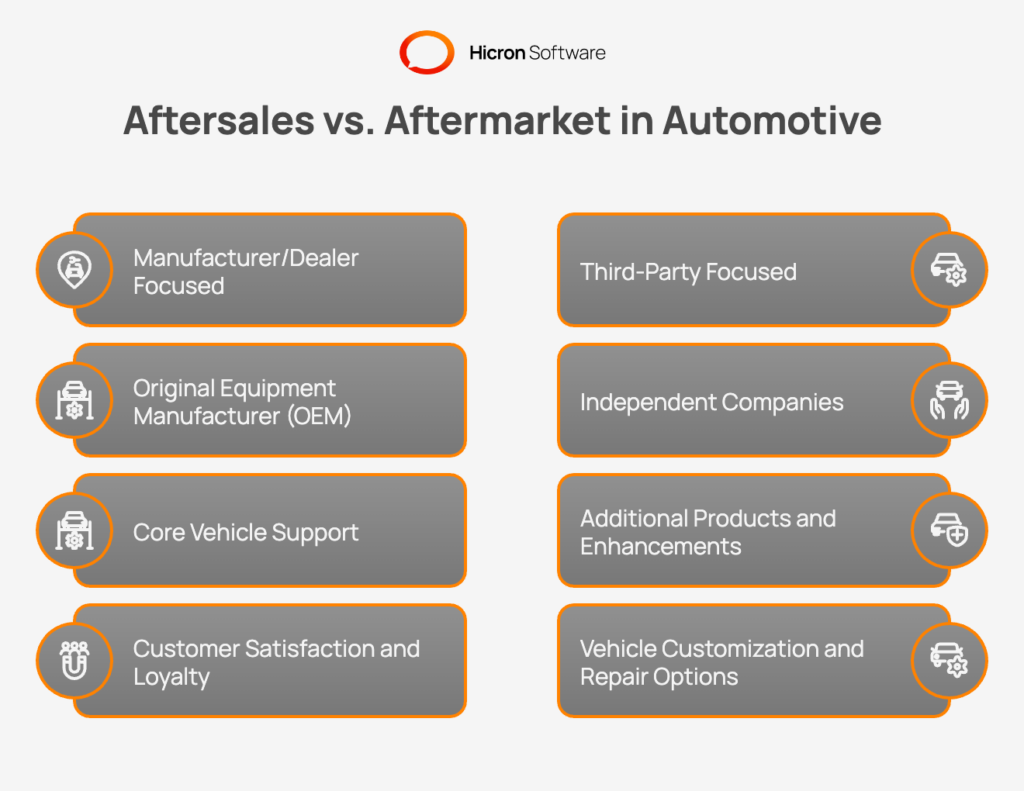
While aftersales focuses on post-purchase services directly from manufacturers or dealers, the aftermarket provides a broader scope of products and services from third-party providers. Recognizing this distinction is essential for optimizing the overall automotive experience. In the automotive industry, the terms “aftersales” and “aftermarket” are commonly used but often misunderstood.
Aftersales refers to the support and services provided by a manufacturer or dealer after the initial sale of a vehicle. This includes warranty work, routine maintenance, servicing, repairs, parts replacement, and customer support. The goal of aftersales services is to ensure customer satisfaction, build brand loyalty, and maintain the performance and safety of the vehicle.
The automotive aftermarket encompasses all vehicle-related products and services not provided by the original manufacturer. This includes parts, accessories, equipment, and enhancements made by third-party companies. Aftermarket products can range from replacement parts for repairs to performance-enhancing accessories and aesthetic modifications.
Distinguishing between aftersales and aftermarket is important for both businesses and consumers. For businesses, understanding these terms helps in strategizing market approaches, improving customer service, and fostering brand loyalty. For consumers, knowing the difference ensures informed decisions regarding vehicle maintenance and upgrades, ultimately affecting the longevity and performance of their vehicles.
In the automotive industry, the terms “aftersales” and “aftermarket” are commonly used but often misunderstood. Aftersales focuses on post-purchase services delivered directly by manufacturers or dealers. The aftermarket covers a broader scope of products and services supplied by third-party providers. According to Grand View Research, the global automotive aftermarket industry was valued at USD 489.5 billion in 2025 and is projected to reach USD 643.8 billion by 2033. Recognizing this distinction is essential for optimizing the overall automotive experience.
Aftersales services are important in ensuring customer satisfaction by offering continuous support and maintaining the reliability of the vehicle. High-quality aftersales services contribute to positive customer experiences, which in turn fosters brand loyalty and encourages repeat business and referrals.
Using genuine parts and adhering to OEM standards during maintenance and repairs is vital for quality assurance. Genuine parts are specifically designed and tested for compatibility with the vehicle, ensuring optimal performance and safety. OEM standards guarantee that the services provided meet the manufacturer’s specifications, preserving the vehicle’s integrity and value.
The independent sector within the aftermarket plays a crucial role by offering a variety of parts, accessories, and services. Unlike original equipment manufacturers (OEMs), which produce parts specifically for new vehicles, the independent aftermarket sector caters to the needs of vehicle owners looking for replacement parts, upgrades, or repairs once their cars are already in use. This includes both branded and non-branded parts.
Aftermarket activities are diverse, encompassing:
Aftermarket services offer several advantages to consumers, including:
Aftermarket services significantly impact vehicle longevity and performance by:
The aftermarket sector is indispensable to the automotive industry, providing essential services and products that support vehicle maintenance, customization, and performance enhancement.
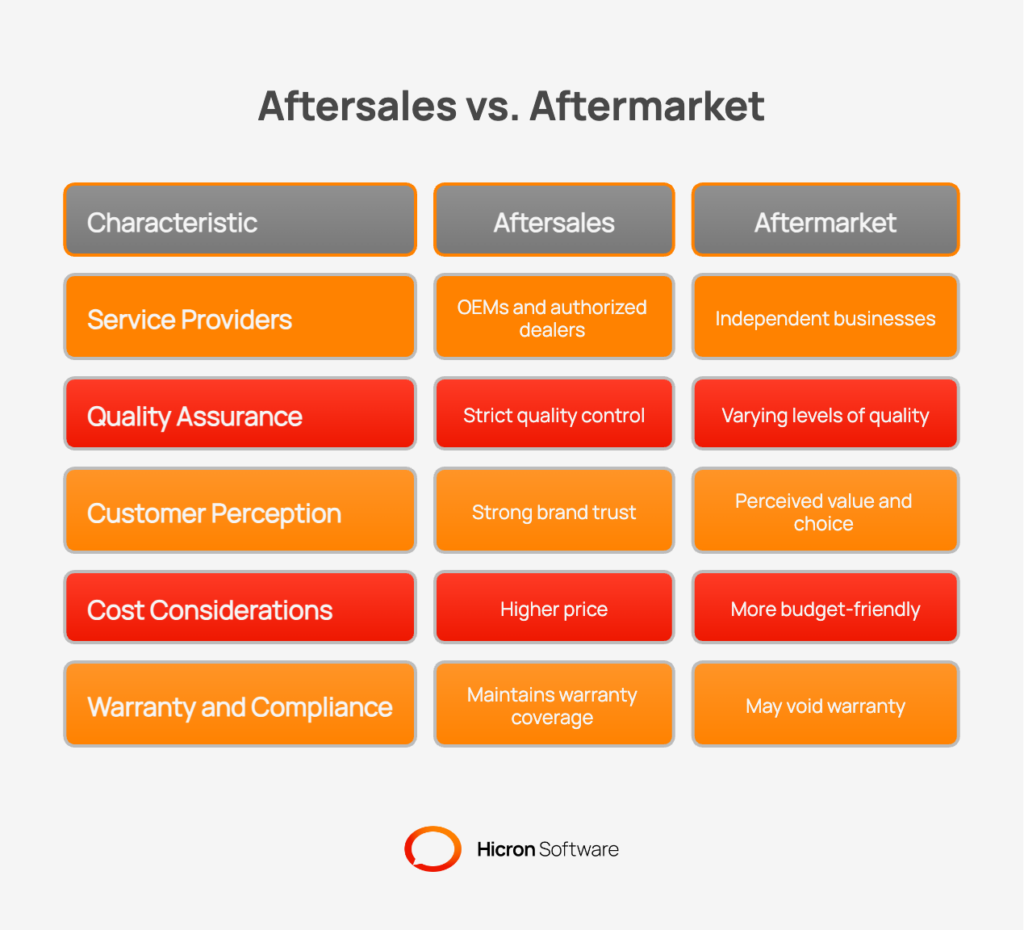
According to Roland Berger and FIGIEFA, the EU market for automotive spare parts is worth around EUR 118 billion. That figure shows the scale of the market that aftersales and aftermarket share. Aftersales runs through OEMs and authorized dealers, who operate within manufacturer networks and follow brand-specific service protocols. The aftermarket relies instead on independent workshops, third-party retailers, and online part suppliers. In fact, the multi-brand independent aftermarket sells about 62% of that spare parts market, or roughly EUR 73 billion, according to Roland Berger and FIGIEFA. Both channels compete for the same repair and maintenance demand, but through separate distribution structures.
OEM parts follow the exact specifications of the original components fitted at the factory. This gives aftersales a consistent baseline for fit, finish, and performance. Aftermarket parts vary more widely because multiple third-party manufacturers produce them. Some match or exceed OEM standards, while others use lower-grade materials. Certification programs and recognized quality benchmarks help buyers verify aftermarket parts before they fit them. The difference comes down to standardized output versus a broader range of quality tiers.
Vehicle owners often associate aftersales with reliability, brand trust, and factory-backed service. The aftermarket carries a reputation for affordability and wider choice. Perception is shifting toward the aftermarket: according to Roland Berger, 57% of consumers now prefer independent aftermarket parts over OE brands. Owners of newer vehicles tend to favor dealer aftersales to protect warranty coverage. Owners of older vehicles more often choose aftermarket options to control repair costs. Both perceptions influence where drivers decide to service their vehicles.
Price is the main driver behind the choice between the two channels. OEM pricing reflects brand-specific engineering and authorized dealer markups, while aftermarket parts fit multiple models, which spreads production costs and lowers unit prices. This price advantage is pushing more buyers toward independent options: according to Roland Berger, 57% of consumers now prefer aftermarket parts over OE brands, a shift driven largely by cost pressure. For cost-sensitive repairs, the aftermarket offers clear savings. For collision work or leased vehicles, OEM parts often justify the higher spend.
OEM parts come with manufacturer warranties and authorized dealer labor incentives, while aftermarket parts typically carry no warranty. This distinction affects both financial risk and compliance exposure. Aftersales repairs through authorized dealers help preserve factory warranty coverage. Aftermarket parts can, in some cases, affect warranty terms on newer or leased vehicles. This matters across a large and aging fleet: according to ACEA, cars in the EU are on average 12.3 years old, and that fleet is served by an extensive network of CECRA member businesses, which represent 336,720 automotive trade and repair enterprises across Europe.
Additionally, regulatory compliance can be an issue. Some aftermarket parts might not meet the stringent standards required by law, potentially impacting the vehicle’s safety and legal operation on the road.
When consumers are faced with the decision between opting for aftersales services or aftermarket alternatives, several key factors come into play. These factors include:
Aftersales pros:
Aftersales cons:
Aftermarket pros:
Aftermarket cons:
These examples illustrate how consumers weigh their options based on personal priorities like cost, convenience, quality, and brand loyalty, ultimately shaping their decision-making process.
Predictions and potential growth areas
Adoption of sustainable practices
Aftersales means OEM and dealer-authorized service; the aftermarket means independent parts and repairs — together they define a European spare parts market worth EUR 118 billion. Aftersales services ensure high-quality standards and seamless integration with the original product but often come at a higher cost. Conversely, aftermarket services offer more cost-effective and diverse options, though quality and compatibility can vary significantly. Both segments play important roles in providing comprehensive vehicle care, ensuring longevity and performance.
As market dynamics evolve, it is imperative for businesses to innovate and adapt their strategies to meet changing consumer demands and leverage emerging technologies. By doing so, they can enhance customer satisfaction, boost loyalty, and capitalize on growth opportunities, ultimately driving success in a competitive landscape.
Hicron Software proved to be a trusted partner with unmatched technical expertise, delivering a scalable and user-friendly web application that was pivotal to our successful U.S. market expansion.

Hicron’s contributions have been vital in making our product ready for commercialization. Their commitment to excellence, innovative solutions, and flexible approach were key factors in our successful collaboration.
I wholeheartedly recommend Hicron to any organization seeking a strategic long-term partnership, reliable and skilled partner for their technological needs.

After carefully evaluating suppliers, we decided to try a new approach and start working with a near-shore software house. Cooperation with Hicron Software House was something different, and it turned out to be a great success that brought added value to our company.
With HICRON’s creative ideas and fresh perspective, we reached a new level of our core platform and achieved our business goals.
Many thanks for what you did so far; we are looking forward to more in future!

Hicron is a partner who has provided excellent software development services. Their talented software engineers have a strong focus on collaboration and quality. They have helped us in achieving our goals across our cloud platforms at a good pace, without compromising on the quality of our services. Our partnership is professional and solution-focused!

The IT system supporting the work of retail outlets is the foundation of our business. The ability to optimize and adapt it to the needs of all entities in the PSA Group is of strategic importance and we consider it a step into the future. This project is a huge challenge: not only for us in terms of organization, but also for our partners – including Hicron – in terms of adapting the system to the needs and business models of PSA. Cooperation with Hicron consultants, taking into account their competences in the field of programming and processes specific to the automotive sector, gave us many reasons to be satisfied.