How to Improve Your Dealership’s After-Sales Process for Better Customer Retention
- December 08
- 14 min


Predictability has become a defining goal in automotive after-sales services, defining how the sector drives customer satisfaction, brand loyalty, and profitability. Digital tools such as AI, predictive analytics, and connected vehicle data now make that predictability possible, moving service models from reactive to proactive. For years, after-sales care relied on fixed maintenance intervals, manual diagnostics, and repairs triggered only after something failed. That approach kept operations running, but it left customers waiting, inventories bloated, and service quality uneven.
This approach, while straightforward, often leads to inefficiencies such as overstocked inventories, underutilized resources, unpredictable service times, and variably satisfied customers.
Examples of such traditional practices include scheduled servicing based on mileage or time intervals, reactive automotive maintenance in response to vehicle breakdowns, and a one-size-fits-all approach to customer service that fails to recognize individual customer needs or preferences.
However, the advent of digital tools, particularly artificial intelligence (AI) and automotive predictive analytics, is ushering in a new era for automotive after-sales services.
These technologies enable a more proactive, personalized, and efficient approach to after-sales care. By analyzing vast amounts of data from vehicle sensors, customer interactions, and service history, AI and automotive predictive analytics tools can anticipate service needs before they arise.
This not only ensures better maintenance of vehicles but also allows for the optimization of inventory management, with parts being ordered and stocked based on predictive models rather than historical averages.
These digital tools for after-sales services facilitate a more customized service experience.
For example, personalized service reminders can be sent to vehicle owners based on individual driving patterns rather than generic schedules, and recommendations for additional services can be tailored to each customer’s usage profile and preferences.
This shift towards data-driven, predictive service models enhances operational efficiency for service providers and improves customer satisfaction in automotive services by delivering timely, relevant, and efficient service solutions.
The integration of AI and automotive predictive analytics into automotive after-sales services represents a paradigm shift from reactive to proactive service delivery. This transformation is poised to redefine the landscape of after-sales services, offering substantial benefits to both service providers and customers alike.
Automotive after-sales services have traditionally been a linchpin of the automotive industry, directly influencing customer retention and brand loyalty. These services encompass everything from regular predictive automotive maintenance and repairs to warranty services and parts replacements.
However, the conventional strategies deployed in the management of these services are increasingly showing their limitations in the face of evolving consumer expectations and technological advancements.
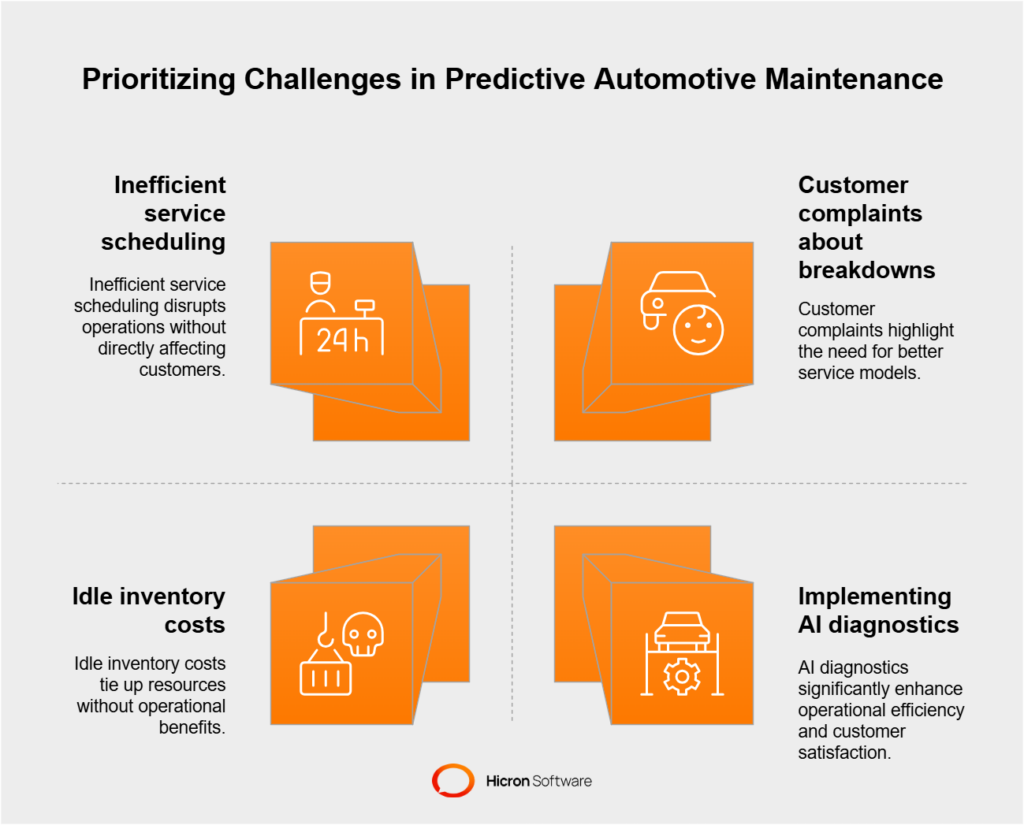
The need for more predictive and personalized after-sales services is evident, prompting a shift towards the adoption of advanced technologies like AI and automotive predictive analytics. These tools offer the promise of transcending the limitations of traditional after-sales service models, heralding a new era of efficiency, customer satisfaction, and operational excellence in the automotive industry.
Among technological advancements, cloud-based Customer Relationship Management (CRM) systems stand out for their ability to streamline interactions between businesses and their customers. These sophisticated platforms offer an all-encompassing solution for enhancing customer experiences, enabling businesses to foster stronger relationships with their clientele.
Cloud-based CRM systems are designed to centralize customer data, making it easily accessible to service teams from anywhere, at any time. This level of accessibility is crucial in today’s fast-paced market, where immediate response and personalization are key to customer satisfaction in automotive services.
By leveraging the power of cloud computing, businesses can ensure that their customer service representatives have real-time access to the information they need to address inquiries and resolve issues promptly.
The advent of digital tools for after-sales service has brought about transformational changes, improving operational efficiency and customer satisfaction in automotive services. Two notable areas of impact are real-time inventory management and efficient service scheduling.
Digital tools for after-sales services have enabled businesses to implement real-time inventory management systems, which provide up-to-the-minute data on stock levels, order statuses, and delivery timelines.
This transparency is invaluable for both businesses and customers, as it helps to set realistic expectations and reduce the potential for dissatisfaction due to delays or stockouts. Real-time inventory management also aids in identifying trends, predicting demand, and optimizing stock levels, thus reducing overhead costs and increasing profitability.
Efficient scheduling of services is another area where digital tools have made an impact. With the help of advanced scheduling software, businesses can optimize their service appointments, ensuring that resources are utilized effectively, and customers are served promptly.
This software often includes features like automated reminders, online booking options, and mobile access, further enhancing the customer experience by offering convenience and flexibility.
For service-oriented businesses, this means reduced wait times, increased throughput, and higher levels of customer satisfaction in automotive services.
The adoption of digital tools for after-sales services has heralded a new era of efficiency and customer-centricity. By harnessing the capabilities of cloud-based CRM systems, real-time inventory management, and efficient scheduling software, businesses can not only meet but exceed customer expectations. This digital transformation streamlines operations and strengthens the bond between businesses and their customers, paving the way for sustained success in today’s competitive market landscape.
Predictability in after-sales services is all about anticipation and proactive measures. EY groups predictive analytics, AI-based inspections, and digital customer engagement among the levers OEMs and dealers use to move aftersales from reactive demand toward proactive service delivery.
Predictability in after-sales services is all about anticipation and proactive measures. For instance, in the automotive industry, leveraging automotive predictive analytics to anticipate vehicle issues before they occur can minimize downtime for the customer.
This approach involves analyzing data from various sources, including vehicle diagnostics, automotive maintenance history, and even real-time sensor data, to identify patterns or signs that could indicate a pending failure.
The power of predictability lies in its ability to transform the after-sales service landscape from reactive to proactive. Instead of waiting for a problem to arise, businesses can use data-driven insights to preemptively address issues. This not only enhances the reliability of the product but also instills a sense of trust and reliability in the brand.
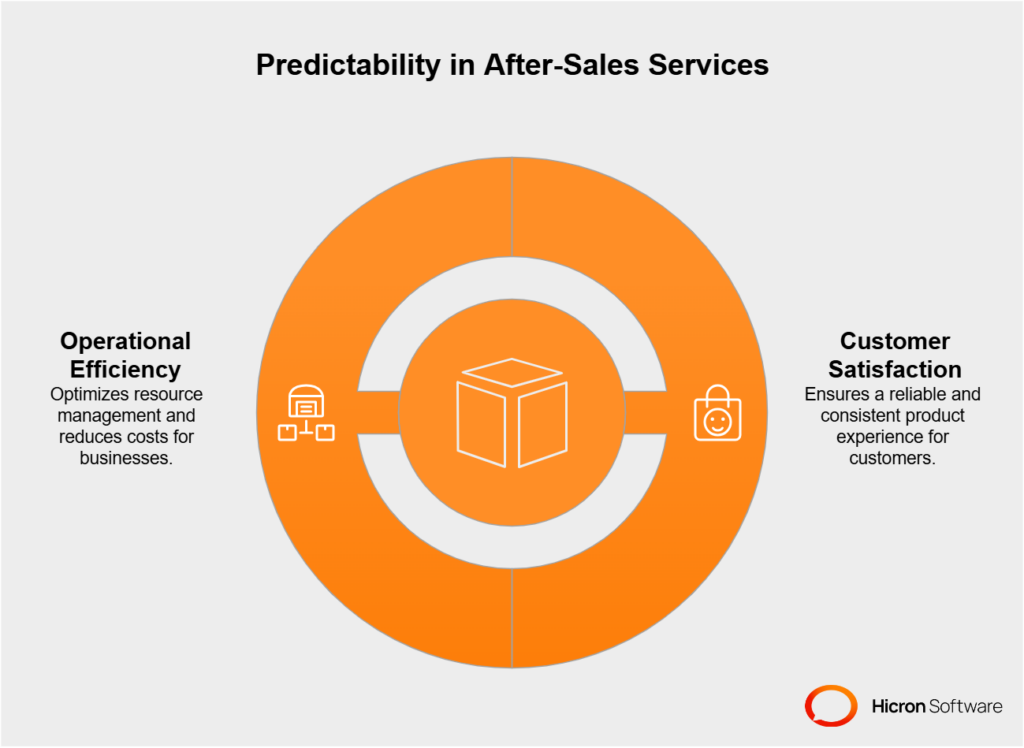
From a customer satisfaction perspective
From the perspective of customer satisfaction, predictability is invaluable. By avoiding sudden breakdowns or failures, customers enjoy a more reliable and consistent experience with their products. This reliability can be especially critical in industries where downtime translates directly to lost revenue or inconvenience, such as in transportation or manufacturing. Customers are more likely to stay loyal to brands that offer peace of mind through dependable after-sales services.
That loyalty carries a measurable financial upside. According to connectedcars.io, connected vehicles that are 8 or more years old generate 57% more workshop revenue than their non-connected counterparts. This suggests that data from connected cars helps keep owners returning for service well beyond the warranty period and turns predictability into a lasting revenue stream.
The scale of the loyalty gap makes that predictability goal concrete. In the Cox Automotive Service Industry Study (April to May 2025, 1,974 U.S. vehicle owners), U.S. dealerships handled 12% fewer service visits in 2025 than in 2018. Among owners of cars two years old or newer, 54% returned to the selling dealership for service, down from 72% in 2023. Owners who do return for service are 74% likely to buy their next vehicle from that same dealership.
From an operational efficiency perspective
Predictability also improves operational efficiency across the after-sales function. This foresight can lead to cost savings, as preventive measures are often less expensive than emergency repairs or replacements. Additionally, it allows businesses to smooth out workloads, avoiding the peaks and troughs associated with unexpected service demands.
When service teams can anticipate likely maintenance needs, they can schedule work more evenly, allocate technicians more effectively, and prepare parts availability with greater accuracy. This reduces both service disruptions and unnecessary inventory pressure. Instead of reacting to breakdowns, businesses can plan resources in advance and use capacity more productively.
For businesses, predictability in after-sales services enhances operational efficiency by enabling better resource allocation and minimizing unforeseen challenges. By investing in automotive predictive analytics and adopting a proactive approach to service management, businesses can achieve a competitive edge while improving both service consistency and cost control.
The integration of digital tools into after-sales services has been a game-changer in building predictability, enhancing both customer satisfaction and operational efficiency.
By leveraging advanced technologies such as automotive predictive analytics, artificial intelligence (AI), and the Internet of Things (IoT), businesses can now anticipate customer needs, forecast potential issues, and deliver personalized, proactive service solutions.
Predictive analytics stands at the forefront of this transformation, especially in sectors where reliability is important, such as the automotive industry. This technology utilizes vehicle data, including usage patterns, automotive maintenance history, and sensor data, to predict potential failures before they occur.
For instance, by analyzing engine temperatures, vibrations, and other operational metrics, predictive models can identify signs of wear and tear that may lead to breakdowns, enabling preemptive maintenance actions that prevent downtime and costly repairs.
Such predictive capabilities not only ensure that vehicles remain operational but also help in optimizing maintenance schedules. This reduces the likelihood of unexpected issues, thereby increasing customer trust and satisfaction.
Furthermore, businesses benefit from streamlined operations and reduced service costs, as predictive automotive maintenance often involves less resource expenditure than reactive maintenance.
By analyzing customer behavior and service history, AI can personalize communication, recommend specific maintenance actions, and even predict future service needs. This level of personalization enhances the customer experience, making interactions more relevant and timely. Additionally, AI-driven chatbots and virtual assistants provide 24/7 support, answering queries and scheduling services without human intervention, further improving service accessibility and responsiveness.
The IoT has revolutionized real-time vehicle monitoring, allowing for continuous tracking of vehicle performance and condition. Sensors embedded in vehicles collect data on various parameters, such as fuel efficiency, engine performance, and component health, transmitting this information to cloud-based platforms for analysis. This data collection and analysis enable immediate identification of irregularities, facilitating swift action to mitigate issues before they escalate.
IoT technology also supports remote diagnostics, allowing service providers to assess a vehicle’s condition remotely and, in some cases, perform updates or repairs without needing physical access. This capability enhances service efficiency and convenience, reducing the need for in-person service visits and minimizing vehicle downtime.
Technologies like predictive analytics, AI, and IoT provide a solid foundation for anticipatory service models that prioritize customer satisfaction and operational excellence.
By harnessing these digital tools for after-sales services, businesses cannot only predict and prevent potential issues but also offer a more personalized, efficient, and responsive service experience. In doing so, they set a new standard for after-sales service in the digital age, driving loyalty, reducing costs, and establishing a competitive edge in the market.
The successful adoption of digital tools in the automotive industry shows the benefits of using technology for proactive maintenance and issue resolution. Two standout examples of such innovation are BMW’s Teleservices and Tesla’s over-the-air (OTA) updates.
These cases highlight the practical application of digital tools for after-sales services and offer valuable insights into best practices for integrating these technologies into existing processes.
BMW Proactive Care for proactive maintenance
BMW Proactive Care uses AI and live vehicle data to identify maintenance and repair needs before they escalate. Depending on urgency, BMW or the preferred service center reaches the owner through the My BMW app, email, in-vehicle notifications, or Roadside Assistance.
That workflow shifts outreach from generic mileage intervals toward condition-based contact. In the same Cox Automotive study, 45% of vehicle owners reported dissatisfaction with dealership service, mainly because of unexpected costs and poor communication; gaps that proactive, data-backed outreach is designed to close.
The key lesson from BMW’s implementation is the importance of an integration between the vehicle’s onboard diagnostics and the manufacturer’s service infrastructure. This tight integration allows for real-time data exchange and immediate action, setting a high standard for customer-centric service.
Tesla’s Over-the-Air updates for issue resolution
Through its use of OTA updates, Tesla has revolutionized the automotive industry’s approach to software updates and issue resolution. Unlike traditional vehicles, which require a physical visit to a service center for most updates and fixes, Tesla vehicles receive software updates remotely, much like smartphones.
These updates can enhance vehicle performance, introduce new features, and even resolve identified issues without any inconvenience to the owner.
Tesla’s OTA updates underscore the potential of digital tools for after-sales services to improve the customer experience and reduce operational costs associated with physical service appointments. Furthermore, the ability to push updates to all vehicles simultaneously ensures that all customers benefit from improvements and fixes right away.
The lesson here is the power of digital tools for after-sales services to deliver continuous value and improvements post-purchase, fostering brand loyalty and customer satisfaction in automotive services.
Both BMW’s Teleservices and Tesla’s OTA updates illustrate the critical importance of integrating digital tools with existing business processes and infrastructure. This integration enables businesses to leverage real-time data, automate service processes, and deliver a superior customer experience.
Another lesson is the commitment to continuous improvement and the willingness to innovate. By constantly seeking ways to apply new technologies, these companies stay ahead of customer expectations and emerging challenges.
Lastly, these case studies highlight the importance of a customer-centric approach. Both BMW and Tesla have used digital tools for after-sales services to improve vehicle performance and reliability and enhance the overall customer experience. This focus on the customer drives brand loyalty and sets a high standard for competitors.
The success of BMW’s Teleservices and Tesla’s OTA updates provides compelling evidence of the value of digital tools for after-sales services. The lessons learned from these implementations – integration, continuous improvement, and a customer-centric focus – are invaluable for any business looking to leverage technology to enhance service offerings and customer satisfaction.
The landscape of digital after-sales services is poised for transformation as emerging technologies like augmented reality (AR), blockchain, and 5G telecommunications are increasingly integrated.
These advancements promise to redefine the standards of service delivery, customer interaction, and operational efficiency. Here’s an insightful look into how each of these technologies could shape the future of digital after-sales services.
Digital twins: virtual replicas fed by live vehicle or workshop data let aftersales teams simulate maintenance scenarios and test service strategies before technicians open a bay. Adoption reviews in manufacturing and maintenance increasingly treat them alongside IoT sensors and predictive analytics platforms.
Digital twins add another layer to this shift. By building virtual replicas of individual vehicles or entire fleets, service teams can simulate maintenance scenarios and test different upkeep strategies in a risk-free environment before applying them in the real world. Fed by live sensor and service data, these models help refine predictive maintenance plans, anticipate component wear more accurately, and fine-tune service timing, strengthening predictability across after-sales operations.
Augmented reality is set to revolutionize the way businesses approach diagnostics and troubleshooting. A systematic review in Discover Applied Sciences (80 peer-reviewed and gray-literature sources, 2017–2025) reports that maintenance tasks performed incorrectly fell from 53% with paper-based instructions to 13% when remote AR support was used—a 75% reduction in task error rates across the studies covered.
This capability can enhance remote support, allowing experts to guide customers or less experienced technicians through complex repairs and maintenance tasks from anywhere in the world.
For example, in the automotive sector, AR can enable a technician to see a 3D model of a car’s engine overlaid on the actual vehicle, highlighting areas that need attention. This speeds up the diagnostic process and improves the accuracy of repairs, reducing the risk of repeat issues.
Blockchain technology offers potential for managing spare parts in after-sales service processes. The Renault Group XCEED initiative with IBM certifies component compliance from design through production and into aftersales on a Hyperledger Fabric network, giving partners a shared record of provenance and lifecycle data. That transparency can reduce fraud, counterfeiting, and supply chain inefficiencies.
Furthermore, smart contracts—self-executing contracts with the terms of the agreement directly written into code—could automate ordering and payment processes, streamlining operations and ensuring timely availability of spare parts. This would boost operational efficiency and enhance customer satisfaction by minimizing service delivery delays.
The rollout of 5G technology is expected to enhance real-time data transfer capabilities. With its promise of higher speeds, lower latency, and increased connectivity, 5G could enable more sophisticated IoT applications in after-sales services. For instance, it would allow for more efficient real-time monitoring and predictive maintenance, where vast volumes of data from sensors embedded in vehicles or devices can be analyzed instantly to forecast potential failures.
The enhanced connectivity offered by 5G also opens up possibilities for more interactive and immersive customer service experiences, such as real-time AR-based support and advanced telematics services. This could further improve predictability in after-sales services, ensuring issues are identified and addressed before they escalate.
The integration of Augmented Reality, blockchain, and 5G telecommunications into the fabric of digital after-sales services heralds a new era of innovation and efficiency.
These technologies promise to enhance remote diagnostics, ensure transparent and efficient management of spare parts, and improve real-time data transfer, thereby elevating both customer satisfaction and operational effectiveness.
As businesses begin to adopt and adapt to these emerging trends, we can expect to see a shift in how after-sales services are delivered, with a greater emphasis on predictability, personalization, and transparency.
In the rapidly evolving automotive sector, the strategic implementation of digital tools is not just an option but a necessity for staying competitive. Here are practical steps and considerations for automotive companies looking to harness the power of digital technologies effectively.
The implementation of digital tools for after-sales services brings its set of challenges, notably concerning data security and privacy. Here’s how to address these concerns:
Data security concerns
Privacy policies
Integrating digital tools into automotive companies’ operations and services offers a pathway to enhanced efficiency, customer satisfaction, and innovation.
By investing in data analytics, partnering with tech companies, and proactively addressing challenges like data security and privacy, these companies can position themselves strongly in a digital-first future. Adopting these strategic recommendations will mitigate risks and unlock new opportunities for growth and competitiveness in the automotive industry.
Digital tools for after-sales services have become indispensable in the automotive industry, especially in enhancing the predictability of after-sales services.
Technologies such as predictive analytics, IoT, augmented reality, and blockchain have revolutionized how automotive companies approach maintenance, repairs, and customer service.
For instance, predictive analytics can foresee potential vehicle issues before they occur, allowing for proactive maintenance that considerably reduces downtime and enhances vehicle longevity. This improves customer satisfaction by ensuring reliability and safety and enhances operational efficiency by streamlining service schedules and reducing unexpected repair costs.
BMW’s Teleservices and Tesla’s over-the-air updates exemplify how digital tools can impact customer satisfaction and operational efficiency. BMW’s use of connected technology for remote diagnostics and maintenance scheduling exemplifies a proactive approach to customer service.
At the same time, Tesla’s OTA updates demonstrate the efficiency and convenience of remote software upgrades and issue resolution. These examples underline the transformational impact of digital tools on automotive after-sales services.
The automotive industry’s future appears increasingly intertwined with digital transformation. The potential introduction of autonomous vehicles stands out as a development, promising to further reshape after-sales services.
Autonomous vehicles will likely require highly sophisticated, real-time monitoring and diagnostic capabilities to ensure safety and reliability. This could lead to an even greater reliance on digital tools and technologies, from advanced sensors and AI-driven analytics for predictive automotive maintenance to blockchain for secure and transparent documentation of vehicle history and repairs.
The evolution towards autonomous vehicles also opens up new opportunities for enhancing customer experiences and operational practices. For example, autonomous vehicles could be programmed to autonomously travel to service centers for maintenance, minimizing inconvenience for owners.
Furthermore, the data collected by these vehicles could provide invaluable insights into user behavior, vehicle performance under different conditions, and long-term wear and tear patterns, enabling manufacturers to improve vehicle design and functionality continuously.
Digital tools have already profoundly impacted the predictability and efficiency of automotive after-sales services, as illustrated by successful implementations by leading companies like BMW and Tesla.
With the ongoing digital transformation and the advent of autonomous vehicles, the industry is set to witness even more changes.
These developments will likely bring about new challenges but also open up unprecedented opportunities for improving service delivery, customer satisfaction, and operational efficiency. The future of automotive after-sales services will undoubtedly rely heavily on the strategic integration of digital technologies, marking a new era of innovation and customer-centricity in the industry.
Predictability means anticipating service needs before a breakdown or surprise repair visit. Aftersales teams use vehicle data, maintenance history, and customer records to schedule work proactively rather than waiting for a failure.
Service visits keep owners inside the authorized network after the vehicle sale and protect fixed-operations revenue as fleets age. Survey data also links repeat service at the selling dealership to a higher likelihood of repurchase.
Blockchain creates an immutable record of each part’s origin, ownership, and service history across the supply chain. OEM and dealer networks can verify genuine components faster during warranty, recall, or repair workflows.
IoT sensors stream fuel, engine, and component health data to cloud platforms in near real time. Service providers can run remote diagnostics, trigger alerts, and in some cases apply fixes without an in-person visit.
Predictive analytics models scan usage patterns, diagnostic codes, and sensor trends to flag wear before it causes downtime. Service centers use those signals to book maintenance at the right time and stock the parts the job requires.
Connected vehicles, CRM platforms, and analytics software combine sensor readings, service history, and customer preferences into early warnings and tailored outreach. That data flow supports proactive scheduling, parts planning, and clearer communication with owners.
AI analyzes large volumes of data from vehicle sensors, service history, and usage patterns to detect early signs of wear before they become failures. It can flag which components need attention and when, so dealerships book maintenance at the right moment and stock the right parts. AI also personalizes customer communication, sending timely reminders based on how each vehicle is actually driven.
A digital twin is a virtual replica of a vehicle or fleet, fed by live sensor and service data. Service teams use it to simulate maintenance scenarios and test upkeep strategies in a risk-free environment before applying them in the real world. This helps refine predictive maintenance plans, anticipate component wear more accurately, and fine-tune service timing.
Hicron Software proved to be a trusted partner with unmatched technical expertise, delivering a scalable and user-friendly web application that was pivotal to our successful U.S. market expansion.

Hicron’s contributions have been vital in making our product ready for commercialization. Their commitment to excellence, innovative solutions, and flexible approach were key factors in our successful collaboration.
I wholeheartedly recommend Hicron to any organization seeking a strategic long-term partnership, reliable and skilled partner for their technological needs.

After carefully evaluating suppliers, we decided to try a new approach and start working with a near-shore software house. Cooperation with Hicron Software House was something different, and it turned out to be a great success that brought added value to our company.
With HICRON’s creative ideas and fresh perspective, we reached a new level of our core platform and achieved our business goals.
Many thanks for what you did so far; we are looking forward to more in future!

Hicron is a partner who has provided excellent software development services. Their talented software engineers have a strong focus on collaboration and quality. They have helped us in achieving our goals across our cloud platforms at a good pace, without compromising on the quality of our services. Our partnership is professional and solution-focused!

The IT system supporting the work of retail outlets is the foundation of our business. The ability to optimize and adapt it to the needs of all entities in the PSA Group is of strategic importance and we consider it a step into the future. This project is a huge challenge: not only for us in terms of organization, but also for our partners – including Hicron – in terms of adapting the system to the needs and business models of PSA. Cooperation with Hicron consultants, taking into account their competences in the field of programming and processes specific to the automotive sector, gave us many reasons to be satisfied.