InsurTech Innovations: Transforming the Insurance Industry
- November 14
- 8 min



Insurance claims automation is the process of utilizing advanced technologies, including artificial intelligence and machine learning, to streamline and optimize the insurance claims lifecycle. This includes automating tasks such as data validation, fraud detection, claim assessment, and approvals, reducing manual intervention, minimizing errors, and improving efficiency.
The insurance industry is undergoing a major transformation, largely driven by the need to modernize the claim process. At the heart of this change is claims automation, a technology-driven approach that replaces outdated manual tasks with efficient, digital workflows.
Market readiness tracks that direction. 2026 ISG research commissioned by mea Platform finds that 83% of senior insurance leaders support AI execution of repeatable operational work, including claims adjudication. Of those surveyed, 75% would allow that execution only with an insurance-specific or institutionally governed model, and 6% would trust a general-purpose model alone for high-consequence underwriting and claims decisions.
This article provides a comprehensive overview of how claims automation is reshaping the insurance sector. It explores the shift from manual processes to intelligent automated systems, highlighting the benefits of speed, accuracy, and customer satisfaction. Reading this guide will equip you with the knowledge to understand how technology is streamlining operations and what the future holds for insurance claims and insurance software solutions.
Claims automation refers to the use of technology to digitize and manage the insurance claim process without heavy reliance on human intervention. Traditionally, the manual claims process was slow, paper-heavy, and prone to errors.
Today, automation in insurance claims allows carriers to handle high volumes of data quickly. By implementing a claims processing system, insurers can streamline everything from claim intake to final settlement. This shift is not just about speed; it is about accuracy and consistency.
Why does this matter now? Customer expectations have changed. People want their insurance claim settled quickly and transparently. Insurance companies that fail to adapt to automated claims processing risk falling behind competitors who can offer a faster claim resolution. Claims automation makes the entire process more efficient, freeing up adjusters to focus on complex claims that truly require human empathy and judgment.
Key benefits:
The traditional manual claims process is often characterized by bottlenecks. Paperwork piles up, data entry errors occur, and communication delays frustrate customers. In a manual environment, a simple insurance claim might take weeks to resolve as it moves from one desk to another. This inefficiency drives up costs and lowers customer satisfaction. In contrast, automated systems can handle simple claims almost instantly. Workflow automation ensures that tasks are routed to the right place immediately, reducing the friction associated with manual processes.
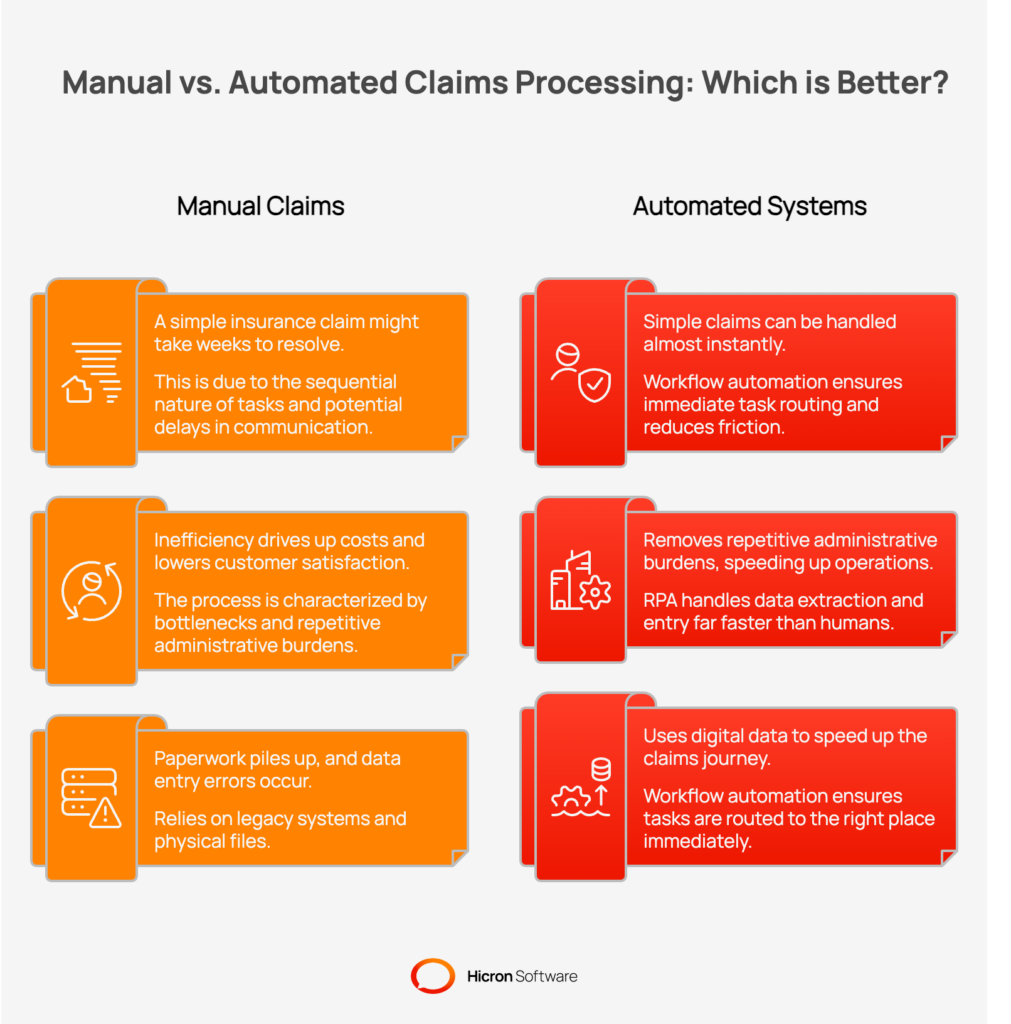
When you automate claims processing, you remove the repetitive administrative burdens that slow down claims operations. For example, robotic process automation (RPA) can handle data extraction and entry far faster than a human ever could. While manual claims rely on legacy systems and physical files, an automated claim workflow uses digital data to speed up the claims journey. The difference in efficiency is stark, making claims processing automation a necessity rather than a luxury for modern insurers.
By integrating Artificial Intelligence (AI) into the claim process, insurers can analyze vast amounts of data in seconds. AI algorithms can review policy details, assess damage from photos, and determine liability with high accuracy. This capability allows for straightforward claims to be processed with minimal human touch, vastly improving the claims experience for the customer. AI doesn’t just speed things up; it makes the process claims smarter.
According to Swiss Re, automated underwriting engines process around 75% of life insurance applications on average globally, and up to 90% in some markets. Complex cases still move to human underwriters for expert review.
AI improves the efficiency of claims management by learning over time. Natural language processing (NLP) allows systems to read and understand documents, emails, and notes, further reducing manual data entry. Intelligent document processing enables the system to extract relevant information from medical reports or police records automatically. This means that insurance claims processing becomes a continuous, fluid operation rather than a series of stop-and-start tasks. AI ensures that the right data reaches the right decision-makers instantly.
Insurance claims automation involves a series of steps backed by advanced technologies to enhance efficiency and accuracy. The process begins with claim submission through digital channels like mobile apps or websites, guided by AI systems to ensure all necessary information is provided. Data collection and validation leverage tools like OCR and AI-backed validation to cross-check policy details and detect inconsistencies. Fraud detection employs machine learning and predictive analytics to identify anomalies, while claim assessment uses AI algorithms and computer vision to evaluate validity and calculate payouts. Workflow automation tools handle approvals or escalate complex cases to human adjusters. Customers are kept informed through chatbots and automated notifications, and payments are processed swiftly via digital platforms. Finally, feedback is collected to refine the system, with AI continuously learning to improve future claims processing.
The table provides a detailed, step-by-step breakdown of each stage in insurance claims automation, along with the specific technologies used at each step.
|
Step |
Description |
Key Technologies |
|
Claim Submission |
Customers submit claims through digital channels like mobile apps, websites, or email. AI-powered systems guide users through the submission process, ensuring all required information is provided. |
|
|
Data Collection and Validation |
The system collects and validates submitted data such as policy details, claim forms, and supporting documents (e.g., photos, receipts). AI tools cross-check this data against policy terms and detect inconsistencies or missing information. |
|
|
Fraud Detection |
AI algorithms analyze claims for potential fraud by identifying patterns, anomalies, or red flags. Machine learning models compare claims against historical data to assess their legitimacy. |
|
|
Claim Assessment |
AI systems evaluate the claim’s validity and calculate the estimated payout based on policy terms and conditions, often leveraging computer vision to analyze evidence such as images or videos. |
|
|
Approval or Escalation |
Valid claims are automatically approved and processed for payment. Complex or flagged claims are escalated to human adjusters for further review. |
|
|
Communication and Updates |
Automated systems inform customers about claim statuses through notifications, emails, or chatbots. Customers can track their claims in real-time. |
|
|
Payment Processing |
Once approved, payments are initiated to the customer, typically processed via digital payment methods for quicker transactions. |
|
|
Feedback and Continuous Improvement |
Post-claim feedback is collected to refine the process and enhance customer experience. AI systems continuously learn from completed claims to improve accuracy and efficiency over time. |
|
Fraud detection is a critical component of insurance claims processing. In a manual setup, identifying patterns indicative of fraud is difficult and time-consuming. However, claims automation uses technology to scan claims data for anomalies that a human might miss. By analyzing historical data and current claim details, AI models can flag suspicious claims for further investigation. This proactive approach helps insurance companies save millions in fraudulent payouts.
The system uses claims data to identify patterns that correlate with known fraud schemes. For instance, if multiple claims originate from the same IP address or involve the same questionable service providers, the automation solution will alert the fraud department. Automation in insurance acts as a powerful shield, ensuring that legitimate claims are paid out quickly while fraudulent ones are stopped in their tracks. This balance protects the insurer’s bottom line and keeps premiums lower for honest policyholders.
Intelligent automation combines AI, machine learning, and RPA to create a cognitive claims processing system. Unlike simple rule-based automation, intelligent systems can learn and adapt. Machine learning algorithms analyze past claims patterns to predict future outcomes and optimize the claims lifecycle. This means the system gets smarter with every insurance claim it processes, continuously refining its accuracy and efficiency.
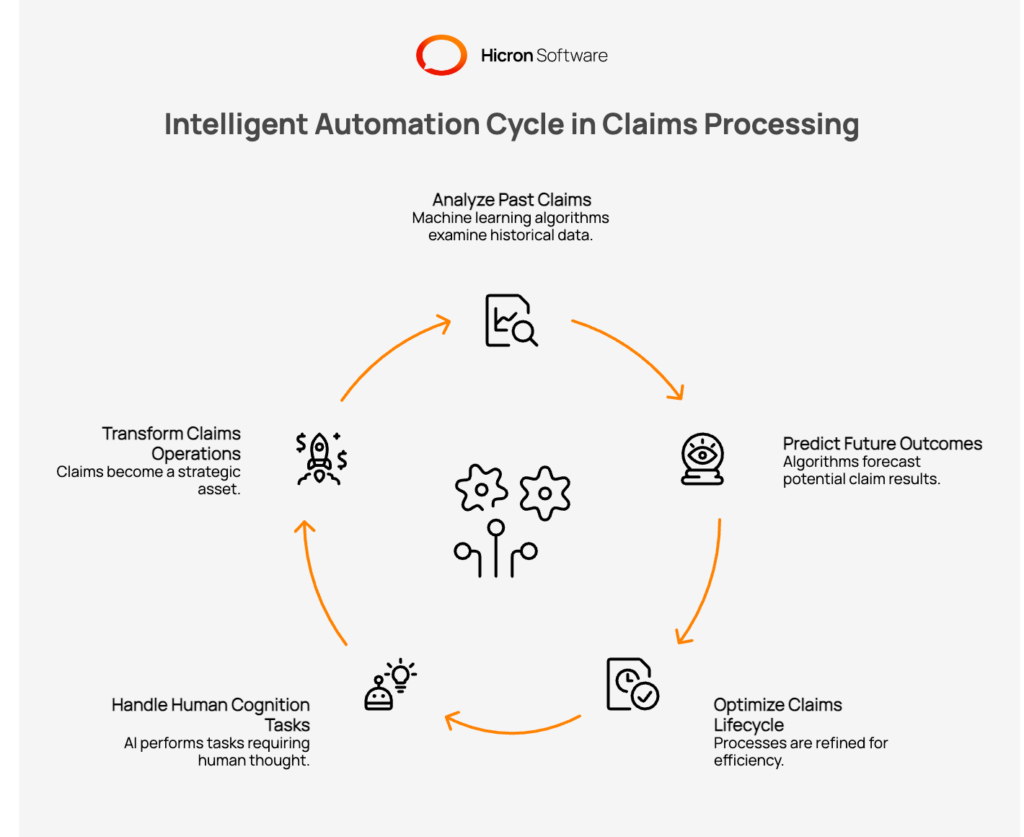
In the context of claims automation in insurance, this technology handles tasks that previously required human cognition. For example, AI in insurance claims processing can assess the severity of car damage from an image and estimate repair costs. Intelligent automation empowers insurers to handle claims management processes with a level of sophistication that was previously impossible. It transforms claims operations from a back-office function into a strategic asset that drives value for the insurance firm.
Speed is the currency of the modern insurance industry. Claims automation makes the entire claims process faster by eliminating waiting periods. Automated claims processing typically involves instant verification of coverage and immediate triggering of payments for approved claims. For simple task automation, such as verifying a policy number or checking a deductible, the system works instantly. This allows insurance claims automation to deliver settlements in hours rather than days or weeks.
Faster claim settlement leads to higher customer retention and better reviews. Automation allows insurers to meet the demand for instant gratification. When you use automation to handle routine tasks, the processing time drops dramatically. Claims automation is about delivering on the promise made to the policyholder when they purchased their policy. A quick, hassle-free settlement is the ultimate goal of claims processing automation.
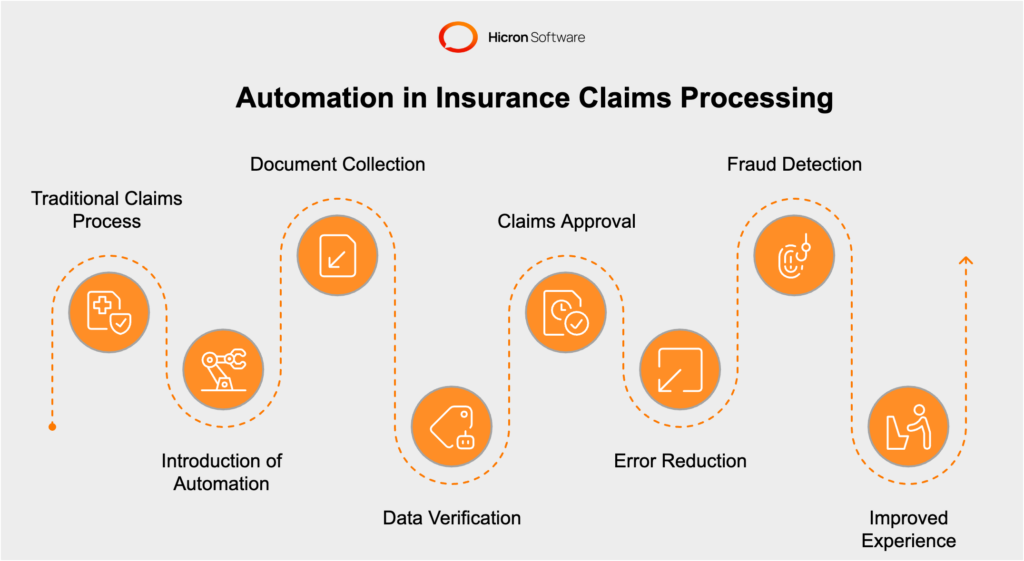
At its heart, automated workflows aren’t just about cutting down the hours in claims processing; they’re about giving insurers and their policyholders a better overall experience. Insurers can save time and costs while customers avoid the dreaded waiting game.
It’s a win-win, and as new technology continues to evolve, the process will only improve. Insurance claims automation workflows take the insurance industry from “hold on to your patience” to “we’ve already got it handled.” And honestly? It’s about time.
While automation tools excel at handling simple claims, there is a common misconception that they cannot handle complexity. In reality, automating your claims workflow benefits complex claims as well. By automating the data gathering and administrative parts of a complex file, adjusters have more time to focus on the nuances of the case. Claims automation handles the “grunt work,” ensuring that the human expert has all the necessary information at their fingertips.
However, insurance claims automation isn’t a complete replacement for human judgment in high-stakes situations. Complex claims involving severe injuries, liability disputes, or large commercial losses still require the empathy and negotiation skills of a seasoned professional. The best approach combines automation with human expertise. Automation and AI support the adjuster, providing insights and data, but the final decision on intricate matters often remains with the human. This hybrid approach ensures efficiency without sacrificing quality in claims handling.
The benefits of automated claims are extensive. First and foremost is cost reduction. By reducing reliance on manual processes, insurance companies can lower their operational expenses significantly. Fewer manual touches mean fewer errors, less rework, and lower administrative overhead. Additionally, claims automation improves scalability. During a catastrophic event, when claim volumes spike, an automated system can scale up instantly to handle the load, whereas hiring and training new staff takes time.
Beyond cost, insurance claims automation makes data more accessible and actionable. Claims data is centralized, allowing for better reporting and analytics. Insurers can track trends, identify bottlenecks in the claims journey, and make data-driven decisions to improve products and pricing.
Automation really transforms the business model, shifting the focus from processing paper to managing relationships and risk. The efficiency gains from claims processing software translate directly to a healthier bottom line and a more competitive market position.
The modern customer expects a digital-first experience. Claims automation delivers this by offering self-service options and real-time updates. Through a mobile app or portal, a policyholder can file an insurance claim (often called claim intake) anytime, anywhere. They can upload photos, track the status of their claim, and receive payments digitally. This transparency and ease of use vastly improve the claims experience.
Automation in claims processing eliminates the frustration of “black hole” claims where the customer doesn’t know what is happening. Automated notifications keep the policyholder informed at every stage of the claims process. By making the claims process faster and simpler, insurers build trust and loyalty. Claims automation makes the entire interaction smoother, turning a typically stressful event into a manageable one. When insurance claims processing works well, it reinforces the value of the insurance policy to the customer.
The future of the insurance industry is undeniably digital. We will see a deeper integration of core insurance platforms with AI and external data sources. Claims automation will evolve from processing transactions to predicting and preventing losses. IoT devices (Internet of Things) will feed real-time data into claims systems, potentially triggering an automated claim before the customer even reports it. For example, a connected car could report an accident and initiate the auto claims process instantly.
As automation technologies mature, the line between manual claims and automated systems will blur further. We will move toward “touchless” claims for a wider variety of scenarios. Guide to claims process automation strategies will focus on hyper-personalization, where the claims journey adapts dynamically to the individual customer’s needs. Automation uses technology not just to fix problems, but to anticipate them. The guide to insurance claims automation of the future will be about proactive protection and smooth service, driven by robust AI and data analytics.
The shift toward claims automation is redefining how insurance companies operate and serve their clients. By embracing AI and modern claims processing automation, the industry is moving away from slow, manual processes toward a future defined by speed, accuracy, and customer-centricity.
Insurance claims automation offers undeniable benefits for insurers, including reduced costs, increased efficiency, and minimized errors. By streamlining claims processing, automation can create a smoother, more reliable experience for insurers and their customers. It’s an opportunity to make processes smarter, simpler, and more effective.
Ready to transform your claims process? Explore how automation can reduce costs, improve efficiency, and enhance customer satisfaction. Contact us today to learn more about implementing claims automation in your organization.
Insurance claims automation refers to the use of advanced technologies, such as artificial intelligence (AI), machine learning, and robotic process automation (RPA), to streamline and expedite the insurance claims process. It reduces manual tasks, enhances accuracy, and improves overall efficiency.
Automation in insurance involves utilizing technology to perform repetitive tasks, such as underwriting, policy management, and claims processing, with minimal human intervention. It ensures faster operations, cost reductions, and improved customer experience.
Yes, many insurance companies are implementing AI for claims management. AI enables faster data processing, real-time fraud detection, and predictive analysis to improve decision-making and efficiency throughout the claims lifecycle.
The four main stages include:
Robotic Process Automation (RPA) in insurance is the deployment of software bots to automate routine tasks such as data entry, policy updates, and claims adjudication. It enhances speed and reduces errors by mimicking human actions in digital systems.
A claims API (Application Programming Interface) allows insurance companies to integrate claims data and workflows with other systems. It facilitates seamless data exchanges, enabling real-time updates and improved communication between stakeholders.
The insurance claims workflow typically includes claim filing, policy verification, loss assessment, documentation review, approval or denial of the claim, and payment processing. Automation simplifies and accelerates each step for better efficiency.
Claims automation leverages AI and machine learning to analyze patterns, flag anomalies, and identify suspicious activities in real-time. This proactive approach helps insurers detect and prevent fraud before payouts occur.
Key technologies driving claims automation include AI, machine learning, RPA, natural language processing (NLP), and predictive analytics. These tools work together to optimize workflows, reduce human error, and improve decision-making.
Claims automation improves customer trust and satisfaction by reducing errors, ensuring faster claims resolution, and providing transparent processes. It enables insurers to deliver consistent and reliable service, building long-term relationships.
Automation can efficiently handle straightforward claims through pre-defined workflows. For complex claims, it provides data insights and decision support for adjusters, enabling faster and more informed resolutions with human oversight when necessary.
The ROI for insurers includes cost savings from reduced manual labor, faster claims processing, fraud prevention, and enhanced customer retention. Long-term gains include operational efficiency and competitive advantages in the market.
Automated systems are designed with robust security protocols, such as encryption, secure access controls, and compliance with regulations like GDPR or HIPAA, to safeguard sensitive data from breaches and unauthorized access.
Insurance claims automation eliminates manual bottlenecks by using AI and RPA to process claims in real-time. Tasks like document verification, fraud detection, and approvals are completed in minutes instead of days.
Common challenges include high implementation costs, integrating automation with legacy systems, and ensuring data quality. However, phased adoption and strong partnerships can help overcome these barriers.
Predictive analytics helps insurers forecast claim trends, identify high-risk policies, and proactively prepare for potential surges, improving efficiency and decision-making.
Automation enables insurers to handle high claim volumes efficiently, especially during natural disasters or seasonal surges, without increasing operational costs or compromising accuracy.
Industries like auto, healthcare, property, and life insurance benefit significantly from automation due to its ability to streamline workflows, reduce costs, and improve customer satisfaction.
Automated systems can use advanced algorithms and machine learning to analyze claim forms for completeness and consistency. They can cross-check required fields, validate data against predefined rules, and flag missing or inconsistent information. Optical Character Recognition (OCR) can also be used to extract and verify data from scanned documents, ensuring accuracy and reducing manual errors.
Automated systems are designed to scale efficiently, allowing them to process large volumes of claims simultaneously. They can prioritize claims based on urgency or predefined criteria, route them to the appropriate departments, and use AI-driven workflows to streamline approvals. Chatbots and self-service portals can assist customers in submitting claims, reducing the burden on human teams and speeding up the overall process.
Hicron Software proved to be a trusted partner with unmatched technical expertise, delivering a scalable and user-friendly web application that was pivotal to our successful U.S. market expansion.

Hicron’s contributions have been vital in making our product ready for commercialization. Their commitment to excellence, innovative solutions, and flexible approach were key factors in our successful collaboration.
I wholeheartedly recommend Hicron to any organization seeking a strategic long-term partnership, reliable and skilled partner for their technological needs.

After carefully evaluating suppliers, we decided to try a new approach and start working with a near-shore software house. Cooperation with Hicron Software House was something different, and it turned out to be a great success that brought added value to our company.
With HICRON’s creative ideas and fresh perspective, we reached a new level of our core platform and achieved our business goals.
Many thanks for what you did so far; we are looking forward to more in future!

Hicron is a partner who has provided excellent software development services. Their talented software engineers have a strong focus on collaboration and quality. They have helped us in achieving our goals across our cloud platforms at a good pace, without compromising on the quality of our services. Our partnership is professional and solution-focused!

The IT system supporting the work of retail outlets is the foundation of our business. The ability to optimize and adapt it to the needs of all entities in the PSA Group is of strategic importance and we consider it a step into the future. This project is a huge challenge: not only for us in terms of organization, but also for our partners – including Hicron – in terms of adapting the system to the needs and business models of PSA. Cooperation with Hicron consultants, taking into account their competences in the field of programming and processes specific to the automotive sector, gave us many reasons to be satisfied.