11 DevOps Automation Tools to Streamline Your Workflow
- May 21
- 10 min


The Strangler Fig Pattern is a software architecture strategy designed for legacy system modernization that incrementally replaces specific functionalities with new applications and services. A strangler application” establishes a bridge between systems and gradually takes over the features of an existing monolithic application. The name comes from the biological behavior of the strangler fig vine, which grows around a host tree until the original structure dies and is fully replaced.
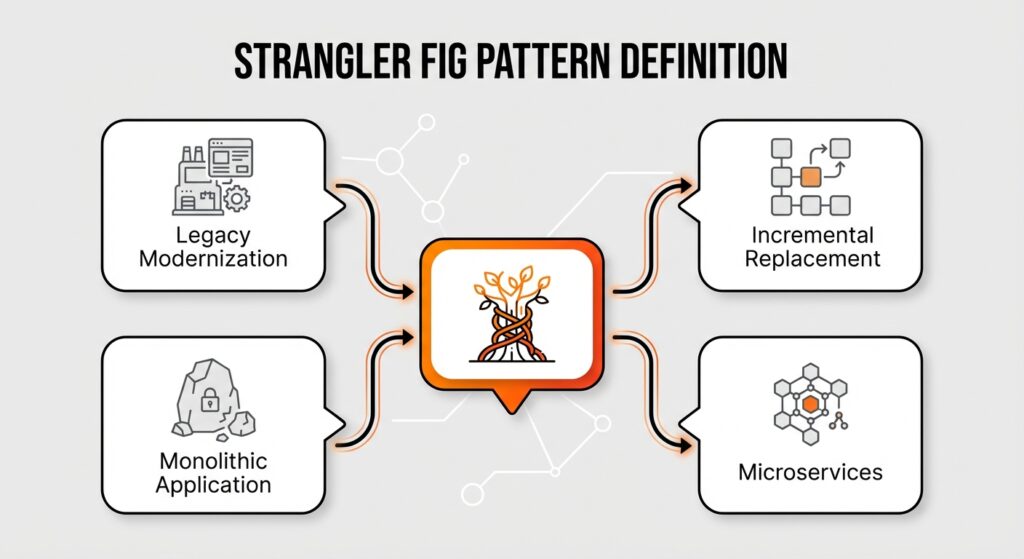
Prioritizing gradual improvement over abrupt replacement, the pattern offers a distinct alternative to high-risk “Big Bang” rewrite strategies. Rather than rewriting the massive application simultaneously, developers implement this by building new components around the edges of the old system. Minimizing technical debt, the process enables a controlled shift toward a cloud-native microservices architecture with better scalability.
| Component / Strategy | Functionality & Role | Strategic Benefit |
|
Strangler Fig Pattern |
A software architecture strategy that incrementally replaces legacy system functionalities by building new applications around the edges of the old monolith. |
|
|
Proxy Layer / Façade |
Acts as a “traffic cop” (often an API Gateway) that intercepts requests and routes them to either the legacy monolith or new microservices based on URI paths. |
|
|
Anti-Corruption Layer (ACL) |
Translates data and requests between the legacy system’s outdated schema and the new microservices’ clean domain model. |
|
|
Shadow Writes |
Dispatches write requests to both the legacy system and new architecture simultaneously, returning only the legacy response to the user. |
|
|
Thin Slices (Incremental Migration) |
Vertical cuts of functionality (UI, logic, data) identified by system seams and loose coupling, extracted one at a time. |
|
|
Polyglot Persistence |
Decoupling new services from the monolithic data store to implement a “database per service” model (e.g., using document stores alongside relational DBs). |
|
Developers prefer the Strangler Fig Pattern over a Big Bang rewrite during legacy system modernization primarily for reducing risk. If you have ever lost sleep over a deployment that went sideways, you know exactly why this matters. Due to unmanageable scope creep and long feedback loops, large-scale rewrites frequently fail. Stakeholders choosing a Big Bang approach often wait years before seeing any return on investment. Incremental migration solves this by delivering value continuously through small, manageable releases.
A Big Bang rewrite forces teams to freeze development on the existing monolithic application, while the Strangler pattern permits parallel development. Parallel work keeps the business running by maintaining system availability throughout the transition. Teams can address technical debt gradually within a transitional architecture. Gradual migration avoids the paralysis often caused by total system overhauls.
To replace legacy systems, the Strangler Fig Pattern establishes a middleman, typically a proxy layer or façade, that sits between users and the backend systems. Such a strategy maintains backward compatibility, letting legacy system modernization proceed without disrupting active users. The transitional architecture allows for a gradual shift where traffic moves to new services while the legacy system eventually shrinks in scope.
Think of the proxy layer as a traffic cop. It stands between your users and your code, intercepting every request and directing it to the right destination—either the old monolith or the new service. In my experience, getting this routing logic right is half the battle. This indirection layer hides the messy details of the migration, keeping the client unaware of the structural changes.
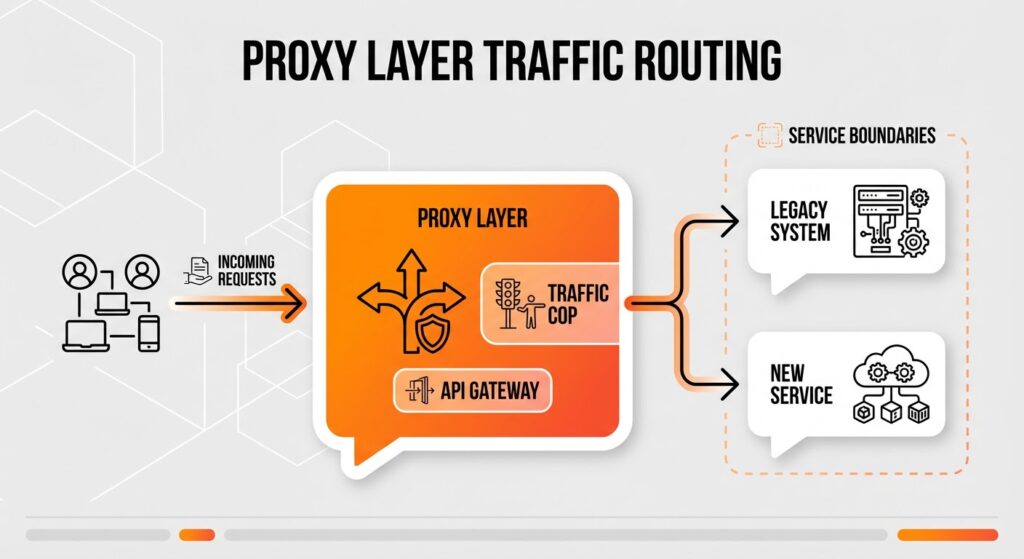
An API Gateway typically implements this logic by inspecting URL paths to enforce established service boundaries. By maintaining backward compatibility, the setup ensures users don’t notice any downtime or errors throughout the modernization. The software architecture relies on this component to safely divert traffic incrementally without operational disruption.
The Anti-Corruption Layer (ACL) acts like a translator at the border, converting the legacy system’s messy dialect into the clean language of your new microservices. Trust me, you do not want to carry over 20 years of bad variable naming into your fresh codebase. It protects the new architecture by translating data and requests between the legacy system’s outdated schema and the modern domain model. Such a translation mechanism guarantees domain isolation by converting legacy formats into clean structures on the fly, preventing technical debt from leaking into the new environment. You need to isolate the new model to apply domain-driven design principles based on current business needs, rather than inheriting the rigid schemas and confusing naming conventions of the legacy system of record.
Without this layer, new services risk adopting obscure logic or column names from the monolithic application, compromising the clean architecture.
Migrating with Strangler Fig is a loop: identify, transform, and eliminate. This iterative approach continues until the legacy system modernization is complete.
Architects identify candidates for incremental migration by locating system seams where the code exhibits loose coupling—areas where components aren’t tightly dependent on each other. These seams act as natural service boundaries that allow for the extraction of components without destabilizing the core monolithic application. Domain-driven design aids this process by mapping bounded contexts to specific business capabilities, revealing where the software architecture can be cleanly divided. You need coupling analysis to avoid parts of the system that are deeply entangled with complex database logic during the initial phases. Your goal is to isolate “thin slices”—vertical cuts of functionality that deliver high value with low risk.
A thin slice includes the user interface, logic, and data required for a specific task. Common starting points include a self-contained user authentication module or a specific reporting feature. I always suggest starting with these “easy wins” to help the team get comfortable with the new workflow. Selecting these isolated components first allows teams to address technical debt and validate the new microservices architecture before tackling complex core logic. Isolating components keeps the migration manageable and provides quick feedback.
Traffic routing relies on the API Gateway or proxy layer acting as a façade to manage request routing. This indirection layer uses URI paths, headers, or cookies to split traffic between the monolithic application and the new microservices architecture. You update the configuration as you deploy new services, so the gateway reflects the current service boundaries.
Fallback mechanisms default to the legacy system for any undefined routes, maintaining backward compatibility within the transitional architecture. For example, traffic for /api/v2/orders routes to the new cloud-native service, while /api/v1/orders stays with the monolith. Granular control makes the migration safer.
Only decommission a feature when it is fully replicated in the strangler application and data synchronization is complete. Wait for monitoring tools to confirm that zero traffic is reaching the legacy component before taking any action. This verification step confirms the new service functions as the definitive system of record.
Teams remove dead code and unused database tables from the monolithic application once the transitional architecture directs all requests to the new environment. Eliminating these artifacts reduces technical debt and minimizes maintenance overhead. The final cutover happens when the legacy system is entirely empty or reduced to a negligible size. A disciplined approach ensures a safe transition during the final stages of legacy system modernization.
Data synchronization is the most complex challenge in legacy system modernization, often requiring the legacy database to remain the system of record while data replicates to new stores. You must maintain consistency between the monolithic application and the emerging microservices architecture to prevent data corruption during the transition. Architects typically use two primary strategies to maintain data integrity across these different architectures: dual-write strategies and Change Data Capture (CDC).
By dispatching write requests to both the legacy system and the new microservices architecture simultaneously, shadow writes guarantee data consistency. The application returns only the response from the system of record to the user, effectively masking the new system’s activity. This approach makes testing safer by allowing developers to verify the new logic against live production traffic without impacting the user experience. Teams use this technique for validation by comparing the results of the shadow write against the established baseline. It is a great way to build confidence before you flip the switch for real users.
Discrepancies trigger alerts rather than user errors, maintaining strict backward compatibility. This transitional architecture allows for risk-free testing until the new service proves its reliability. You promote the new system to the primary authority only once its output consistently matches the legacy data.
The Strangler Fig Pattern makes polyglot persistence possible by decoupling new services from the monolithic data store, allowing teams to implement a “database per service” model within the transitional architecture. This approach enables each component of the microservices architecture to use the storage technology that best fits its specific requirements rather than being constrained by the legacy database. This strategy enhances scalability and performance by allowing for faster query times and optimized data handling for distinct business capabilities.
For instance, a modernized ‘Catalog’ service might adopt a document store to handle unstructured product data efficiently, while the legacy ‘Billing’ system remains on a relational database to maintain strict transactional integrity. This separation supports domain-driven design by isolating data schemas, though it introduces integration challenges regarding cross-database querying. Architects address this complexity by using APIs or event streams for data synchronization. This allows cloud-native services to operate independently while maintaining consistency with the legacy system modernization efforts.
The Strangler Fig Pattern primarily lowers the stakes of legacy system modernization. Unlike a complete rewrite that often takes 2 to 3 years to launch, this strategy delivers an earlier return on investment through continuous updates. Organizations choose this software architecture despite the complexity of managing two systems because it prevents the catastrophic failures associated with “Big Bang” replacements.
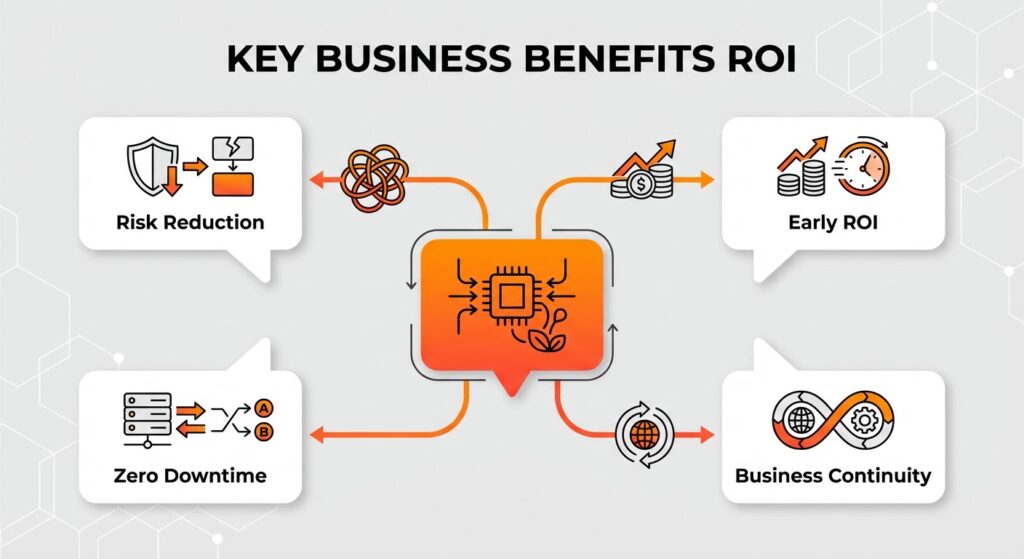
The Strangler Fig Pattern eliminates operational downtime by using a proxy layer or façade to switch traffic dynamically between the legacy and modern systems. This layer separates the user interface from the backend implementation, allowing the application to remain live throughout the legacy system modernization. The architecture achieves high availability through two key mechanisms:
This secures business continuity as the incremental migration shifts traffic gradually rather than all at once. The system maintains backward compatibility by keeping the legacy system active for unmigrated features. This approach reduces risk by enabling immediate rollback if a new component fails. The result is a seamless transition where the application stays online continuously.
Incremental migration mitigates technical risk by isolating changes to small, manageable thin slices, meaning that any potential failure is contained within a specific component. Isolating changes limits the “blast radius” to a single service within the software architecture, preventing a localized error from crashing the entire monolithic application. Modernizing one function at a time lets teams establish a “fail-fast” capability where issues are detected early in the development cycle. This isolation significantly simplifies debugging, as identifying and fixing a bug in a decoupled microservices architecture is easier than tracing faults through a tangled legacy codebase.
Immediate fallback mechanisms reinforce operational safety. For example, if a newly deployed ‘Search’ service fails under load, the proxy layer can instantly revert traffic to the existing legacy search function. This capability secures business continuity and provides precise validation for each release. Short feedback loops allow developers to address technical debt iteratively, avoiding the integration nightmares common in a Big Bang rewrite. This process helps ensure that legacy system modernization remains stable and predictable throughout the transition.
While the Strangler Fig Pattern offers a safer alternative to a total rewrite, it comes with significant architectural trade-offs:
The Strangler Fig Pattern is the best choice for large, complex systems and monolithic application environments where a complete rewrite poses unacceptable risks. This approach is meant for legacy system modernization scenarios involving critical business functions that can’t tolerate operational downtime. Organizations select this pattern when the main goal is a gradual transition to a cloud-native microservices architecture without halting ongoing development. It is particularly effective for systems with high technical debt where understanding the entire codebase is no longer feasible.
Small applications with low complexity rarely justify the overhead of a transitional architecture.
Hicron Software proved to be a trusted partner with unmatched technical expertise, delivering a scalable and user-friendly web application that was pivotal to our successful U.S. market expansion.

Hicron’s contributions have been vital in making our product ready for commercialization. Their commitment to excellence, innovative solutions, and flexible approach were key factors in our successful collaboration.
I wholeheartedly recommend Hicron to any organization seeking a strategic long-term partnership, reliable and skilled partner for their technological needs.

After carefully evaluating suppliers, we decided to try a new approach and start working with a near-shore software house. Cooperation with Hicron Software House was something different, and it turned out to be a great success that brought added value to our company.
With HICRON’s creative ideas and fresh perspective, we reached a new level of our core platform and achieved our business goals.
Many thanks for what you did so far; we are looking forward to more in future!

Hicron is a partner who has provided excellent software development services. Their talented software engineers have a strong focus on collaboration and quality. They have helped us in achieving our goals across our cloud platforms at a good pace, without compromising on the quality of our services. Our partnership is professional and solution-focused!

The IT system supporting the work of retail outlets is the foundation of our business. The ability to optimize and adapt it to the needs of all entities in the PSA Group is of strategic importance and we consider it a step into the future. This project is a huge challenge: not only for us in terms of organization, but also for our partners – including Hicron – in terms of adapting the system to the needs and business models of PSA. Cooperation with Hicron consultants, taking into account their competences in the field of programming and processes specific to the automotive sector, gave us many reasons to be satisfied.