The “Human” Face of AI, aka Story of Alex, Grandma Antonina, & Selma
- June 04
- 17 min


The most affordable AI consulting services for legacy systems focus on specific, high-value outcomes through targeted engagements. These services give companies access to artificial intelligence expertise without a large project commitment. By starting on a small scale, businesses can demonstrate the value of AI and build momentum for future investments.
Many small and medium-sized businesses view AI innovation as out of reach and feel limited by aging software. Legacy systems may contain valuable data, but starting an AI project can seem expensive and confusing at first. This guide explains affordable AI consulting services built for system modernization. We break down what are the most affordable AI consulting services for businesses looking to modernize legacy systems. You will see how to begin with small projects, quickly demonstrate results, and invest wisely in your company’s future.
A legacy system is any IT system that relies on outdated technology, lacks proper documentation, or is difficult to update and maintain. Over time, these systems build up technical debt. This debt is made up of missed upgrades and temporary fixes that eventually slow progress. Technical debt increases maintenance costs and makes it harder to respond to changes. For many organizations, legacy systems can hold back growth and add barriers to new initiatives.
AI helps businesses move beyond old limitations. Artificial intelligence can automate routine tasks, raise data quality, and reveal insights hidden in complex data environments. Businesses see gains in efficiency and manage costs more effectively. AI upgrades often make legacy systems easier to use and help organizations meet user expectations. This transition creates opportunities for innovation instead of focusing only on technical fixes or ongoing maintenance.
Several challenges come up when updating legacy systems, and AI consultants help address them:
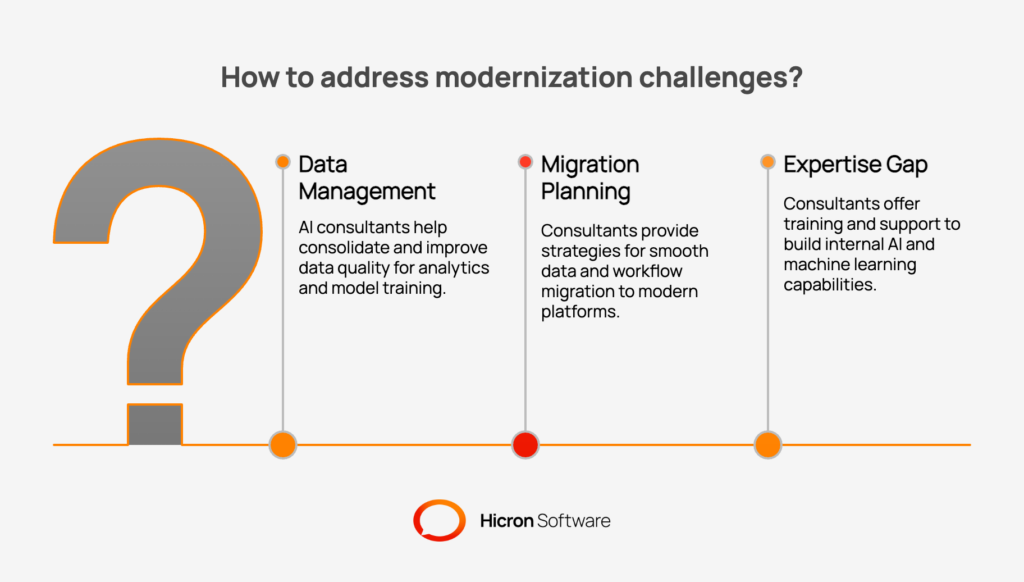
AI Consultants with experience in modernization projects can help organizations manage these risks and drive successful outcomes.
When thinking about AI consulting for legacy systems, move beyond sticker price. The true value of a consulting engagement shows in the business impact, not just the fee. Two main metrics help clarify whether a service is affordable for your needs.
Total Cost of Ownership covers all expenses related to your AI project. It includes consulting fees along with supporting costs. Cloud hosting, the time invested by your internal team, and ongoing support costs all contribute to the overall amount you will spend. Sometimes, a low upfront rate results in higher costs down the line if the solution needs frequent maintenance or additional resources.
Quality consultants aim to deliver measurable business results quickly. Time-to-Value is measured by a project’s ability to provide a strong and clear return on investment (ROI) in a short period.
AI consulting offers different engagement models to match diverse business needs and budgets. Choosing the right model helps control costs and lets organizations build on early successes.
|
Service Model |
Description |
Best Use Case |
|
Strategic Advisory & Roadmap |
A high-level engagement to identify AI use cases, define a strategy, and create a phased implementation plan. |
When you are unsure where to start with AI and need help building a business case. |
|
Proof of Concept (PoC) |
A small-scale, time-limited project to test a specific AI idea using your company’s data to validate its value. |
When you have a specific use case and need to prove its technical feasibility and business value with minimal risk. |
|
Fractional Staff Augmentation |
Adding a specialized AI expert to your team on a part-time basis to fill specific skill gaps. |
When your internal team can handle most of a project but lacks specific AI or machine learning skills. |
|
Fixed-Scope Integration Sprints |
A project with a clearly defined outcome, timeline, and price to integrate a single AI function into a workflow. |
When you have a well-defined problem that can be solved with a standard AI solution. |
|
Managed AI & MLOps Services |
Outsourcing the ongoing monitoring, maintenance, and retraining of your AI models after they are deployed. |
When you have a successful AI model but lack the internal resources to manage it long-term. |
A strategic advisory project is a high-level service meant to help you plan. Consultants identify AI use cases, shape a practical strategy, and outline a phased path forward. This option makes sense when your team is just starting or needs help creating an internal business case for AI.
A Proof of Concept is a limited-scope project that tests a targeted idea with your company’s data. This approach lets you confirm that a solution works and offers value without a major investment. Teams who know their use case but need evidence before broader rollout often choose a PoC.
Fractional staff augmentation brings specialized AI skills to your team on a part-time basis. Internal teams can manage the main aspects of a project but benefit from short-term support in areas like machine learning or advanced analytics. Accessing expertise without hiring a full-time employee lowers the cost.
Fixed-scope sprints are focused projects with clear outcomes, timelines, and costs. These services integrate a specific AI feature into a workflow, such as automating invoice data entry. This model is suited to problems with well-defined solutions.
AI solutions need maintenance and care after launch. Managed services for AI and MLOps cover monitoring, maintenance, and retraining of models. These services help teams maintain quality and reliability, especially if they lack in-house expertise.
How AI consulting firms price their services depends on project scope, time, and required skills. Understanding these structures can make budgeting easier.
Consultants usually offer project-based fees for PoC projects and fixed-scope sprints, while monthly retainers are common for continuous advisory or managed services. Staff augmentation is often billed using hourly or daily rates.
Organizations can take several steps to keep AI projects affordable.
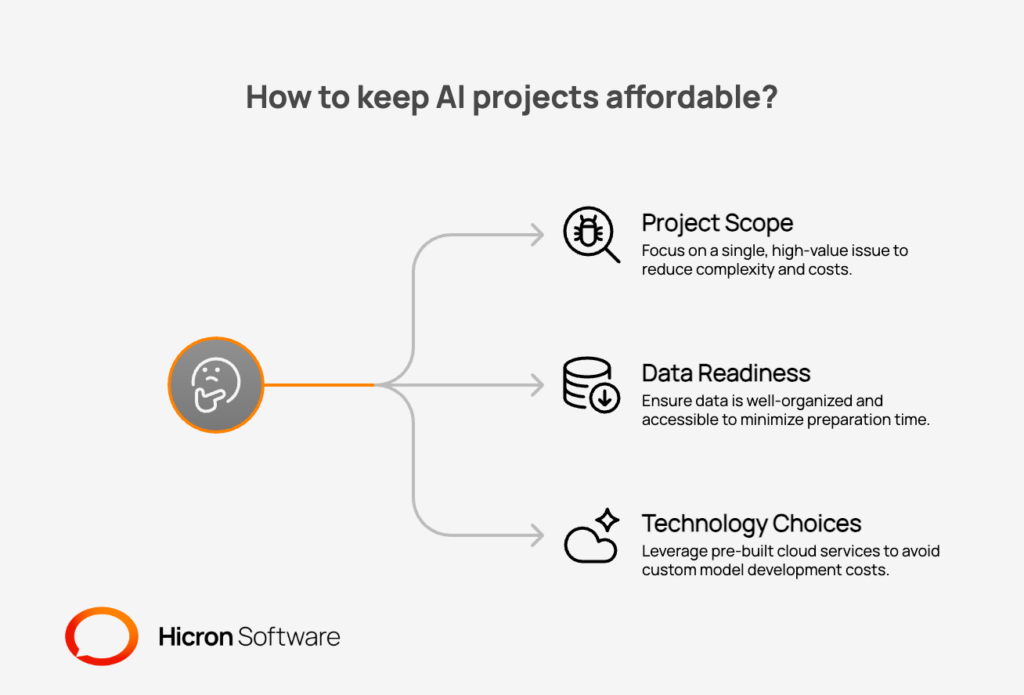
A successful first AI project should be practical and low risk, with outcomes that are easy to track and communicate.
|
Step |
Description |
Example |
|
1. Identify Problem |
Pick a clear, measurable business issue, focusing on manual, repetitive, or error-prone processes. |
Automating manual invoice data entry or improving inventory checks. |
|
2. Define Success |
Set simple, concrete goals and Key Performance Indicators (KPIs) at the start of the project. |
Reduce data entry error rates by 50% or cut time spent on a task by 10 hours per week. |
|
3. Propose PoC |
Frame the initial project as a short, time-limited assessment or Proof of Concept (PoC) to keep risk low. |
A 4-week project to test the feasibility of an AI model on a small dataset before committing to a full rollout. |
Pick a clear business issue that is easy to measure. Manual, repetitive tasks and error-prone processes, such as invoice processing or inventory checks, are strong candidates.
Set simple, concrete goals at the start. Examples include reducing error rates by a certain percentage or cutting the time spent on repetitive tasks.
By limiting the project to a short assessment or PoC, you keep risk low and make it easier to evaluate results when the project ends.
The right consulting partner can make or break your experience. Consider these qualities:
A detailed plan helps move smoothly from the first idea to a working proof of value.
|
Phase |
Timeline |
Description |
|
Discovery & Roadmap |
Days 1-30 |
Work with a consultant to set priorities, identify one or two use cases, and establish goals for a pilot project. |
|
Execute the Proof of Concept (PoC) |
Days 31-75 |
Build a prototype or model connected to your data and monitor progress against agreed-upon Key Performance Indicators (KPIs). |
|
Evaluate Results & Plan Next Steps |
Days 76-90 |
Compare project outcomes against original goals to decide whether to expand, adjust, or end the engagement. |
Start by working with a consultant to set priorities and map out your AI strategy. Identify one or two promising use cases. Establish goals for the coming pilot project.
The next phase involves building a prototype or model, often linked to your current data. Progress is monitored based on agreed KPIs. Regular updates keep the project on track.
In this final phase, compare your outcomes against the original goals. From there, you can decide whether to expand the project, adjust your approach, or end the engagement based on performance.
For organizations operating on legacy systems, the prospect of adopting Artificial Intelligence (AI) often raises more questions than answers. Particularly about budget. While legacy data holds immense untapped value, the path to extracting that value is rarely a straight line. This framework provides a structured approach to estimating the costs associated with starting an AI project within a legacy environment. It is designed to help business leaders identify key cost drivers, manage financial risks, and build a realistic budget for modernization.
|
Phase |
Description |
Cost Drivers and Variance Criteria |
|
Data Readiness and Extraction |
Involves auditing, extracting, and cleaning relevant data from legacy systems for AI model training or analysis. |
Data Format Accessibility: Data Quality: Silo Complexity: |
|
Project Scope and Definition |
Determines the specific business problem the AI will solve and the extent of its integration into existing workflows. |
Engagement Model: Integration Requirements: |
|
Technology Stack Selection |
Involves choosing the AI architecture, computing resources, and software that will power the project. |
Model Type: Infrastructure: |
|
Talent and Implementation |
Covers the human resources needed to execute the strategy, manage the project, and maintain the system post-launch. |
Sourcing Strategy: Internal Capability: |
The most affordable path is a narrow, fixed-scope engagement rather than a full rewrite. Use this shortlist to compare partners that combine AI consulting with legacy modernization.
Price ranges below are indicative planning benchmarks only. Actual cost depends on scope, system complexity, data readiness, integrations, and delivery timeline. Confirm figures in a scoped proposal after discovery.
|
Company |
Focus |
Affordable model |
|
AI consulting + legacy modernization (EU / nearshore PL) |
Fixed-scope discovery sprints, hourly advisory, and milestone projects. Start with a PoC/MVP, reuse existing infrastructure, and track ROI checkpoints. Estimated ranges: discovery / AI readiness from $10k–$25k; senior advisory from $50–$99/hour. |
|
|
2. LTK Soft |
AI-assisted Java/.NET analysis and migration |
Analysis typically $15k–$30k fixed; migration phases often $30k–$80k |
|
3. Dream Beyond |
Legacy Modernization Sprint (one bounded slice) |
From $20k; typical range $20k–$50k |
|
Company |
Focus |
Price signal |
|
4. Belitsoft |
Application modernization with GenAI support |
Projects from about $10k |
|
5. StepTo |
Incremental web/app modernization (Serbia, CET) |
Dedicated teams often about $15k–$25k/month |
|
6. Hauer Power |
Strangler-pattern modernization (.NET/Java/PHP) |
Pilot teams often about $30k–$42k/month |
|
7. Leobit |
.NET, AI/ML, cloud, and re-platforming |
Often about $25–$49/hour; minimum project about $25k+ |
|
8. EonTech |
AI strategy through hands-on delivery (Poland) |
Senior nearshore advisory + build |
How to choose: ask for a fixed discovery or PoC at or below $30k, confirm the team can read your legacy stack (not only GenAI demos), and keep code plus IP ownership on your side.
Starting your AI modernization journey does not have to be complicated or expensive. By focusing on targeted, high-value projects, you can see real returns and build a solid foundation for future innovation. If you are ready to explore how affordable AI consulting can transform your legacy systems, we are here to help. Schedule a consultation with our experts today to discuss your specific needs and create a practical roadmap for success.
You can begin with a strategic roadmap or PoC, keeping costs much lower than a large system overhaul. Starting small provides practical results while managing your investment.
Your organization is ready if you can identify a clear business issue, have access to relevant data, and are open to working through a short-term trial project.
Yes. Today’s technology allows AI to use APIs for connecting with existing legacy systems. Upgrades can work with your current infrastructure.
No. The right consultant brings the expertise needed and can collaborate with your current teams.
A small PoC targeting a clear, costly problem, such as automation or error reduction, can provide quick wins and build support for wider adoption.
Hicron Software proved to be a trusted partner with unmatched technical expertise, delivering a scalable and user-friendly web application that was pivotal to our successful U.S. market expansion.

Hicron’s contributions have been vital in making our product ready for commercialization. Their commitment to excellence, innovative solutions, and flexible approach were key factors in our successful collaboration.
I wholeheartedly recommend Hicron to any organization seeking a strategic long-term partnership, reliable and skilled partner for their technological needs.

After carefully evaluating suppliers, we decided to try a new approach and start working with a near-shore software house. Cooperation with Hicron Software House was something different, and it turned out to be a great success that brought added value to our company.
With HICRON’s creative ideas and fresh perspective, we reached a new level of our core platform and achieved our business goals.
Many thanks for what you did so far; we are looking forward to more in future!

Hicron is a partner who has provided excellent software development services. Their talented software engineers have a strong focus on collaboration and quality. They have helped us in achieving our goals across our cloud platforms at a good pace, without compromising on the quality of our services. Our partnership is professional and solution-focused!

The IT system supporting the work of retail outlets is the foundation of our business. The ability to optimize and adapt it to the needs of all entities in the PSA Group is of strategic importance and we consider it a step into the future. This project is a huge challenge: not only for us in terms of organization, but also for our partners – including Hicron – in terms of adapting the system to the needs and business models of PSA. Cooperation with Hicron consultants, taking into account their competences in the field of programming and processes specific to the automotive sector, gave us many reasons to be satisfied.