Balancing the DRY Principle with Readability in Software Development
- March 19
- 5 min



Software modernization is the process of updating or replacing legacy systems with current technology. It includes migrating codebases, updating architecture, and adopting AI tools to reduce cost and improve performance.
This article is a practical guide to software modernization for technology leaders. It covers the core strategies teams use to modernize legacy systems without disrupting ongoing operations. You will learn why modernization efforts often fail, how AI tools change the process, and what a phased roadmap looks like in practice. The article also covers risks in GenAI refactoring, the role of feature flags and kill switches, and how to build a program that delivers measurable value. Whether you are starting a modernization journey or scaling a pilot, this guide will help you move forward.
Key Takeaways
Software modernization in the age of AI has changed how enterprises update their systems. AI tools now automate dependency mapping, code analysis, and test generation. This compresses timelines that once took years into months. Many companies still rely on software built decades ago. These systems were not designed for modern architectures, cloud native platforms, or current AI workloads.
The software modernization market is projected to reach $56.87 billion by 2030, driven by hybrid cloud and AI adoption. As of 2026, 62% of U.S. organizations still rely on outdated software. These systems consume up to 80% of IT budgets. That leaves little room for innovation or building competitive advantage. Organizations that do not keep pace risk falling behind peers already moving faster with AI.
GenAI tools can now decompose monolithic codebases in hours. They generate documentation and flag architectural flaws before they reach production. Teams that once needed months for code audits now complete them in days. The case for modernizing applications is both strategic and technical. Waiting longer only increases the cost of eventual change.
Legacy systems are expensive in ways that go beyond maintenance costs. Engineering teams spend 60 to 70 percent of their time trying to keep systems running. That leaves little capacity for building new capabilities. As products and services evolve, systems remain tied to outdated patterns. Every future change becomes harder and more expensive to implement.
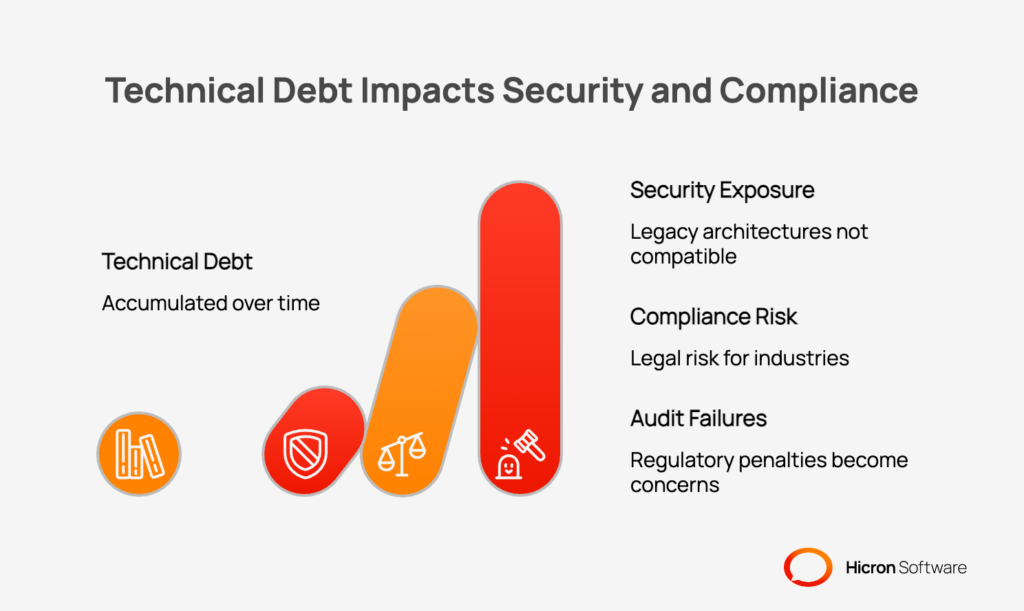
Accumulated technical debt compounds over time. Legacy architectures are often not compatible with Zero Trust security or cloud native platforms. This creates security exposure and compliance risk across the organization. For industries like finance and healthcare, legacy code that operates as a black box creates legal risk. Audit failures and regulatory penalties become real concerns as a result.
When engineering resources are locked in legacy support, organizations cannot adopt AI workloads. They cannot integrate with modern APIs or respond quickly to market changes. Legacy applications become an anchor that keeps product roadmaps frozen. The longer modernization is deferred, the larger the eventual effort becomes.
The Strangler Fig pattern is one of the most reliable approaches to application modernization. It replaces legacy modules one phase at a time. Old and new code run in parallel during each transition. APIs route traffic between components based on current configuration. This gives engineering teams time to validate each change before a full cutover.
AI backed coding tools have expanded what teams can accomplish within each modernization wave. Refactoring from COBOL to Java or converting a monolithic UI to React now takes far less time. Automated test generation handles codebases that were never documented properly. These capabilities let teams preserve embedded business logic while upgrading the technical foundation.
Modern architectures built on API first design and Zero Trust security create a scalable base for future work. Teams that invest in this architecture during modernization avoid rebuilding it again within a few years. The right framework reduces both risk and total cost over time. Organizations that skip this foundation often find themselves modernizing again within three to five years.
|
Core Strategy |
Description |
|
Strangler Fig Pattern |
Replaces outdated modules incrementally instead of a high-risk, all-at-once rewrite. Traffic is routed through API gateways, and old and new code run in parallel, allowing validation in production-like conditions with continuity. |
|
AI Toolkits for Modernization |
Enables code migration (e.g., COBOL to Java/Spring Boot), UI conversion (e.g., legacy screenshots to React), and automated test generation. Supports brownfield refactoring while preserving embedded business logic. |
|
Architectural Foundation |
Includes hybrid/multi-cloud architectures, API-first design, and Zero Trust security. These are essential for supporting AI workloads, seamless integration, and meeting modern security and compliance requirements. |
Multi-agent AI systems have changed how modernization projects are executed. Rather than relying on individual developers to translate legacy code manually, agentic systems now orchestrate entire modernization workflows. They handle
across complex environments. The workload on engineering teams drops as a result.
AI agents embedded in ERP and CRM platforms can manage workflow steps without constant human oversight. They handle tasks like invoice processing and supply chain optimization. Teams using these tools report up to 65% faster time to market after modernization. Post modernization organizations have also seen IT cost reductions of up to 74%. For any CTO evaluating modernization services, the business case is well supported.
Multi-agent systems move from task automation to decision-making support. They transform legacy software from static tools into active components of a digital workforce. This is what modernization in the age of AI looks like at scale. Engineering teams focus on orchestration rather than repetitive manual work.
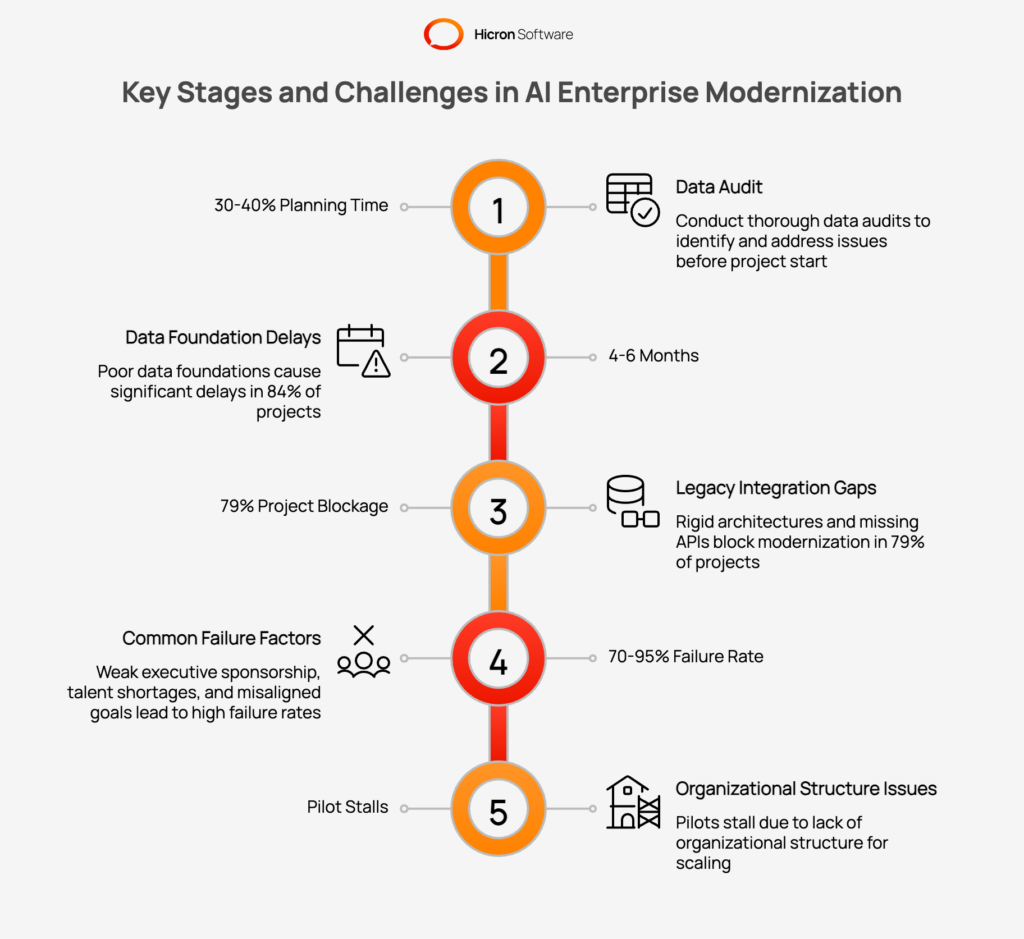
Failure rates for AI enterprise modernization initiatives range from 70 to 95 percent. The cause is almost never the technology itself. Weak executive sponsorship, talent shortages, and misaligned goals are the most common factors. Pilots stall before production because the organizational structure needed to scale them was never built.
Poor data foundations create delays in 84% of projects, averaging four to six months. Without a trusted data layer, AI capabilities produce output that teams cannot verify. Pre-project data audits reduce this risk before work begins. These audits should consume 30 to 40% of planning time. This investment consistently prevents the costly discoveries that derail projects midway.
Legacy integration gaps compound these challenges. Rigid architectures, missing APIs, and accumulated technical debt block modernization in 79% of projects after investment has already been made. The answer is not to wait for a clean architecture. Adopting API first designs and phased Strangler patterns from the start creates a path forward. Governance frameworks that enforce explainability help sustain progress over time.
GenAI tools accelerate legacy code refactoring. Large language models can analyze poorly documented legacy software in hours. They map dependencies and generate tests for code that was never designed for review at scale. But this speed comes with real risk. Hallucinations, regressions, and compliance gaps are serious concerns in production environments.
The right approach is to build comprehensive test suites before applying any AI assisted changes. Unit tests, integration tests, and characterization tests should all run in your pipeline. AI backed tools should focus on analysis and documentation in the early phases. Human reviewers validate the output before any changes are deployed to production. This model keeps quality standards high while reducing manual effort across the team.
Never apply AI assisted changes to public APIs, authentication flows, or cryptographic configuration without explicit expert review. For regulated industries, keeping AI away from behavioral tasks until compliance is confirmed is the safest path. Governance platforms with audit trails support systematic oversight at enterprise scale.
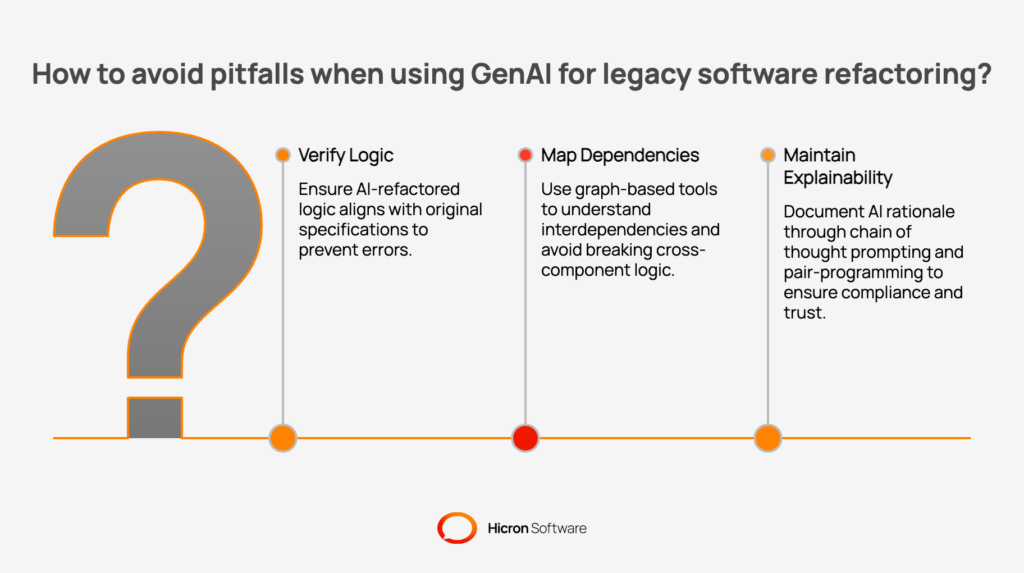
GenAI models often hallucinate constraints that do not exist in the original code. They add validation rules that block valid transactions. They miss edge cases unique to the legacy software being analyzed. These errors lead to regression rates of 20 to 30 percent in untested code paths. Always verify AI refactored logic against original specification documents to catch these issues early.
Dependency oversights are another serious risk. Existing applications embed business rules inside data flows and external calls. AI tools may refine code locally while breaking cross-component logic elsewhere. Use graph-based analysis tools alongside AI to map interdependencies before making any changes. This step is especially important in systems with sequence-dependent update operations.
Explainability gaps create compliance and audit risk. When AI altered code has no traceable connection to the original business rules, it erodes trust in audits and incident reviews. For finance and healthcare organizations, this is a regulatory concern. Chain of thought prompting and human pair-programming during critical refactoring sessions keep the rationale documented and reviewable.
Staged rollouts reduce disruption when modernizing legacy applications. Start by routing 5% of traffic to the modernized component via feature flags. Teams validate behavior with real users before expanding to 20% and then 50%. Blue green deployments support zero downtime switches at each stage. Full cutover happens only after stability is confirmed at 90% or above.
Rollback strategy design comes before any modernization wave begins, not after failures occur. Teams need dual environments, point in time backups, and versioned infrastructure configurations. Automated validation scripts should cover schemas, APIs, and business rules throughout the process. When rollback is triggered, the sequence is clear: redirect load balancers, restore from incremental snapshots, replay queued events, and validate workflows before declaring recovery complete.
For GenAI specific rollbacks, version models, prompts, and indexes independently. Track hallucination scores and cost spikes as rollback triggers alongside standard error rate monitoring. Semantic versioning enables exact configuration rollback without the risk of mismatched components. Quarterly chaos drills help teams hit sub five minute recovery targets consistently.
Feature flags and kill switches form the runtime control framework for modernization services at scale. Feature flags handle proactive control. Teams use them for canary rollouts, A/B testing, and shadow mode runs where AI refactored code runs silently alongside legacy systems. Kill switches handle reactive emergencies. They are binary, coarse grained halts embedded directly in pipeline gates and API gateway layers.
For GenAI modernization, flag design needs to be specific to each use case.
Organizations using tools like LaunchDarkly or Unleash can centralize flag management and enforce audit logging for all state changes. Automation via monitoring thresholds removes human delay from the critical path. Monthly chaos drills that simulate bad AI outputs help teams maintain sub five minute recovery targets. This setup lets teams accelerate their modernization posture in real time without risking production stability.
Modernization starts with a dependency audit. Map all legacy system connections before choosing any vendor or platform. Identify high-impact targets and build a risk register around them. This prioritization phase should consume 30 to 40% of planning time. Many enterprises skip this step and encounter integration issues that block progress after investment has been made.
The roadmap should follow a phased delivery model. Start with a pilot using cross functional teams tied to specific business goals. Expand incrementally with KPI gates at each stage. Measure technical outcomes like total cost of ownership and engineering velocity. Measure business outcomes like time to market and digital transformation milestones. Deliver measurable results at each stage before expanding scope.
Governance ties the roadmap together. Assign cross functional ownership with clear accountability at every level. Secure executive sponsorship tied to business outcomes rather than technology milestones. Deploy AI in private environments when handling sensitive workloads. Organizations that treat modernization as a continuous capability keep pace with market demands better than those that treat it as a one-time project. Software modernization is not a destination. It is how you modernize legacy systems for the long term.
Ready to start your modernization journey? Our software experts help engineering teams at every stage. From dependency mapping to AI backed migration and post modernization governance, we help you deliver measurable value. Contact us today to build a roadmap that turns legacy software into a scalable competitive asset.
Sources:
Hicron Software proved to be a trusted partner with unmatched technical expertise, delivering a scalable and user-friendly web application that was pivotal to our successful U.S. market expansion.

Hicron’s contributions have been vital in making our product ready for commercialization. Their commitment to excellence, innovative solutions, and flexible approach were key factors in our successful collaboration.
I wholeheartedly recommend Hicron to any organization seeking a strategic long-term partnership, reliable and skilled partner for their technological needs.
After carefully evaluating suppliers, we decided to try a new approach and start working with a near-shore software house. Cooperation with Hicron Software House was something different, and it turned out to be a great success that brought added value to our company.
With HICRON’s creative ideas and fresh perspective, we reached a new level of our core platform and achieved our business goals.
Many thanks for what you did so far; we are looking forward to more in future!

Hicron is a partner who has provided excellent software development services. Their talented software engineers have a strong focus on collaboration and quality. They have helped us in achieving our goals across our cloud platforms at a good pace, without compromising on the quality of our services. Our partnership is professional and solution-focused!

The IT system supporting the work of retail outlets is the foundation of our business. The ability to optimize and adapt it to the needs of all entities in the PSA Group is of strategic importance and we consider it a step into the future. This project is a huge challenge: not only for us in terms of organization, but also for our partners – including Hicron – in terms of adapting the system to the needs and business models of PSA. Cooperation with Hicron consultants, taking into account their competences in the field of programming and processes specific to the automotive sector, gave us many reasons to be satisfied.