How RAG Architecture Changed: From PDF Chatbots to Context Engineering
- July 03
- 14 min



Quick answer: The autonomy ladder of AI in software development defines how AI assists engineers. It ranges from basic code completion to fully autonomous systems. Software development is shifting from writing code to designing context. Engineers now focus on setting constraints and reviewing AI decisions.
Software development methodologies change because process bottlenecks shift. The cost of implementation is dropping rapidly. Engineers can generate code faster than they can review it. This shift moves the primary bottleneck from typing code to problem framing. You need to define precise requirements for an AI agent. Clear specification stops being process overhead and becomes pure leverage. This article explores the levels of AI autonomy in software engineering. You will learn about the economic implications of token budgets. You will also understand how the role of a human software engineer changes.
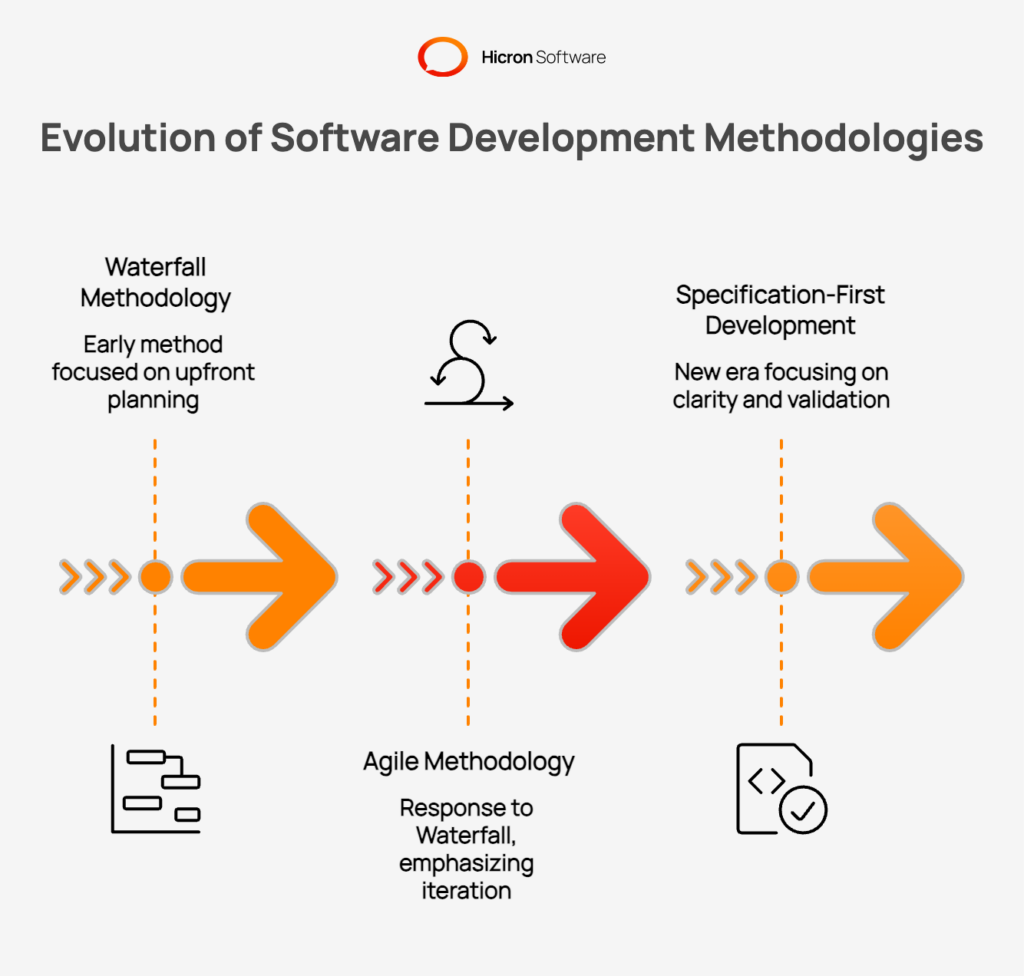
The methods we use to build software change over time. These changes happen because the primary constraints of the process change. We move to new methods when the old bottlenecks disappear.
In the early days of software engineering, coding was very expensive. Companies used the Waterfall methodology to plan everything upfront. Implementation took months or even years. Mistakes were discovered very late in the process. The failure mode of Waterfall was delayed reality validation.
Agile methodology was the response to the slow Waterfall process. Coding became cheaper over time. Teams started to iterate fast and validate continuously with the client. Agile methods absorbed the slow implementation bottleneck effectively. However, speed often created technical debt and documentation decay. Process theater replaced deep architectural thinking in many organizations.
Today, the marginal cost of code generation is collapsing. We are entering a new era of specification-first development. The new bottleneck is clarity of intent and rigorous validation. Whoever can specify precisely and constrain clearly wins twice.
AI in programming means different things at different levels. We need to define the term clearly before using it. The autonomy ladder categorizes how much independence an AI agent has.
The autonomy ladder consists of six distinct levels of AI involvement. Each level represents a different relationship between the human and the AI.
|
Level |
AI Involvement |
Human Role |
|
Level 0 |
No AI assistance. This is traditional software development. |
The human writes every line of code manually. |
|
Level 1 |
AI provides basic code completion and static analysis. |
The human reviews every line of code. |
|
Level 2 |
The AI generates software components like scaffolding and boilerplate code. |
The human controls the primary logic and architecture. |
|
Level 3 |
The human delegates a specific feature development task to the AI. |
The human reviews the module generated by the AI. |
|
Level 4 |
Autonomous agents execute complex tasks over extended periods. |
The human acts as a reviewer of completed work. |
|
Level 5 |
Fully autonomous, self evolving software agents operate. |
Minimal human intervention is required. This level is theoretical. |
There is a paradox in AI autonomy. In production environments, autonomy is purchased with rigid structure. Agent capability does not equal reliable software delivery. A powerful model can generate code easily. However, it cannot consistently execute work in a repeatable way alone.
Frameworks encode patterns we do not want to rediscover. They structure context, roles, handoffs, and review gates. Frameworks turn random prompting into repeatable technical workflows. Systems like BMad and AIUP enforce architectural decisions upfront. Good output from an AI agent always starts from good structure.
The introduction of AI agents changes the economics of software development. We have to measure cost and productivity in completely new ways.
AI models exhibit a broad spectrum of technical capabilities, performance characteristics, and cost structures. These differences mean that selecting an AI model for production is a nontrivial decision.
Total cost of ownership derives from several sources:
Model capabilities differ by size, specialization, and architecture:
Trade-offs appear in speed, transparency, privacy, and customization potential. Business objectives determine whether open-source models with full auditability or closed-source APIs with advanced features are best suited.
Understanding these factors offers a strategic advantage in the AI SDLC. It enables precise alignment between budgetary requirements, technical needs, and application scenarios, directly impacting project feasibility and total investment.
The financial cost of generating code can drop. AI tools can produce thousands of lines of code instantly. This reduces the time engineers spend on manual code writing.
Companies can build software products with smaller engineering teams. However, this shift introduces new costs related to AI context management.
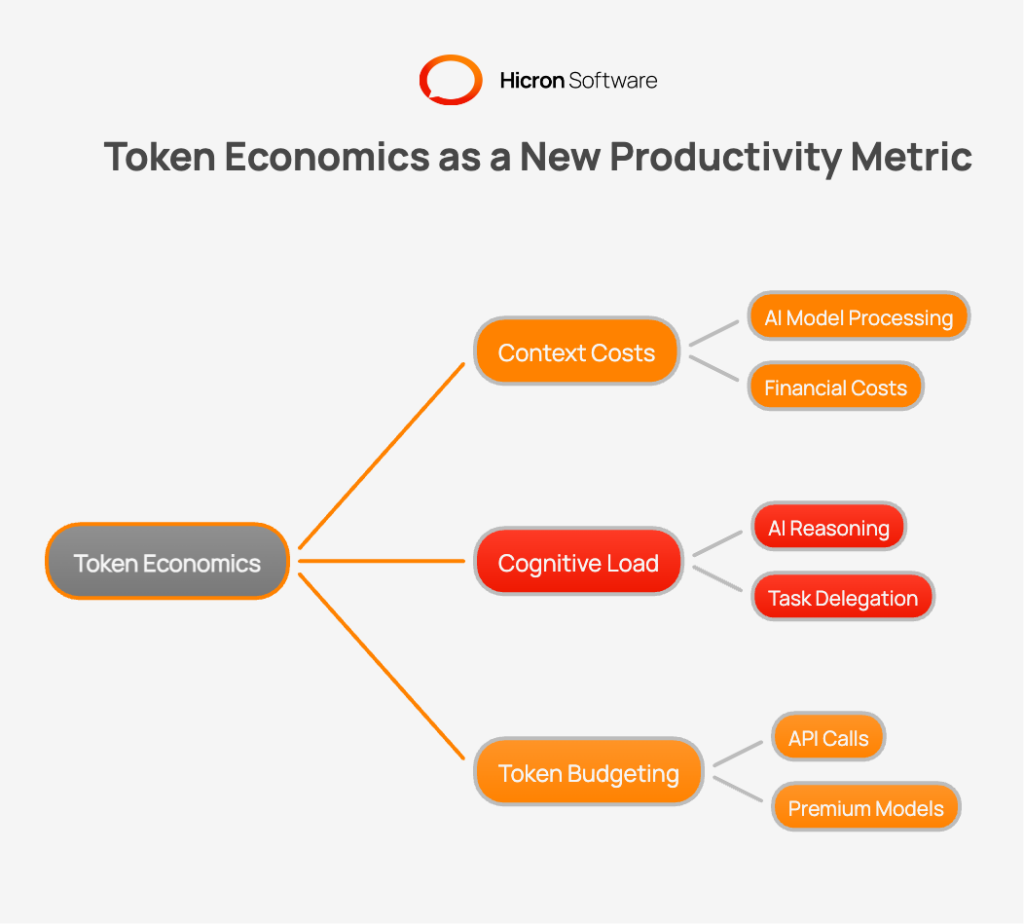
In the era of AI, context costs money. AI models process information using tokens. Sending too much context scales financial costs very quickly. Good context engineering is an economic discipline.
We can measure the cognitive load offloaded to AI. High token consumption indicates heavy use of AI reasoning. It shows how many tasks the engineer delegated to the model.
Organizations need to plan a token budget. Teams should forecast how much AI assistance they will require. They need to allocate funds for API calls and premium models.
Measuring productivity is complicated when AI writes the code. We can compare story points delivered by humans versus AI. AI can resolve an eight-point story in fifteen minutes. A human might need four days for the exact same task.
Lines of code and reviewed code serve as secondary metrics. Evaluating how much code a human reviews shows their new output. The specific method of AI usage also matters greatly. Some engineers use basic internal models for simple tasks. Others use complex auto mode setups for full application builds.
AI does not replace the need for strong engineering discipline. Instead, it exposes the absence of good engineering practices.
The human role is moving away from writing code directly. Engineers now focus on designing context and setting constraints. The hard part is validating decisions and spotting subtle mistakes.
Working with AI agents shifts effort from building to supervising. Engineers experience less coding flow and require more vigilance. A senior engineer spots AI mistakes instantly. A junior engineer often misses these subtle logical errors. AI amplifies the gap between junior and senior judgment.
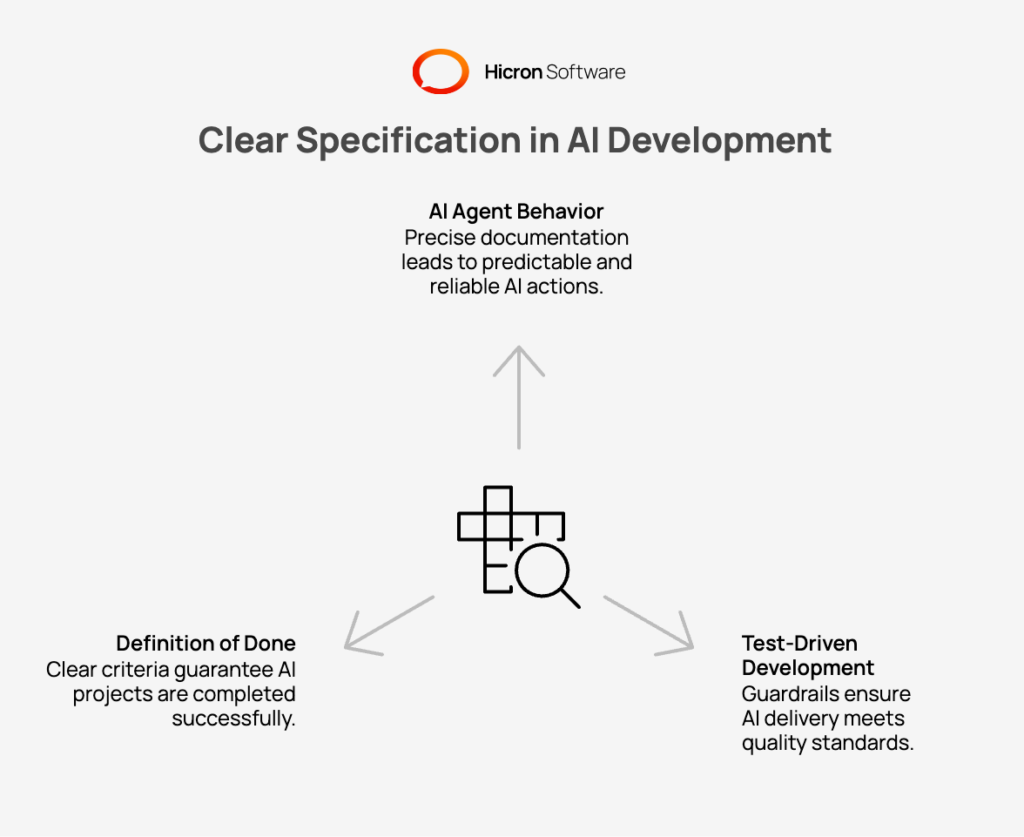
Documentation has changed its absolute role in software engineering. It is the operating interface for the AI agent. Files like architecture notes become the operating context for the model. If the documentation is vague, the agent behaves vaguely.
Clear specification is no longer overhead. When generation is cheap, precise specification becomes your biggest leverage. Test-driven development and definition of done act as guardrails. They make AI agent delivery much more reliable.
AI rewards good engineering and punishes its absence. If you have solid architecture, the AI will build upon it. If you have messy code, the AI will multiply the mess.
You need strict review gates and automated testing. These practices keep the AI model grounded in reality. Good engineering discipline ensures the AI produces maintainable software solutions.
Preparing systems for greater autonomy comes with major technical challenges. We do not recommend fully autonomous delivery for business critical work today.
AI models can generate massive amounts of code quickly. This speed can create severe technical debt if left unchecked. Engineers might accept generated code without understanding the underlying logic.
Teams must enforce strict code review policies for AI output. They should use static analysis tools to verify code quality constantly. Paying down technical debt remains a human responsibility.
Agent capability means a model can write complex functions. Reliable delivery means the software actually works in production environments. There is a massive gap between these two concepts.
Frameworks help bridge this gap by structuring the workflow. However, agentic frameworks are only months old. Traditional frameworks like Angular have over thirteen years of production history. Your AI frameworks should be chosen deliberately and carefully.
Trust and verification are essential components of AI software development. Models can hallucinate and write code that looks correct but fails. An AI might act confident while providing completely wrong logic.
Experienced engineers need to remain involved in crucial decisions. Think of today’s agents like an autopilot in a cockpit. The agent does the work, but the human pilot takes over.
The AI market moves incredibly fast. New models are released every few weeks with better reasoning capabilities. Tools like Kimi 2.6 introduce new paradigms for software generation.
Engineering teams need a process to evaluate these new models. They should test models against their specific internal codebases. Teams should measure token efficiency and logical accuracy during these tests.
The winning model today is experienced engineers amplified by structured AI. AI changes how products are built and delivered.
A company that understands autonomy designs its architecture for it. The goal is to make strong engineers significantly more effective. Prepare your products for the moment when greater autonomy becomes safe.
Adopt structured workflows and keep experienced engineers in the loop. Use AI to handle the repetitive implementation details. Focus your human talent on problem framing and architectural design.
Hicron Software proved to be a trusted partner with unmatched technical expertise, delivering a scalable and user-friendly web application that was pivotal to our successful U.S. market expansion.

Hicron’s contributions have been vital in making our product ready for commercialization. Their commitment to excellence, innovative solutions, and flexible approach were key factors in our successful collaboration.
I wholeheartedly recommend Hicron to any organization seeking a strategic long-term partnership, reliable and skilled partner for their technological needs.

After carefully evaluating suppliers, we decided to try a new approach and start working with a near-shore software house. Cooperation with Hicron Software House was something different, and it turned out to be a great success that brought added value to our company.
With HICRON’s creative ideas and fresh perspective, we reached a new level of our core platform and achieved our business goals.
Many thanks for what you did so far; we are looking forward to more in future!

Hicron is a partner who has provided excellent software development services. Their talented software engineers have a strong focus on collaboration and quality. They have helped us in achieving our goals across our cloud platforms at a good pace, without compromising on the quality of our services. Our partnership is professional and solution-focused!

The IT system supporting the work of retail outlets is the foundation of our business. The ability to optimize and adapt it to the needs of all entities in the PSA Group is of strategic importance and we consider it a step into the future. This project is a huge challenge: not only for us in terms of organization, but also for our partners – including Hicron – in terms of adapting the system to the needs and business models of PSA. Cooperation with Hicron consultants, taking into account their competences in the field of programming and processes specific to the automotive sector, gave us many reasons to be satisfied.