11 DevOps Automation Tools to Streamline Your Workflow
- May 21
- 10 min




Shifting from basic AI chatbots to advanced, autonomous AI agent ecosystems poses a challenge for software development teams. These teams frequently encounter challenges with maintaining context in prolonged projects. This complexity often leads to AI models overlooking binding project details.
This guide offers an in-depth analysis of two leading frameworks designed to solve these problems: BMad (Breakthrough Method for Agile Development or Build More Architect Dreams) and GSD (Getting Stuff Done). Drawing on expert insights and practical applications, we’ll examine the strengths, weaknesses, and adoption strategies for each framework. This will help you understand why structuring your AI-assisted software development projects with frameworks is important and how to choose the best approach for your AI development needs.
BMad (Breakthrough Method for Agile AI-Driven Development / Build More Architect Dreams) is an open-source software development framework created by Brian Madison that turns chaotic AI-assisted coding into a structured Spec-Driven Development process. Instead of using language models as simple code generators, it organizes them into specialized AI agents that handle roles such as analysis, planning, development, and review.
BMad manages the entire agile development lifecycle, from market research to final deployment. It assigns tasks to specialized virtual agents, such as an analyst, project manager, or developer, simulating a real-world team. Each agent uses its specific knowledge and communicates with others to advance the project logically. BMad resolves context retention issues by using persistent text files, which keep information organized across project sessions.
The framework provides a structured development environment where developers interact with specialized agents to define requirements. For instance, a project manager agent organizes the daily workflow, while an architect agent discusses system design choices, mimicking the operations of a real software team.
BMad also uses standard agile practices, like virtual planning meetings with the agent team. Based on user requirements, the project manager agent creates tickets that are reviewed before any code is generated, ensuring the project stays on track.
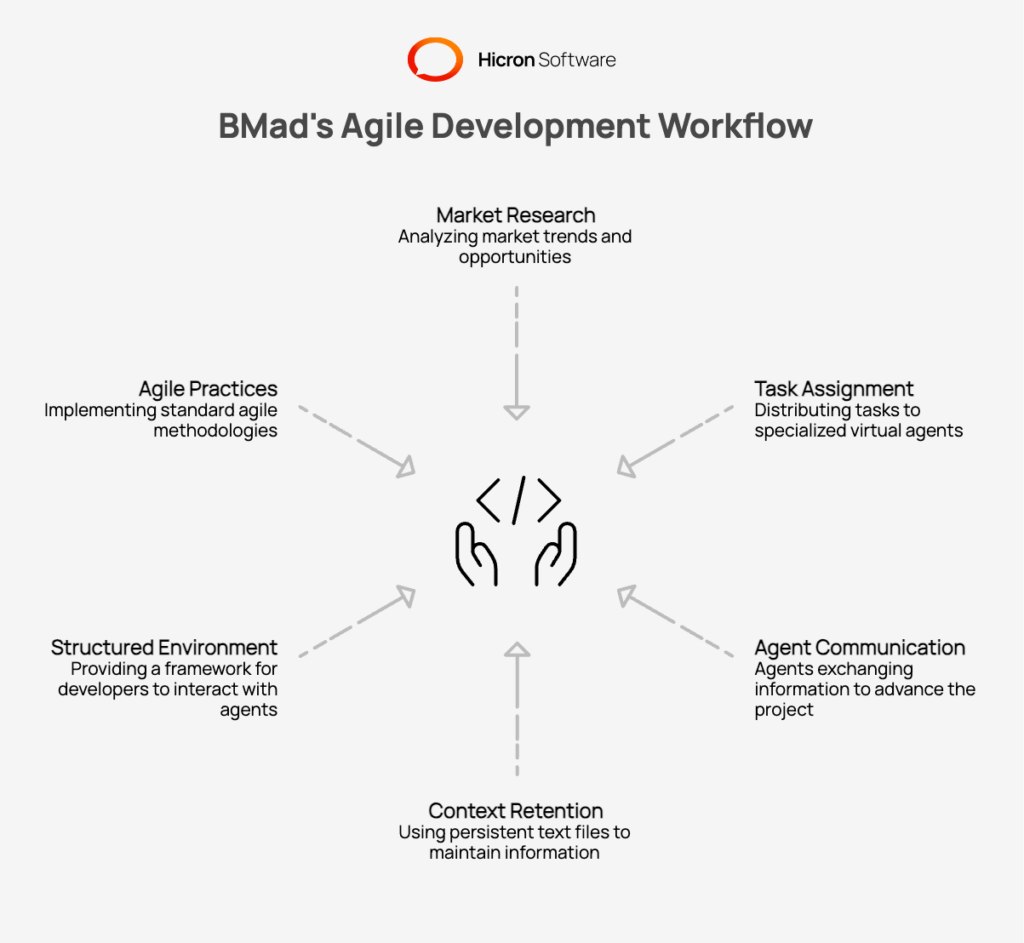
BMad helps facilitate complex projects by assigning clear roles, providing a highly structured approach to software creation. This framework addresses context retention exceptionally well, ensuring project continuity remains stable across multiple development sessions.
BMad uses text files and skills to store information and remember previous steps, preventing the model from losing crucial historical details. The framework also offers suggestions to reduce the need for constant human oversight. This allows to easily return to a project after weeks away and know exactly where you left off, making it ideal for massive, multi-phase projects.
BMad simplifies complex planning through specialized agents, such as the “architect agent,” which evaluates the technical feasibility of proposed solutions. This collaborative simulation lessens the user’s mental workload, creating the feeling of having a dedicated team’s support.
Here are the core strengths of the BMad framework:
Users often perceive BMad as a very heavy framework. Its comprehensive nature requires a steep learning curve and careful implementation to avoid over-complication. The system primarily focuses on organizational structure over pure execution and maintaining the simulated agile process creates heavy operational overhead. The framework can generate documentation that feels overwhelming.
Developers may find that the time required to learn and navigate BMad’s internal processes slows down development, especially for tasks where immediate code generation is expected. The framework’s comprehensive management is often excessive for smaller tasks, and its conversational interface can be inefficient for simple edits or minor bug fixes where faster tools fit better.
While potent, the BMad’s weaknesses are:
GSD (Get Stuff Done) is an open-source GitHub framework for Spec-Driven Development that helps AI coding agents manage complex software tasks without losing context.
It addresses “context rot” during long programming sessions by splitting work into structured, isolated cycles:
GSD operates by breaking down high-level goals into manageable, executable tasks through a hierarchical approach to agent coordination, where each agent contributes directly to the main objective. The framework functions based on explicit user commands rather than conversational interactions with named agents, allowing a single command to trigger a cascade of actions, such as code creation, unit testing, and security reviews.
This command-driven process is designed for maximum efficiency by removing conversational overhead and focusing on direct, actionable instructions. For example, a build command can initiate a set of scripts to automatically create files, write code, and run initial tests. This allows the framework to manage complex backend processes, offering a highly efficient method for application development.
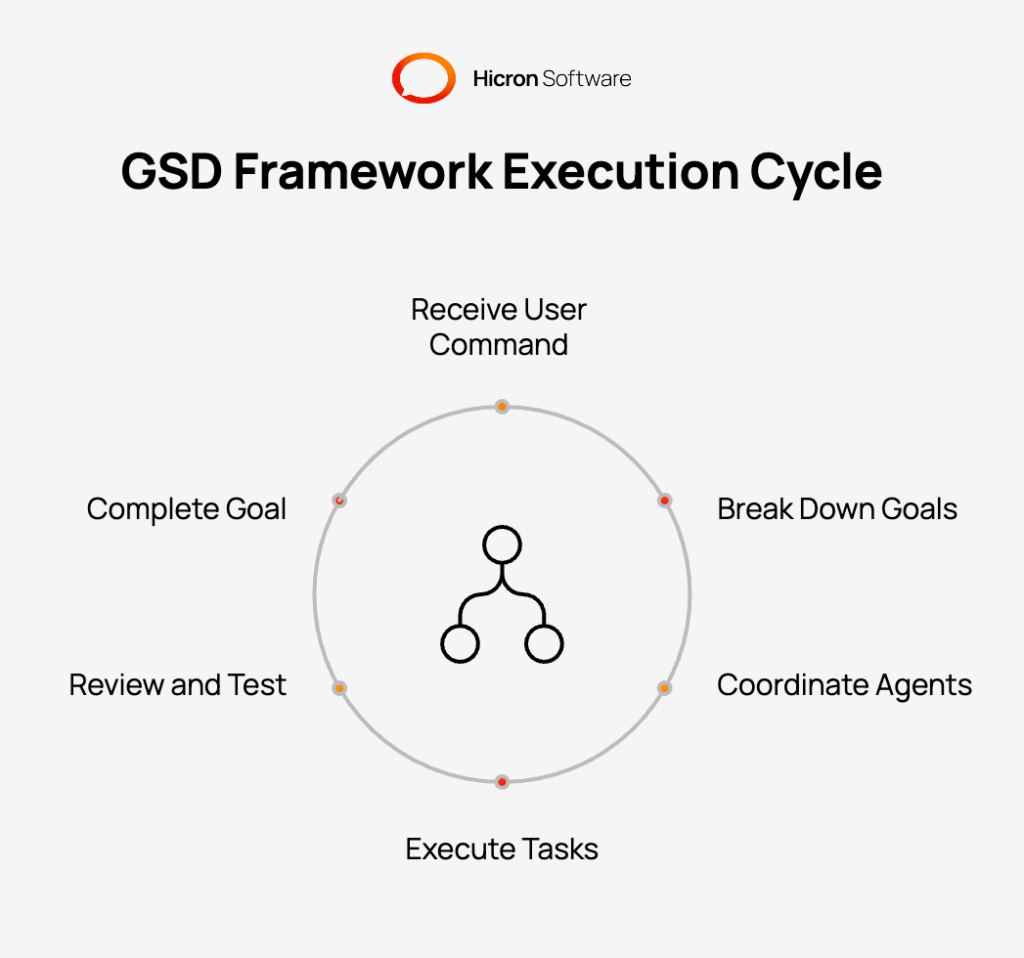
GSD is ideal for projects with clearly defined objectives, optimizing agent actions toward specific goals and adapting well to rapid iteration cycles. Features like the progress command allow developers to precisely track their work.
This framework is best suited for technical users with exact requirements who can leverage its command-driven nature for rapid execution, bypassing unnecessary dialogue. The system can take initiative based on its command structure, such as automatically suggesting a security audit. This predictability is valuable for quality assurance, as the system’s actions are transparent and reduce the variability of open-ended conversational models. The focus is on quantifiable output rather than simulated collaboration.
The primary strengths of the GSD framework include:
GSD struggles with ambiguous or rapidly changing project requirements during early phases. The framework lacks the collaborative team simulation aspect found in BMad. Users face risks of AI hallucinations without clear initial goal definitions. GSD requires a very concentrated project plan for effective technical operation. Command-driven execution leaves less room for brainstorming or architectural debate. The user needs clear technical knowledge to guide the system properly.
BMad handles complex team simulation well, whereas GSD simplifies direct command execution. The choice between these frameworks depends entirely on the specific project scope. Choose BMad if team simulation and agile lifecycle coverage matter most. Choose GSD if rapid goal-oriented task execution is the primary objective. Both frameworks require strict human oversight to ensure final code quality.
| Feature | BMad Framework | GSD Framework |
| Complexity Level | High complexity with team simulation | Medium complexity with command focus |
| Operational Scope | Full agile development lifecycle | Task-specific execution and delivery |
| Context Retention | Integrated via dedicated agent roles | Command-based session management |
| Primary Strength | Large projects with multiple phases | Clear and defined technical tasks |
| Community Trust (as of May 27, 2026) | 48,114 GitHub stars | 63,712 GitHub stars |
Testing new AI frameworks requires caution during the early adoption stage. Tools from unverified sources, or even verified ones, can introduce operational risks. Recent incidents with the GSD project highlight these software vulnerabilities. What happened? The founder deleted all social media accounts and sold related cryptocurrency assets. Following this, the developers moved the project to a new repository, get-shit-done-redux, and did a security sweep. Teams should perform comprehensive due diligence before integrating unproven software into live environments.
The launch of a crypto token alongside an open-source project can introduce security threats. If a project founder abandons the codebase, it can create financial losses for contributors. This action also leaves users with an insecure technical foundation.
Further risk exists if the original creator retains access to package manager registries. While current software versions may not show malicious activity, this presents a dangerous scenario. A creator can upload a malicious update at any time. If the software runs with extensive permissions on local machines, an update could compromise many systems. This level of access highlights the risk posed by projects without strong governance.
Language models naturally lose context during long working sessions. This poses a major challenge for modern software development. One common practice is to use persistent files to store crucial information, allowing specific agent skills to maintain project continuity over time. BMad solves this by saving the project’s state in text files.
This approach saves developers the mental fatigue of remembering every detail, especially after returning from a longer break. While regaining project context can normally take hours or even days, BMad provides a quick summary of the current state, listing completed tasks and outlining priorities to make resuming work less stressful. GSD commands can reset the AI’s memory by closing the current session and starting a fresh one, which keeps the AI focused on the immediate task. Both methods effectively manage the inherent memory limitations of language models.
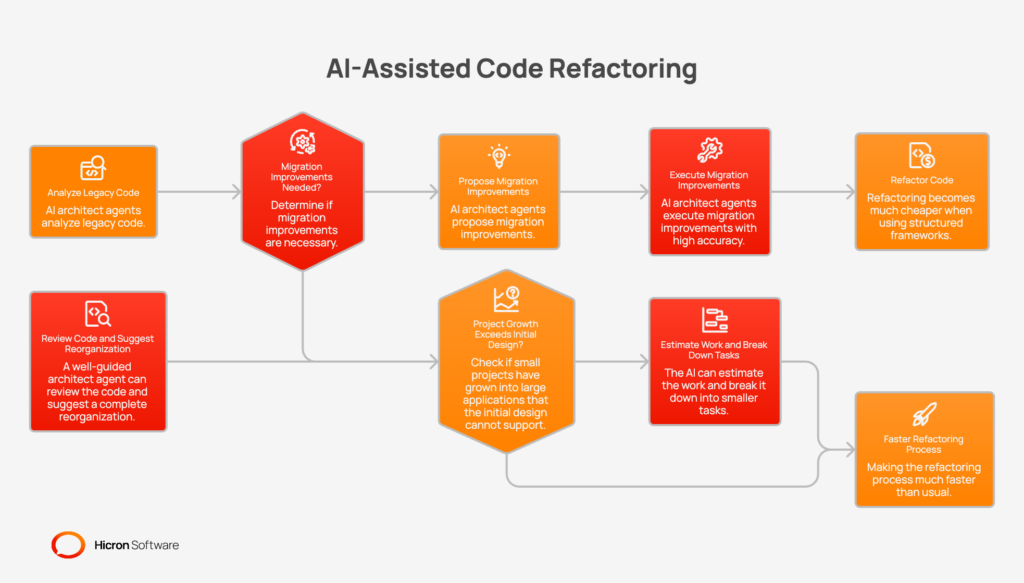
Modifying old code presents unique challenges for development teams. AI architect agents can analyze legacy code, then propose and execute migration improvements with high accuracy. Refactoring becomes much cheaper when using these structured frameworks. A well-guided architect agent can review the code and suggest a complete reorganization.
Refactoring is common because small projects often grow into large applications that the initial design cannot support.
The AI can estimate the work and break it down into smaller tasks, making the refactoring process much faster than usual.
True autonomy in software development does not exist yet in modern tools. Human oversight remains a strict requirement for all AI agent operations. AI-generated code remains economically expensive due to mandatory security reviews. QA Engineers stress that automated tools do not guarantee production-ready code. Teams need to manually review any AI-generated architecture before deployment. This requires skilled experts who can spot subtle bugs and verify the correctness of the output. Businesses bear the ultimate responsibility for the code deployed to production environments. True automation still requires a skilled professional to validate results.
Using AI agents shifts development costs from raw coding to system verification. Writing code becomes faster but reviewing that code requires highly skilled professionals. Businesses save money on initial drafting but spend resources on quality assurance. The frameworks eliminate heavy cognitive penalties associated with switching project contexts. This efficiency translates directly into better resource allocation across engineering departments.
QA Engineers transition from finding basic bugs to verifying complex AI logic. The QA role becomes more focused on security audits and architectural integrity. Automated agents write unit tests but humans evaluate the overall system quality. Testing AI outputs demands deep technical understanding. The value of human engineering skills remains high despite increased automation.
AI frameworks reduce the time spent on writing repetitive boilerplate code. They help teams bypass missing resources like dedicated UX designers during early stages. However, the need for senior developers to review code offsets some savings. Generating code is cheap, but fixing poorly architected AI code is expensive. Companies save money only when they combine AI generation with strict verification.
Professionals select AI models based on the specific phase of the software project.
This approach balances quality with computational cost and helps prevent cascading technical errors.
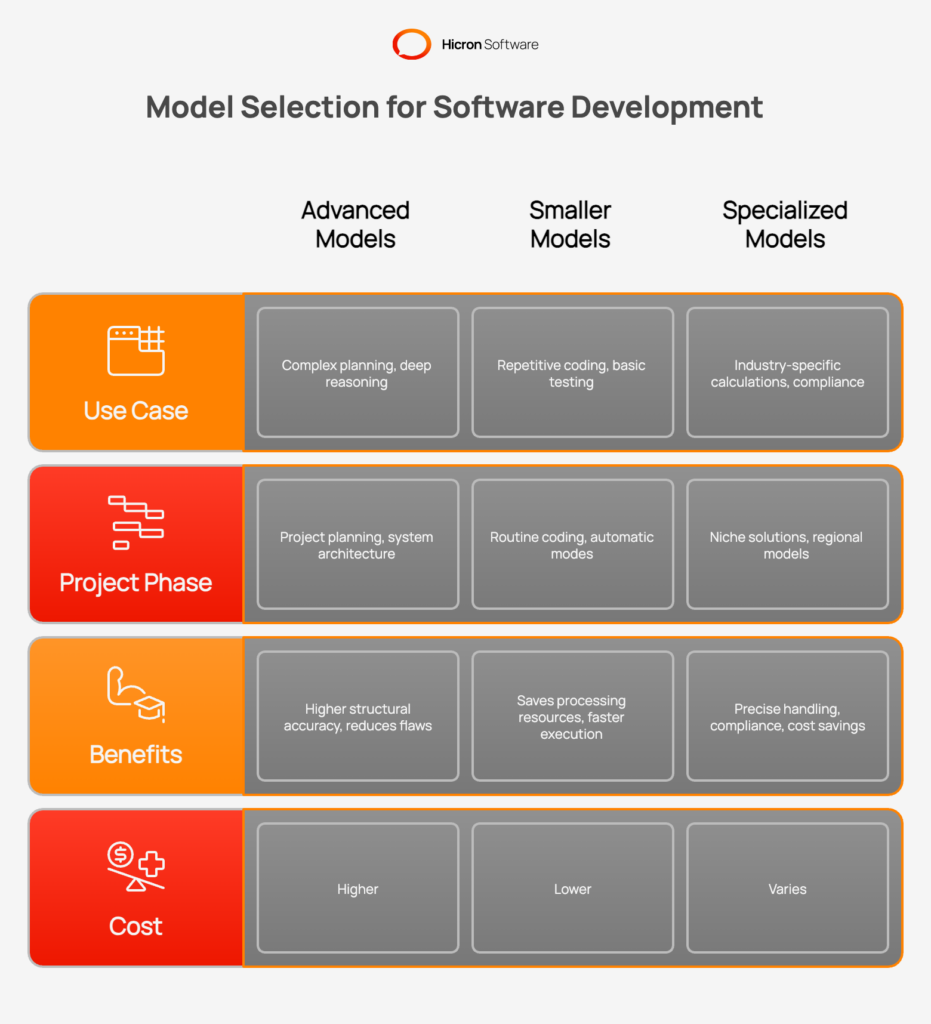
Teams choose top-tier models for project planning and system architecture design. These critical phases dictate the success of the entire software development lifecycle. Strong models reduce the chance of propagating fundamental flaws throughout the codebase. The cost of advanced models is justified by higher structural accuracy. Experts rely on the most capable models when establishing project guidelines.
Smaller models excel at executing routine coding tasks and basic test generation. Once the architecture is defined, smaller models operate well in automatic modes. The industry shows growing interest in using domain-specific lightweight models. These smaller models run faster and consume fewer financial resources during execution. Teams optimize their budgets by restricting advanced models to planning phases only.
The market is shifting from general-purpose AI models toward more specialized, niche solutions. For instance, the development of finance-specific models enables more precise handling of industry calculations and compliance with regulations. In a similar vein, smaller, regional models are becoming more popular worldwide.
Asian models like Kimi and DeepSeek offer competitive performance, often requiring less infrastructure and money. It’s worth evaluating these alternatives for your specific workflows. Different projects require different levels of computational power. Exploring specialized models can save companies a lot of money.
Use advanced models for initial planning and architecture phases. Highly logical models prevent cascading errors in the foundation. Switch to smaller models for routine coding execution. This approach saves money while maintaining high-quality output. The quality assurance expert recommends strong initial definitions.
A clear plan reduces the chance of model hallucinations. The project manager expert advises using auto modes for standard tasks. Align your tool choice with the specific phase of development. A heavy planning phase benefits from the BMad framework. A rapid prototyping phase might benefit more from GSD.
Pilot GSD for discrete technical tasks in your organization. It works well for specific command-based automation. Test BMad for broader project management initiatives. See which framework fits your team communication style better. Evaluate the results based on actual time saved.
Don’t assume one tool fits every scenario. Learning these frameworks requires hands-on practice and experimentation; reading about them isn’t enough to understand their potential. To truly grasp the mechanics, you need to build something. Start with a small internal tool to minimize business risk.
Make manual code reviews mandatory for your entire team. Security checks are essential before deploying any generated architecture. These frameworks will make mistakes during development, so a qualified professional is still needed to take responsibility for the final release. Focus on the quality of the output, not the speed of code generation.
The quality assurance engineer focuses on whether the application functions. The project manager focuses on maintaining the structural integrity. Both roles require active human participation to ensure quality. Never deploy generated code directly to production without testing.
Hicron Software proved to be a trusted partner with unmatched technical expertise, delivering a scalable and user-friendly web application that was pivotal to our successful U.S. market expansion.

Hicron’s contributions have been vital in making our product ready for commercialization. Their commitment to excellence, innovative solutions, and flexible approach were key factors in our successful collaboration.
I wholeheartedly recommend Hicron to any organization seeking a strategic long-term partnership, reliable and skilled partner for their technological needs.

After carefully evaluating suppliers, we decided to try a new approach and start working with a near-shore software house. Cooperation with Hicron Software House was something different, and it turned out to be a great success that brought added value to our company.
With HICRON’s creative ideas and fresh perspective, we reached a new level of our core platform and achieved our business goals.
Many thanks for what you did so far; we are looking forward to more in future!

Hicron is a partner who has provided excellent software development services. Their talented software engineers have a strong focus on collaboration and quality. They have helped us in achieving our goals across our cloud platforms at a good pace, without compromising on the quality of our services. Our partnership is professional and solution-focused!

The IT system supporting the work of retail outlets is the foundation of our business. The ability to optimize and adapt it to the needs of all entities in the PSA Group is of strategic importance and we consider it a step into the future. This project is a huge challenge: not only for us in terms of organization, but also for our partners – including Hicron – in terms of adapting the system to the needs and business models of PSA. Cooperation with Hicron consultants, taking into account their competences in the field of programming and processes specific to the automotive sector, gave us many reasons to be satisfied.