How do Agile and DevOps Interrelate?
- January 16
- 9 min



Scope creep is the uncontrolled expansion of a project’s requirements without matching adjustments to time, budget, or resources, and it ranks among the leading causes of blown deadlines, cost overruns, and outright project failure. In this article, we will explore exactly what scope creep is, why it happens, and actionable strategies to prevent it. Whether you are a seasoned project management professional or new to the field, understanding how to control the scope of a project is essential for delivering a successful project.
Scope creep in project management refers to the uncontrolled expansion of a project’s scope without adjustments to time, cost, or resources. It typically happens when new requirements are added after the project has started, bypassing the formal approval process. While project stakeholders might see these additions as necessary improvements, for the project team, they often represent unpaid work and unmanageable pressure. If left unchecked, scope creep occurs so frequently that it becomes the norm, leading to missed deadlines and blown budgets.
What best describes scope creep? Scope creep means a project keeps growing with extra requests or tasks, but the time, budget, and team resources do not grow with it.
The impact of scope creep dilutes the focus of the original project scope, forcing the team to spread their efforts thin across too many tasks. This often results in lower quality deliverables and high stress. According to the Project Management Institute, scope creep is one of the leading causes of project failure. Understanding that scope creep is a risk in every initiative is the first step toward mitigation. You must define boundaries early, or the project will inevitably drift away from the project scope.
When you manage scope creep, you protect the integrity of the project plan. It is not about saying “no” to everything; it is about ensuring that every scope change is deliberate, documented, and approved. A project management professional knows that maintaining the defined scope is crucial for keeping the project on time and within the project budget.
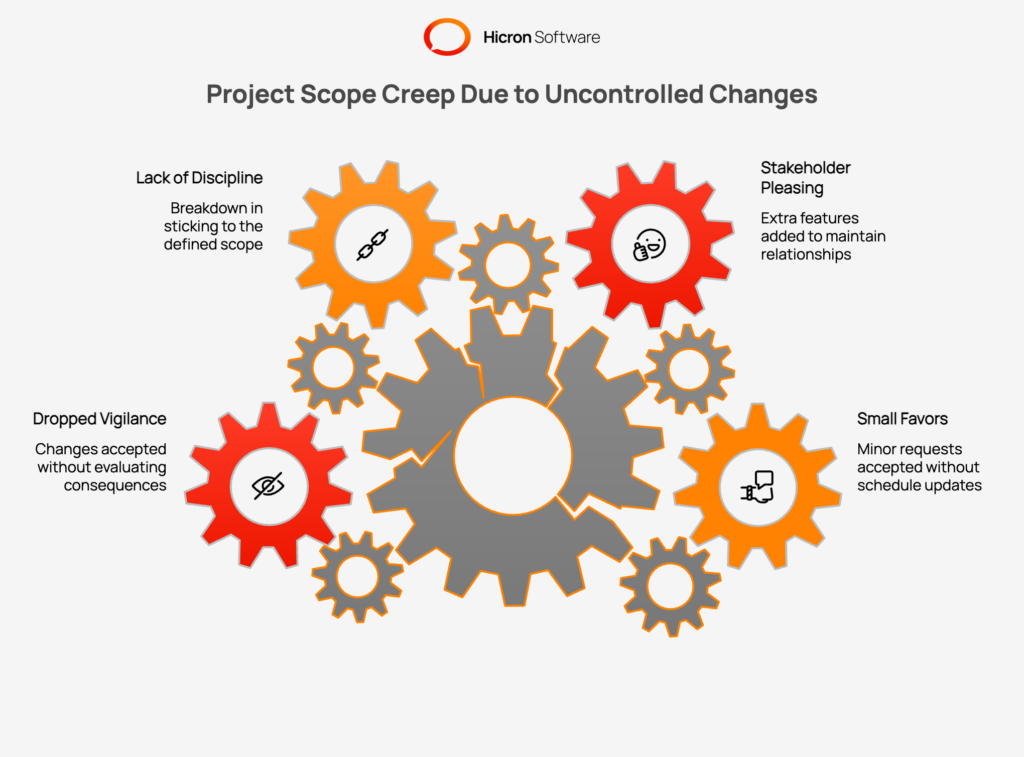
Project scope creep often begins innocently. It might start during a casual conversation between a client and the project manager, where a “small favor” is requested. Because the request seems minor, it is accepted without updating the project schedule or assessing the impact on the project timeline. However, scope creep can happen at any stage, from the initial planning phase to the final weeks of execution. It is rarely a single event but rather a gradual accumulation of unauthorized changes.
This phenomenon is often fueled by a desire to please stakeholders. A project manager might agree to extra features to maintain a good relationship, not realizing that these additions lead to scope creep. Once the door is opened to informal changes, project team members may struggle to push back on future requests. Scope creep occurs when the discipline to stick to the scope of work breaks down.
To understand how does project scope creep occur, look at the gap between the original scope and the current reality. If the project deliverables have expanded but the deadline hasn’t moved, you have experienced scope creep. It is vital to monitor the project constantly. Scope creep happens when vigilance drops, and the team begins to accept changes to the project without evaluating their consequences.
There are several common causes of scope creep that plague projects across all industries. One of the most frequent offenders is poor communication. When the project goals are not clearly articulated, stakeholders may have different interpretations of what the project success looks like. This misalignment creates a vacuum that is quickly filled with new, often conflicting, requirements. Scope creep is a risk whenever assumptions are made rather than verified.
Another cause of scope creep is direct access between stakeholders and the technical team. If a project sponsor or client can bypass the project manager and ask developers or designers for changes directly, the management plan falls apart. These “side door” requests act as a hidden cause of scope creep, as they are rarely tracked or accounted for in the project budget.
Additionally, gold plating, where project team members add features they think are cool but weren’t requested, can lead to scope creep. While the intention is to deliver extra value, it consumes resources allocated for the defined project scope. Identifying the reasons why scope creep occurs allows you to build defenses against them, ensuring that the overall project remains focused on its primary objectives.
Ambiguity is the enemy of a successful project. When you fail to define the project scope with precision, you invite interpretation. A vague project scope statement allows stakeholders to believe that their new requests were “implied” in the original agreement. This is why a lack of clarity is a primary cause of scope creep. If the requirements are not specific, measurable, and agreed upon, scope creep in your projects becomes almost inevitable.
To prevent scope creep, you should invest time in the requirements gathering phase. Scope or requirements that are “high-level” are insufficient for execution. You need a clear scope with effective requirements elicitation. This involves asking the “Why?” and “What if?” questions from the Berger framework mentioned earlier. By drilling down into the specifics, you can establish a scope statement that acts as a concrete boundary for the work.
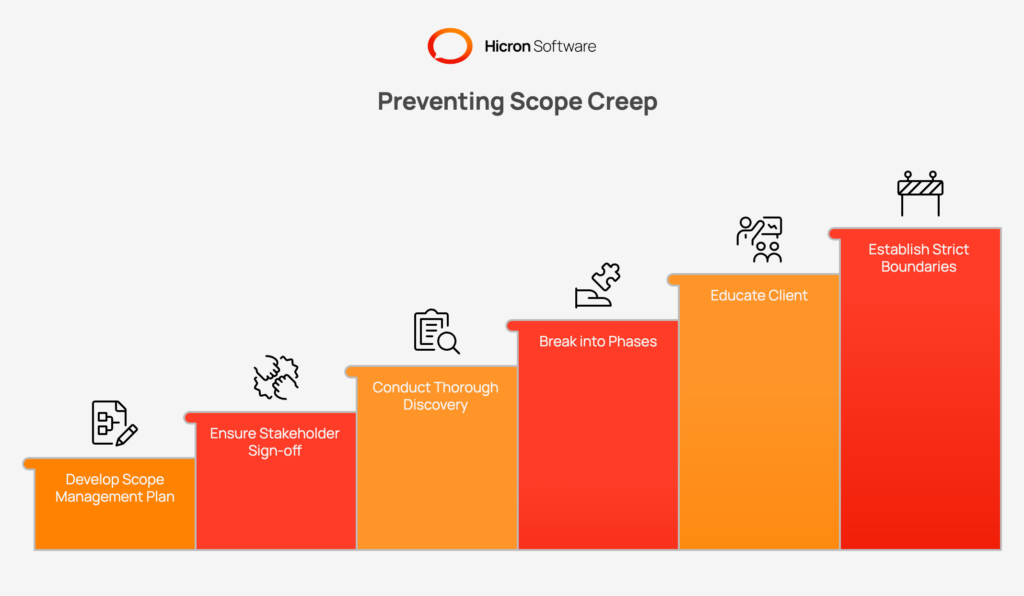
Without a solid foundation, the project scope and scope creep become difficult to distinguish. Stakeholders will argue that a new feature is part of the original project. To eliminate scope creep, or at least minimize it, every deliverable must be documented. A detailed scope management plan ensures that everyone agrees on what is in and what is out before the project begins.
A scope management plan is the document or framework that defines how your project scope will be set, approved, monitored, and changed. It is your reference point for what is in the project, what is out, and how any adjustments get handled, which makes it one of your strongest defenses against scope creep.
A detailed plan usually covers:
In practice, it looks like a structured document or a clearly sectioned part of your project plan, with headings, defined boundaries, and step-by-step procedures. Some teams keep it formal and detailed, while others use a lean version inside their project management tool. Either way, the goal is the same: everyone knows the rules before the work begins.
If you are building one for the first time, start with your deliverables and boundaries, then add your change control process.
Let’s look at a concrete example of scope creep. Imagine a team building a simple e-commerce website. The project requirements specify a standard checkout process. Halfway through, the client asks to add a “Buy Now, Pay Later” option. It seems like a small addition. However, this scope change requires new API integrations, legal compliance checks, and UI redesigns. The project manager accepts it without adjusting the deadline. This single change ripples through the project plan. The developers have to pause their current work, causing project delays. The testing team now has a complex new feature to validate. This impact of scope creep isn’t just about the extra hours; it disrupts the flow and focus of the project team. The project risk increases because the timeline is now compressed.
Soon, seeing that one change was accepted, the client asks for a loyalty program integration. This is how scope creep include multiple small additions that eventually wreck the project schedule. The original project scope is lost under layers of new requests. This example of scope creep illustrates why it is vital to handle scope creep immediately and formally, rather than letting it accumulate.
The best way to manage scope creep is to stop it before it starts. This requires a robust scope management plan developed during the initiation phase. You must ensure that the project scope statement is comprehensive and signed off by all key project stakeholders. This document should serve as the single source of truth for the project deliverables.
To prevent scope creep, engaging in thorough discovery is essential. Use frameworks like Berger’s “Why / What if / How” to challenge assumptions. Ensure that the project objective is tied to business value, not just a wishlist of features. When the project scope and long project timelines are involved, break the work into smaller, manageable phases. This reduces the uncertainty that often creates scope creep.
Educate your client. Explain that changes to scope are possible but expensive. Set expectations that the defined scope is locked in for the current phase. By establishing strict boundaries early, you reduce the likelihood that scope creep can happen. A project management professional knows that the battle against scope creep is largely won or lost in the planning stage.
Once execution starts, ways to avoid drift involve constant vigilance. You must monitor the project against the scope statement and a work breakdown structure (WBS). Regular check-ins and demos keep stakeholders aligned with the actual progress, reducing the gap between expectation and reality. If you avoid scope creep effectively, you do so by maintaining transparency.
One of the most effective project management practices is to implement a “zero tolerance” policy for informal changes. Every request must go through a formal review. This doesn’t mean you can’t be flexible, but it ensures that changes to the project are conscious business decisions. You keep scope creep at bay by forcing a trade-off: “If we add this, what are we removing to keep the project on time?”
Empower your project team. They are often the first to notice when work is drifting away from the project scope. Encourage them to flag tasks that weren’t in the project requirements. Collaborative vigilance is one of the strongest ways to avoid the slow erosion of project boundaries.
Modern project management software is an ally in the fight against project scope creep. Tools like Jira, Asana, or Monday.com allow you to document the scope of a work explicitly. By creating tickets for every requirement, you create a visual boundary. If a task isn’t in the software, it isn’t in the project. This visibility helps manage scope creep by making unauthorized work immediately obvious.
These tools also help track project change. When a new requirement is introduced, it can be logged as a “change request” rather than just being slipped into the backlog.
This creates an audit trail. You can show stakeholders exactly how many new requests have been made and how they impact the project timeline. Project management software provides the data needed to push back against scope creep.
Using software to visualize dependencies helps stakeholders understand the risk of scope creep. If they see that adding a feature pushes the launch date back by two weeks, they might reconsider. Transparency provided by project management software turns abstract warnings into concrete reality, helping to prevent scope creep.
You cannot eliminate scope creep entirely, but you can control it with a formal change management process. This is the mechanism by which scope change is introduced, evaluated, and approved. Without it, creep and how to avoid it becomes a chaotic struggle of wills. A formal process depersonalizes the rejection of new ideas. It’s not the project manager saying “no”; it’s the process requiring justification.
A good change management process requires an analysis of the impact on project cost, time, and risk. When a stakeholder requests a change, they must complete a form detailing the value of the addition. The project team then estimates the effort. This rigor often discourages frivolous requests that cause scope creep. It ensures that only high-value changes alter the project scope. According to the Project Management Body of Knowledge (PMBOK), integrated change control is a core component of project governance. It protects the project baseline. By managing scope creep in project environments through formal channels, you ensure that the project plan remains a reliable roadmap rather than a suggestion.
To eliminate scope creep, or strictly control it, a project manager should act as a guardian of the vision. You should be comfortable having difficult conversations. When scope creep occurs, you should address it immediately. Ignoring it in hopes that the team can “catch up” is a recipe for project failure.
Success requires a balance of rigidity and flexibility. Handling scope creep happens by being rigid about the process but flexible about the content, provided strictly that trade-offs are made. If a new feature is critical, something else from the original project scope must go. This is how you deliver a successful project despite evolving needs. Managing scope creep is ultimately about managing expectations.
Finally, always return to the “Why.” If a new request doesn’t serve the primary project objective, it is a distraction. By strictly enforcing scope boundaries and focusing on value, you protect your team and your reputation. Scope creep is a risk that never goes away, but with the right mindset, team, and tools, it can be tamed. Contact us to set your IT project back on track.
Key takeaways:
Scope creep is usually bad. It adds work to a project without matching increases in time, budget, or resources, which strains your team and puts deadlines and quality at risk.
It can be beneficial only in limited cases, specifically when the added work creates clear business or customer value and the project plan is formally reviewed, approved, and adjusted to support it. In those situations, the change strengthens the outcome instead of quietly draining your resources.
The key difference comes down to control. Uncontrolled scope creep slips in informally and erodes your plan. A managed scope change is intentional, documented, and resourced. So when a valuable new requirement appears, route it through your change process rather than absorbing it on the fly.
These three terms describe different ways a project can grow beyond its original plan, and the distinction matters for your timeline, budget, and governance.
Scope creep is the uncontrolled expansion of a project’s requirements without matching adjustments to time, budget, or resources. It slips in informally, often through small requests that never get reviewed or approved.
Scope change is the opposite of creep in terms of control. It is a formal modification to the original plan that has been reviewed, approved, and resourced. The work still grows, but the timeline and budget are adjusted to support it.
Gold plating happens when your team adds extra features or polish that nobody requested. The intent is usually good, but it consumes time and budget meant for the agreed deliverables.
The key difference comes down to control and authorization. Scope change is deliberate and governed, scope creep is unauthorized and unmanaged, and gold plating is well-meaning but unrequested. Route every new request through your change process so growth stays intentional rather than accidental.
Hicron Software proved to be a trusted partner with unmatched technical expertise, delivering a scalable and user-friendly web application that was pivotal to our successful U.S. market expansion.

Hicron’s contributions have been vital in making our product ready for commercialization. Their commitment to excellence, innovative solutions, and flexible approach were key factors in our successful collaboration.
I wholeheartedly recommend Hicron to any organization seeking a strategic long-term partnership, reliable and skilled partner for their technological needs.

After carefully evaluating suppliers, we decided to try a new approach and start working with a near-shore software house. Cooperation with Hicron Software House was something different, and it turned out to be a great success that brought added value to our company.
With HICRON’s creative ideas and fresh perspective, we reached a new level of our core platform and achieved our business goals.
Many thanks for what you did so far; we are looking forward to more in future!

Hicron is a partner who has provided excellent software development services. Their talented software engineers have a strong focus on collaboration and quality. They have helped us in achieving our goals across our cloud platforms at a good pace, without compromising on the quality of our services. Our partnership is professional and solution-focused!

The IT system supporting the work of retail outlets is the foundation of our business. The ability to optimize and adapt it to the needs of all entities in the PSA Group is of strategic importance and we consider it a step into the future. This project is a huge challenge: not only for us in terms of organization, but also for our partners – including Hicron – in terms of adapting the system to the needs and business models of PSA. Cooperation with Hicron consultants, taking into account their competences in the field of programming and processes specific to the automotive sector, gave us many reasons to be satisfied.