11 DevOps Automation Tools to Streamline Your Workflow
- May 21
- 10 min



Scope creep is the uncontrolled expansion of a project’s requirements after it has already started. This includes new features, last-minute changes, and shifting priorities, all without adjusting the project’s timeline, budget, or resources. This gradual expansion can undermine even the most well-planned projects, turning promising initiatives into sources of frustration and failure.
This article explains what scope creep is and how you can prevent it by using a simple but powerful communication model: the Berger framework. By structuring conversations around three core question, Why?, What if?, and How?, teams can establish clear goals, build a shared vision, and create a realistic plan that protects projects from uncontrolled changes. You will learn to transform your project discussions from a list of demands into a collaborative search for value, creating a solid defense against project derailment.
Key Takeaways:
When a project’s scope is not well-defined or managed, it becomes vulnerable to changes. A client might ask for “just one more feature,” or a team member might add a “nice-to-have” function. Individually, these requests seem small. But together, they add up. The project’s timeline gets longer, costs go up, and the team becomes overworked and demotivated.
The results are often predictable:
More importantly, scope creep can erode trust between clients and delivery teams, leading to frustration and damaged relationships. Preventing scope creep of IT project is about ensuring its success from start to finish.
Understanding the sources of scope creep is the first step toward preventing it. While every project is different, the underlying causes are often similar.
Recognizing these patterns allows teams to address them proactively rather than reacting to problems as they arise.
The Berger framework provides a structured approach to communication that helps prevent scope creep before it starts. Developed from the idea of “a more beautiful question,” it centers on a sequence of inquiries designed to build deep understanding and alignment. The framework moves conversations from abstract ideas to concrete actions, ensuring everyone involved shares the same perspective.
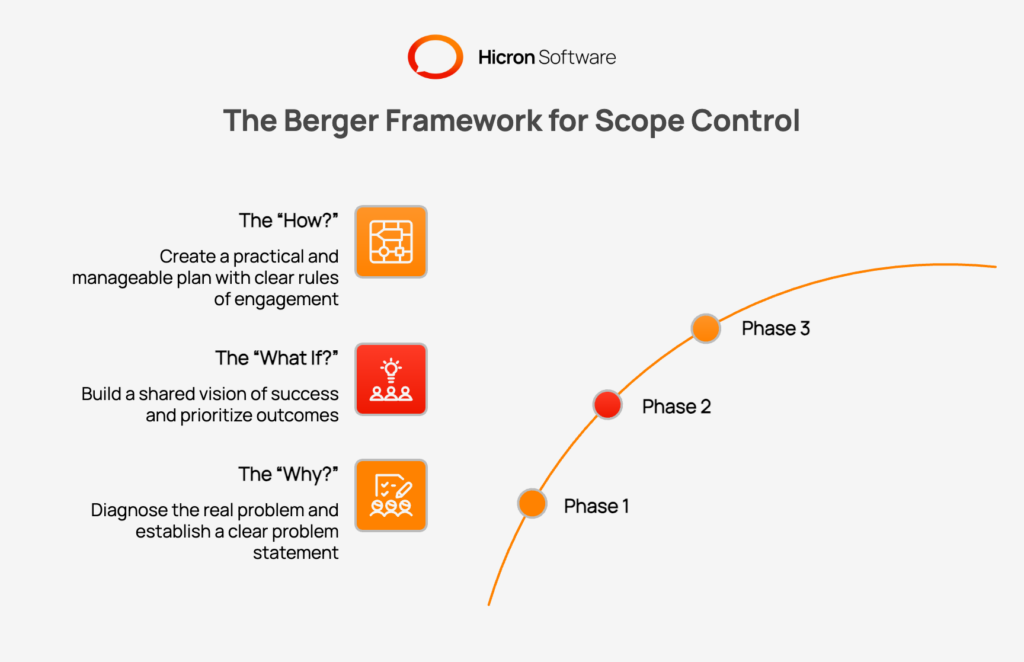
The root of most scope creep is a poorly defined problem. When a team doesn’t fully understand why they are building something, it’s easy for new, unrelated ideas to find their way into the project. The first phase of the framework tackles this directly by using diagnostic questions. These questions help everyone involved move beyond surface-level requests to uncover the true business context and strategic goals.
Instead of asking “What do you want?”, you should ask questions that uncover the underlying need:
These questions force a deeper look into the business context. The goal is to move beyond surface-level requests and identify the core pain points and strategic goals. This process establishes a clear problem statement and defines what is truly important. It also provides the first line of defense against scope creep by creating a clear standard against which all future requests can be measured. If a new idea doesn’t help solve the core problem, it’s easier to say “no” or “not now.”
A project without a strong “why” is like a ship without a rudder. It may move forward, but its direction is susceptible to every passing current. By anchoring the project in a clear and agreed-upon purpose, you give it the stability needed to stay on course.
Once the problem is clear, the next step is to build a shared vision for the solution. Scope creep often happens when a project is defined by a long list of features rather than a desired outcome. The “What if?” phase shifts the focus from a technical checklist to the achievement of business value. This is where you and your stakeholders can dream a little, exploring the realm of possibility without immediately committing to a specific solution.
Use hypothetical questions to explore possibilities and align on the business impact:
These questions help clients and teams think about the end result. They connect technical solutions to measurable business outcomes, like increased revenue, lower costs, or better customer satisfaction. By defining success in terms of value, you create a framework for prioritizing work. Instead of asking “Should we add this feature?”, the team can ask, “Does this feature help us achieve our vision faster?”
This phase is not about creating an endless wishlist. It’s about prioritizing outcomes. A useful tool here is an impact-effort matrix, where potential ideas are plotted based on the value they deliver versus the work required to implement them. This visual aid helps stakeholders see which initiatives offer the best return on investment, making it much harder for low-value requests to creep into the project scope.
With a clear problem and a shared vision, the final step is to translate it all into an actionable plan. This is where many projects fail, as a grand vision can quickly become overwhelming. The “How?” phase grounds the project in reality by breaking it down into manageable steps and establishing clear rules of engagement. It’s about building a bridge from the desired future state to the present reality.
This phase is about planning and de-risking the project by asking practical questions:
Answering these questions creates a concrete plan. It defines the initial scope (the MVP), sets clear success metrics, and establishes a formal process for managing changes. This change control process is critical. It ensures that every new request is evaluated for its impact on the project’s timeline, budget, and quality before a decision is made.
A formal change request process typically involves a document or ticket where the requester outlines the change, its business justification, and its expected benefits. The project team then analyzes the request to determine the effort required and its potential impact on other parts of the project. This analysis is presented to decision-makers, who can then make an informed choice. It forces a conscious trade-off: if something new is added, what will be delayed or removed to make room for it? This discipline closes the door on uncontrolled scope expansion.
Scope creep is a common challenge, but it is not inevitable. By applying the Berger framework, teams can move from a reactive mode of fighting fires to a proactive one of building firebreaks. Starting with “Why?” ensures that everyone understands the core mission and is working toward the same goal. Asking “What if?” aligns the team and client around a shared vision of value, moving the conversation beyond a simple checklist of features. Finally, figuring out “How?” creates a practical, disciplined plan for execution that includes guardrails for managing change.
This structured approach to communication builds clarity and trust, creating a strong foundation that can withstand the pressures that often lead to project failure. It transforms the project dynamic from a simple transaction to a collaborative partnership, where all parties are invested in delivering real business value on time and on budget. Contact us o set your project back on track.
By defining the core problem or “Why,” you establish a clear purpose for the project. This purpose acts as a filter, helping the team evaluate new requests. If a new request does not directly support the original “Why,” it can be easily identified as out of scope or deferred for a future phase.
Yes, change is often necessary and even beneficial. The goal is not to prevent all changes but to manage them effectively. A good project plan includes a formal change control process to assess the impact of new requests on the budget, timeline, and quality before they are approved, ensuring that all changes are deliberate and add value.
An MVP, or Minimum Viable Product, is a version of a new product with just enough features to be usable by early customers and provide value. Focusing on an MVP is an effective strategy against scope creep because it forces the team to prioritize the most essential functions and deliver that value quickly, deferring less critical features for later versions.
Preventing scope creep is a shared responsibility. The project manager is responsible for establishing and enforcing the change control process. The client or product owner is responsible for prioritizing requests based on business value. The entire project team is responsible for maintaining focus on the agreed-upon scope and raising concerns when new requests threaten the project’s stability.
Hicron Software proved to be a trusted partner with unmatched technical expertise, delivering a scalable and user-friendly web application that was pivotal to our successful U.S. market expansion.

Hicron’s contributions have been vital in making our product ready for commercialization. Their commitment to excellence, innovative solutions, and flexible approach were key factors in our successful collaboration.
I wholeheartedly recommend Hicron to any organization seeking a strategic long-term partnership, reliable and skilled partner for their technological needs.
After carefully evaluating suppliers, we decided to try a new approach and start working with a near-shore software house. Cooperation with Hicron Software House was something different, and it turned out to be a great success that brought added value to our company.
With HICRON’s creative ideas and fresh perspective, we reached a new level of our core platform and achieved our business goals.
Many thanks for what you did so far; we are looking forward to more in future!

Hicron is a partner who has provided excellent software development services. Their talented software engineers have a strong focus on collaboration and quality. They have helped us in achieving our goals across our cloud platforms at a good pace, without compromising on the quality of our services. Our partnership is professional and solution-focused!

The IT system supporting the work of retail outlets is the foundation of our business. The ability to optimize and adapt it to the needs of all entities in the PSA Group is of strategic importance and we consider it a step into the future. This project is a huge challenge: not only for us in terms of organization, but also for our partners – including Hicron – in terms of adapting the system to the needs and business models of PSA. Cooperation with Hicron consultants, taking into account their competences in the field of programming and processes specific to the automotive sector, gave us many reasons to be satisfied.