How RAG Architecture Changed: From PDF Chatbots to Context Engineering
- July 03
- 14 min



AI is moving the software development life cycle (SDLC) from manual coding to spec-first, agentic workflows. As the marginal cost of code generation drops toward zero, the main bottleneck shifts from implementation to problem framing. Software engineers and software teams must now focus on precise specification, context design, and rigorous validation.
Software engineering methods have always evolved around one central question: Where is the bottleneck? Teams do not abandon one methodology for another because earlier ideas were entirely wrong. They change because the economics of building software change.
That is exactly what is happening now.
Artificial intelligence is not just speeding up development. It is redefining how applications are planned, built, and maintained. The SDLC is moving away from manual typing, syntax correction, and repetitive implementation work. In its place, a new model is emerging. Engineers delegate complex tasks to AI systems that can generate, test, and refine code at scale.
Tools like GitHub Copilot, Claude Code, and Cursor are already changing daily development work. For software professionals, this transition is no longer theoretical. It is operational. And for companies evaluating bespoke software development partners, understanding this shift is now essential.
To understand where the SDLC is going, it helps to understand what earlier models optimized for.
Historically, software development methodologies tried to balance two forces:
Major methodology, like Waterfall or Agile, was a response to the dominant constraint of its era.
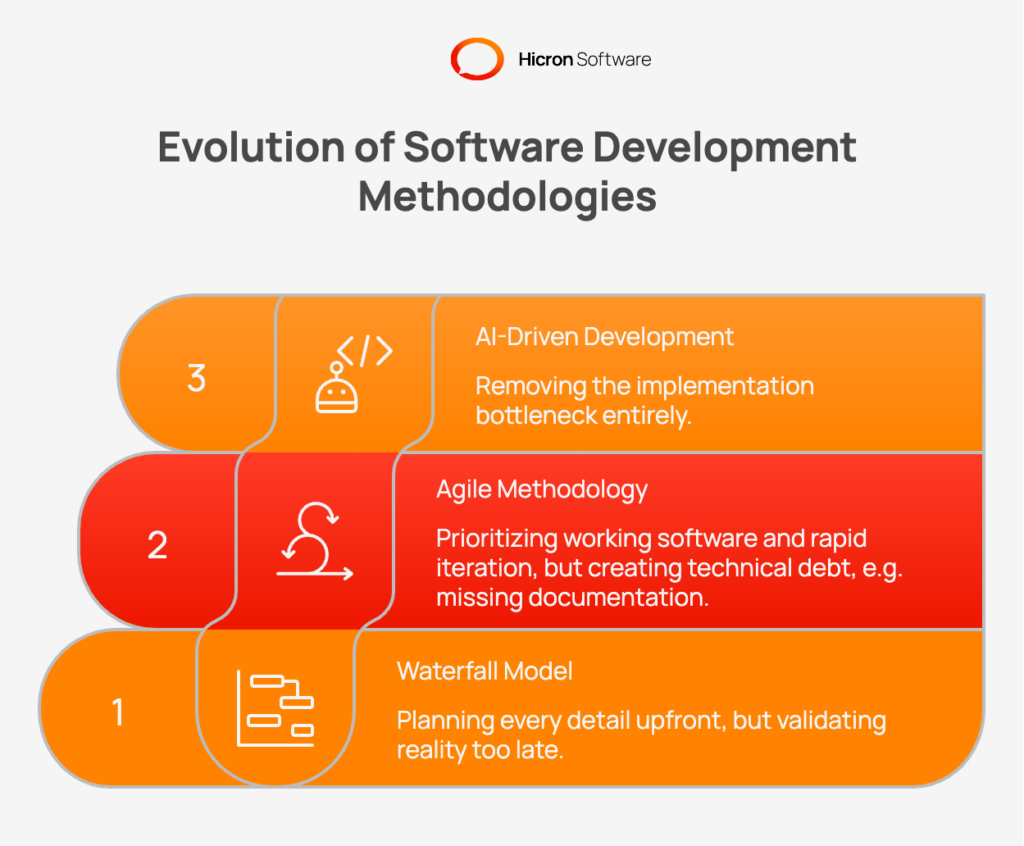
The Waterfall model was a rational response to a world where writing software was painfully expensive.
From the 1960s through the early 2000s, implementation costs were high. Writing, testing, and compiling code could take months or years. In that environment, it made sense to plan everything upfront, document requirements in detail, and release infrequently.
Waterfall did not fail because planning was foolish. It failed because reality check arrived too late.
Teams spent enormous amounts of time producing detailed requirements and documentation, only to discover, often at launch, that the market had shifted, user needs had changed, or the original assumptions were wrong. Feedback came too slowly, and course correction came too late.
In that era, the core bottleneck was the sheer time and cost of writing software.
Agile emerged to solve Waterfall’s late-feedback problem.
Instead of shipping massive releases, teams began delivering software in smaller increments. They validated assumptions earlier, adapted more often, and prioritized working software over exhaustive documentation. This dramatically improved responsiveness.
For nearly two decades, Agile helped teams absorb the bottleneck of implementation cost.
But Agile introduced new failure modes.
In many organizations, speed came at the expense of structure. Teams accumulated technical debt. Architecture drifted. Documentation decayed. Some teams misread Agile as a rejection of documentation altogether. In reality, it called for useful documentation, not none at all.
So while Agile improved delivery, it did not eliminate the need for discipline. It simply shifted where discipline mattered.
Now AI is shifting it again.
We are entering a new phase of software development, one defined by the collapse of the marginal cost of code generation.
This shift is best understood through an autonomy ladder. AI in software development is moving from simple assistance to partial delegation, and eventually toward more autonomous execution.
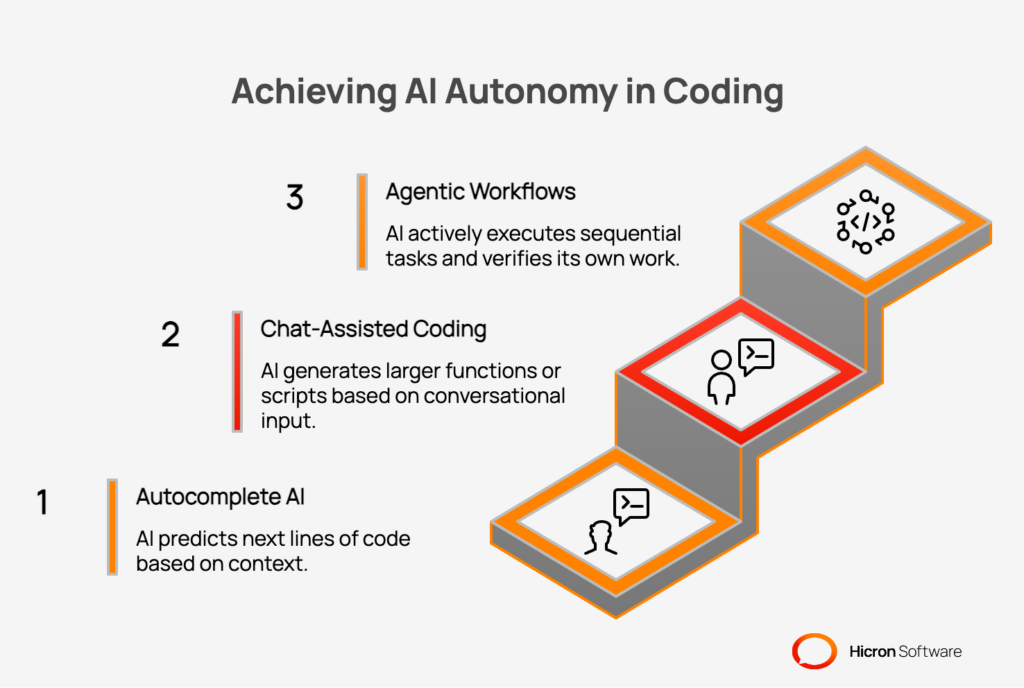
The first meaningful integration of AI into development came through autocomplete.
Tools like Copilot offered inline suggestions, predicting the next line or block of code from local context. These systems improved speed and reduced repetitive typing, but their role remained narrow.
At this stage, AI acts as a reactive assistant. The developer remains fully in control, accepting or rejecting suggestions line by line. The architecture, intent, and workflow still belong to the human.
Autocomplete made developers faster. It did not fundamentally change the SDLC.
The next step was chat-assisted coding.
Instead of suggesting the next few lines, AI systems began generating larger functions, scripts, and implementation blocks based on natural language prompts. Developers could describe a problem and receive usable code in return.
This was a major leap in productivity.
But even here, the developer still carried the core burden of execution. Humans had to stitch together outputs, manage project state, maintain architectural consistency, and ensure the generated code actually fit the wider system.
In other words, AI became a programming partner, not yet an autonomous operator.
Level three of the autonomy ladder is where the true shift occurs. AI transitions from being a simple helper to functioning as an active agent capable of executing sequential tasks.
Agentic workflows involve delegating a high-level objective to an AI system. The developer provides the context, the necessary tools, and clear constraints. The agent then breaks down the objective, executes a sequence of steps, and uses tools like compilers or linters to verify its own work.
Here, AI no longer acts as a helper that responds to isolated prompts. It acts as an agent that can execute a sequence of tasks toward a broader goal.
In an agentic workflow, the developer provides:
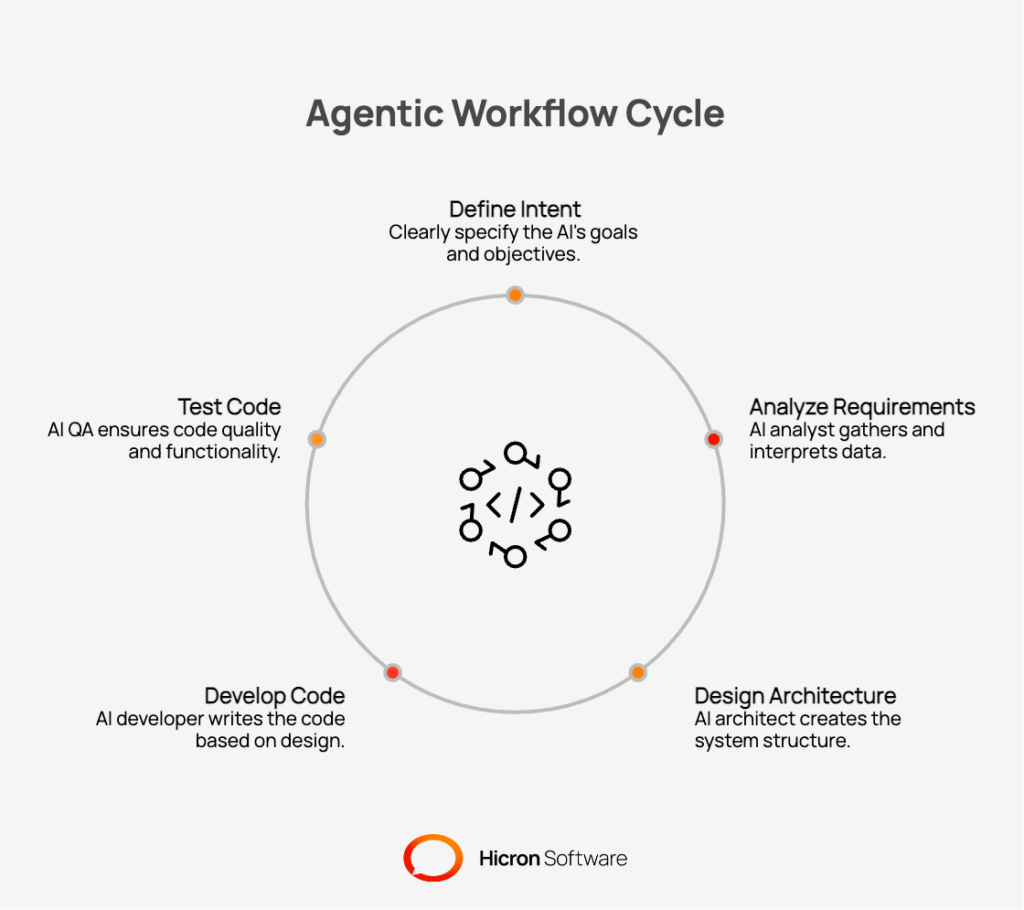
Frameworks like BMad (Build Multi-Agent Driven Agile Development) and GSD (Get Stuff Done) structure this process. BMad, the one we currently test, splits the SDLC into specialized agent roles, such as Analyst, Architect, Developer, and QA. The workflow moves sequentially from product requirements to architecture, epics, and finally, tasks. Every stage produces a text artifact that feeds the next agent. This structured handoff prevents the AI from losing context and ensures repeatable, reliable delivery.
When an AI agent can generate thousands of lines of code in seconds, code itself stops being the scarce resource.
That changes everything.
In traditional development, writing code was the expensive part. In AI-driven development, code generation becomes abundant. The new scarcity is clarity.
That means specification is no longer overhead. It is now one of the highest-value activities in the SDLC.
The engineers who create the most value will not be the ones who type the fastest. They will be the ones who can:
This is a profound role shift for software engineers.
The job is moving from syntax production to intent design. From implementation effort to context engineering. From writing every line manually to ensuring the system produces the right result for the right reason.
That does not reduce the importance of engineers. It raises the bar.
The highest level of the autonomy ladder is delegated autonomy. These are systems that can operate independently for long stretches with minimal supervision.
Tools like Devin and OpenHands represent the frontier of this autonomy, for now. These agents possess their own browser, terminal, and integrated development environment (IDE). They can search the web, write tests, deploy code, and work autonomously for hours on complex, isolated tasks.
Looking further ahead, the industry anticipates autonomous swarms of AI agents. In this model, multiple agents collaborate dynamically without a predefined, rigid framework. A developer simply defines the ultimate requirement, and the swarm self-organizes to architect, build, test, and deploy the application, learning and correcting errors in real-time.
The operational maturity of fully autonomous swarms is currently uneven. While they excel at isolated, well-defined tasks, they struggle when deep, undocumented business context is required.
However, as these tools mature, they will demand a return to rigorous engineering disciplines. Agents require exact precision to function correctly. Consequently, practices like Test-Driven Development (TDD), Definition of Done (DoD), and Definition of Ready (DoR) will shift from being perceived as process ceremony to acting as essential guardrails for agent quality.
Integrating AI into the SDLC introduces unique operational and financial hurdles. The assumption that AI makes development universally cheaper and easier is flawed without proper governance.
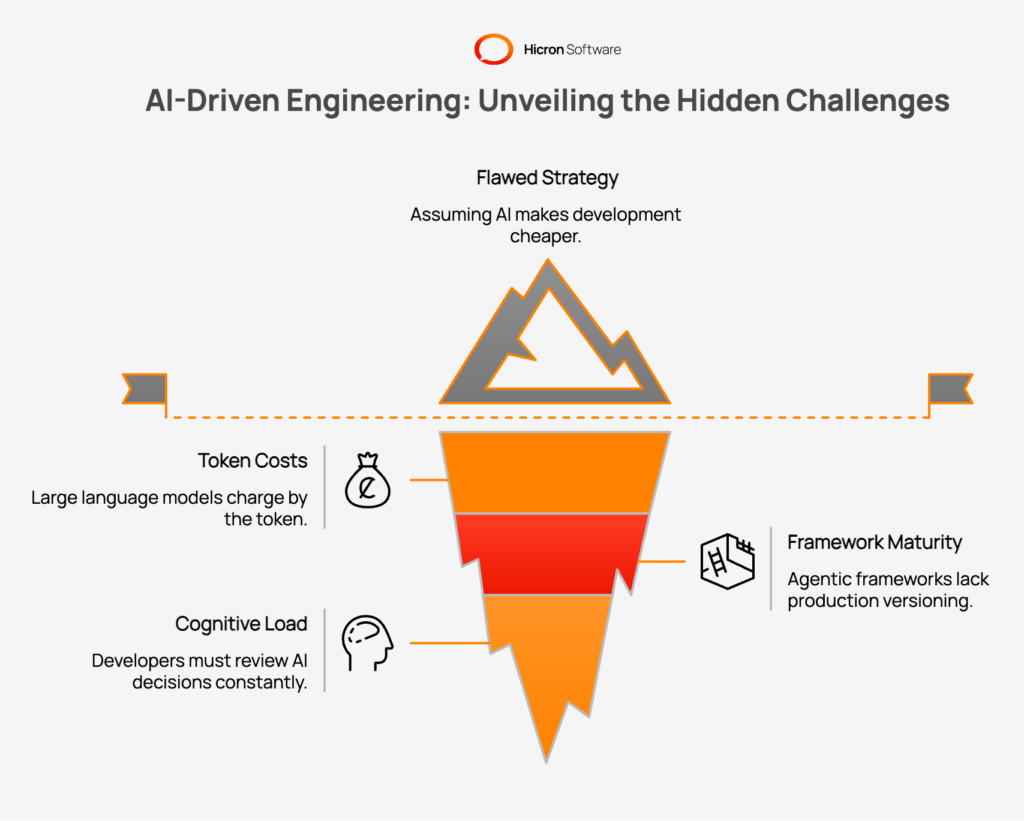
Agentic workflows run on large language models, and large language models charge for context.
That means context costs money.
If teams send too much context, or the wrong context, costs rise quickly. As the market moves away from unlimited AI pricing and toward strict usage-based billing, context engineering becomes inseparable from cost engineering.
This has immediate practical implications.
Teams must learn to manage documentation efficiently. Architecture decision records, technical specs, and structured project files are not just helpful references anymore. They are part of the operating interface for the agent.
Bloated documentation leads to bloated prompts. Bloated prompts lead to bloated token usage. And bloated token usage can make projects unexpectedly expensive.
Model selection matters too. Larger models may deliver stronger reasoning and better outputs, but they also carry higher costs. Smaller, specialized models are often more affordable, but they may lack the flexibility required for complex work.
Choosing the right model is now an engineering and budget decision at the same time.
Agent capability does not equal reliable delivery. While an AI can write code, integrating that code into a large, legacy enterprise system requires complex frameworks.
Maturity is a noteworthy issue. Traditional frontend frameworks have over a decade of production testing. In contrast, many agentic frameworks are mere months old, community-driven, and lack production versioning. Using them requires deliberate consciousness of the risks. Additionally, debugging AI-generated code introduces high cognitive load. An agent might fix a local bug without understanding the global architecture, masking deeper systemic issues. Developers face a shift from the flow state of writing code to a state of constant vigilance, reviewing AI decisions to ensure long-term stability.
The most effective model today is not full autonomy.
Handing business-critical systems to autonomous agents without human oversight is a fast path to architectural decay. The winning model is experienced engineers amplified by structured AI workflows.
A better analogy is the cockpit, not the assembly line.
AI is the autopilot. It handles much of the execution. But a trained professional still sets the destination, monitors the instruments, and takes control when conditions change.
That is what strong software teams should be building toward now.
They should prepare for greater autonomy by:
AI does not replace good engineering.
It rewards strong engineering fundamentals and exposes weak ones faster than ever.
The software development life cycle is not disappearing. It is being rebuilt around a new economic reality. In this reality, code is cheap, but clarity, context, and validation are priceless.
Sources:
Agentic workflows shift the focus from manual coding to system design and oversight. Developers delegate routine code generation tasks to intelligent autonomous agents. This approach requires precise specification and rigorous quality assurance at each stage. Human developers transition to roles centered on architecture and high level strategy. They guide the agents by setting clear goals and constraints for the system.
The primary focus of AI in software development is to automate repetitive tasks and enhance system quality. It streamlines processes like code generation, testing, and debugging. This allows developers to focus on complex problem solving and system architecture. AI tools analyze code for potential errors and suggest optimizations. They improve efficiency throughout the development life cycle.
An AI powered software development life cycle operates through a structured process. It starts with AI analyzing project requirements to generate initial specifications. Intelligent agents then produce code based on these specifications. They also perform continuous testing and debugging to identify and fix errors. Human developers oversee this process. They provide high level guidance and validate the AI generated outputs. This integration automates many traditional development tasks. It results in a more efficient and iterative software development process.
Hicron Software proved to be a trusted partner with unmatched technical expertise, delivering a scalable and user-friendly web application that was pivotal to our successful U.S. market expansion.

Hicron’s contributions have been vital in making our product ready for commercialization. Their commitment to excellence, innovative solutions, and flexible approach were key factors in our successful collaboration.
I wholeheartedly recommend Hicron to any organization seeking a strategic long-term partnership, reliable and skilled partner for their technological needs.

After carefully evaluating suppliers, we decided to try a new approach and start working with a near-shore software house. Cooperation with Hicron Software House was something different, and it turned out to be a great success that brought added value to our company.
With HICRON’s creative ideas and fresh perspective, we reached a new level of our core platform and achieved our business goals.
Many thanks for what you did so far; we are looking forward to more in future!

Hicron is a partner who has provided excellent software development services. Their talented software engineers have a strong focus on collaboration and quality. They have helped us in achieving our goals across our cloud platforms at a good pace, without compromising on the quality of our services. Our partnership is professional and solution-focused!

The IT system supporting the work of retail outlets is the foundation of our business. The ability to optimize and adapt it to the needs of all entities in the PSA Group is of strategic importance and we consider it a step into the future. This project is a huge challenge: not only for us in terms of organization, but also for our partners – including Hicron – in terms of adapting the system to the needs and business models of PSA. Cooperation with Hicron consultants, taking into account their competences in the field of programming and processes specific to the automotive sector, gave us many reasons to be satisfied.