Developing a Secure AI Solution for Enterprise Applications
- June 16
- 28 min




Generative AI governance is the combination of policies, technical controls, and organizational practices that define how an enterprise manages data classification, compliance obligations, and accountability when deploying large language models across its operations.
Deploying generative AI without structured data governance creates compounded legal, competitive, and operational risks. Organizations are integrating language models faster than they are classifying their data or reviewing compliance obligations. The gaps this creates extend well beyond accidental data leaks. They reach intellectual property ownership, GDPR compliance, and regulatory standing under the AI Act and NIS2. They also affect the long-term expertise of engineering teams. This article covers each of these risk areas in concrete terms. It also provides a governance framework that translates risk into actionable technical controls. The result is a clear path to confident, structured AI deployment.
Language models amplify the consequences of poor data governance. When an organization lacks data classification policies, an LLM with broad organizational access becomes a reliable mechanism for assembling information that was never intended to be assembled in one place.
Most organizations have not classified their data, documented processing purposes, or defined access boundaries before deploying AI tools. A model works with everything it receives. Without classification policies in place, teams send whatever is relevant to their immediate task, and the model combines it with everything else it has seen in the session.
The pace of adoption accelerates the gap. Compliance procedures and access controls typically follow technology adoption rather than precede it. With generative AI, the window between deployment and governance failure is shorter than with previous generations of enterprise software.
This is the structural challenge. The ISO/IEC standards that organizations now cite as AI governance baselines include ISO/IEC 42001 for AI management systems, ISO/IEC 42005 for AI system impact assessment, and ISO/IEC 23894 for AI risk management. These standards consolidated around the 2022 to 2023 cycle, before large language models became everyday enterprise tools in 2023 and 2024. The impact assessments written during that wave assumed a narrower set of model capabilities than today’s LLMs deliver. Regulations drafted in the same window reflect the technical possibilities of their time. Organizations deploying current models operate in a compliance environment whose foundations were laid before anyone understood what probabilistic models at this scale could reconstruct from organizational data. CIOs and compliance officers who apply those frameworks without adaptation inherit that gap as operational exposure.
Data emergence is the ability of a language model to reconstruct patterns, intentions, or confidential structures from fragments of information that individually appear harmless.
The risk multiplies in professional services and software development. A company working on client systems may upload documentation to prepare for a project meeting. A developer may query specific libraries. An account manager may include contract context. Each action is individually unremarkable. Combined in a model with broad organizational access, they give the model detailed knowledge of a client’s infrastructure, and the company loses control over where that knowledge sits.
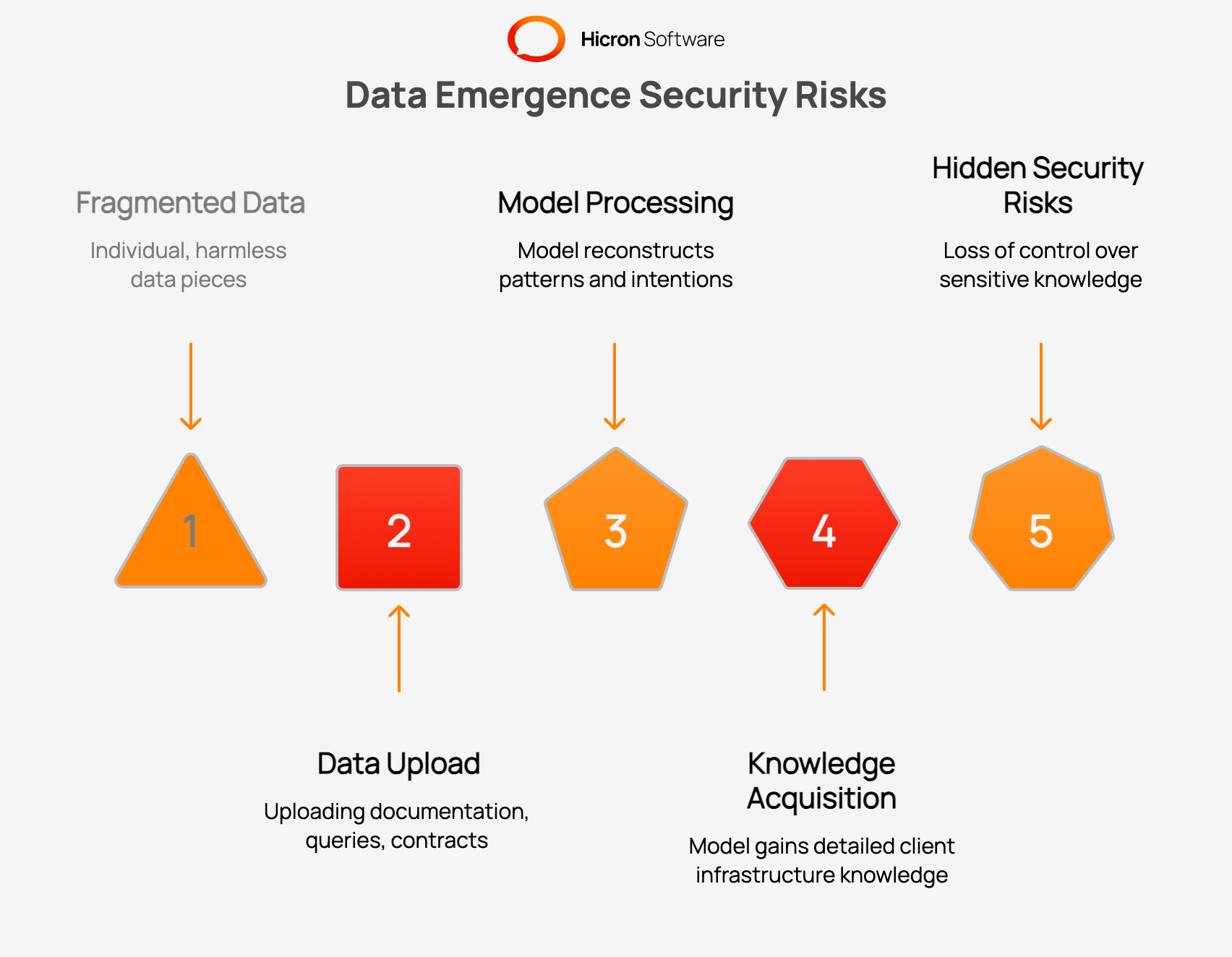
Classical data protection measures focus on individual records. Probabilistic models operate differently. Masking names and entity references reduces some risk. A sufficiently large and coherent text sample allows a model to identify context regardless of surface-level masking. Emergence means the complete picture reveals more than the sum of its masked parts.
When organizations send personal data to external language models, several processing violations occur simultaneously:
The practical risk is procedural. A technically functional AI deployment can breach GDPR because the processing purpose was never updated, data subjects were never informed about AI transfers, or the legal basis for third-country transfer was never established. The breach lives in the governance structure, not in any visible data exposure event.
A company that has documented its data classification, applied pseudonymization, and implemented routing rules holds a demonstrably stronger legal position than one that gave every employee unrestricted access to a public model.
The AI Act introduces obligations for providers and deployers of AI systems. Current implementation phases require labeling of synthetic content so that audiences can identify AI-generated material. This obligation applies now to content providers and will expand over subsequent implementation phases through 2027.
The AI Act also references explainability and observability of AI systems. For language models, these requirements present a technical limitation. The probabilistic weight distribution across attention layers cannot be traced the way a deterministic system can be audited. Observable inputs and outputs can be logged. The internal computation resists the kind of step-by-step explanation that compliance officers expect from classical software systems. Organizations that treat AI observability as a logging and documentation challenge, rather than a model transparency challenge, build a more realistic compliance posture.
Vendors offering AI models will face growing obligations around training data transparency. That affects procurement: knowing what your tools were trained on becomes a compliance requirement alongside a quality consideration.
NIS2 extends cybersecurity requirements to entities whose operations are critical to the continuity of other organizations. A software development firm that builds and maintains systems on which clients depend can be assessed as a critical entity under this regulation. That classification carries specific obligations: incident response requirements, resilience planning, and security controls that extend to third-party technology dependencies.
AI systems form part of the operational infrastructure that falls within NIS2 scope. If a model becomes unavailable, produces outputs that disrupt client operations, or is compromised through adversarial input, the event enters NIS2 reporting territory. Organizations that have not mapped their AI dependencies into their business continuity and incident response planning carry an unaddressed regulatory risk.
Copyright protection in Poland and across the EU requires a demonstrable human creative contribution. Code generated by a language model or an autonomous agent does not automatically qualify for that protection. The challenge is practical: when an agent generates, tests, revises, and delivers a software component with minimal human intervention, establishing the required creative contribution becomes difficult to demonstrate.
The business consequence is direct. A software product built primarily through generative AI may fall outside copyright protection. A competitor could replicate it without legal consequence for the copying.
The mitigation is documentation. Human decisions that shape the architecture, select between generated options, define constraints, and review outputs constitute creative contribution. Organizations that want to retain IP protection over AI-assisted work maintain records of the decisions that influenced the final output. The documentation habit that protects IP also creates an audit trail for other governance purposes.
Knowledge atrophy is the gradual loss of operational competence that occurs when teams delegate cognitive work to AI without maintaining the underlying skills.
Short term: Developers who accept generated code without reviewing its logic stop developing the judgment that comes from understanding what the code actually does. Analysts who read AI summaries instead of source documents lose the capacity to evaluate what those summaries omit or distort.
Long term: When organizations stop hiring junior engineers because AI handles entry-level work, they interrupt the career pipeline that produces senior engineers. Current senior engineers built their expertise by working through exactly the kinds of problems that AI now handles. A new generation that skips that experience will lack the judgment to manage situations where AI falls short.
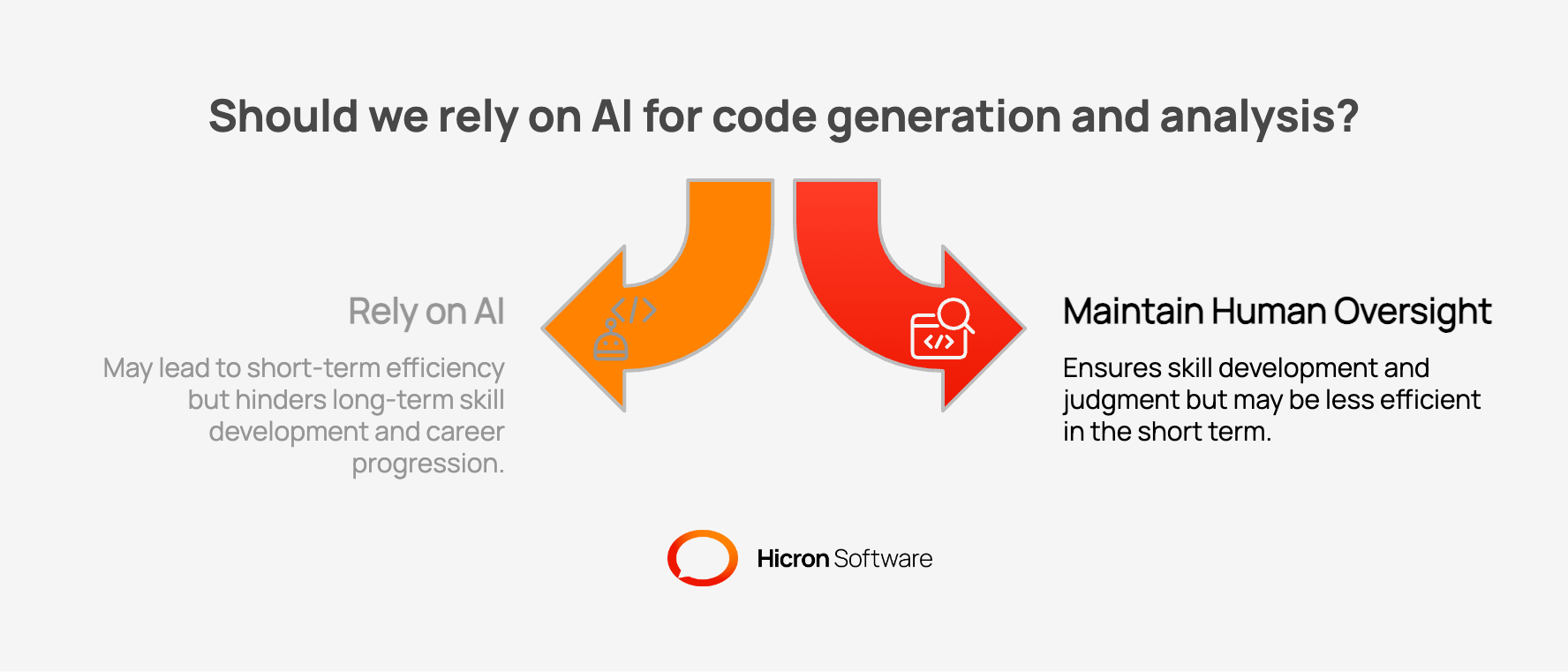
Governance policy should account for competence retention alongside data protection.
Enterprise Governance Cannot Be an Afterthought
How Can Organizations Build a Practical Data Governance Framework?
|
Component |
What It Does |
Key Benefit or Risk Note |
|
Intelligent Data Router |
Classifies inputs by sensitivity before they reach a model. Sensitive data routes to local environments; lower-risk queries go to external models. |
Teams access AI capability without per-query security judgments. Forms the foundation of an AI governance policy. |
|
Pseudonymization and Prompt Paraphrasing |
Strips entity names, system identifiers, and structural markers before external transmission. Azure PII detection and AWS equivalents automate this step. |
Reduces risk across known elements, but large text samples can still trigger emergence. Best used as one layer in a defense-in-depth strategy. |
|
Organizational Query Cache |
Stores responses to repeated queries. Teams pull from the cache instead of generating new external calls. |
Cuts external data exposure and cost at scale. Creates an internal audit record of queries and responses. |
|
Client Data Separation |
Assigns separate model instances or credentials per client project. Sessions carry no cross-client context. Access rules, isolation, and logging enforce separation. |
Prevents cross-client leakage. Holds even when individual users take shortcuts. |
A data router classifies information before it reaches a model and directs it based on sensitivity. Highly sensitive data, including client system documentation, strategic plans, and personal information, routes to local models or stays within controlled environments. Lower-sensitivity queries route to external models where processing capability justifies the exposure.
This routing logic is the foundation of an organizational AI governance policy. It gives teams access to AI capability without requiring individual security judgments on every query.
Removing entity names, system identifiers, and structural markers from prompts before they reach an external model reduces exposure. Paraphrasing a query before transmission adds separation between the original intent and the transmitted text. Azure’s PII detection services and equivalent AWS offerings can automate this process, producing a sanitized version of the document before it enters the AI workflow.
Pseudonymization reduces risk across the identified elements. Emergence from large, coherent text samples remains a vulnerability even after masking individual identifiers. Pseudonymization works best as one layer within a defense-in-depth strategy. The combination of layers addresses emergence risks that no single measure resolves alone.
A shared cache at the organizational level stores responses to frequently repeated queries. Teams retrieve answers from the cache rather than generating new calls to external models. This reduces external data exposure and creates cost efficiency as AI usage scales. It also gives the organization a record of what has been queried and what responses have been distributed internally.
For organizations that manage multiple clients with competing interests, logical and organizational separation of AI access is essential. Different client projects use separate model instances or separate access credentials. AI sessions for one client’s work carry no context from another client’s project. Governance infrastructure enforces this separation through access rules, session isolation, and logging that hold even when individual users take shortcuts.
Organizations already embedded in a technology ecosystem gain the most by building AI governance within that ecosystem. For organizations running on Microsoft infrastructure, Azure provides governance components that integrate directly with existing tooling:
These components form an auditable, policy-driven governance layer without requiring a separate AI security stack.
An LLM Gateway or proxy sits between users and external models. It applies classification rules, logs inputs and outputs, enforces pseudonymization, and routes queries based on sensitivity. Recent months have seen major providers, including Anthropic, introduce full gateway and proxy support with advanced telemetry. This architecture gives the organization a single control point for AI governance without requiring each user to make governance decisions manually.
Vendor independence requires deliberate planning. Organizations that build workflows tightly coupled to a single provider’s model or API expose themselves to pricing changes, capability shifts, or service discontinuations. Portable workflows, where the organization can substitute a different model without rebuilding the application, are a risk-mitigation investment. Dramatic license price increases are a realistic scenario. Having a documented migration path before it becomes necessary is an operational resilience measure.
Shadow AI is a persistent gap that governance infrastructure reduces but cannot eliminate. Teams will use personal accounts and consumer tools outside any organizational governance framework. Providing capable, accessible organizational tools reduces the incentive to go outside them. A combination of good tooling and clear policy is more effective than policy alone.
Organizations that address data governance before scaling AI adoption build a structural advantage that compounds over time. Classification policies, routing infrastructure, and access controls become more valuable as AI usage expands. Organizations that skip this foundation take on legal exposure under GDPR, the AI Act, and NIS2, while also weakening their IP position and the long-term competence of their teams.
The sequence that works in practice:
Complete risk elimination is unrealistic. Risk mitigation, executed deliberately, is achievable and defensible.
If your organization is scaling AI usage without a clear data classification and governance baseline in place, that is the conversation worth having before the next deployment decision.
Generative AI governance is the set of policies, technical controls, and organizational practices that define how a company manages data, compliance, and accountability when deploying large language models. Without it, organizations accumulate GDPR exposure, IP ownership gaps, and operational dependencies that become costly to address retroactively.
The most effective approach combines an intelligent data router that classifies and directs queries by sensitivity level, pseudonymization of sensitive content before external model access, a shared organizational query cache for frequently repeated requests, an LLM gateway for centralized control, and governance tooling within the organization’s existing technology ecosystem. This structure gives teams access to AI capability while keeping data exposure within defined boundaries.
European copyright law requires a demonstrable human creative contribution. Code generated autonomously by an agent may fall outside copyright protection. Documenting the human decisions that shaped the architecture, selected between options, and defined constraints is the practical way to support an intellectual property ownership claim over AI-assisted output.
Sending personal data to an external LLM typically triggers several obligations simultaneously: the processing purpose shifts, control over the data transfers to a third party, the ability to update or correct that data is lost, and data often moves outside the EEA without the required legal basis. The risk is procedural, meaning it exists in governance documentation gaps rather than in visible data breach events.
Data emergence occurs when a language model reconstructs confidential patterns from fragments of organizational data that individually appear harmless. Combined in a model with broad access, those fragments can expose trade secrets, client system architectures, or unreleased product strategies. For everyday scenarios where this risk appears, see How to Use AI Safely in Your Company.
Hicron Software proved to be a trusted partner with unmatched technical expertise, delivering a scalable and user-friendly web application that was pivotal to our successful U.S. market expansion.

Hicron’s contributions have been vital in making our product ready for commercialization. Their commitment to excellence, innovative solutions, and flexible approach were key factors in our successful collaboration.
I wholeheartedly recommend Hicron to any organization seeking a strategic long-term partnership, reliable and skilled partner for their technological needs.
After carefully evaluating suppliers, we decided to try a new approach and start working with a near-shore software house. Cooperation with Hicron Software House was something different, and it turned out to be a great success that brought added value to our company.
With HICRON’s creative ideas and fresh perspective, we reached a new level of our core platform and achieved our business goals.
Many thanks for what you did so far; we are looking forward to more in future!

Hicron is a partner who has provided excellent software development services. Their talented software engineers have a strong focus on collaboration and quality. They have helped us in achieving our goals across our cloud platforms at a good pace, without compromising on the quality of our services. Our partnership is professional and solution-focused!

The IT system supporting the work of retail outlets is the foundation of our business. The ability to optimize and adapt it to the needs of all entities in the PSA Group is of strategic importance and we consider it a step into the future. This project is a huge challenge: not only for us in terms of organization, but also for our partners – including Hicron – in terms of adapting the system to the needs and business models of PSA. Cooperation with Hicron consultants, taking into account their competences in the field of programming and processes specific to the automotive sector, gave us many reasons to be satisfied.