Your AI Chatbot is Lying to You: The Quick Guide to Getting Smarter Answers from AI
- October 24
- 8 min




Safe AI adoption in a company is an organizational and technical discipline that governs what data enters language models, how outputs are reviewed, and how teams retain the competence to work without AI when it is unavailable or unreliable.
Presume your sales team shares contract details with a language model, your delivery team uploads architecture notes, and HR uses the same model for job descriptions. None of them meant to expose a product roadmap. The model may have inferred one anyway.
This is the operating reality of AI in software companies today. Most teams still focus on the wrong risks. This article walks through emergence, daily data habits, shadow AI, and the operator mindset that keeps human judgment at the center as AI takes over more of the daily workflow.
Key Takeaways:
Company secrets leak through fragmented context more often than through intercepted prompts. When sales, delivery, and HR each feed separate inputs into the same model, the system connects dots your own teams never connected in one place.
Emergence, in the context of language models, describes the capacity to derive conclusions from incomplete input. The model does not need to see your full strategy document. It needs enough fragments to reconstruct one. Sales shares contract volumes. Delivery shares service architecture. HR posts a job description for a specialist role that does not exist yet. A model working across those inputs can infer a new product direction from the pattern alone.
The clearest analogy is the MacGyver framing: from ordinary, unconnected pieces, something unexpected emerges. In intelligence work, this is called mosaic theory. In enterprise AI, it is a confidentiality risk with no clean legislative framework yet.
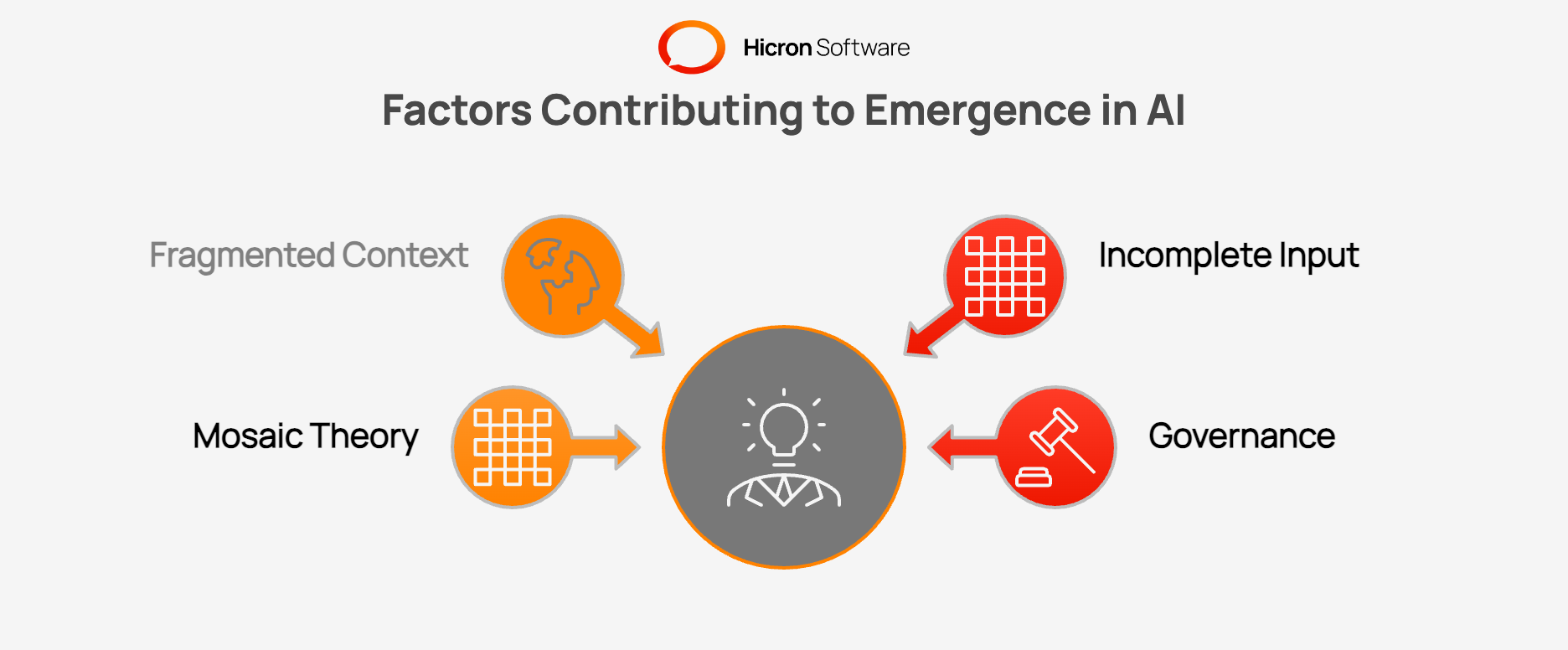
The same property works in your favor. Emergence is also why language models produce synthesis that surprises teams: connecting project knowledge to meeting notes, surfacing patterns across client accounts, generating insights no single analyst would have produced alone. Governance determines whether emergence helps or harms the organization.
A language model is a probabilistic function. It generates responses based on statistical patterns across training data. It does not store your prompts the way a database stores rows.
The scenario that worries most teams, specifically that someone will query a public model tomorrow and receive a colleague’s project plans in response, does not match how these systems work at normal use levels. That fear is based on a misunderstanding of how training data is processed, normalized, and weighted. Individual data points rarely survive that process in recoverable form.
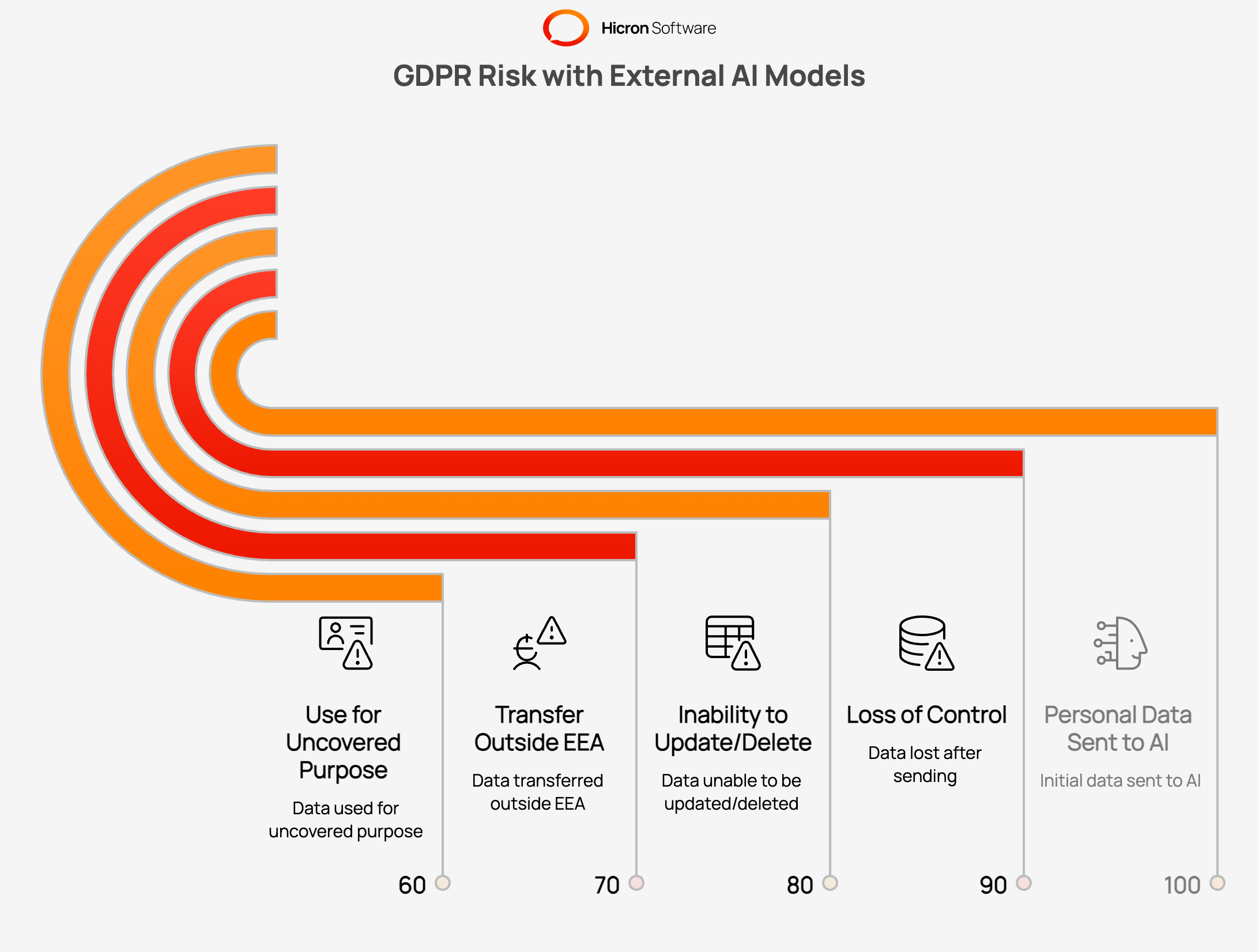
The real exposure vector is different. When teams use an external LLM without governance, the company loses control of the data the moment it leaves the internal environment. There is no mechanism to update, correct, or delete that data later. The processing likely occurs outside the European Economic Area. And the original consent or legal basis for collecting that data almost certainly did not anticipate this use case.
The failure starts with the process, before the model enters the picture. Sending governed data to an ungoverned endpoint breaks compliance rules regardless of what the model does with the input.
For how legacy governance frameworks and pre-LLM regulations create structural compliance gaps at the enterprise level, see Generative AI Governance for Enterprises.
Most teams frame GDPR and AI as a single question: will the model leak a personal identifier? That framing misses the structure of the actual risk.
When a company sends personal data to an external language model, procedural violations stack quickly: loss of control, inability to update or delete on request, transfer outside the EEA without a documented legal basis, and use for a purpose the original consent never covered.
Demonstrable reasonable care is the practical standard. A company that has documented its data classification, applied pseudonymization, and implemented routing rules is in a fundamentally different legal position than one that gave every employee unrestricted access to a public model. Both may face questions. Only one has documented answers.
If your organization has been assessed as a critical entity under NIS2, AI tooling that affects service delivery falls under those obligations as well.
Code generated predominantly by AI, without a documented human footprint on architecture and review decisions, may not meet the copyright standard that Polish and European law requires. That exposure grows as agents take on more autonomous decision-making in the pipeline.
The fix is documentation. Logging prompts, recording architectural decisions, maintaining review trails, and building approval gates into the pipeline create the evidence that a human shaped the work. This is the most underestimated legal exposure for software teams using AI today.
Bans push AI usage underground. Teams that prohibit AI lose velocity and shift work to personal accounts. Architecture gives a better path forward.
Routing shrinks the blast radius of emergence and data loss. Pseudonymization helps but does not defeat reconstruction from large, coherent context samples.
TSMC manufactures chips for Apple, NVIDIA, and Qualcomm simultaneously. Each client holds patents and trade secrets that represent existential competitive value. TSMC has maintained that separation for decades at scale.
TSMC relies on organizational architecture to sustain client separation at scale. Teams are assigned to specific clients and technologies. Physical and digital access is separated at multiple layers. No single engineer holds full context across competing client projects.
That structure is directly applicable to AI governance in a software company. The target is a pipeline that mirrors the confidentiality boundaries your contracts already require, rather than a single AI assistant with access to everything the company knows.
This also becomes a client-facing argument. A software company that can articulate how its AI infrastructure separates client data, limits cross-context inference, and logs model interactions is making a substantively different pitch than one that says “we use enterprise-grade tools.” Clients who understand the risk will respond to that difference.
Shadow AI describes the use of AI tools outside any governance structure, typically through personal accounts or home devices during remote work. It cannot be eliminated through policy alone. It can be reduced by making the governed option the path of least resistance.
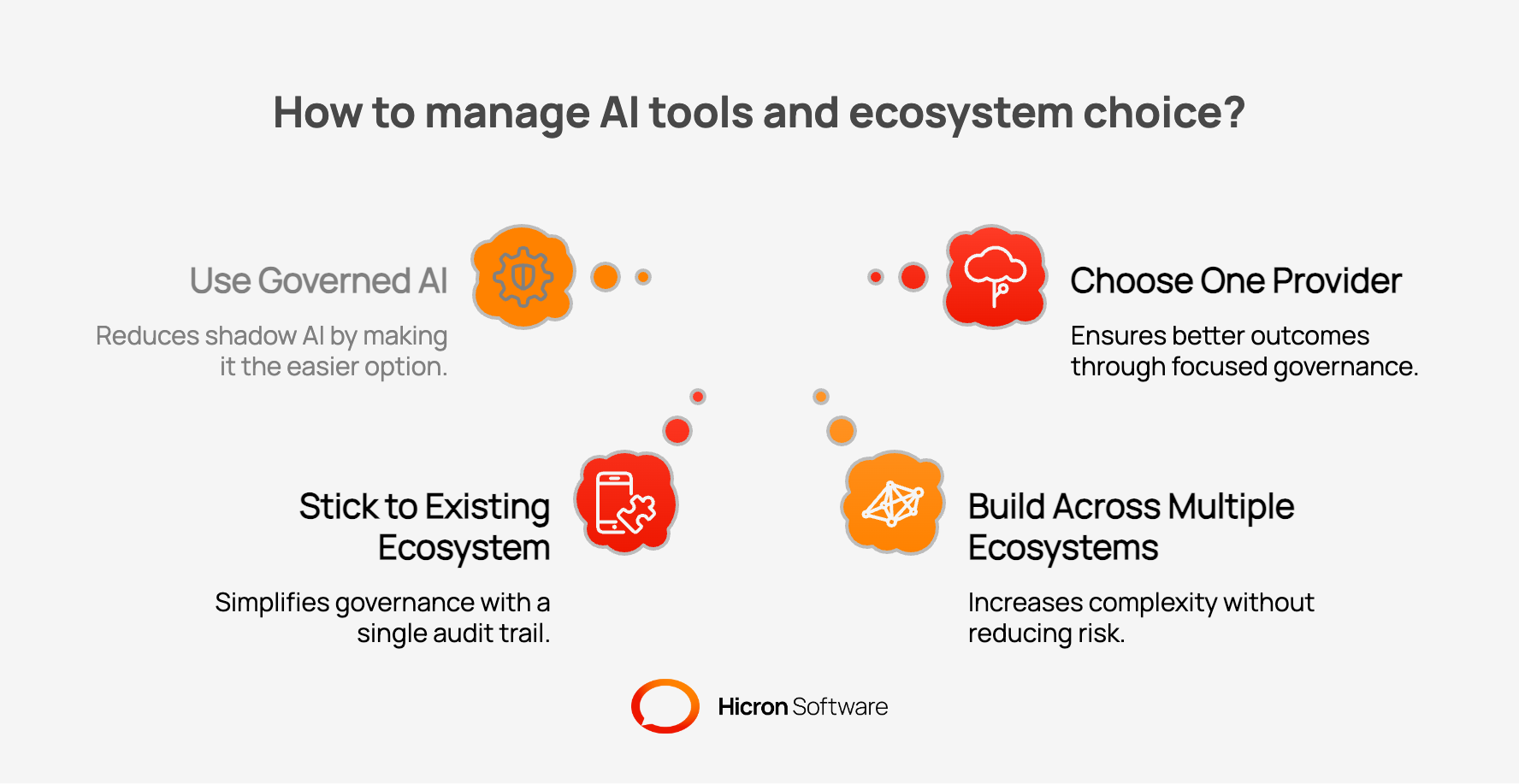
The ecosystem decision matters here. A company already operating within Microsoft 365 has a practical baseline. Teams, Outlook, SharePoint, and OneDrive already pass through Microsoft infrastructure. Extending governance to Copilot within that same tenant produces a single audit trail across AI and non-AI work.
Absolute security does not exist. Every cloud provider requires institutional trust. The pragmatic question centers on whether the tools that provider offers let you govern, audit, and demonstrate compliance. Building across multiple disconnected ecosystems compounds governance complexity without reducing the underlying risk.
The same logic applies to model selection. Choosing one provider and governing it well produces better outcomes than distributing usage across five providers with no visibility into any of them.
For software development teams, three near-term obligations matter in daily practice:
Knowledge atrophy is the gradual erosion of competence that occurs when skills go unused. The forgetting curve is well documented in cognitive science. It applies to engineering teams as much as it applies to individuals.
The risk builds slowly. Junior engineers stop developing foundational skills because AI handles the cases that build them. Senior engineers stop staying current on implementation details because they operate at the prompt layer. Three years later, the team operates at a lower baseline without the tools it now depends on.
The junior pipeline problem is the clearest version of this. If companies stop hiring and developing junior engineers because AI can produce equivalent output faster, the supply of experienced engineers in five to ten years contracts sharply. The senior engineers who exist today cannot sustain those volumes indefinitely. There is no replacement cohort if no one trained one.
A language model produces statistically plausible output by recognizing and recombining patterns from training data. The output can read like reasoning, knowledge, or empathy. None of those cognitive states exist inside the model. Baudrillard called this kind of artifact a simulacrum: a representation with no original behind it.
That distinction matters for two reasons. First, anthropomorphizing AI tools leads to misplaced trust. Teams that treat LLM output as authoritative rather than probabilistic make worse decisions about when to review and when to accept. Second, the language teams use internally shapes expectations across the organization.
The Operator Model frames the relationship correctly. An operator holds domain competence, plans the workflow, moderates the output, and makes the decisions that carry accountability. The AI tool extends throughput within that structure. The operator role stays central throughout.
There is also a less obvious risk here worth naming: ideolect. The stylometric profile of a person, specifically the vocabulary, sentence patterns, and rhetorical habits visible in transcripts and documents, is itself personal data under GDPR. A model with enough of your team’s output can generate a convincing stylistic replica of any individual contributor. That is both a data protection consideration and an organizational one that most companies have not begun to address.
The teams that adopt AI safely build the governance layer before adoption outpaces it. Speed without structure creates exposure that compounds over time.
Sources:
https://en.wikipedia.org/wiki/Idiolect
Enterprise tiers of most major providers exclude customer data from training by default. That is different from zero risk. Data processed by an external model still leaves your control boundary. Governance starts at data classification and routing, not at the provider’s privacy policy.
That depends on your contracts with the client, your data classification policy, and which Copilot deployment your company uses. Microsoft 365 Copilot in an enterprise tenant does not use tenant data for model training by default. The more relevant question is whether your client contract permits that processing at all.
In European jurisdictions, copyright requires a human creative contribution. Code generated entirely or predominantly by an AI tool may not meet that standard. The practical response is to log architectural decisions, maintain review records, and build approval gates that create a documented human footprint on the output.
Shadow AI describes use of AI tools outside any company governance structure, typically on personal accounts or home devices. It cannot be eliminated through policy alone. The most effective reduction strategy is making the governed option faster and easier than the ungoverned one, combined with clear policy and regular team awareness.
Yes. Labeling requirements for synthetic content, input/output logging for LLM systems, and tiered obligations based on risk classification all apply in various ways.
Hicron Software proved to be a trusted partner with unmatched technical expertise, delivering a scalable and user-friendly web application that was pivotal to our successful U.S. market expansion.

Hicron’s contributions have been vital in making our product ready for commercialization. Their commitment to excellence, innovative solutions, and flexible approach were key factors in our successful collaboration.
I wholeheartedly recommend Hicron to any organization seeking a strategic long-term partnership, reliable and skilled partner for their technological needs.

After carefully evaluating suppliers, we decided to try a new approach and start working with a near-shore software house. Cooperation with Hicron Software House was something different, and it turned out to be a great success that brought added value to our company.
With HICRON’s creative ideas and fresh perspective, we reached a new level of our core platform and achieved our business goals.
Many thanks for what you did so far; we are looking forward to more in future!

Hicron is a partner who has provided excellent software development services. Their talented software engineers have a strong focus on collaboration and quality. They have helped us in achieving our goals across our cloud platforms at a good pace, without compromising on the quality of our services. Our partnership is professional and solution-focused!

The IT system supporting the work of retail outlets is the foundation of our business. The ability to optimize and adapt it to the needs of all entities in the PSA Group is of strategic importance and we consider it a step into the future. This project is a huge challenge: not only for us in terms of organization, but also for our partners – including Hicron – in terms of adapting the system to the needs and business models of PSA. Cooperation with Hicron consultants, taking into account their competences in the field of programming and processes specific to the automotive sector, gave us many reasons to be satisfied.