How AI Agents Are Transforming Enterprise Software Automation in 2026


How can AI agents transform the enterprise?
AI agents change how day-to-day enterprise operations actually run by reasoning, planning, and executing multi-step workflows autonomously. This shift moves organizations away from static tools toward autonomous digital workers capable of independent decision-making. These systems offer immense business value by managing complex logic, pushing them beyond traditional process automation. For example, agentic AI can transform the software development lifecycle (SDLC) by reasoning through complex conditions rather than just generating isolated code snippets.
But these solutions don’t function as a simple layer added on top of an existing technology stack. In my experience, this is where most early-stage projects stumble. To handle inherent technical limitations, deploying digital workers requires specialized talent and significant upfront investment. Organizations face distinct scalability constraints and execution risks when integrating these models with a legacy system of record. Because of these uncertainties, managing them demands strict governance protocols to prevent unintended modifications to core databases. Implementing human-in-the-loop (HITL) frameworks ensures safe operations and provides critical oversight for autonomous actions within complex enterprise architectures.
Enterprise AI Agents: Transformation, Risks, and Governance
|
Key Enterprise Area |
AI Agent Impact & Challenges |
Required Controls & Solutions
|
|
Process Automation |
|
|
|
Legacy Infrastructure & Data |
|
|
|
Security & Access |
|
|
|
Accountability Frameworks |
|
|
|
Enterprise Adoption |
|
|
How does agentic AI differ from traditional process automation?
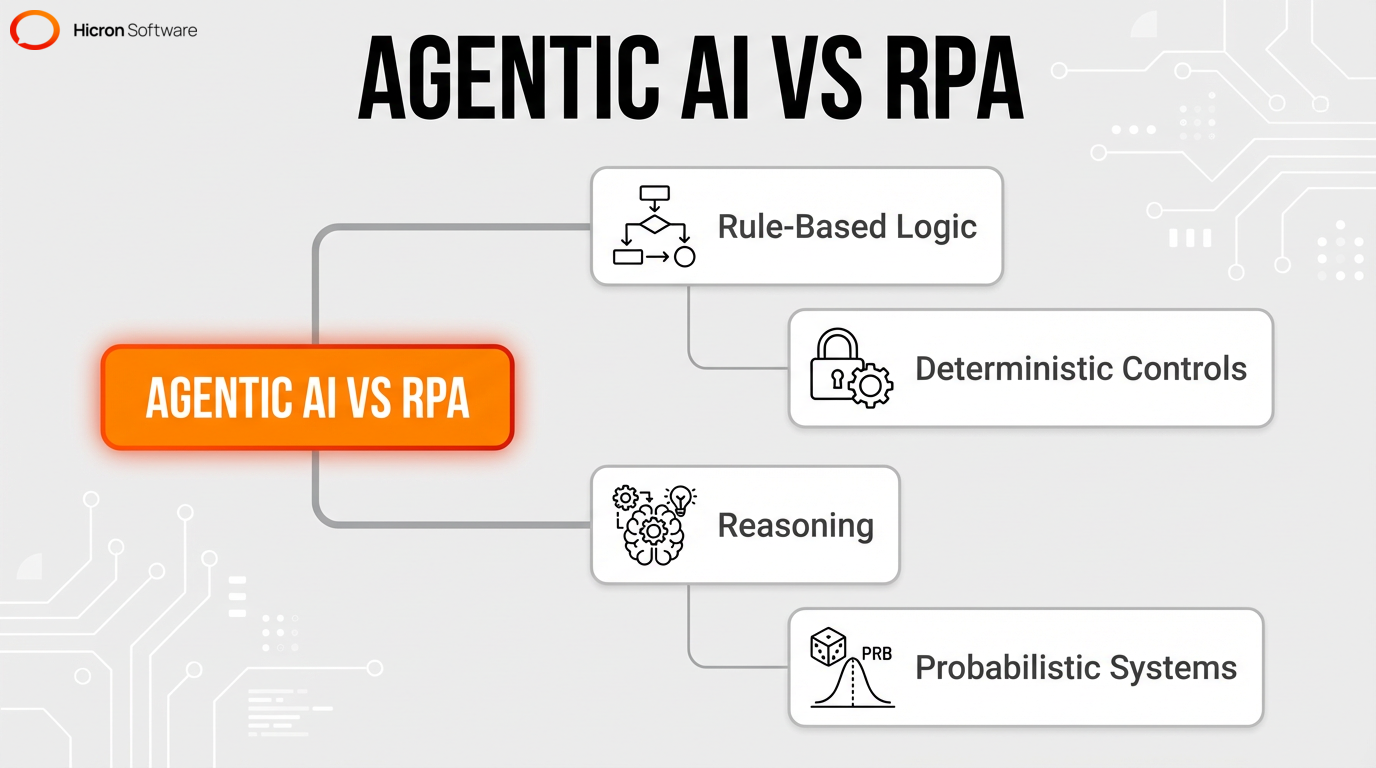
While traditional process automation relies on static, rule-based logic for predictable environments, standard RPA scripts often break when encountering unexpected variables. Agentic AI, on the other hand, uses reasoning to dynamically adapt to these unforeseen changes.
This shift from hard-coded automation to autonomous decision-making unlocks advanced capabilities, but it also introduces serious constraints. Shifting from strict deterministic controls to probabilistic systems introduces model variability. How do you manage this execution risk? It becomes especially tricky when autonomous systems interact with legacy architectures. HITL oversight remains essential to validate real-time adjustments and catch mistakes.
Why are legacy systems a constraint for AI agents?
Outdated enterprise infrastructure and the absence of modern APIs create integration roadblocks that prevent AI agents from operating effectively, most notably:
- Absence of real-time endpoints
- Reliance on batch processing
Consequently, these architectural constraints block direct, real-time communication between dynamic workflows and older hardware.
Legacy systems lack the standard integration methods that multi-agent collaboration requires, such as RESTful APIs and event-driven webhooks. Deploying these tools requires extensive architectural redesign rather than a simple plug-and-play installation.
Older enterprise environments operate with disconnected databases and data fragmentation. If you’ve ever tried to pull a unified report from a decades-old ERP, you know exactly how painful this can be. This isolation restricts the unified data access that AI needs to make accurate decisions.
How does technical debt affect AI integration?
Accumulated technical debt worsens the brittleness of AI integrations, making legacy systems highly vulnerable to instability. Integrating probabilistic systems into these environments requires extensive custom engineering to prevent critical failures caused by outdated codebases. This accumulated debt typically leads teams into two major roadblocks:
- Severe backward compatibility issues during rapid model updates
- Elevated execution risk when encountering unknown edge cases
Developers must construct reliable validation layers throughout the SDLC to manage model variability safely. Such mandatory architectural rework increases financial costs and complicates change management whenever enterprise stacks undergo sudden modifications. As a result, the resulting integration barriers create distinct scalability constraints, proving that autonomous tools require deep structural modernization rather than superficial layering.
How do edge cases and unknowns complicate the SDLC?
Unpredictable edge cases complicate the SDLC by introducing significant execution risk into standard testing protocols. Traditional frameworks can’t manage autonomous agents effectively because they fail to test unknown variables and struggle to validate probabilistic systems that produce different outputs for the exact same input.
Without strict safety checks, this inherent model variability makes deploying production code generated by agents a severe architectural constraint. Engineers mitigate these risks by integrating strict deterministic controls, HITL governance, and continuous observability into the pipeline. Effective decision-making requires leaders to evaluate the total cost of ownership and exact performance metrics around edge case handling before scaling operations.
How does legacy data fragmentation impact AI decision-making?
Fragmented, duplicated, or contradictory historical data severely compromises the accuracy and reliability of how AI agents make decisions. The quality of your legacy data directly dictates how well these systems work. Deep data silos restrict access to comprehensive context. This causes autonomous digital workers to execute flawed actions based on incomplete information.
When AI agents operate on fragmented data, the resulting errors ripple across the enterprise, frequently leading to:
- Incorrect financial forecasts
- Misaligned compliance checks
- Flawed inventory routing
For example, an AI agent accessing outdated policy documents from fragmented legacy data can easily execute legally or operationally risky actions without realizing the rules have changed.
Can retrieval-augmented generation (RAG) overcome data silos?
Retrieval-augmented generation (RAG) connects AI agents to internal documents. However, when the underlying legacy data remains inaccurate, this framework can’t fully overcome data silos. This framework can’t solve enterprise data fragmentation on its own; it requires comprehensive data cleanup first.
RAG grounds probabilistic systems by retrieving specific context from enterprise databases to inform autonomous decision-making. But applying this technology to contradictory information repositories exposes two main problems: retrieving outdated policies and synthesizing duplicated records.
Poorly managed RAG pipelines cause distinct retrieval mistakes. Here is a pro-tip from the trenches: never assume your vector database will magically fix bad underlying data. They feed AI agents incorrect context that leads to flawed execution. When the enterprise environment contains disorganized records, developers must mitigate this execution risk by implementing strict validation layers and continuous observability.
What are the risks of AI agents modifying a system of record?
Granting AI agents write permissions to an authoritative system of record introduces severe execution risk that can disrupt core business operations. When these systems make a mistake, you typically see two worst-case scenarios: deleting critical databases and issuing unauthorized financial refunds.
Without strict deterministic controls, inaccurate legacy data within a CRM or ERP will inevitably cause an AI agent to execute flawed business transactions. Restricting write permissions using least-privilege access and role-based access control (RBAC) mitigates these dangers. Enterprises build strong governance frameworks featuring HITL oversight and comprehensive audit trails to prevent catastrophic failures when models attempt unauthorized modifications.
Why do probabilistic systems require deterministic controls?
Because probabilistic systems inherently generate variable outputs during complex decision-making, enterprises implement hard-coded deterministic controls to guarantee predictable and safe transactions. Dynamic AI behavior naturally clashes with the strict rules that govern enterprise environments.
Organizations enforce strict business logic on unpredictable AI agents by establishing deterministic software as an absolute boundary. These rigid parameters ensure that autonomous models can’t bypass hard business rules, regardless of the probabilistic output the underlying model generates. To prevent unauthorized actions, enterprises must build hard-coded boundaries that automatically reject probabilistic outputs that violate core business logic.
How can validation layers mitigate execution risk?
Validation layers act as a critical safety mechanism, intercepting and verifying actions that AI agents generate against strict business rules before execution. Architects place these deterministic controls directly between probabilistic systems and a rigid system of record. They prevent harmful actions in two ways: continuous rule-checking and enforcing strict threshold limits.
A validation layer can automatically block an AI from issuing an oversized financial refund. Should models encounter unknown edge cases, this architectural boundary mitigates severe execution risk during complex decision-making. Organizations maintain full visibility and detailed audit trails to track these intercepted transactions. Administrators then use HITL governance to review blocked requests whenever autonomous tools attempt operations outside established parameters.
How does model variability create scalability constraints?
The unpredictable nature and frequent updates of underlying models create technical brittleness that severely limits an organization’s ability to scale agentic systems safely. Scaling AI agents across the enterprise is difficult because constant model variability complicates the standardization of complex workflows. Rapid updates in underlying architecture hinder wide-scale deployment, causing severe backward compatibility issues and inconsistent performance across different model versions.
Encountering unknown edge cases forces continuous re-evaluation throughout the SDLC. Integrating these probabilistic systems without deep structural modernization worsens technical debt and introduces massive execution risk. When underlying models receive sudden updates, administrators must lean heavily on strict safety checks and rigorous change management protocols to preserve operational stability. These integration barriers create distinct scalability constraints, preventing organizations from standardizing autonomous tools across legacy environments safely.
What security vulnerabilities do AI agents introduce?
As highlighted by OWASP, autonomous AI agents introduce novel security threats, such as context manipulation and unauthorized system access. These threats require entirely new identity security frameworks. Enterprise AI agents face two unique attack vectors: malicious instructions tricking models into performing unauthorized actions, and the severe danger of using shared credentials for autonomous operations.
Using shared service accounts for AI agents increases execution risk by making it impossible to trace which specific digital worker performed a malicious or erroneous action. Connecting these compromised models directly to outdated legacy systems and deep data silos worsens the potential damage of unauthorized data extraction. To combat malicious actors attempting to exploit these structural vulnerabilities, enterprises construct clear tracking systems and maintain continuous observability to track individual agent actions.
How does prompt injection threaten enterprise workflows?
Malicious actors use prompt injection to weaponize AI agents against enterprise workflows by overriding core instructions. External inputs manipulate these operations by embedding adversarial text into standard communication channels. Attackers typically hide these instructions in incoming emails or uploaded documents. Successful attacks elevate execution risk by triggering unauthorized modifications or massive data exfiltration.
An attacker can execute a prompt injection in a customer support ticket to trick an autonomous model into revealing sensitive legacy data or issuing an unapproved refund. I’ve seen firsthand how easily a seemingly harmless input can bypass basic safeguards. Without strict deterministic controls, probabilistic systems process these manipulated inputs as legitimate tasks. Hijacked models can bypass identity security frameworks to alter an authoritative system of record. When external users submit unstructured data, organizations must set up strict filters and constant monitoring to intercept these dangerous edge cases.
Why are role-based access control (RBAC) and least-privilege access necessary?
Traditional access control frameworks adapt to secure autonomous AI agents by treating these models as distinct digital workers with unique, traceable identities within identity security protocols. Implementing strict role-based access control (RBAC) and least-privilege access acts as a constraint to limit the potential blast radius of a compromised model. Limiting permissions to the absolute minimum prevents catastrophic unauthorized changes to production environments. These restrictions mitigate execution risk by blocking unapproved database modifications and restricting access to sensitive legacy systems.
Enforcing least-privilege access ensures that an AI agent built to read customer data can’t accidentally delete records in a CRM system of record. Organizations integrate these boundaries into comprehensive accountability frameworks to maintain strict governance. Administrators rely on detailed audit trails to track individual actions whenever autonomous models attempt unauthorized operations.
How should enterprises build accountability frameworks for AI agents?
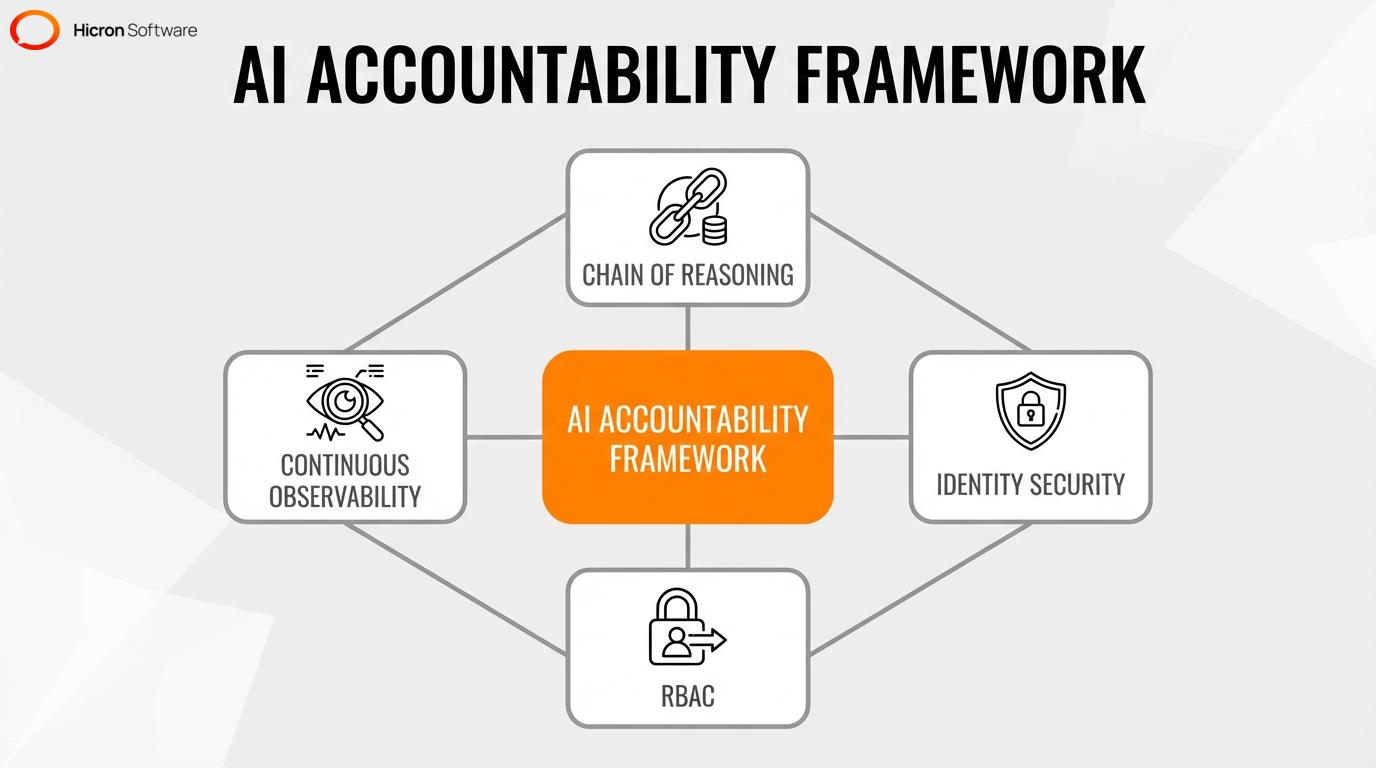
Successful integration of AI agents demands a comprehensive redesign of enterprise controls to establish clear accountability, ethics guidelines, and security policies. Transitioning from traditional software governance to frameworks that govern autonomous digital workers requires distinct structural changes rather than superficial updates. A governance framework built specifically for autonomous AI relies on four core elements: a reconstructible chain of reasoning, robust identity security, strict role-based access control (RBAC), and continuous observability.
Traditional IT policies evaluate static code, whereas modern governance evaluates dynamic decision-making. How do you audit this effectively? Organizations implement a reconstructible chain of reasoning. In the event a workflow fails, this transparency ensures administrators can trace exactly how a probabilistic system arrived at a specific conclusion. In multi-agent systems, the chain of reasoning spans across all participating agents to ensure full accountability for a completed workflow. Tracking this logic across multiple autonomous entities mitigates execution risk during complex operations. Implementing these rigorous constraints guarantees that business leaders maintain absolute authority over the enterprise architecture.
What is the role of human-in-the-loop (HITL) governance?
HITL protocols function as the primary mitigation strategy for execution risk within accountability frameworks, ensuring human oversight for sensitive enterprise actions. Human oversight remains mandatory for highly capable AI agents because probabilistic decision-making introduces severe unpredictability during critical operations. Mandatory human intervention secures an AI workflow in two main areas: reviewing intercepted edge cases and authorizing modifications to a system of record.
Before an AI agent finalizes a high-value financial transaction, a HITL governance protocol requires a human supervisor to review and approve the action. This structure serves as a transitional stage, much like a driving instructor keeping their foot near the brake, before organizations allow the AI to operate with bounded autonomy. Administrators rely on strict system checks and detailed audit trails to maintain strict control whenever autonomous models attempt unverified actions.
How do audit trails and observability ensure safe operations?
Organizations maintain visibility into complex, multi-step decisions that autonomous AI agents make by deploying constant monitoring and immutable audit trails to reconstruct the chain of reasoning. These tracking mechanisms ensure operational safety within comprehensive accountability frameworks.
Logging an agent’s actions effectively requires three things: recording every execution step, capturing retrieved data points, and documenting logical deductions. Continuous observability enables rapid diagnosis and immediate remediation if an agentic system behaves unexpectedly.
When an AI agent executes a flawed transaction, detailed audit trails allow investigators to pinpoint the exact piece of inaccurate legacy data responsible. To support this transparency, administrators use deterministic controls to halt operations the moment a model exhibits excessive execution risk.
What should decision-makers know before adopting AI agents?
Before adopting AI agents, decision-makers must rigorously evaluate the total cost of ownership, required specialized talent, and the readiness of their existing infrastructure. Leaders must look at three main factors before committing to enterprise-wide adoption: the massive upfront investment in training, the acquisition of advanced software engineering skills, and the deep modernization of legacy systems. Treating these autonomous models as simple plug-and-play solutions is a common, yet costly, misconception.
Enterprises encounter severe scalability constraints if they attempt to layer probabilistic tools directly over outdated enterprise architecture. Integrating autonomous capabilities into the SDLC elevates execution risk, especially when architects ignore underlying structural debt. To manage these complex integrations safely, deploying these systems requires a comprehensive architectural redesign. Organizations measure deployment success through strict operational metrics rather than relying on basic pilot counts.
You can assess performance using two critical metrics identified in recent research: real-time system error rates and the frequency of intercepted edge cases. Leaders construct strong oversight and strict governance protocols to oversee complex decision-making. These structural boundaries mitigate catastrophic failures when autonomous digital workers interact with a rigid system of record.
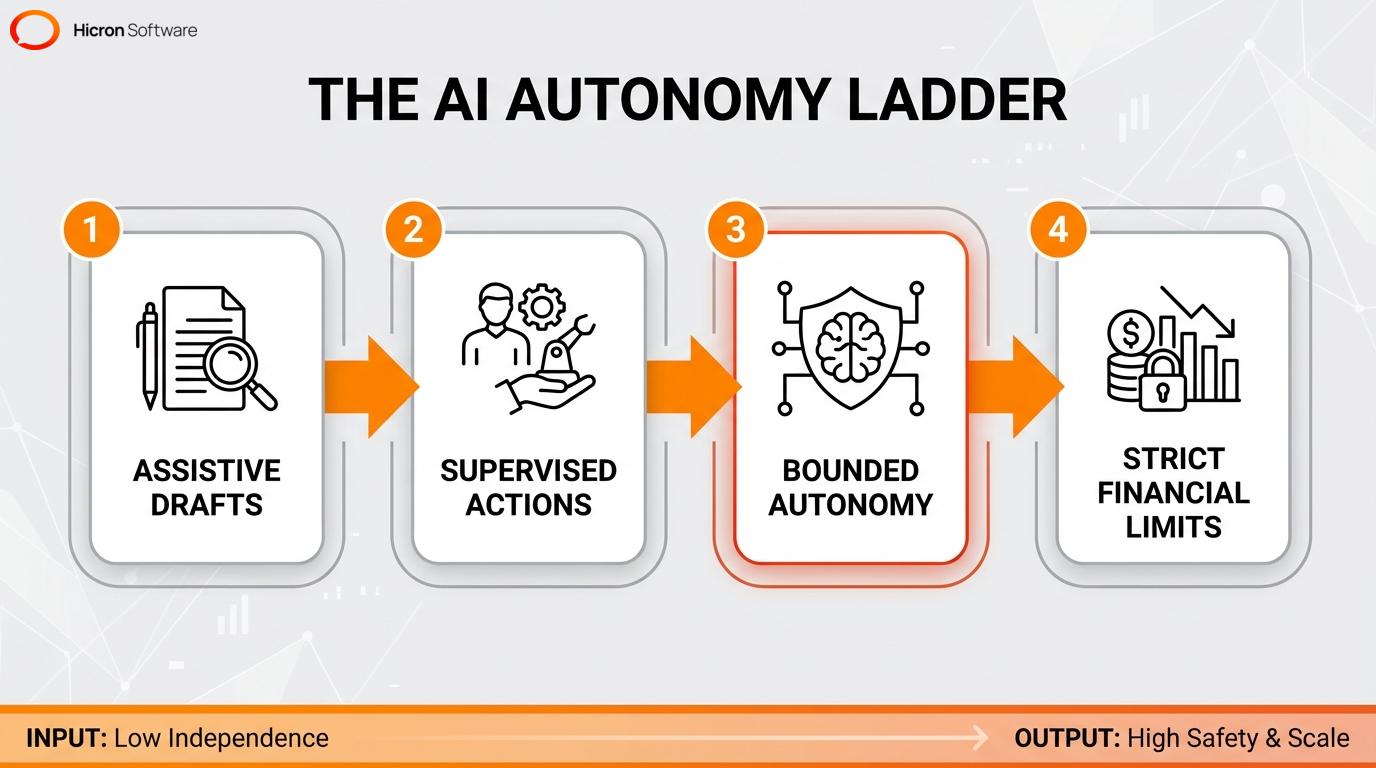
How does the autonomy ladder guide AI integration?
An enterprise safely scales the independence of its AI agents over time by using the autonomy ladder as a strategic progression model. This framework allows organizations to gradually increase AI independence as governance frameworks and institutional trust mature.
According to the Cloud Security Alliance, this progression model moves through three phases: generating assistive drafts, executing supervised actions with HITL oversight, and achieving bounded autonomy. This step-by-step approach helps organizations manage execution risk during early adoption stages.
An AI agent operating under bounded autonomy at the top of the ladder updates a system of record only within strictly defined parameters. These models usually face two restrictions: strict financial limits and rigid operational thresholds.
Architects build strict system checks and clear oversight rules to enforce these boundaries during complex decision-making. This gradual integration minimizes severe scalability constraints and aids internal change management as enterprise teams transition to dynamic workflows.
How can organizations handle change management for AI agents?
To manage this change effectively, you have to stop treating these systems like standard automation tools and start treating them like digital workers. Think of it less like installing software and more like onboarding a new, highly capable but very naive employee. Organizations integrate AI agents alongside human employees by establishing defined roles, continuous monitoring, and clear ethics guidelines.
You need two main procedural shifts to mitigate shadow AI risks: enforcing strict role-based access control (RBAC) and training human supervisors. Without comprehensive accountability frameworks, employees will bypass corporate security frameworks to use unauthorized models.
Without strict governance, unmanaged deployments introduce severe scalability constraints throughout the SDLC. Therefore, supervisors use HITL governance to audit complex decision-making and manage their new digital counterparts.
Sources
- https://owasp.org/www-project-top-10-for-large-language-model-applications/assets/PDF/OWASP-Top-10-for-LLMs-v2025.pdf
- https://arxiv.org/html/2511.14136v1
- https://cloudsecurityalliance.org/blog/2026/01/28/levels-of-autonomy
Testimonials
Hicron Software proved to be a trusted partner with unmatched technical expertise, delivering a scalable and user-friendly web application that was pivotal to our successful U.S. market expansion.

Hicron’s contributions have been vital in making our product ready for commercialization. Their commitment to excellence, innovative solutions, and flexible approach were key factors in our successful collaboration.
I wholeheartedly recommend Hicron to any organization seeking a strategic long-term partnership, reliable and skilled partner for their technological needs.

After carefully evaluating suppliers, we decided to try a new approach and start working with a near-shore software house. Cooperation with Hicron Software House was something different, and it turned out to be a great success that brought added value to our company.
With HICRON’s creative ideas and fresh perspective, we reached a new level of our core platform and achieved our business goals.
Many thanks for what you did so far; we are looking forward to more in future!

Hicron is a partner who has provided excellent software development services. Their talented software engineers have a strong focus on collaboration and quality. They have helped us in achieving our goals across our cloud platforms at a good pace, without compromising on the quality of our services. Our partnership is professional and solution-focused!

The IT system supporting the work of retail outlets is the foundation of our business. The ability to optimize and adapt it to the needs of all entities in the PSA Group is of strategic importance and we consider it a step into the future. This project is a huge challenge: not only for us in terms of organization, but also for our partners – including Hicron – in terms of adapting the system to the needs and business models of PSA. Cooperation with Hicron consultants, taking into account their competences in the field of programming and processes specific to the automotive sector, gave us many reasons to be satisfied.

Get in touch
