What Is a Data Fabric: A Guide to Unified Data Integration
- July 08
- 16 min


Agentic AI vs. Generative AI compares two distinct AI technologies that serve different roles in enterprise operations. Generative AI creates content from a prompt. Agentic AI executes goals autonomously across multi-step workflows. Robotic process automation (RPA) sits alongside both as the execution layer for structured, rule-based tasks.
Most enterprise teams are deploying these AI technologies in parallel without a clear framework for when to use each. The result is overlap, inefficiency, and missed automation value. This article explains how each type of AI works, where each fits, and how all three combine into a practical AI strategy. Understanding the differences between generative AI, RPA, and agentic AI is the first step to deploying each where it adds real value.
Generative AI is a reactive system that waits for input, produces output, and stops. That input-output loop defines both how generative AI works and where its limits begin. Unlike traditional AI, which classifies or predicts from labeled data, a generative AI model produces new content rather than categorizing existing information. This distinction sets generative AI apart from earlier machine learning systems.
According to McKinsey, generative AI describes algorithms that can create new content, including audio, code, images, text, and video. Tools like ChatGPT and DALL-E are widely used generative AI tools. The gen AI model interprets a prompt and returns a result based on patterns learned from its training data. The content it produces can be high quality and contextually aware. But the model does not decide what to do next on its own. It responds to what it is given.
Generative AI primarily responds to prompts but does not initiate tasks or retain goals across sessions. Without additional tooling, it does not interact directly with external systems. Generative AI generates outputs that humans review and act upon. A person provides the prompt, examines the result, and determines the next steps. This reactive quality is not a flaw, because it makes generative AI well-suited to content and knowledge tasks where human review is appropriate. Generative AI poses real challenges only when teams treat it as an autonomous system rather than a collaborative one. The limit becomes a problem only when organizations expect generative AI to do more than it is built to do.
Generative AI excels in content-heavy functions. Teams use generative AI to draft marketing copy, create customer support responses, produce code, and summarize reports. In a widely cited 2023 report, McKinsey estimated that generative AI could add $2.6 trillion to $4.4 trillion annually across 63 use cases it analyzed. These figures are still cited as a baseline, though the underlying research predates the current wave of agentic tools. About 75 percent of that value falls across four functions:
The pattern is consistent: the biggest benefit from generative AI comes when a human provides context and reviews the result before using it. Generative AI capabilities are well suited to any use case that requires generating, interpreting, or summarizing information at scale.
Agentic AI is an autonomous form of AI built for goal-oriented execution. Agentic AI is proactive by design. Where generative AI waits for a prompt, agentic AI works toward a defined outcome. It plans, acts, and adjusts without waiting for a human to direct each step. AI agents are applications that make decisions and perform tasks with minimal human oversight. Agentic AI coordinates those agents and represents a structural shift in enterprise automation.
Agentic AI operates continuously toward an outcome rather than waiting for a new prompt at each step, and the reflection stage allows the system to evaluate what happened and correct course before moving forward. It is also worth separating two related terms:
Within these systems, specialized agents handle distinct roles: one retrieves data, another drafts a report, a third routes the result to the right team. Agentic AI is the orchestration layer that connects them, using large language models as the cognitive engine, with an agentic layer added on top that provides memory, tool use, and the ability to act on external systems.
This process forms a recurring loop, which means that there is no single, standardised definition of how agentic artificial intelligence operates. However, most descriptions point to a similar cycle in which the system perceives its environment, considers a goal, plans its actions, acts, and then analyses the outcome, before starting again. Such ‘plan-act-analyse’ pattern is a useful way of describing what distinguishes agentic systems from generative ones.
Agentic AI represents a structural advance in automation. An agentic system might use a generative AI model to draft a communication, then act on that communication by routing it, logging it, and triggering follow-up steps. Agentic AI often combines a gen AI model at the reasoning layer with tools for external action. Agentic AI uses the underlying language model to interpret goals and plan responses, while the agentic layer executes across connected systems. The Model Context Protocol (MCP) is one emerging standard aimed at making those tool connections more consistent across platforms.
Comparing agentic AI vs. AI agents makes an important practical distinction. A single AI agent performs specific, bounded tasks. Agentic AI coordinates multiple specialized agents toward a broader goal, making decisions about which agent to deploy and when. Agentic AI vs. AI agents is a question of coordination and scope. Teams that understand this difference tend to build more coherent automation architectures rather than assigning every task to a single AI model.
Robotic process automation (RPA) mimics human interactions with digital systems by following fixed, rule-based instructions. IBM describes RPA as software that performs business process activities at high volume, freeing up human resources to focus on more complex tasks. RPA carries out defined tasks quickly, consistently, and reliably in environments where processes are stable and change infrequently.
RPA fits well in predictable, high-volume tasks: moving data between systems, processing invoices, filling out forms, updating records, and triggering standard workflows. These are areas where process steps are known in advance, and inputs do not vary much. In that context, RPA is fast, accurate, and cost-effective.
RPA cannot make judgment calls or handle unstructured information, and when a process falls outside its script, it doesn’t adapt but simply stops or fails. That’s exactly the boundary where agentic AI becomes relevant: RPA handles what’s fixed and predictable, while agentic AI takes over where decisions are actually required. Knowing where one ends and the other begins is what makes a coherent AI solution possible.
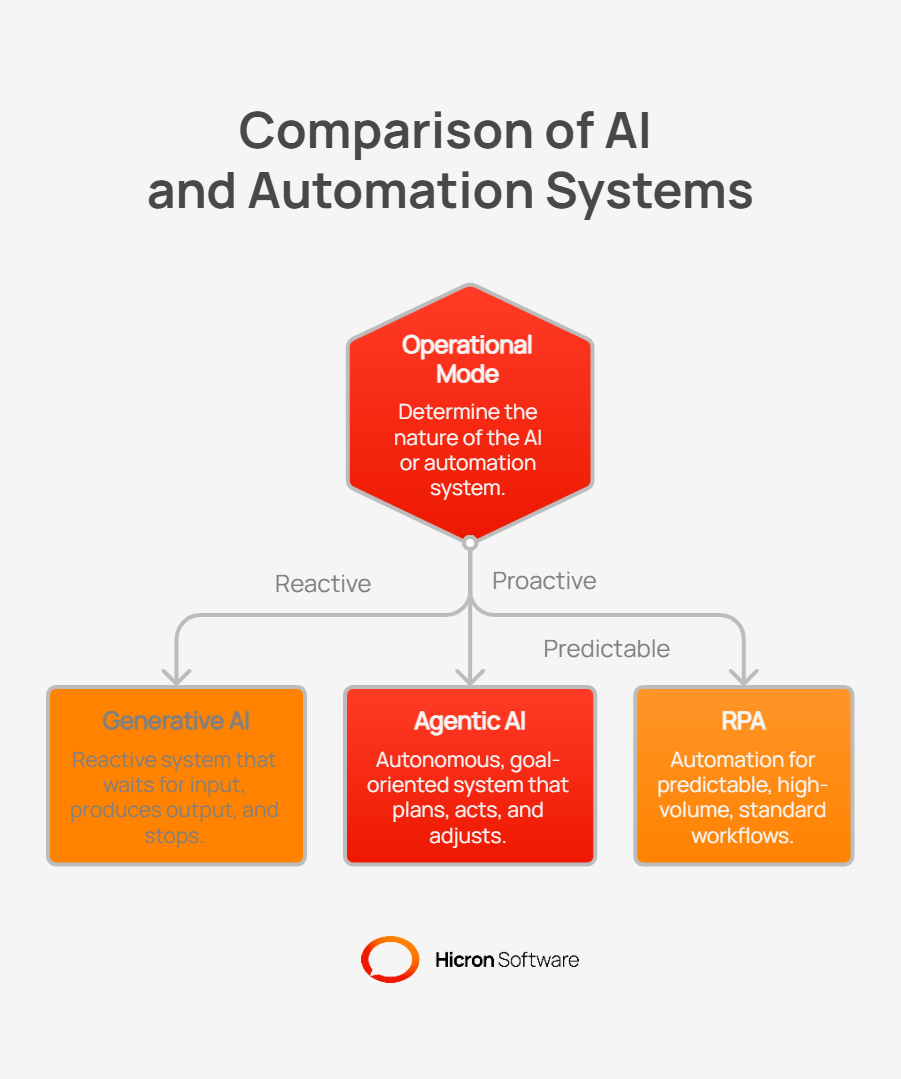
The key differences between agentic AI and generative AI come down to purpose, autonomy, and scope. The table below compares all three AI technologies across five dimensions to make the differences between generative AI, RPA, and agentic AI clearer in practice.
|
Dimension |
Generative AI |
RPA |
Agentic AI |
|
Primary purpose |
Creates content from a prompt |
Executes predefined, rule-based tasks |
Achieves a goal through multi-step actions |
|
Autonomy |
Reactive, low autonomy |
Fixed scripts, no judgment |
Plans and acts, comparatively high autonomy |
|
Supports individual steps |
Automates stable, repetitive processes |
Manages dynamic, multi-step processes |
|
|
Tool use |
Produces text for a human to act on |
Interacts with apps via scripted rules |
Calls APIs and queries systems adaptively |
|
Decision making |
Pattern recognition |
No judgment; stops outside its script |
Weighs options and adapts to feedback |
For a quick read, here is how generative AI vs. agentic AI differ across five practical dimensions:
A delayed flight makes these differences concrete. Generative AI can draft an apology email to affected passengers, but it stops there. RPA can send that email and update the CRM record as scripted steps, but it cannot interpret the delay, identify which passengers need rebooking, or decide what happens next. Agentic AI can handle the fuller sequence: identifying affected passengers, drafting the communication, sending it, rebooking connecting flights, and updating records end to end. This is a simplified illustration of what agentic AI and generative AI each contribute in a real-world setting. In practice, most deployments still need human checkpoints, especially for anything customer-facing.
Generative AI vs. agentic AI is fundamentally a question of how much the system does on its own. Generative AI works within a single interaction. Agentic AI works across a sequence of interactions, systems, and decisions. Generative AI typically produces content for a human to review. Agentic AI aims for more complete execution toward a defined objective, though the degree of true autonomy still varies widely by implementation. Both are valuable. Both serve different purposes. Treating them as interchangeable is one of the most common sources of misalignment in enterprise AI deployments.
All three AI technologies often serve the same business functions. The role each plays depends on the task, not the function. McKinsey’s State of AI 2025 survey found that 88 percent of organizations are using AI in at least one business function, and 62 percent are already experimenting with AI agents, though most remain in the piloting phase. Deployment decisions made now will likely shape who captures value first.
Teams use generative AI for content and knowledge tasks: creating marketing copy, drafting customer support responses, generating code, summarizing reports, and producing HR documentation. These tasks have a clear start and end point. A person provides context and reviews the output before using it. Use generative AI to create content at scale, support knowledge workers, and speed up tasks that require interpretation at the end rather than throughout. Generative AI helps organizations produce more output with the same resources by handling drafting, not deciding.
Common use case examples for generative AI include:
RPA fits stable, rule-based processes with low variability. Invoice processing, data entry between systems, form submissions, and record updates are clear candidates. Use agentic AI for multi-step, cross-system processes that require ongoing decisions. End-to-end customer service, IT operations, healthcare workflow coordination, and supply chain monitoring are examples where agentic AI can deliver value that generative AI or RPA cannot provide alone. Agentic workflows can help organizations automate processes that span multiple departments and require continuous decision-making, though most of these deployments today are still narrow pilots rather than fully autonomous systems.
Common agentic AI use case examples include:
When inputs vary, or decisions are required at multiple points, teams generally choose agentic AI over both generative AI and RPA, with appropriate oversight built in.
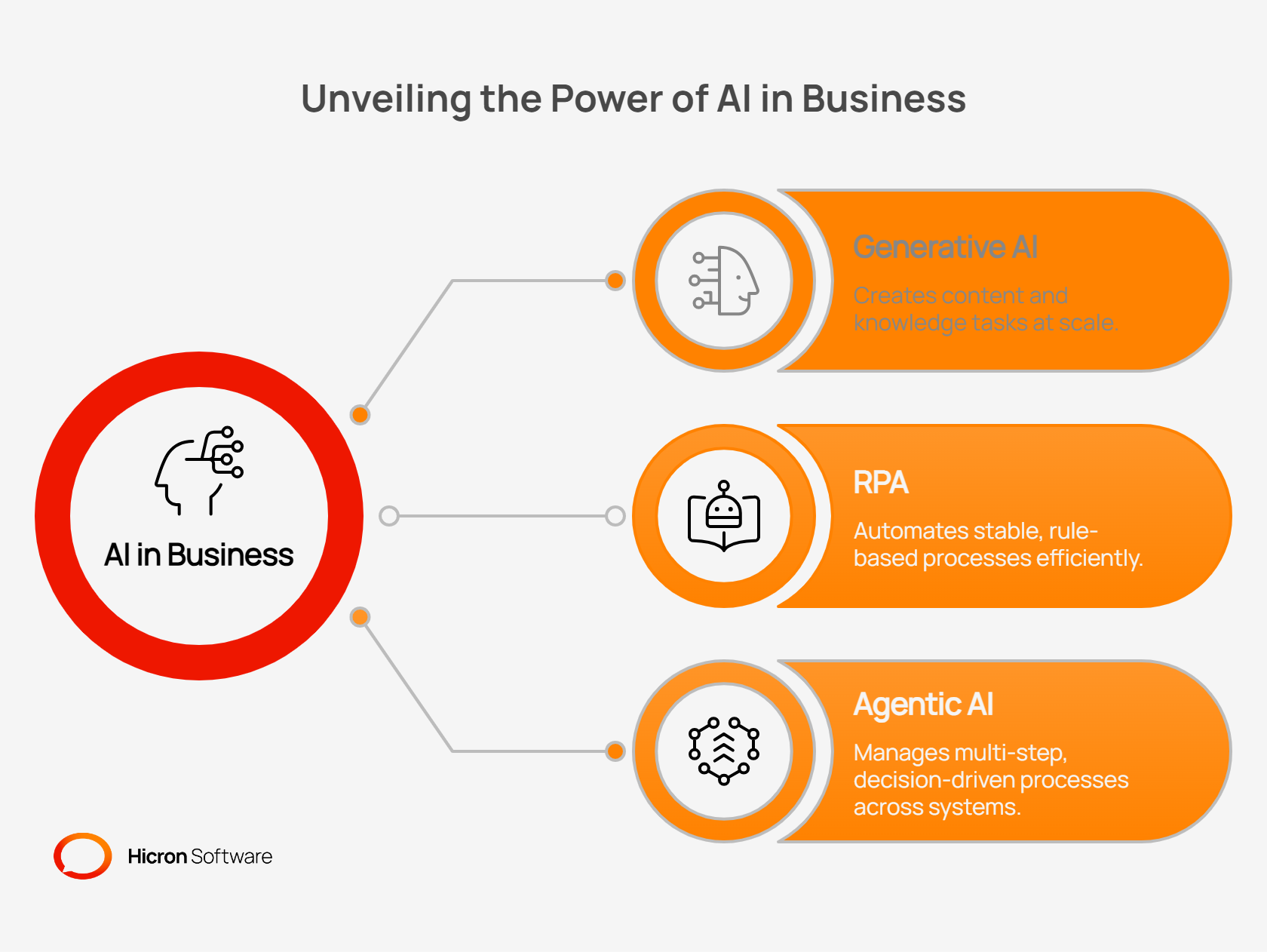
Agentic and generative AI are complementary. Each plays a distinct role in the enterprise automation stack. The most capable organizations tend to use all three AI technologies in combination rather than choosing one over the others. Together, agentic AI and generative AI address what neither can handle alone.
Agentic AI often uses generative AI as its content and communication layer. The agentic layer handles planning, memory, and action. RPA fits within that structure, executing predictable steps that don’t require reasoning: logging data, triggering a system update, or sending a templated notification. This frees agentic AI to focus on decisions and coordination rather than repeatable execution. Powered by generative AI at the reasoning layer, agentic systems can handle complex communication tasks while acting on the results through the broader workflow. Using agentic AI and gen AI for coordination can let organizations move from isolated automation toward more integrated process execution.
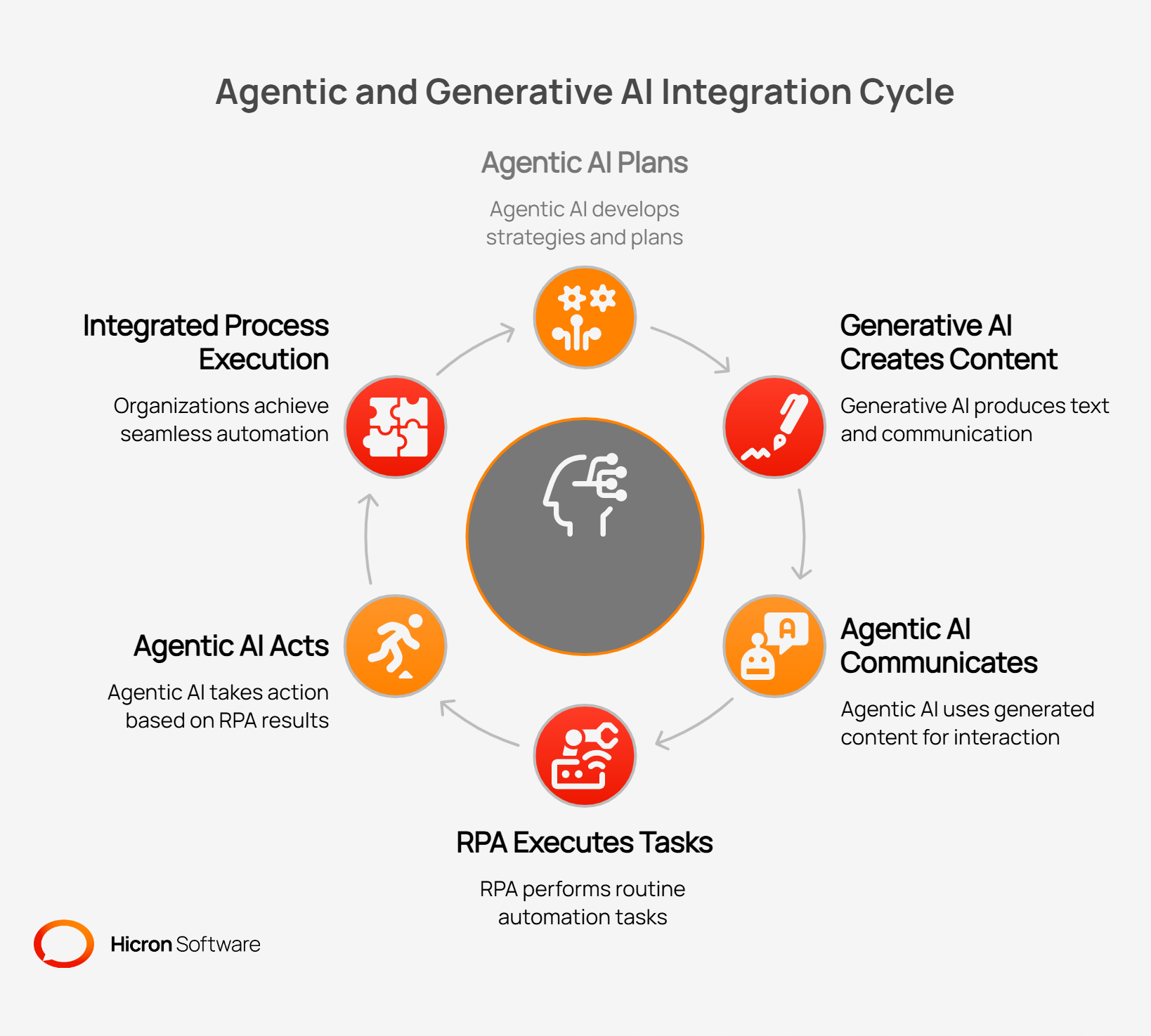
Consider a customer event. Generative AI can write the agenda and draft invitation content. RPA can send calendar invites and enter data into the events system. Agentic AI can book the space, coordinate vendors, track responses, and manage exceptions as they arise. Each layer does what it does best. AI can assist at multiple stages of a workflow when you match each type of AI to the right task, though a human still needs to own the overall outcome.
IBM has framed a version of this idea as “Enterprise Automation”: generative AI generates insight and content, RPA carries out repeatable operational actions at volume, and agentic AI coordinates across the stack, connecting reasoning with execution across more complex workflows. Vendors describe this layered architecture in different ways, but the underlying pattern of content generation, rule-based execution, and autonomous coordination as separate layers shows up consistently across the industry. Seeing these AI technologies as a coordinated stack, rather than competing tools, is one thing that tends to separate organizations scaling AI from those still piloting it.
Choosing between generative AI and agentic AI starts with the task. What level of reasoning does it require? How much does the input vary? Does the process need to act on external systems, or simply produce content for a human to act on? Generative AI or agentic AI: the decision generally comes down to scope and autonomy.
Use this quick guide to match each AI technology to the task at hand:
Choose generative AI when:
Choose agentic AI when:
Use both when:
For structured, repetitive, rule-based tasks with stable inputs, RPA is usually the right AI solution. For content creation, summarization, and knowledge-based tasks, generative AI fits best, and generative AI works best when a human reviews the output before it goes out. For multi-step workflows that require decisions and actions across multiple systems, agentic AI is generally the better fit, particularly for tasks that require coordination, memory, and action across tools, where the endpoint is defined but the path requires ongoing judgment.
Agentic AI can operate with a high degree of autonomy, so define human oversight at key decision points before deployment. In its 2025 State of AI survey, McKinsey found that inaccuracy was the most commonly experienced AI-related risk, reported by roughly a third of organizations using AI. Clear approval workflows and audit trails are a practical mitigation. Aligning AI strategy with governance requirements from the start tends to produce more sustainable deployments. Many enterprise deployments benefit from combining generative AI, RPA, and agentic AI rather than betting on just one. McKinsey’s 2025 findings also suggest that organizations setting growth and innovation as objectives alongside efficiency tend to see more measurable impact from their AI systems.
Generative AI, RPA, and agentic AI play distinct roles in an integrated stack. As adoption matures, the architecture around them tends to become more formalized, and the value from combining these AI technologies becomes clearer.
Improvements in generative AI tend to expand what agentic AI can reliably do. Better reasoning supports better planning. Better planning supports better execution. Agentic AI becomes more capable as the underlying generative AI model improves. McKinsey reports that 23 percent of organizations were already scaling agentic AI in at least one function as of its 2025 survey. Agentic AI focuses on achieving defined outcomes through autonomous coordination, and as generative AI models improve, agentic systems are likely to take on more complex, higher-stakes decisions, carefully and with oversight. RPA is not displaced in this picture; it continues to handle structured execution at volume, and existing RPA deployments are usually best mapped into the broader stack rather than replaced outright.
Multi-agent systems with orchestration layers are becoming more common. Some vendors, including SAP, describe collaborative agentic AI systems that coordinate across departments, with specialized agents handling data retrieval, analysis, and action. Emerging standards like the Model Context Protocol are making it easier to connect agentic AI to external tools at scale. These AI applications are extending what’s possible at the enterprise level, and agentic AI provides the coordination layer that can connect those applications into more coherent, end-to-end workflows.
There’s a useful historical analogy here: real productivity gains from electricity came when factories redesigned their workflows around electric power, rather than simply bolting motors onto machines built for steam. AI arguably works the same way. Organizations that redesign workflows around AI capabilities, including existing RPA investments, tend to extract more value than those that layer AI onto unchanged processes. Treating AI as a design constraint, not just an add-on, is what tends to produce more durable results.
The core distinction is fairly clear. Generative AI creates. RPA executes. Agentic AI acts and coordinates. All three are generally needed for a complete enterprise approach.
Agentic AI is the newer capability layer, adding autonomy, planning, and cross-system execution. RPA remains a reliable execution layer for stable, repeatable processes. Generative AI handles the content and reasoning layer. The strongest results tend to come from combining all three within a single, coherent AI strategy.
Practical next steps for enterprise teams:
Contact our software experts for a structured assessment of where generative AI, RPA, and agentic AI fit within your operations.
SOURCES:
Hicron Software proved to be a trusted partner with unmatched technical expertise, delivering a scalable and user-friendly web application that was pivotal to our successful U.S. market expansion.

Hicron’s contributions have been vital in making our product ready for commercialization. Their commitment to excellence, innovative solutions, and flexible approach were key factors in our successful collaboration.
I wholeheartedly recommend Hicron to any organization seeking a strategic long-term partnership, reliable and skilled partner for their technological needs.

After carefully evaluating suppliers, we decided to try a new approach and start working with a near-shore software house. Cooperation with Hicron Software House was something different, and it turned out to be a great success that brought added value to our company.
With HICRON’s creative ideas and fresh perspective, we reached a new level of our core platform and achieved our business goals.
Many thanks for what you did so far; we are looking forward to more in future!

Hicron is a partner who has provided excellent software development services. Their talented software engineers have a strong focus on collaboration and quality. They have helped us in achieving our goals across our cloud platforms at a good pace, without compromising on the quality of our services. Our partnership is professional and solution-focused!

The IT system supporting the work of retail outlets is the foundation of our business. The ability to optimize and adapt it to the needs of all entities in the PSA Group is of strategic importance and we consider it a step into the future. This project is a huge challenge: not only for us in terms of organization, but also for our partners – including Hicron – in terms of adapting the system to the needs and business models of PSA. Cooperation with Hicron consultants, taking into account their competences in the field of programming and processes specific to the automotive sector, gave us many reasons to be satisfied.