AI Business Process Automation: The New Standard for Business
- November 13
- 15 min

Responsible AI in software development is the practice of building AI systems in which every automated decision remains traceable, reviewed, and owned by a named person throughout the full software development lifecycle.
Over the past two years, AI has moved from experiment to a permanent part of conversations about software modernization. Client expectations have shifted, prototyping is faster, and development teams work differently. But adoption is not the same as maturity. One recent study found that only 21% of enterprises report mature mechanisms for managing AI agents, while 74% expect moderate or broad use by 2027. That gap is where projects stall, budgets erode, and accountability goes unassigned. This article is not against AI. It is against thoughtless AI implementation. It explains how development companies can make sensible decisions about when to use AI, how to match autonomy to risk, how to build a governance framework, and how to earn lasting client trust in custom software projects where AI is at once a promise, a tool, and a source of real risk.
For development teams working on custom software, the real question is not whether to use AI. It is where AI genuinely adds value, where a simpler solution works better, and how to design for risk, ownership, and client trust from the start. Not every feature needs AI. Not every process should be autonomous. The choices made before the first line of code is written determine whether a project delivers lasting results or stalls under the weight of unassigned accountability and misaligned expectations.
Teams now use AI tools to generate code and tests, automate documentation, and speed up prototyping. Coding assistance and AI-assisted software development have made it possible to build software faster than ever. But faster delivery does not answer the harder questions: which AI applications actually serve the business, who stays accountable when something goes wrong, and where a simpler solution would have worked better. The future of software development depends not on how much AI can do, but on which problems it should solve, under whose ownership, and within what limits.
Alongside traditional productivity tools, a new class of AI applications now appears in client conversations:
Each AI system carries a different risk profile and requires a different level of oversight. The main types of AI used in software creation each introduce distinct workloads, capabilities, and governance implications. Treating them as a single category leads to poor planning decisions.
Client expectations have also evolved. Clients now ask how data will be protected, whether the AI system can be audited, who is responsible when the model makes a mistake, and whether the solution meets regulatory requirements. Development companies offering AI development services and AI integration services are now expected to answer these questions before work begins. These questions represent the right starting point for any responsible AI engagement, and the teams that answer them clearly earn trust that technical capability alone cannot produce.
Responsible AI in practice starts with a clear signal that the technology adds measurable value beyond the current process. An 8×8 survey found that 52% of technology leaders say CIOs take the blame when an AI agent makes an error, compared with only 16% who point to customer service staff. That gap exists because no one assigned accountability at the start. The responsible AI approach closes it before development begins.
AI fits well under the following conditions:
When a task follows a predictable pattern, a coded rule often has fewer failure points than an AI model. Teams that explore AI options carefully will find that AI fits best where data volume or language variation goes beyond what fixed logic handles well. Using generative AI tools adds value when a task involves unstructured data or language that shifts from case to case. Understanding different types of AI and when to use each helps teams select the right AI for each situation rather than defaulting to the most complex option.
Process clarification should lead when:
If a problem can be solved with a rule, do not start with a model. If it can be solved with a classic workflow, do not start with an agent. If a model is truly needed, start with the lowest level of autonomy and move up only when results, risks, and controls are well understood. Without AI governance built in from the start, even a well-chosen model can create accountability gaps that are hard to close after launch.
Once a team confirms that AI fits the problem, the next step is to select the right AI solution and assign a governance framework before development begins. Incorporating AI into existing management systems and change management processes early reduces risk and improves outcomes. Integrating AI into a project without first identifying AI assets, approved AI platforms, and governance responsibilities creates the conditions for AI risk to go unmanaged. The table below helps teams place a proposed use case in the right category before committing to development.
|
Worth Considering |
Requires Caution |
|
Document classification |
Autonomous decision-making |
|
Data extraction |
Customer or risk assessment |
|
Knowledge discovery |
Unverified content generation |
|
Employee support tools |
High-stakes automated recommendations |
|
Anomaly detection |
AI agents with broad permissions |
|
Task prioritization |
Systems without full auditing |
For each use case, three questions establish governance readiness before anyone writes code:
These real-world examples of sorting value from risk are what separate a thoughtful, responsible AI approach from one that creates downstream accountability problems. AI governance capability grows when teams ask these questions consistently across their AI inventories and portfolio management processes.
Client skepticism is not resistance to innovation. It is useful information about what proof a client needs to make a confident decision — and teams that read it that way build stronger relationships and better systems.
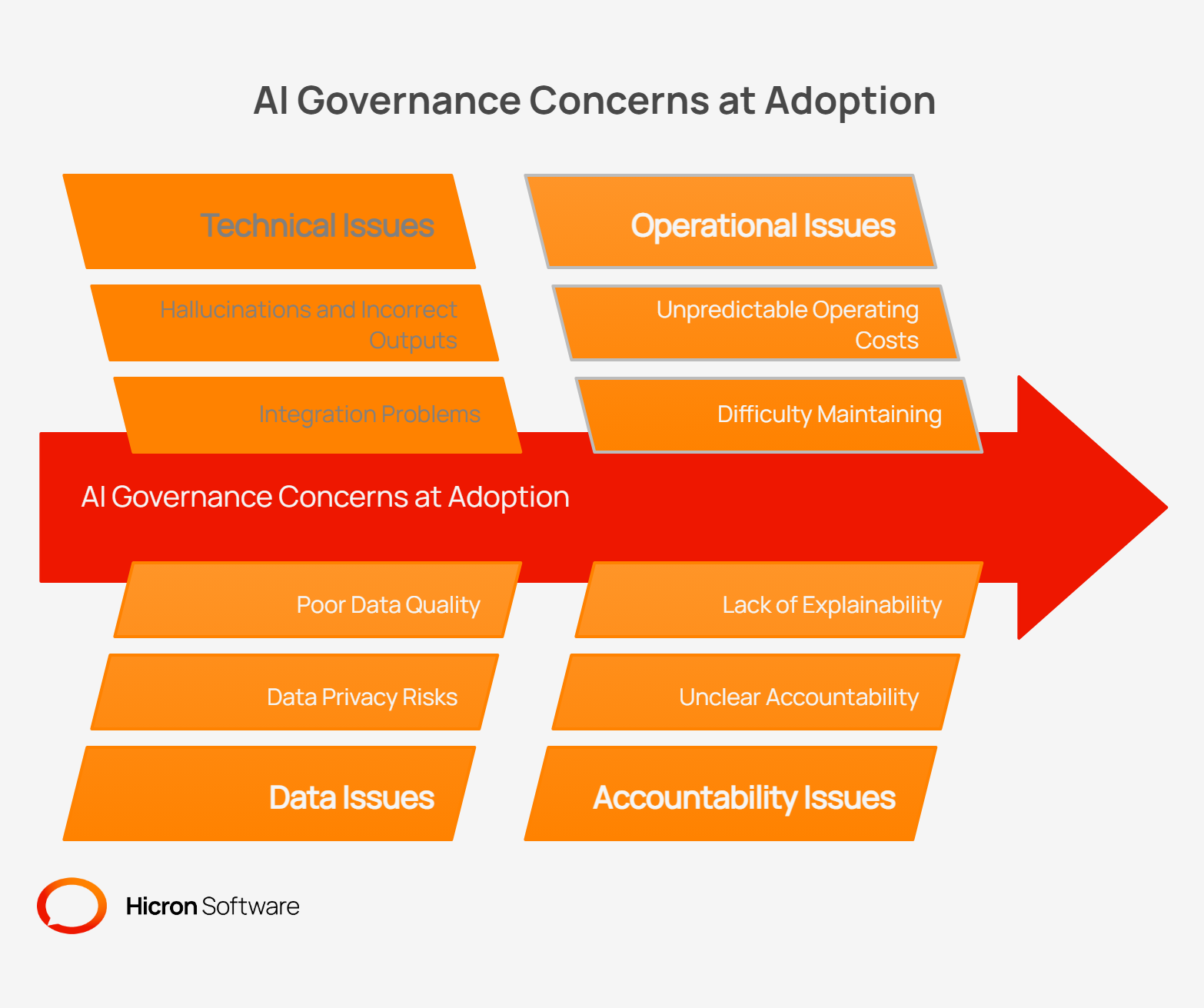
AI adoption without clear governance creates the concerns that surface most often:
Each concern a client raises points to a specific proof the delivery team needs to provide. A question about incorrect outputs calls for a quality demonstration on the client’s own data. A question about data privacy calls for a documented data flow and a clear statement of what leaves the environment. A question about accountability calls for a named owner and an escalation path written into the project plan. When a client raises AI governance concerns, they are asking:
These questions deserve specific answers. Teams that engage with them directly build more durable client relationships. This is building trust in practice, and it is a core part of any responsible AI approach. Organizations that treat AI as intellectual property and invest in AI governance capability are better positioned to answer these questions with confidence.
Responsible AI frameworks treat autonomy as a graduated scale, not a binary state. The table below maps each level to how it works, the value it produces, and the oversight it requires.
|
Autonomy Level |
How It Works |
Oversight Required |
|
Assistant |
The AI system suggests an action; a person executes it. |
Human review before every action |
|
Copilot |
The system completes part of the work; a named person approves before it continues. |
Approval at each handoff |
|
Conditional automation |
The system acts independently within a defined scope, with escalation paths in place. |
Monitoring and defined escalation rules |
|
Autonomous agent |
Agentic AI plans and executes multiple steps within set boundaries. |
Human oversight at defined checkpoints |
Gartner predicts that more than 40 percent of agentic AI projects will be canceled before 2028, with weak risk management and unclear value driving most of those cancellations. Conditional automation means the system operates independently within a defined scope, with escalation paths for decisions that fall outside those boundaries. An agentic AI system that plans and acts across many steps needs tighter governance than a simple assistant, and the data confirms what happens when teams treat autonomy as a setting rather than a design decision. Autonomy should increase gradually, in step with data quality, test results, and the maturity of control mechanisms. Successful AI deployments in this category depend on how well teams develop AI governance capability before deploying AI systems at scale.
Deloitte reports that only 21% of enterprises have mature AI governance for AI agents, yet 74% expect moderate or extensive use of agentic systems by 2027. Research cited by the World Economic Forum found that fewer than one in five organizations consider themselves ready with trusted data. These figures point to where AI projects accumulate risk and get canceled. Building a modern AI system without addressing this gap is one of the most common ways adopting AI creates more problems than it solves.
Responsible AI deployment starts with data. Before any model is selected, teams should answer the following questions as part of model development and design:
Coding and integration work can begin only after you have clear answers to these questions. AI work that skips this step routinely produces the data and privacy problems that surface after launch.
Every AI system in production benefits from a minimum set of controls:
These controls make a system auditable and maintainable over time. Identifying AI assets, maintaining AI inventories across software versions, and managing approved AI platforms are governance practices that build AI governance capability across the organization. Teams that implement AI with these controls in place also reduce the impact of AI errors, making it easier to detect, contain, and correct problems before they reach clients.
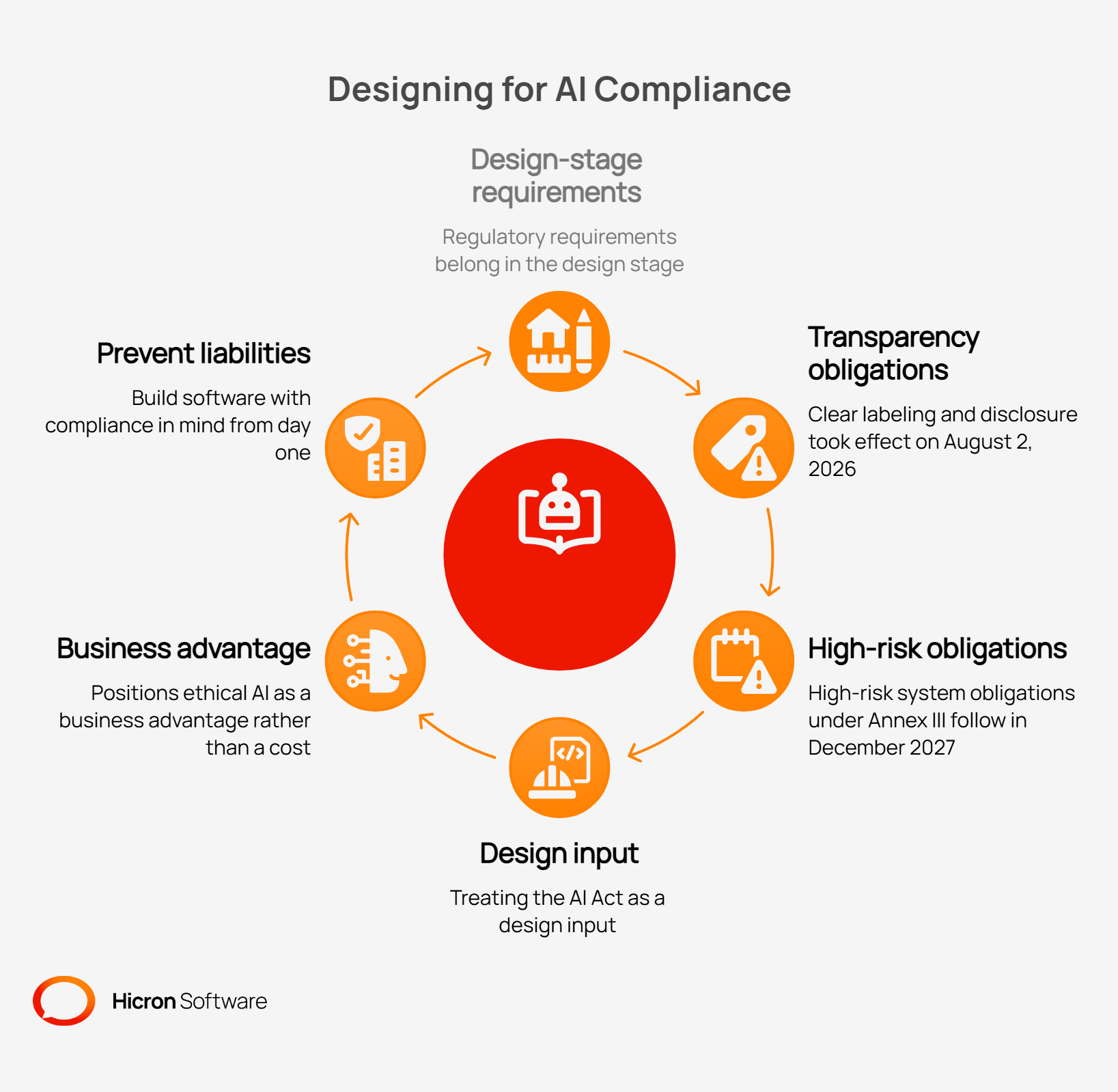
Regulatory requirements belong in the design stage. The EU AI Act‘s transparency obligations for using generative AI systems took effect on August 2, 2026, requiring clear labeling of AI-generated content and disclosure when users interact with a system. High-risk system obligations under Annex III follow in December 2027. Treating the AI Act as a design input rather than a compliance checklist produces AI software that meets regulatory requirements from the start and positions ethical AI as a business advantage rather than a cost. Teams that build software with compliance in mind from day one prevent AI use cases from becoming liabilities.
Implementing responsible AI in client engagements starts with a different kind of opening question. The weak version sounds like:
“We can build an AI agent for you.”
The stronger version is diagnostic:
“Which decisions or activities take your team the most time, where do errors occur most often, and which of these could be partially automated without losing control?”
That really matters. Rather than leading with a technology pitch, development teams ask:
Starting with diagnostic questions rather than an AI recommendation surfaces what matters most: where the real operational pain lives, who owns the process, and how much risk the client can absorb. That information leads to a better solution. One grounded in the client’s actual situation rather than a technology assumption. It also makes it easier to recommend a simpler path when a rule, a workflow, or no AI at all is the right answer. Teams that build this habit produce outcomes with stronger business justification, clearer accountability, and fewer surprises after launch. AI usage delivers the most value when it is grounded in a documented process, a defined AI solution, and an agreed measure of success agreed on by both sides before development begins.
Define success criteria before development begins. Useful metrics include:
Every proposal should describe the scope of functions, known limitations, data requirements, possible failure modes, situations that require human intervention, maintenance costs, and a development roadmap. AI features that go undocumented at the proposal stage tend to create the AI risk that surfaces after launch. Clients who receive this information before approval can give meaningful consent. Proposals that skip this step tend to create accountability gaps that surface after launch.
A responsible AI deployment follows five stages, each with defined exit criteria. This governance framework applies across the full AI lifecycle and development process.
|
Stage |
Focus Areas |
|
Stage 1: Discovery |
Document the process, identify the specific problem, analyze available data, assess risk, define success metrics |
|
Stage 2: Feasibility Assessment |
Compare AI options against simpler alternatives, select the level of autonomy, verify vendors, conduct security and AI compliance analysis |
|
Stage 3: Prototype or Proof of Value |
Test on representative data, define criteria for moving forward, test for errors and edge cases, estimate operational costs |
|
Stage 4: Controlled Pilot |
Limit rollout to a defined user group, monitor outputs, collect feedback from stakeholders, keep a manual override in place, review risks regularly |
|
Stage 5: Production and Continuous Improvement |
Build in observability, maintain an audit trail, run regression tests, manage model changes through a defined process, review permissions, measure business value |
Each stage is a checkpoint. Moving past a stage without meeting its exit criteria is where enterprise AI programs accumulate risk. The governance gap in the Deloitte and Gartner data becomes most costly at exactly these transition points. Deploying AI systems without clear exit criteria at each stage is one of the main ways that otherwise capable AI solutions fail to reach production or deliver lasting value. Teams that manage these stages carefully, including portfolio management of active AI workloads, build durable, accountable software. Integrating AI into existing processes works best when teams treat every stage of the AI lifecycle as a design decision.
At Nawigator, we don’t start by asking where AI can be added. We start by asking where AI can safely and measurably improve how the organization operates. Four principles guide that work in every custom software project.
Value first, then technology. Every AI feature needs a business owner, a success metric, and a cost justification. If the technology serves the problem, it earns its place. If a rule or a workflow does the job, that is the right answer.
Control first, then autonomy. The system earns greater independence only after you know and have tested its results, risks, and emergency mechanisms. Autonomy is a design decision, not a default setting.
Data and process first, then the model. AI will not fix disordered data or a poorly designed process. Teams that clarify ownership and clean up the process before selecting a model produce systems that hold up in production.
Relationship first, then contract. The client should understand not only what the solution delivers, but also what it does not guarantee. Open discussion of limits, costs, and failure modes before signing creates a partnership that lasts beyond the first release.
The coming years will not belong solely to the companies that deploy AI the fastest. The advantage will go to organizations that choose the right automation processes, limit autonomy to a level their risk tolerance supports, and measure each solution’s real value against the original criteria. In custom software development, this shifts the delivery partner’s role from simply executing feature requests to collaborating with clients on sound technology choices, including recognizing when not to implement AI.

Responsible AI in software development is the practice of building AI systems where every automated decision stays traceable and owned by a named person. It covers the full AI lifecycle from data preparation through deployment and monitoring, with defined controls and escalation paths at each stage. AI in software development is most effective when governance is embedded from the start of model development.
Development teams apply AI when a task involves unstructured data or language that varies from case to case, and when a named person can review AI output before any action proceeds. Fixed rules and workflows handle predictable patterns with fewer failure points and are the right starting point for well-defined processes. Using AI tools in contexts built for AI, where data is clean and ownership is clear, reduces AI risk and increases the chance of successful AI adoption.
Teams implement AI governance by logging decisions, maintaining AI inventories, defining approved AI platforms, assigning named owners to each automated step, and building escalation paths into the design. AI governance tools that support audit, access control, and quality monitoring are part of the baseline for any production AI system. Identifying AI assets early and managing them through portfolio management practices helps organizations build AI governance capability at scale.
The EU AI Act’s transparency obligations for generative AI systems took effect in August 2026, requiring clear labeling of AI-generated content and disclosure when users interact with an AI system. High-risk system obligations under Annex III apply from December 2027. Development companies that offer AI development and integration services and treat these as design inputs from the start avoid the cost of retrofitting compliance later.
AI assists software developers by handling repetitive coding tasks and accelerating routine AI work, while engineers retain authority over design, review, and final decisions. The responsible AI approach treats the AI system as a support layer, with named owners keeping control at every stage of the development process. AI may change how software creation works and reshape certain AI tasks, but it does not replace the judgment and accountability that software developers bring to each stage of the AI lifecycle.
Hicron Software proved to be a trusted partner with unmatched technical expertise, delivering a scalable and user-friendly web application that was pivotal to our successful U.S. market expansion.

Hicron’s contributions have been vital in making our product ready for commercialization. Their commitment to excellence, innovative solutions, and flexible approach were key factors in our successful collaboration.
I wholeheartedly recommend Hicron to any organization seeking a strategic long-term partnership, reliable and skilled partner for their technological needs.

After carefully evaluating suppliers, we decided to try a new approach and start working with a near-shore software house. Cooperation with Hicron Software House was something different, and it turned out to be a great success that brought added value to our company.
With HICRON’s creative ideas and fresh perspective, we reached a new level of our core platform and achieved our business goals.
Many thanks for what you did so far; we are looking forward to more in future!

Hicron is a partner who has provided excellent software development services. Their talented software engineers have a strong focus on collaboration and quality. They have helped us in achieving our goals across our cloud platforms at a good pace, without compromising on the quality of our services. Our partnership is professional and solution-focused!

The IT system supporting the work of retail outlets is the foundation of our business. The ability to optimize and adapt it to the needs of all entities in the PSA Group is of strategic importance and we consider it a step into the future. This project is a huge challenge: not only for us in terms of organization, but also for our partners – including Hicron – in terms of adapting the system to the needs and business models of PSA. Cooperation with Hicron consultants, taking into account their competences in the field of programming and processes specific to the automotive sector, gave us many reasons to be satisfied.