









Automotive
Custom Fleet Management System for the Automotive Industry



A web-based application gave iLOQ a U.S. ready platform that launched ahead of schedule.
Read the complete success story
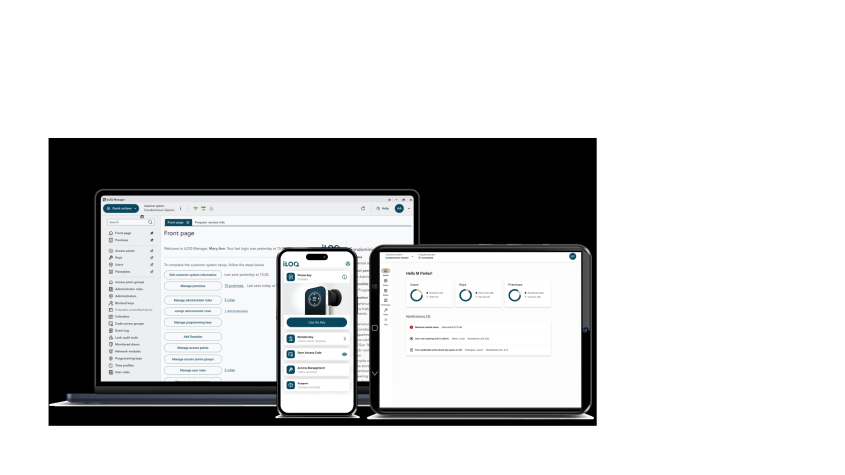

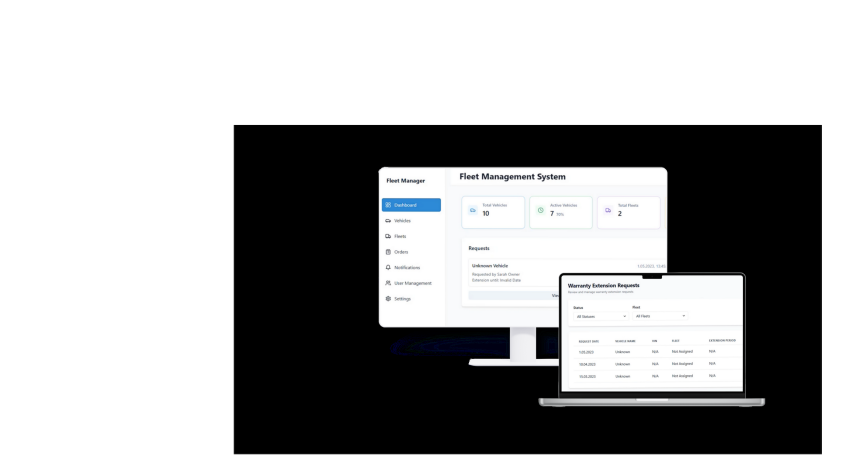
Learn how our browser-based application helped a US-based automotive company automate and manage fleet operations.
See the details
Our web app development services focus on business software with real users, live data, and integrations. Each system type below includes a typical scope and timeline.
Clients log in to track orders, download invoices and contracts, submit service requests, and book appointments. The portal reads live data from your ERP or CRM, so order status and balances match what your back office sees. Your support team receives structured requests with every required field already filled in.
Typical scope: role-based access, document storage, email notifications, 1 to 3 integrations
Typical timeline: 12 to 20 weeks

Order management, inventory, scheduling, approvals, field service, and reporting run in one application with one shared database. Managers see the status of every order or task on a single screen. Each user role sees the actions and data relevant to its daily work.
Typical scope: 3 to 6 modules, user roles and permissions, reporting, ERP or accounting integration
Typical timeline: 12 to 24 weeks

We build subscription products with multi-tenant architecture, organization and user management, billing through Stripe, Adyen, or Paddle, usage tracking, and admin panels. The first release goes to paying customers. Each later release adds features based on usage data and customer feedback.
Typical scope: tenant isolation, billing, onboarding flow, admin panel, usage analytics
Typical timeline: 10 to 16 weeks for the MVP
A custom CRM follows the exact steps your sales and service teams use today. It handles lead and request intake, task routing, multi-step approvals, SLA tracking, and automated email and SMS updates. Each request has a named owner and a visible deadline at every stage.
Typical scope: pipeline stages, routing rules, approval chains, email and SMS automation, 2 to 4 integrations
Typical timeline: 16 to 28 weeks
Dashboards pull data from your databases, ERP, CRM, and external APIs into one view. Users filter, drill down, and export to Excel or PDF. Scheduled reports land in managers’ inboxes every Monday morning, or on any cycle you set.
Typical scope: 2 to 5 data sources, near-real-time KPIs, role-based views, scheduled reports
Typical timeline: 6 to 12 weeks
Larger organizations get single sign-on through Microsoft Entra ID or Okta, audit logs, granular permissions, data retention rules, and GDPR compliance built in from the first sprint. Your security team reviews the architecture during discovery and signs off before development starts.
Teams evaluating the best web application development platform or software usually compare five things: fit with existing systems, speed of delivery, hiring market, long-term support, and total cost over three to five years. We run that comparison with you during discovery and document the result.
These are the web application development frameworks we use most, and where each one fits best. This framework comparison covers both front-end and back-end, so you can plan a full-stack setup.
| Framework | Layer | Strongest fit | Typical projects |
|---|---|---|---|
| Angular | Front-end | Enterprise apps with complex forms, many user roles, and long maintenance horizons | Internal systems, admin panels, ERP extensions |
| React | Front-end | Highly interactive interfaces with a large component ecosystem | SaaS products, customer portals |
| Vue.js | Front-end | Lighter applications with a fast learning curve | Dashboards, internal tools |
| ASP.NET Core | Back-end | Companies running Azure, SQL Server, and Microsoft Entra ID | Enterprise systems, Microsoft Dynamics integrations |
| Java (Spring Boot) | Back-end | High-reliability systems in organizations with Java teams | Core business platforms, banking and insurance systems |
| Node.js (NestJS) | Back-end | Real-time features, APIs, and full-stack TypeScript | SaaS platforms, notification services |
Angular web application development is our default for internal and enterprise systems with complex forms, many user roles, and long maintenance horizons. Its strict structure keeps large codebases consistent as developers join and leave the team.
For back-end work in Microsoft environments, we use .NET web application development with ASP.NET Core. If your company already runs Azure, SQL Server, or Microsoft Entra ID, .NET Core web application development keeps your stack consistent and keeps hosting and licensing simple.
The best framework for web application development is the one that fits your environment, your team, and the type of application you need. We score each option against five criteria:
You receive the scoring, the recommended stack, and the reasoning in writing at the end of discovery.
Low-code tools such as Microsoft Power Apps or OutSystems fit simple internal forms, small user groups, and processes that match the vendor’s data model. Custom web app development fits applications with complex business rules, several integrations, customer-facing traffic, or a product you plan to sell.
Many companies combine both. A low-code tool handles simple approvals, and a custom application runs the core process. Discovery ends with a recommendation and a three-year cost estimate for each option you consider.
These ranges reflect typical custom web application projects. We confirm your exact timeline at the end of discovery, once scope and integrations are clear.
| Stage or project type | Typical duration | What you receive |
|---|---|---|
| Discovery and business analysis | 2 to 7 business days | Requirements, user roles, integration map, architecture outline, estimate |
| UX/UI design and clickable prototype | 3 to 10 business days | Wireframes, UI design, prototype tested with real users |
| MVP | 8 to 14 weeks | Working product with core features, live in production |
| Business platform (portal, CRM, or internal system with 2 to 4 integrations) | 16 to 28 weeks | Production-ready application with integrations, admin panel, reporting |
| Enterprise web application (multiple modules, SSO, complex integrations, data migration) | 6 to 12 months to the first major release | Phased rollout with new releases every 4 to 8 weeks |
| Optimization sprint for an existing app | 5 to 15 business days | Audit, prioritized fixes, measured before-and-after results |
| Post-launch stabilization | 1 to 3 weeks | Bug fixes, monitoring, tuning under real traffic |
Fast web application development comes from a tight first release. When the launch date is fixed, we move lower-priority features to the next release and keep code reviews, automated tests, and QA in every sprint.
Our web application development process runs in short cycles with a clear owner for every decision. After each stage, you receive a concrete deliverable and approve the next step.

We run workshops with stakeholders and the people who will use the app every day. We map processes, user roles, data flows, and integrations.
You receive: scope, release plan, stack recommendation, estimate.
You decide: scope and budget for the first release.

We design wireframes and a clickable prototype, then test it with real users. Changes at this stage take hours, so the riskiest assumptions get settled early.
You receive: tested prototype and final UI design.
You decide: design sign-off.

We define the data model, set up CI/CD pipelines, and prepare separate test and production environments.
You receive: architecture document and working environments.
Your IT or security team: reviews and approves the architecture.
Each sprint ends with a demo of working features. Every change passes code review and automated tests before it is merged.
You receive: a working increment every two weeks.
Your product owner: sets priorities for the next sprint.
We run functional, regression, performance, and security tests. Your team then tests the app against real scenarios.
You decide: release approval.
We deploy to production, migrate data when needed, and switch on monitoring and alerts.
We fix priority issues and tune performance based on how people use the application day to day.

Security patches, dependency upgrades, monitoring, and new features run under an SLA with response times written into the contract.

Year Hicron was established, as a provider of ERP technology
Our certification is a guarantee of quality and security for digital projects
software projects delivered since the company was founded, across all types of software
from consulting to go-live
Send us three things: who will use the application, what it should do, and which systems it connects to.
A solution architect joins a 30 to 45 minute call with you. Within 5 business days, you receive a recommended scope, a technology proposal with framework reasoning, and an estimated timeline and budget range.
Web application development services cover discovery, UX/UI design, front-end and back-end development, integrations, testing, deployment, and maintenance. The result is browser-based software such as a customer portal, CRM, internal system, SaaS product, or dashboard. Modern web application development also includes automated testing, CI/CD pipelines, and cloud infrastructure from the first sprint.
A focused MVP typically takes 8 to 14 weeks. A business platform with two to four integrations takes 16 to 28 weeks. An enterprise web application usually reaches its first major release in 6 to 12 months. Discovery takes 2 to 7 business days and ends with a confirmed timeline for your scope.
On the front end, Angular, React, and Vue.js lead for business applications. On the back end, ASP.NET Core, Java Spring Boot, Node.js, cover most custom projects. Angular with ASP.NET Core is a common full-stack choice for enterprise systems. React with Node.js is common for SaaS products.
The best web application development platform matches your existing systems, your users, and your three-year budget. Low-code platforms fit simple internal forms for small teams. Custom development with a framework such as Angular, React, or ASP.NET Core fits complex rules, multiple integrations, and customer-facing products. Discovery compares the options and recommends one in writing.
Cost depends on the number of features, user roles, integrations, and compliance requirements. An MVP sits at the lower end, and an enterprise platform with SSO and data migration sits at the higher end. After a 30 to 45 minute call, you get a budget range. After discovery, you get a detailed estimate broken down by release.
Yes. We start with a 5 to 15 business day audit of code, performance, infrastructure, and integrations. Then we modernize in stages, for example moving from AngularJS to Angular or from .NET Framework to .NET, while your team keeps using the application. Or Java to newest stack, like we didi it for HDI, see the details here.
Yes. We connect custom web apps to ERPs, CRMs, accounting software, payment providers, identity systems, and internal databases through REST or GraphQL APIs, webhooks, or message queues. Older systems connect through scheduled file exchange or database-level integration. Each integration typically takes 1 to 3 weeks.
Yes. Every launch includes 1 to 3 weeks of stabilization. After that, maintenance runs under an SLA covering security updates, dependency upgrades, monitoring, and bug fixes, with ongoing feature development in regular sprints.
Hicron Software proved to be a trusted partner with unmatched technical expertise, delivering a scalable and user-friendly web application that was pivotal to our successful U.S. market expansion.
Hicron’s contributions have been vital in making our product ready for commercialization. Their commitment to excellence, innovative solutions, and flexible approach were key factors in our successful collaboration.
I wholeheartedly recommend Hicron to any organization seeking a strategic long-term partnership, reliable and skilled partner for their technological needs.
After carefully evaluating suppliers, we decided to try a new approach and start working with a near-shore software house. Cooperation with Hicron Software was something different, and it turned out to be a great success that brought added value to our company.
With HICRON’s creative ideas and fresh perspective, we reached a new level of our core platform and achieved our business goals.
Many thanks for what you did so far; we are looking forward to more in future!

Hicron is a partner who has provided excellent software development services. Their talented software engineers have a strong focus on collaboration and quality. They have helped us in achieving our goals across our cloud platforms at a good pace, without compromising on the quality of our services. Our partnership is professional and solution-focused!

The IT system supporting the work of retail outlets is the foundation of our business. The ability to optimize and adapt it to the needs of all entities in the PSA Group is of strategic importance and we consider it a step into the future. This project is a huge challenge: not only for us in terms of organization, but also for our partners – including Hicron – in terms of adapting the system to the needs and business models of PSA. Cooperation with Hicron consultants, taking into account their competences in the field of programming and processes specific to the automotive sector, gave us many reasons to be satisfied.