Claim Automation AI: Insurance with Smarter Claim Processing AI
- March 13
- 29 min



ACORD data standards are technical specifications that give the insurance industry a common way to exchange information. They cover core areas like property & casualty, life & annuities, and reinsurance. ACORD develops and oversees these standardized forms as the recognized authority for global insurance data exchange. These standards make sure that insurers, agents, and business partners worldwide can communicate clearly and share data efficiently.
This article explains how ACORD standards influence insurance technology. It covers why software is essential for meeting compliance standards and how custom software makes managing certificates easier. The article also discusses how APIs improve data exchange and outlines the steps to create scalable technology solutions. You’ll learn about the advantages of digitizing ACORD forms, as well as how modern technologies like AI and blockchain can help process and validate ACORD data. The article examines integrating ACORD standards with older systems and explores what the future holds for ACORD in a technology-focused industry.
Key Takeaways:
ACORD data standards serve as the universal dictionary for the insurance market. They define how data is structured, labeled, and shared between parties. Without these shared definitions, communication between insurers, agents, and tech providers fails. Systems cannot talk to each other if they speak different languages.
Technically, these standards use formats such as ACORD XML and AL3. These protocols have changed from electronic data interchange (EDI) to flexible structures. JSON appears in modern web services as well. This change keeps data usable, even when the underlying technology shifts.
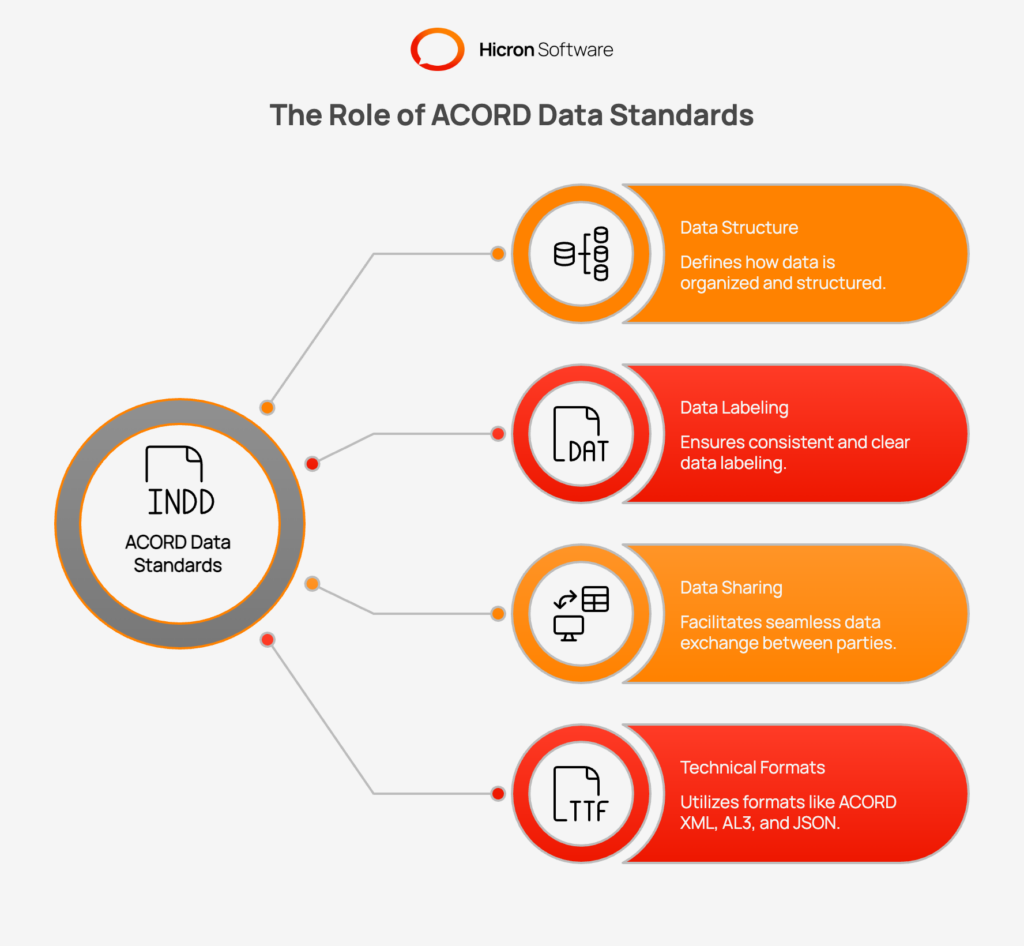
ACORD uses data models and well-defined data types like standardized formats for date/time, decimals, and unique IDs. This way, information is always clear and consistent. This shared set of rules lets companies connect old legacy systems with new cloud platforms. The result is better collaboration among IT, business teams, and all other stakeholders involved in insurance operations.
In a scenario where a broker sends policy details to a carrier. Without standards, the carrier might misinterpret “premium” or “coverage limits.” This causes errors, delays, and potential legal disputes. Standards prevent miscommunication by giving strict definitions for every data element.
Standards form the base for modern software integration. Cloud platforms use consistent data structures to work well. When systems use ACORD’s standards, integration is smooth and predictable.
This table outlines the key distinctions between ACORD’s two primary standards, highlighting their specific focuses within the insurance industry.
|
Aspect |
P&C Standards |
L&A Standards |
|
Primary Domains |
Property, Casualty, Surety, Auto |
Life, Annuities, Health (Non-Medical) |
|
Key Transactions |
Quotes, Claims, Bindings |
Illustrations, Policy Issuance |
|
Schema Versions |
e.g., PersAuto 1.4.0 |
e.g., Life 2.29.0 |
|
Interoperability Focus |
Localized, Market-Specific |
Enterprise-Focused |
|
Data Model Structure |
Lacks a single unified business data model; relies on domain-specific schemas. |
Maintains a distinct data model separate from P&C due to different business requirements. |
Manual workflows slow down every step in insurance. Human data entry introduces error risks. Typing fatigue brings mistakes that can make a policy invalid. Mistakes lower data quality and cause compliance trouble.
Regulatory bodies require strict audit trails and accurate data. Manual management does not work at scale because of these requirements. An insurance agency cannot manually process thousands of forms without mistakes. The cost of fixing these errors often exceeds the cost of automation.
Automation tools and digital workflows fix these problems. Software can validate data against ACORD schemas in real time. This keeps only correct, complete data in the system. Speed and reliability rise when machines handle the validation steps.
For example, a carrier’s automated ingestion process cut processing time by 80%. The software flagged missing fields before data reached an underwriter. This lowers operational burden and improves audit trails for compliance reviews.
The following table outlines key tools and frameworks used to implement and manage ACORD standards, detailing their primary functions and supported environments.
|
Tool/Framework |
Purpose |
Language/Support |
|
eiConsole for ACORD |
Acts as an Integrated Development Environment (IDE) for building interfaces, performing validation, and managing templates. It allows users to graphically manage, edit, and slice schemas. |
Java/XML |
|
Siebel Connector |
Facilitates the mapping of Siebel data to ACORD XML formats through a wizard-based interface. |
Siebel/Oracle |
|
WebSphere Transformation Extender |
Provides specialized packs for handling ACORD forms and pureXML data transformation within the IBM ecosystem. |
IBM Stack |
|
Open-source (e.g., GitHub ACORD-OPENAPI) |
Enables the conversion of XML schemas to JSON schemas using XSLT, supporting modern API development. |
Any XML Processor |
|
JAXB / XMLSerializer / lxml |
Generates code bindings (classes) from XSD files to simplify programmatic manipulation of ACORD messages. |
Java, C#, Python |
|
ACORD Validation Engine |
Validates messages against official schemas and business rules to ensure compliance before transmission. |
ACORD Member Tools |
Delivering audit-ready technology that aligns with ACORD standards requires a strategic approach focused on traceability, compliance, and data integrity from the ground up.
Key features of an audit-ready system include complete traceability, where every transaction and data modification is logged with user IDs and timestamps, creating a clear and unchangeable record. This is complemented by strong data integrity measures, such as encryption for data both at rest and in transit, and automated validation rules that ensure accuracy before data is ever submitted.
To achieve this, organizations should follow these steps:
Regular internal audits and partnering with technology experts who specialize in ACORD standards helps maintain ongoing compliance and ensure the system is always prepared for regulatory scrutiny.
ACORD insurance certificates are vital for proving coverage status. They are the standard proof of insurance across the industry. However, managing these certificates is often chaotic and not centralized.
Many organizations run both old and new technology. Older systems do not create or send certificates in real time. A backup forms when people make certificates by hand as needed. That delay lowers client happiness and hurts how well things run.
Custom insurance software automates the entire lifecycle of ACORD certificates. It creates an ACORD 25 form as soon as a policy is bound. The software tracks renewal dates and sends automatic updates. This keeps every client up to date with current proof of coverage.
Integration is crucial for this process. Middleware and adapters connect the certificate engine to core platforms or CRMs. This lets sales teams request certificates from their dashboard. Users do not have to move between different systems.
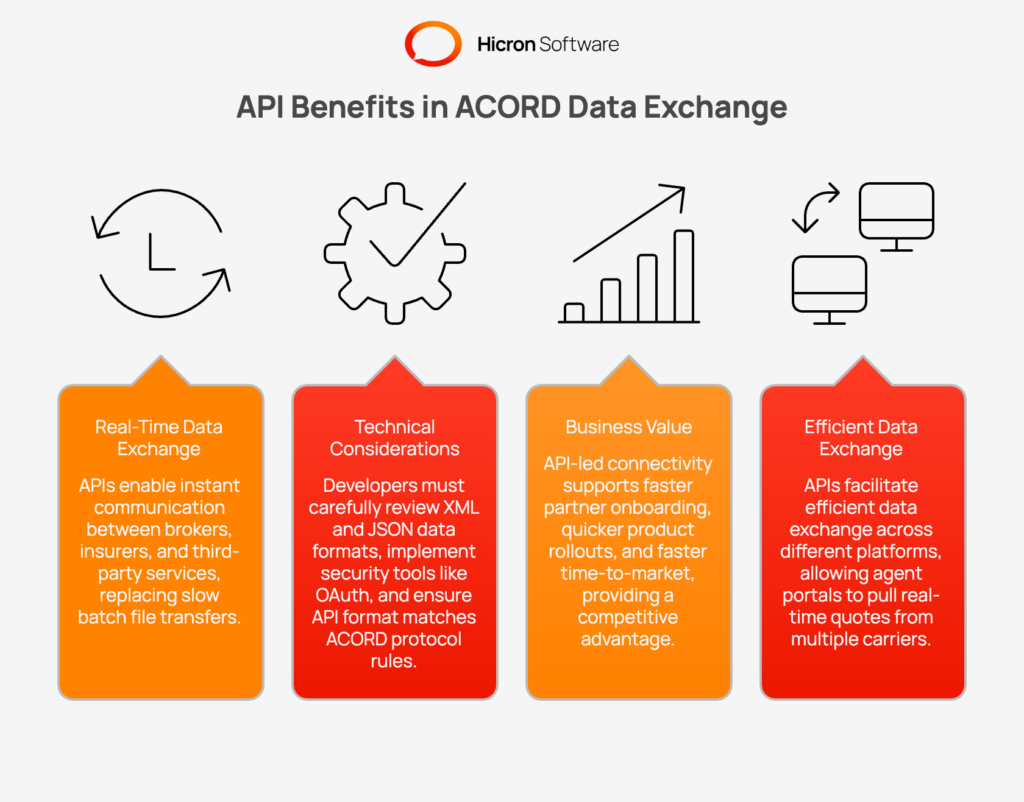
APIs power real time data exchange in insurance. They let brokers, insurers, and third-party services communicate instantly. This replaces slow, batch file transfers used in the past. Real time connectivity is now a standard requirement for customers.
Technical points matter when setting up these APIs. Developers review XML and JSON data formats with care. Security tools like OAuth and strong encryption keep the data safe. The API format must match ACORD protocol rules exactly.
API-led connectivity brings major value for businesses. It supports faster partner onboarding by using the same connection points. Insurers can roll out new products and reach new markets faster. Faster time-to-market is a clear competitive benefit.
APIs also support efficient data exchange across different platforms. An agent portal can pull real time quotes from multiple carriers at once. This capability depends entirely on robust, standardized API architecture.
Scalability in insurance operations means handling growth without hurting system performance. Systems must manage spikes in data volume during renewal seasons with no trouble. Designing for this level of traffic requires following the best practices.
Handling large volumes of complex ACORD data requires robust architecture. Systems should parse and validate XML or AL3 streams with care. Database schemas need tuning to store this hierarchical data. Performance techniques like indexing help with fast retrieval.
Security requirements need attention in scalable systems. Encryption protects data at rest and in transit. Detailed access controls let only authorized staff view private details. A cloud-native setup supports growth and brings security features.
Resiliency strategies keep the system available during failures. Automated testing suites catch regressions before deployment. Disaster recovery plans keep business running if something extreme happens. Modular code allows for easier maintenance and independent scaling of components.
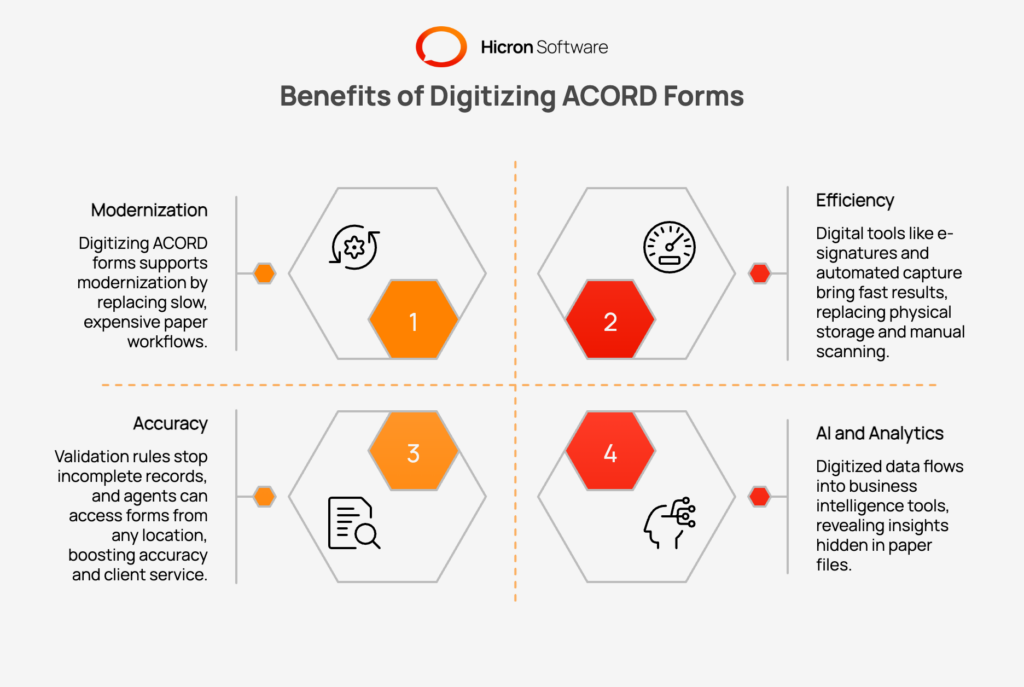
Digitizing standard ACORD forms supports modernization. Paper-based workflows are slow, expensive, and at risk of loss. Digital transformation turns static documents into dynamic data assets.
Paper workflows demand physical storage, mailing, and manual scanning. In contrast, digital tools such as e-signatures and automated capture bring fast results. Digital forms are instantly searchable, shareable, and secure. Automated capture moves data straight from the form into the database.
Digital forms boost accuracy for everyone who uses them. Validation rules stop users from sending incomplete records. Agents can access and fill out forms from any location. This flexible process helps agents work better and serve clients faster.
In addition, digital forms set up data for AI and analytics use. You cannot run analytics on a stack of paper. Digitized data flows into business intelligence tools. This reveals insights that were hidden in paper files.
AI and Machine Learning (ML) work best with structured, high-quality data. ACORD data provides a strong base for these advanced algorithms. For example, message types such as PersAutoPolicyAddRq in property and casualty insurance apply to claims fraud detection and anomaly finding. AI connects directly to data validation and anomaly tasks.
ML models can find patterns that show fraudulent activity. For example, they can spot inconsistencies in claims data quickly. Automated form classification sorts incoming documents without human review. This speeds up the intake process.
Predictive underwriting uses this data to assess risk more accurately. AI reviews past data to produce clear risk scores. This lets insurers price policies in a way that is both fair and profitable.
The business advantage comes from real time reporting and up to date insights. AI-powered dashboards show a current view of business health. Executives can make smart choices using fresh data, not old reports. This focus on speed helps a company adjust quickly when markets shift.
Blockchain technology provides qualities such as immutability and decentralization. These match the need for data integrity in insurance. For example, an ACORD message type like PersAutoPolicyAddRq is recorded on a blockchain to track new personal auto policies. This supports automated claims validation and fraud monitoring. Once data is on the blockchain, it cannot be altered in secret.
Applications for real time certificate verification hold great promise. A certificate of insurance stored on a blockchain can be verified quickly. Anyone can check coverage without calling the carrier. This creates audit trails that help prevent fraud.
Smart contracts can automate claims processing based on trusted data. If a flight is cancelled, the blockchain triggers an automatic payout. This depends on the core data record being accurate and standard.
Adoption challenges slow wider blockchain use. Interoperability between blockchains and legacy systems creates technical obstacles. Regulatory issues cause more trouble when using decentralized ledgers. The industry faces these barriers to gain results from blockchain solutions.
Skipping legacy integration brings business risks. Problems grow when newer tools cannot reach old data. Data silos give only partial customer and business insights. Processing costs keep rising if staff use manual workarounds.
A solid integration plan uses ETL processes and API gateways. ETL (Extract, Transform, Load) moves data from old silos to current data storage. API gateways act as a secure entry for legacy functions. Careful data mapping makes sure fields match correctly between systems.
A careful approach supports gradual migration rather than only fast, all-at-once replacements. Keeping backward compatibility protects business continuity as changes occur. Systems may run side by side while data moves in a controlled way. This reduces harm to daily work.
Support for XML and AL3 standards must be kept during migration. Legacy systems often use much older AL3 formats. The integration layer needs to convert these into current formats smoothly. This connection keeps the business running while technology changes.
Standards will grow with microservices and cloud computing. We will see smaller, modular standards that fit specific microservices. The single, large schema will give way to more flexible, assembled definitions.
Tech partners drive this change. They create new ACORD-ready adapters. These tools will make compliance almost invisible to users. Validation systems will get smarter, using AI to suggest corrections.
Insurers must prepare for future changes with flexible architecture. Rigidly encoding standards into main systems leads to outdated tools. Consistent upgrades and modular design let firms update with ease. The future rewards those who change their data strategy quickly.
By using these standards, the insurance industry moves toward a more connected future. Efficiency, accuracy, and new ideas will shape the next era of insurance.
Sources:
ACORD standards are the accepted data formats for the global insurance industry. They ensure data consistency. They let computer systems exchange information accurately. Without them, smooth data exchange across the insurance value chain would not happen.
The certification process begins when you join ACORD as a member. Membership gives you access to schemas, guides, and testing resources. Your organization prepares XML messages with ACORD’s official schema files. These messages are submitted through the Testing and Certification Facility (TCF), which is an online portal for validation. The system first checks for schema or DTD syntax and structure. After this, a manual review checks compliance with business rules and data quality rules. Passing both stages brings a certification report. Certified messages earn badges for production use in the insurance market.
AL3 was created for the first generation of electronic data interchange and remains in use. ACORD XML is a newer, flexible format fit for web-based data exchange. Both standards let industry stakeholders exchange data well, though XML works better for internet tools.
ACORD members get access to the library of schemas and guides. Membership lets organizations take part in shaping standards directly. It gives resources to support using ACORD standards in your technology setup.
Hicron Software proved to be a trusted partner with unmatched technical expertise, delivering a scalable and user-friendly web application that was pivotal to our successful U.S. market expansion.
Hicron’s contributions have been vital in making our product ready for commercialization. Their commitment to excellence, innovative solutions, and flexible approach were key factors in our successful collaboration.
I wholeheartedly recommend Hicron to any organization seeking a strategic long-term partnership, reliable and skilled partner for their technological needs.
After carefully evaluating suppliers, we decided to try a new approach and start working with a near-shore software house. Cooperation with Hicron Software House was something different, and it turned out to be a great success that brought added value to our company.
With HICRON’s creative ideas and fresh perspective, we reached a new level of our core platform and achieved our business goals.
Many thanks for what you did so far; we are looking forward to more in future!

Hicron is a partner who has provided excellent software development services. Their talented software engineers have a strong focus on collaboration and quality. They have helped us in achieving our goals across our cloud platforms at a good pace, without compromising on the quality of our services. Our partnership is professional and solution-focused!

The IT system supporting the work of retail outlets is the foundation of our business. The ability to optimize and adapt it to the needs of all entities in the PSA Group is of strategic importance and we consider it a step into the future. This project is a huge challenge: not only for us in terms of organization, but also for our partners – including Hicron – in terms of adapting the system to the needs and business models of PSA. Cooperation with Hicron consultants, taking into account their competences in the field of programming and processes specific to the automotive sector, gave us many reasons to be satisfied.