Hybrid Cloud Security: Components, Challenges, Best Practices
- May 22
- 24 min


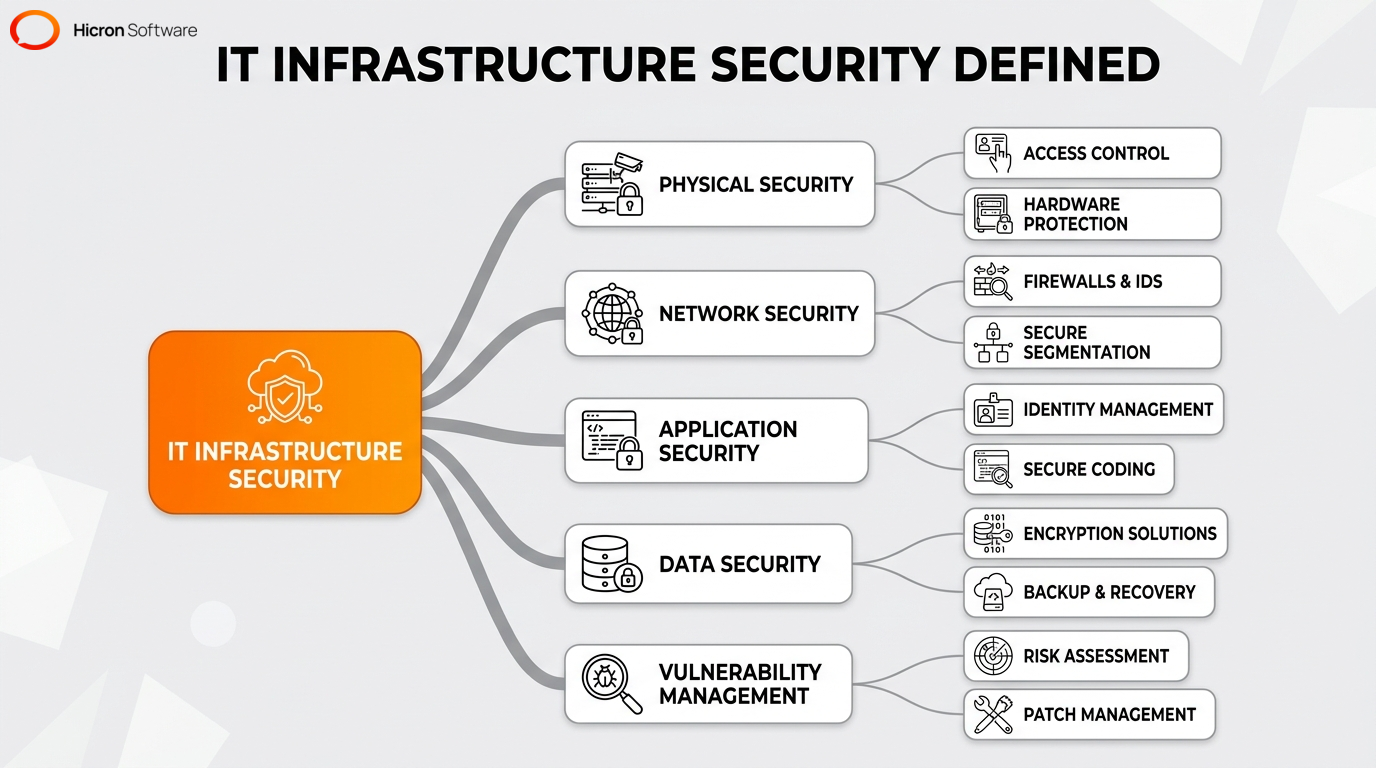
IT infrastructure security protects the hardware, software, networks, and access controls that keep IT operations running. Think of it as a digital safety net against cyber threats. At its core, it breaks down into four main areas:
Security teams safeguard critical infrastructure using specific defensive tools like firewalls, encryption, and intrusion detection systems. Vulnerability management identifies weaknesses across these environments. Strict access controls restrict unauthorized entry to prevent data breaches.
|
Security Domain |
Focus Area |
Common Threats |
Defensive Tools & Strategies |
|
Physical Security |
Tangible hardware, facilities, and data centers |
|
|
|
Hardware & Firmware Security |
Physical components and low-level software |
|
|
|
Network Security |
Communication pathways and moving data |
|
|
|
Application Security |
Software code and workloads |
|
|
|
Data Security |
Sensitive corporate information |
|
|
|
Cloud & Remote Infrastructure |
Virtualized environments, hybrid clouds, and edge devices |
|
|
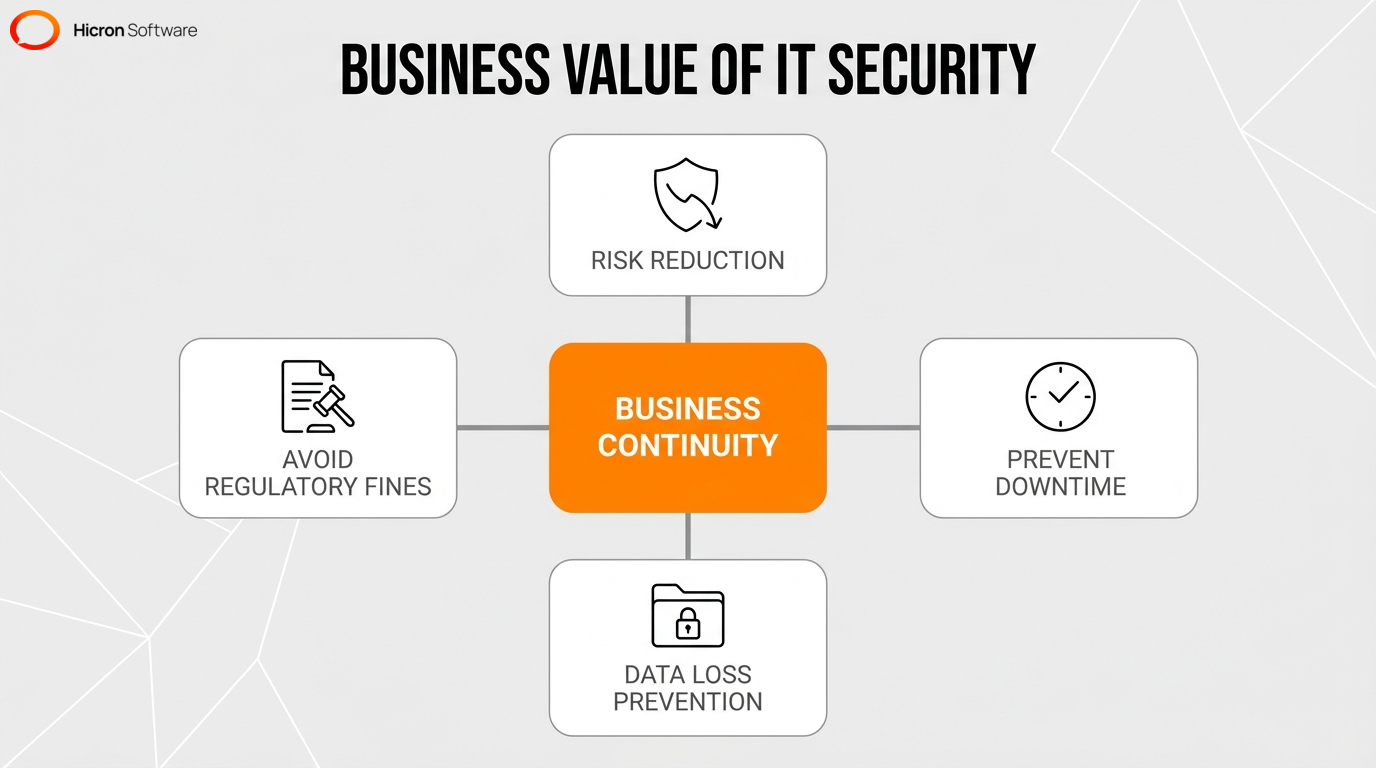
Above all, a well-configured security infrastructure ensures business continuity by reducing operational risk and protecting critical assets. It keeps your corporate data secret, accurate, and accessible when you need it. Proactive security operations prevent costly downtime and major data breaches caused by ransomware infections, insider threats, and network intrusions. If you’ve ever dealt with a sudden system outage, you already know how stressful and expensive that downtime can be.
Active vulnerability management, such as patching outdated software, helps IT teams minimize the organization’s exposure to attacks. If a breach does occur, having solid disaster recovery and data loss prevention plans ensures the business can keep running and avoid costly regulatory fines.
A defense-in-depth approach secures the entire technology stack using multiple connected layers, which eliminates single points of failure within IT environments. The OSI model serves as a conceptual framework for aligning cybersecurity domains across these different infrastructure levels. Overlapping defenses across every layer keep enterprise systems safe against advanced threats.
Physical security protects the tangible hardware and facilities supporting digital operations. After all, even the most advanced firewalls are useless if an attacker can physically walk out of a data center with a server rack. Securing data centers prevents critical physical risks, including hardware theft, equipment tampering, and natural disasters. In my experience, organizations sometimes spend millions on advanced software defenses while completely overlooking who has the physical keys to the server room.
Hardware security usually involves:
These steps keep the lights on and the servers running even if a facility experiences extreme weather or power outages.
Hardware and firmware security protect physical components and low-level software from low-level attacks. Securing the lowest level of the technology stack prevents system compromise before the operating system boots. Systematic patch management closes critical security gaps, such as unpatched interfaces and outdated microcode.
When IT teams apply updates systematically, they prevent attackers from exploiting hardware-level flaws. Effective vulnerability management strengthens overall infrastructure security by blocking advanced threats like hardware Trojans and firmware rootkits.
Network security defends communication pathways to keep data safe while it moves between systems. These defenses block unauthorized network access and external attacks, such as DDoS attacks.
The main tools for this job include:
Alongside firewalls, intrusion detection and prevention systems actively monitor this traffic to catch and stop threats in real time.
Application security protects software code and workloads to prevent exploitation. This discipline identifies and fixes internal flaws, such as hardcoded credentials or injection vulnerabilities, throughout the entire lifecycle, from development to deployment. Developers rely on core practices to ensure applications remain secure, such as DevSecOps integration, penetration testing, and runtime protections.
Effective vulnerability and patch management fix software misconfigurations. These operations block malicious threats, such as malware and application-layer attacks.
Data security safeguards sensitive information from loss, corruption, and unauthorized access. Security teams achieve this through a mix of encryption, strict access controls, and reliable backups. For instance, protecting information within the infrastructure requires both encryption at rest and in transit, while disaster recovery backups provide a safety net against ransomware.
IT systems are constantly under attack from both outside hackers and internal flaws. The evolving cybersecurity landscape targets these environments through distinct threat categories, primarily external attacks and internal vulnerabilities. Security teams counter these threats by continuously scanning for exposed entry points and enforcing strict access policies.
Ransomware and malware directly compromise data security and system availability by encrypting files or disrupting normal operations. When attackers demand payment to release data, companies face massive financial losses and prolonged operational downtime.
Effective incident response and strict data loss prevention help teams stop these attacks before they lock down the network.
Instead of trying to steal data, these attacks aim to take systems offline entirely by overwhelming networks with massive floods of traffic. This threat causes systems to crash, bringing business operations to a halt. Organizations protect their infrastructure using primary network security tools like firewalls and intrusion prevention systems.
These defensive mechanisms detect and block malicious traffic in real time. By actively monitoring traffic patterns, companies can detect and reroute malicious floods before they take systems offline.
Insider threats and phishing trick employees into bypassing security systems. Human error compromises infrastructure security primarily through insiders abusing legitimate access and social engineering, extracting user credentials. Security teams reduce this risk using tools like identity and access management (IAM) and multi-factor authentication (MFA).
Security awareness training teaches employees how to spot scams and phishing emails.
Cloud infrastructure security relies on a shared responsibility model between the provider and the organization, unlike fully controlled on-premises environments. This model dictates a strict division of security tasks: the provider manages physical hardware while the organization secures internal assets. This is a major shift from physical control to securing virtualized environments and cloud-based data.
Virtualization technologies isolate workloads to reduce the attack surface in cloud environments. By isolating workloads, organizations ensure strong network and data security across distributed systems. Administrators protect these virtualized assets using strict access controls, identity and access management, and workload encryption.
Hybrid cloud security integrates these modern cloud defenses with traditional on-premises protections, which is necessary to keep data safe as it moves back and forth between local servers and the cloud.
Securing a hybrid cloud environment is highly complex because it requires integrating, monitoring, and protecting assets seamlessly across both on-premises and cloud platforms. The biggest challenge is maintaining consistent security policies across disparate infrastructures and managing data flow between local servers and the cloud.
Administrators ensure uniform protection by extending modern cloud infrastructure security principles to legacy on-premises systems. This integration guarantees strong data and network security across all connected platforms. IT teams prevent unauthorized entry by enforcing strict access controls and comprehensive identity and access management (IAM). Using virtualization across the entire technology stack helps administrators effectively isolate workloads.
Edge computing security protects data and devices at distributed locations to secure entry points outside the central data center. Securing these edge locations reduces latency while lowering the risk of physical tampering and network breaches at remote sites.
Securing these distributed components requires strong endpoint protection, secure remote access, and zero-trust security.
Because modern work happens in the cloud and on remote devices, the old “castle and moat” approach to network security no longer works. Zero-trust assumes attackers have already breached the network, eliminating default trust and requiring continuous validation for every user and device. This model completely shifts away from perimeter-based defenses to a strict “never trust, always verify” approach. While treating every single connection with suspicion might sound a bit paranoid at first, it has become an absolute necessity in today’s threat landscape. This framework reduces the overall attack surface by strictly limiting access to internal resources.
Modern IT infrastructure increasingly adopts zero-trust policies to prevent unauthorized lateral movement across networks. Continuous endpoint protection and advanced data security protect data against compromised credentials.
Core technologies that enforce zero-trust access policies include identity and access management (IAM) and multi-factor authentication (MFA). These tools strictly check user identities and control resource access. IAM provides the policy framework to ensure the right users have appropriate access controls. MFA requires multiple verification steps, significantly reducing the risk of compromised credentials.
Zero-trust security architectures use multi-factor authentication to validate identity before granting secure remote access through IAM controls. These identity tools protect infrastructure and data security against critical vulnerabilities like insider threats and phishing.
Protecting IT environments requires a complete approach that combines proactive maintenance, modern architectures, defensive tools, and continuous security testing. A multi-layered defensive framework integrates overlapping safeguards to protect critical corporate assets. Integrating human-centric defenses with technical controls fixes critical vulnerabilities. Continuous monitoring across all physical and virtual environments ensures comprehensive infrastructure security.
Vulnerability and patch management keep systems safe by identifying, prioritizing, and fixing software flaws before exploitation. Proactive maintenance prevents cyberattacks through distinct security operations, such as scanning systems for misconfigurations. Vulnerability management provides the specific analysis required to prioritize patch deployment effectively.
This critical practice applies updates to software and firmware to close security gaps across infrastructure and application security domains. Administrators validate this defense using proactive methods like penetration testing and automated scanning, which blocks devastating cybersecurity threats, including malware and ransomware.
Network segmentation divides a network into smaller, isolated zones to contain potential breaches and restrict the lateral movement of attackers. Dividing a network improves overall cybersecurity by ensuring a local compromise doesn’t affect the entire system. Network segmentation works hand-in-hand with zero-trust security to reduce the attack surface.
Firewalls and intrusion prevention systems act as the borders between these segmented zones to enforce strict access controls.
Penetration testing tests how strong a network really is by simulating real-world cyberattacks to prove existing cybersecurity defenses actually work. Ethical hacking tests current security operations across critical environments, including infrastructure, application, and network security. As a security professional, I can tell you that nothing exposes hidden blind spots quite like watching a skilled ethical hacker successfully bypass a defense you thought was bulletproof.
Administrators use these test results to improve vulnerability management and confirm that previously identified gaps are effectively closed.
DevSecOps integrates security practices directly into the software development and IT operations lifecycle to ensure continuous protection. This approach embeds defensive measures into modern workflows by treating protection as a priority and getting development, security, and operations teams to work together. DevSecOps uses automation for continuous vulnerability scanning and patch management during active deployment.
These integrated security operations proactively secure critical IT domains, such as application and cloud infrastructure security. Effective vulnerability management fixes critical software flaws, such as unpatched code and exposed credentials.
Securing IT infrastructure requires a stack of defensive technologies that integrate monitoring, prevention, and response across the environment. A strong defense requires specialized tools to maintain continuous observability and ensure rapid incident response.
Firewalls and intrusion detection systems monitor network traffic to enforce access rules, detect suspicious activity, and automatically block potential cyber threats. Firewalls act as a strict barrier between trusted and untrusted networks based on predefined rules, while intrusion detection systems analyze traffic patterns to identify malicious behavior.
Intrusion prevention systems take this a step further by actively blocking threats like DDoS attacks and malware.
Security teams maintain visibility across complex IT environments by centralizing security logs and event data, such as firewall logs and authentication records, for analysis. SIEM and observability tools automate monitoring and provide real-time system insight. Security operations use automation and AIOps to identify anomalies that indicate a security breach, such as unauthorized logins or traffic spikes.
SIEM gives teams the real-time data they need to respond to incidents quickly.
Endpoint protection and secure remote access protect individual devices connecting to the corporate network to prevent them from becoming vulnerable entry points. This covers primary user devices, including laptops, mobile phones, and remote workstations.
These defensive tools block major threats like malware and ransomware. Administrators ensure encrypted and authenticated connections for remote workers using zero-trust security architectures, strict identity and access management, and multi-factor authentication.
Data encryption encodes sensitive information to ensure data confidentiality by converting plaintext data into unreadable ciphertext using cryptographic algorithms. This process protects corporate assets in two primary states: encryption at rest for stored data and encryption in transit for moving data. By doing this, encryption stops attackers from exploiting critical vulnerabilities like packet sniffing on networks and unauthorized server access.
Cryptographic algorithms ensure that even if hackers steal the files, they can’t read them.
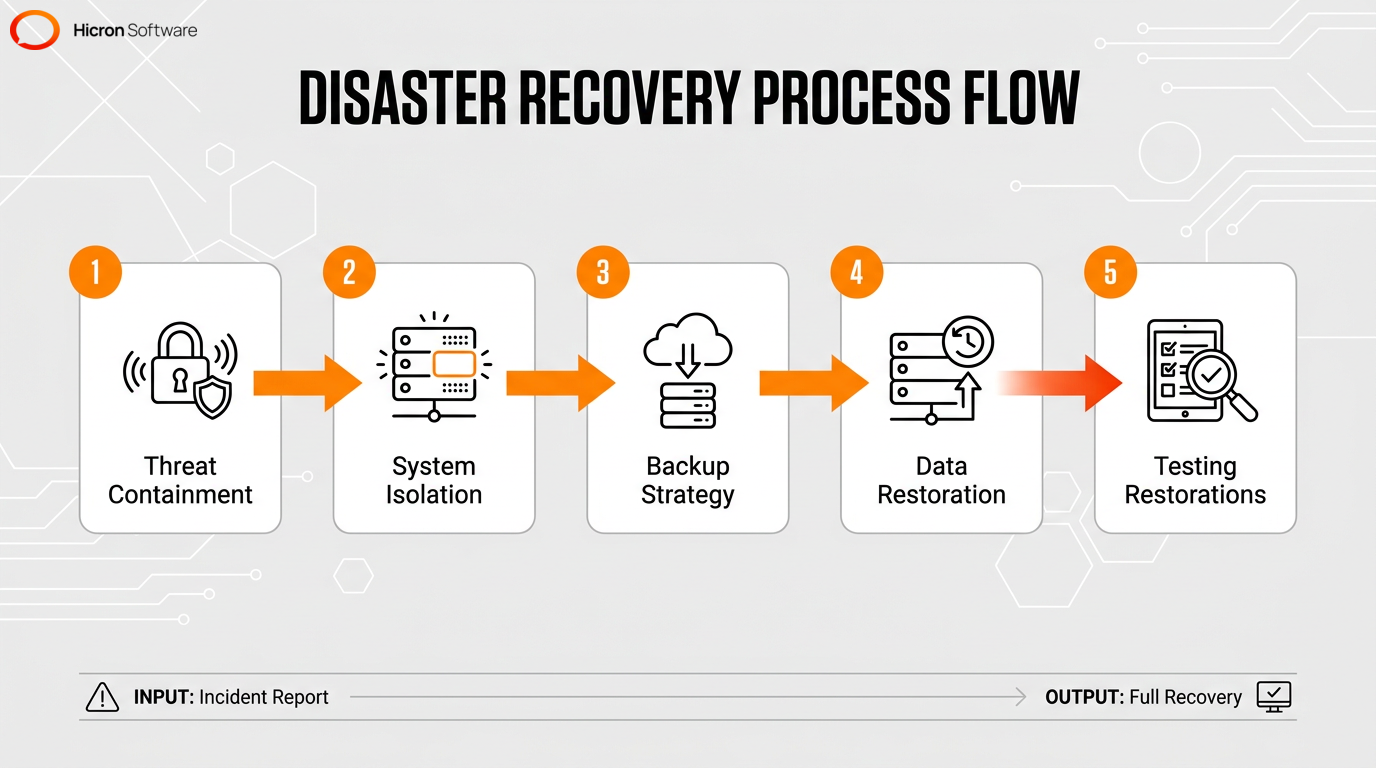
Disaster recovery and incident response provide the exact framework necessary to swiftly restore vital IT functions and minimize downtime following a security event. Organizations recover from successful cyberattacks using structured methodologies like incident response to contain active threats and disaster recovery to restore corrupted systems. Incident response uses a structured approach, such as threat containment and system isolation, to contain active breaches.
Data security relies on a reliable backup strategy to enable disaster recovery in case of devastating incidents like ransomware and data loss. This dual approach ensures business continuity by recovering lost information. A pro-tip often shared with IT teams is to regularly test those restorations, because a backup you haven’t tested isn’t a backup at all, it’s just a wish.
Regulatory compliance standards mandate specific data protection measures, establishing strict rules for data security that force organizations to align their IT security strategies with statutory law. As a result, aligning with a regulatory framework helps companies avoid devastating consequences like financial penalties and operational shutdowns. Primary laws impacting infrastructure security design include HIPAA and GDPR.
To meet these legal requirements, companies use tools like data encryption and identity and access management for data protection. Formal audits and strict access controls prove compliance during a regulatory evaluation.
Hicron Software proved to be a trusted partner with unmatched technical expertise, delivering a scalable and user-friendly web application that was pivotal to our successful U.S. market expansion.

Hicron’s contributions have been vital in making our product ready for commercialization. Their commitment to excellence, innovative solutions, and flexible approach were key factors in our successful collaboration.
I wholeheartedly recommend Hicron to any organization seeking a strategic long-term partnership, reliable and skilled partner for their technological needs.

After carefully evaluating suppliers, we decided to try a new approach and start working with a near-shore software house. Cooperation with Hicron Software House was something different, and it turned out to be a great success that brought added value to our company.
With HICRON’s creative ideas and fresh perspective, we reached a new level of our core platform and achieved our business goals.
Many thanks for what you did so far; we are looking forward to more in future!

Hicron is a partner who has provided excellent software development services. Their talented software engineers have a strong focus on collaboration and quality. They have helped us in achieving our goals across our cloud platforms at a good pace, without compromising on the quality of our services. Our partnership is professional and solution-focused!

The IT system supporting the work of retail outlets is the foundation of our business. The ability to optimize and adapt it to the needs of all entities in the PSA Group is of strategic importance and we consider it a step into the future. This project is a huge challenge: not only for us in terms of organization, but also for our partners – including Hicron – in terms of adapting the system to the needs and business models of PSA. Cooperation with Hicron consultants, taking into account their competences in the field of programming and processes specific to the automotive sector, gave us many reasons to be satisfied.