11 DevOps Automation Tools to Streamline Your Workflow
- May 21
- 10 min



Software development faces new challenges with autonomous artificial intelligence agents. Engineering teams need to establish cognitive guardrails to guarantee accuracy and adherence to standards. Cognitive guardrails like Test-Driven Development (TDD), Definition of Ready (DoR), and Definition of Done (DoD) establish necessary boundaries. These structures transform probabilistic generative models into predictable engineering workflows. Readers will understand how to apply these frameworks to effectively control artificial intelligence output.
Key Takeaways:
Cognitive guardrails act as stabilizing frameworks against systemic instabilities. LLMs often suffer from semantic drift and instruction amnesia during long sessions. These frameworks mitigate risks and reduce ambiguity in complex tasks. They improve workflow efficiency across multiple stages and agent interactions. Granular engineering artifacts enforce determinism in AI operations and maintain a high signal-to-noise ratio during development cycles.
Artifacts stiffen the entire work system by limiting acceptable solutions. They transfer memory beyond the standard context window. These structures provide clear stop criteria and create essential validation loops. More context does not always equate to better results. A model easily loses information and experiences context rot over time. Rotary Position Encoding has limitations over long operational horizons. Granular artifacts help manage context effectively without overwhelming the model.
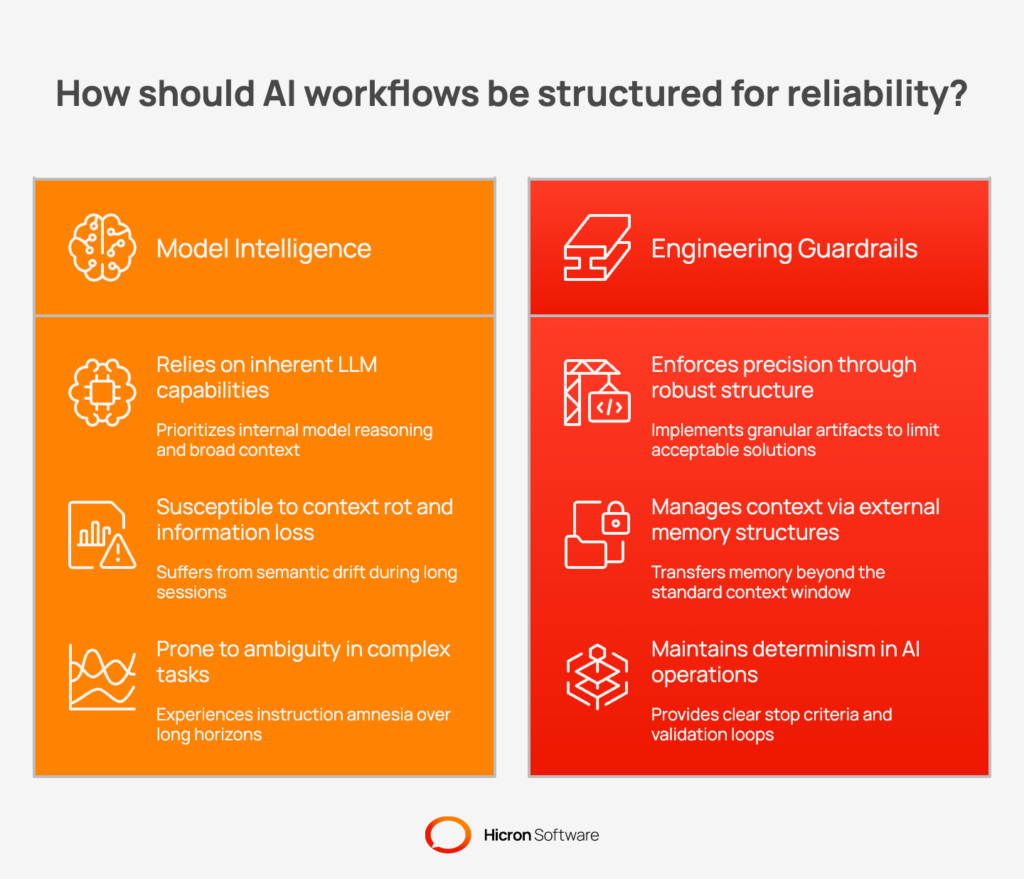
The thesis about artifacts as guardrails shifts the center of gravity. It moves away from relying entirely on model intelligence. It moves toward enforcing precision through robust engineering structure. This principle guarantees that agents operate within safe and predictable bounds.
Test-Driven Development offers a structured approach for software teams. It relies on a generate, run, and fix loop. This loop adapts perfectly for modern autonomous workflows.
There are several benefits of using Test-Driven Development here:
Development efforts now shift from implementation to rich definition phases. Code generation becomes faster, but error costs change entirely. The most expensive mistake is no longer writing bad code. The worst error is sending an agent on the wrong trajectory. A system needs a mechanism to stop the agent early. Test-Driven Development serves as the required stopping mechanism.
Test suites narrow the space of possible implementations. They act as active steering mechanisms for code generation. Agents use tests to retrieve relevant context. They also use failing tests to refine their output. This continuous feedback loop ensures high-quality code generation.
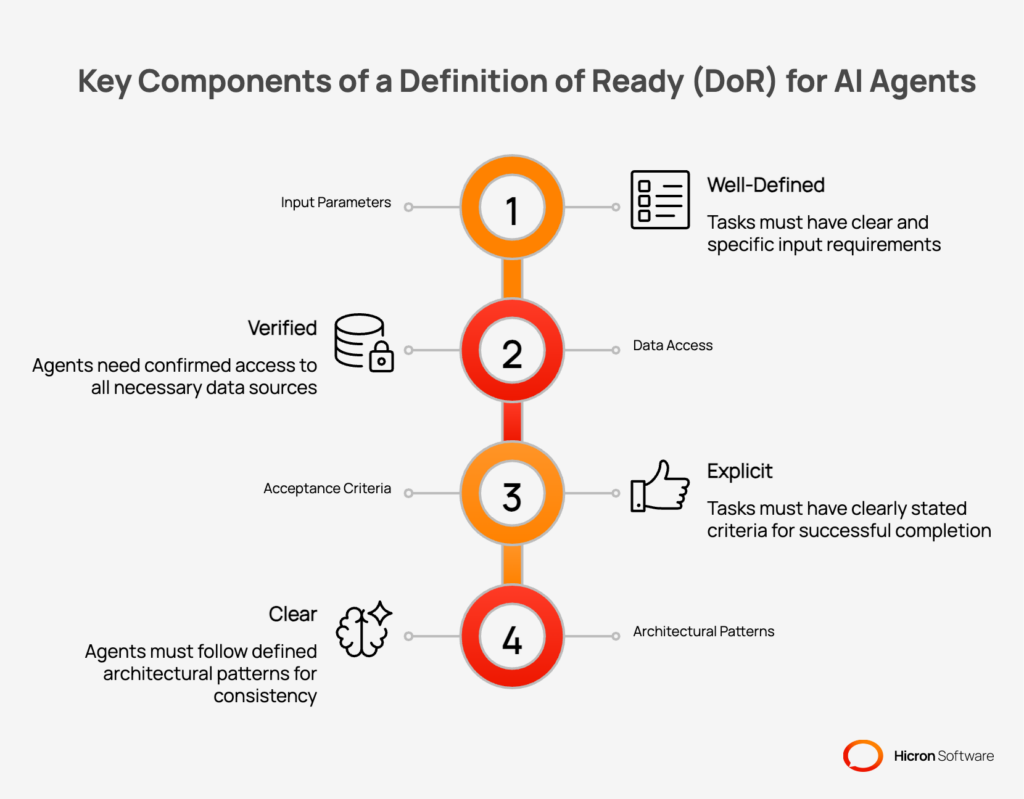
A Definition of Ready (DoR) establishes clear criteria that tasks must meet before work begins. For an AI agent, this protocol is crucial for minimizing rework and improving predictability in complex projects. Poorly prepared prompts can lead to cascading errors, as agents need specific conditions to start a task successfully.
A proper Definition of Ready includes well-defined input parameters, verified access to necessary data sources, explicit acceptance criteria, and clear architectural patterns to follow. Missing information forces models to fill knowledge gaps with generalized training data, leading to false assumptions and creating massive technical debt. A well-working system requires completely clear and unambiguous objectives.
DoR acts as an input gate. Investing time in these readiness checks reduces downstream debugging. Software development teams save valuable resources by clarifying objectives upfront. Strict input boundaries prevent models from diverging from architectural standards.
By progressively providing context, we can improve an agent’s performance. Teams break down large problems into smaller, more manageable parts like requirements, design, and specific tasks. This method feeds information to the agent sequentially, helping it understand both what to build and why. The initial readiness checks ensure that no critical information is missing from the start.
The Definition of Done (DoD) establishes completion criteria for technical tasks. It determines when an agent’s output is considered complete and acceptable. This framework ensures the overall quality and compliance of generated outputs. It maintains high utility standards for all artificial intelligence contributions.
Key elements of a Definition of Done include:
Adjudication artifacts play a critical role here. They determine whether a specific outcome is ultimately accepted or rejected. Without these artifacts, teams cannot verify the actual quality of the output.
An artifact only becomes a guardrail when it is subject to validation itself. Without a feedback loop, it is merely a formalized hypothesis that an agent can uncritically scale.
Engineering artifacts guide agents by serving four distinct cognitive roles. They replace vague prompts with machine-verifiable rules.
A bad artifact is worse than having no artifact if validation loops are missing. An agent will blindly scale errors based on flawed artifacts. Artifacts become powerful only when systems continuously test and validate them.
Different frameworks serve distinct purposes in the development lifecycle. The table below illustrates their primary functions.
|
Framework |
Primary Purpose |
Execution Phase |
Core Benefit |
|
Definition of Ready |
Establishes starting criteria |
Before task initiation |
Prevents bad trajectories |
|
Test-Driven Development |
Validates incremental work |
During code generation |
Provides immediate feedback |
|
Definition of Done |
Confirms task completion |
After task execution |
Ensures quality compliance |
The engineering community debates the ultimate source of truth. Some argue that the code is the only truth. Others champion the specification as the ultimate authority. Relying solely on code causes problems for artificial intelligence. The code contains implementation details but lacks the original intent.
Specifications capture a feature’s purpose and constraints, and progressive context construction relies heavily on them. However, massive static documents confuse language models. Lean specifications work much better because they provide just enough structure to guide the agent.
The best approach uses a layered truth model. The specification holds the truth regarding intent and constraints. The code holds the truth regarding the current implementation. Tests and policies hold the truth regarding system behavior. Machine-verifiable criteria resolve conflicts between the specification and the code.
Definition of Done, Definition of Ready and Test-Driven Development make workflows more deterministic. Large language models are inherently probabilistic and stochastic. Strict guardrails wrap these probabilistic models in deterministic rules. Tools like JSON Schema enforce strict data shapes and types.
High-stakes environments like finance and healthcare demand absolute security. Soft guardrails in prompts fail easily under complex conditions. Hard guardrails acting outside the model provide true security. Policy engines block unauthorized actions regardless of the model reasoning. Teams building critical applications must prioritize hard external guardrails over prompt engineering.
Artificial intelligence code generation reduces initial implementation time. However, debugging poorly generated code consumes massive resources. Artifacts require an initial time investment from human engineers. Senior engineers need to design precise specifications and rigorous tests, but this initial investment pays off by reducing technical debt down the line.
Project management dynamics are shifting from pure coding toward better-defined requirements. Teams control outcomes by validating machine-verifiable artifacts. This process makes stochastic models behave more deterministically. High-stakes environments demand this level of predictability.
Organizations will be subject to a new skill tax. Relying entirely on artificial intelligence reduces local team knowledge. Code reviews become harder when humans lack full context. Creating detailed engineering artifacts compensates for this knowledge loss. Artifacts capture tribal knowledge and store it permanently.
Cognitive guardrails offer a structural solution to the instability of artificial intelligence. Models require precise constraints to function reliably. Definition of Done, Definition of Ready, and Test-Driven Development provide the necessary boundaries. These tools convert probabilistic code generation into strict engineering output.
Engineering leaders moving their teams through the next levels of the AI autonomy ladder should adopt these cognitive guardrails as standard practice. Software quality depends entirely on the constraints placed around the generation process. Teams should focus on building executable specifications and verifiable boundaries by integrating strict acceptance criteria into all automated workflows.
Hicron Software proved to be a trusted partner with unmatched technical expertise, delivering a scalable and user-friendly web application that was pivotal to our successful U.S. market expansion.

Hicron’s contributions have been vital in making our product ready for commercialization. Their commitment to excellence, innovative solutions, and flexible approach were key factors in our successful collaboration.
I wholeheartedly recommend Hicron to any organization seeking a strategic long-term partnership, reliable and skilled partner for their technological needs.

After carefully evaluating suppliers, we decided to try a new approach and start working with a near-shore software house. Cooperation with Hicron Software House was something different, and it turned out to be a great success that brought added value to our company.
With HICRON’s creative ideas and fresh perspective, we reached a new level of our core platform and achieved our business goals.
Many thanks for what you did so far; we are looking forward to more in future!

Hicron is a partner who has provided excellent software development services. Their talented software engineers have a strong focus on collaboration and quality. They have helped us in achieving our goals across our cloud platforms at a good pace, without compromising on the quality of our services. Our partnership is professional and solution-focused!

The IT system supporting the work of retail outlets is the foundation of our business. The ability to optimize and adapt it to the needs of all entities in the PSA Group is of strategic importance and we consider it a step into the future. This project is a huge challenge: not only for us in terms of organization, but also for our partners – including Hicron – in terms of adapting the system to the needs and business models of PSA. Cooperation with Hicron consultants, taking into account their competences in the field of programming and processes specific to the automotive sector, gave us many reasons to be satisfied.