11 DevOps Maturity Assessment Questions to Ask During the Audit
- April 02
- 6 min



Artificial intelligence frameworks reduce token consumption and improve the structure of software projects. Using frameworks like BMad prevents developers from recreating basic architecture. Clear specifications save money as GitHub Copilot tightens usage limits. Structured workflows ensure reliable code generation and better project management.
Software development changes because bottlenecks shift. Writing code previously required very heavy financial investments from businesses. Teams used the Waterfall method to plan entire systems upfront. Developers often discovered critical errors too late in the process. The Agile methodology eventually solved this specific project management issue. Agile permitted teams to ship smaller pieces of code continuously.
Now, artificial intelligence tools generate code in seconds, dropping the cost of creation dramatically. So, what is the new bottleneck? Problem framing. Developers must specify exactly what they need the AI to do. While a clear specification used to feel like extra overhead, it now provides massive leverage. The developers who specify constraints the most effectively will ultimately win.
Let’s explore why frameworks matter for modern software development, how you can manage the economics of AI, and what you need to do to maintain top-tier engineering quality.
Frameworks structure context and establish clear review gates for AI agents. Strong models can generate code quickly, but this doesn’t guarantee reliable delivery. Frameworks encode proven patterns so developers do not recreate them. This creates a foundation for autonomy in production.
Using AI tools without structural guardrails creates chaotic results. Just as Angular provides strict rules for frontend development to prevent teams from reinventing architectural decisions, agent frameworks bring that same discipline to AI. They turn random, unstructured prompting into repeatable, predictable workflows.
However, maturity levels vary wildly across different tools. While conventional frameworks like Angular have over a decade of production history, agent frameworks are still in their infancy. For example, BMAD operates as a community project without production versioning, and GitHub Spec Kit remains an experimental tool. Based on our hands-on experience testing these systems, developers must evaluate these options carefully. Understanding the underlying structure helps teams deploy reliable, long-lasting solutions.
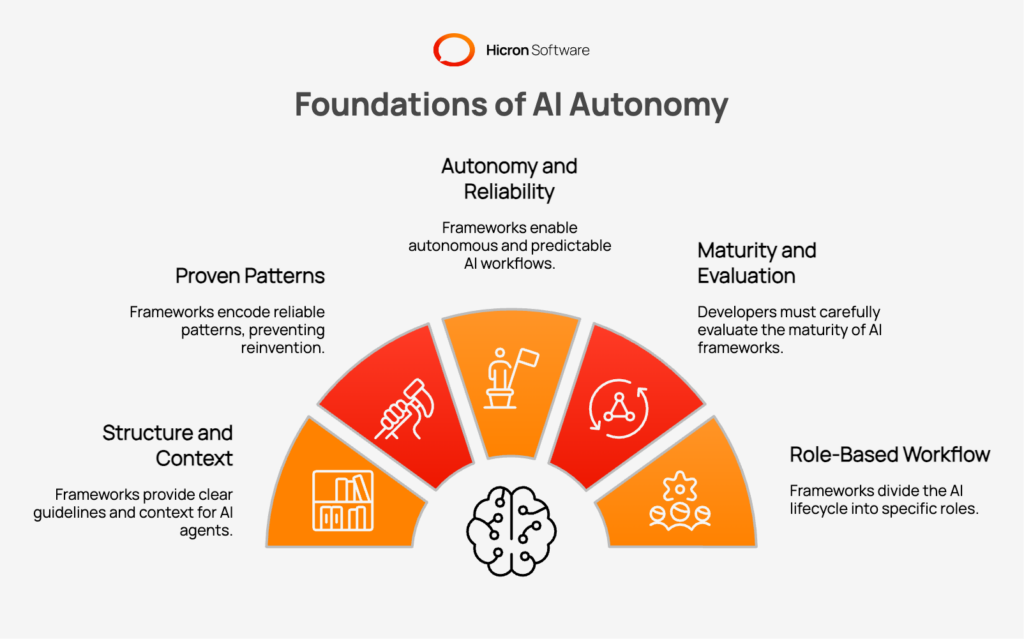
Structure is the price of reliable autonomy. Frameworks divide the AI software lifecycle into specific, manageable roles. The BMad framework, for instance, assigns distinct roles like Analyst and Architect. Each role receives specific context, moving the workflow smoothly from requirements to architecture, and finally to task execution. By placing human checkpoints before every implementation phase, this approach catches mistakes early and keeps projects on track.
Token consumption directly impacts your software project’s financial budget. Sending too much context to an AI model costs money, making good context engineering a vital economic discipline.
The correlation between token usage and technology adoption is clear: higher token usage typically indicates that developers are using AI to solve complex problems. However, the cost of implementation changes quickly. Developers actively use tools like Claude Code and Cursor, and different models carry different price tags. Since premium models are more expensive, teams must track usage carefully and proactively budget for token consumption.
In this new economic model, documentation serves an extra purpose. Files like architecture notes now act as the operating interface for the AI agent. Vague documentation leads to vague agent behavior, which wastes tokens and inflates project costs. Precise documentation saves money.
Measuring developer productivity also requires new metrics. Story points and lines of code no longer tell the whole tale. Instead, teams should measure how many cognitive tasks the AI agent successfully handles. Tracking token consumption helps quantify this efficiency, ensuring teams have enough runway for necessary experimentation.
Artificial intelligence rewards good engineering and punishes poor practices. Human judgment remains fundamental for validating decisions. Tools do not replace software engineers, they amplify the capabilities of strong engineers. Experienced developers spot subtle mistakes instantly. Junior developers often miss these errors. The technology amplifies the gap between junior and senior judgment.
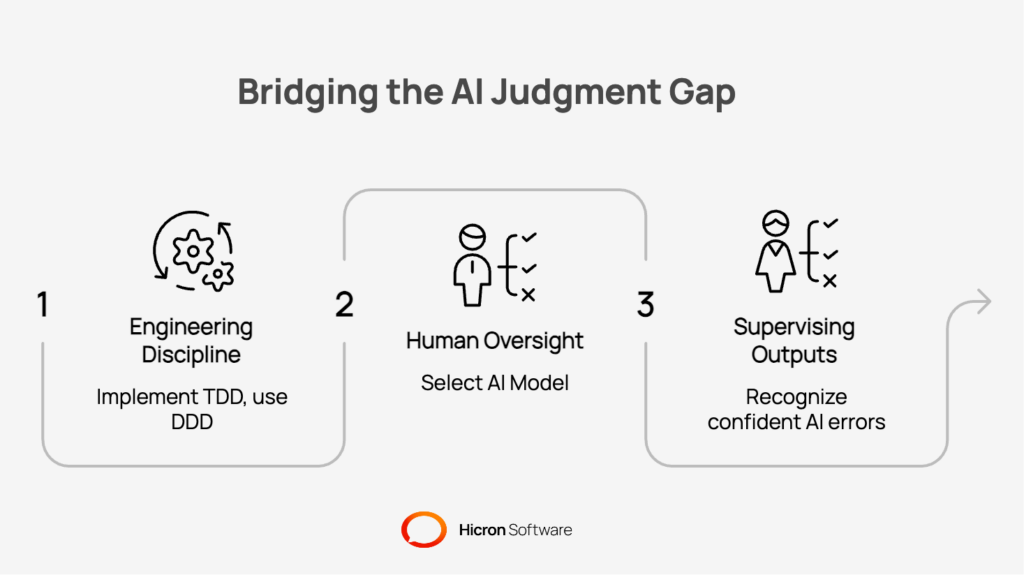
Experienced developers spot subtle, generated mistakes instantly, whereas junior developers often miss them. Consequently, this technology widens the gap between junior and senior judgment. Working with AI agents shifts the developer’s effort from typing out code to supervising outputs. The hardest part of the job is now recognizing when an AI agent is confidently wrong.
Engineering discipline acts as your primary guardrail for quality. Practices like Test-Driven Development (TDD) or strict Definitions of Ready followed by strict Definitions of Done are no longer just corporate ceremonies; they ensure agent delivery is reliable. Missing requirements inevitably lead to poor code quality.
Also, selecting the right AI development model requires human oversight. Whether choosing between autonomous engineers like Devin or open-source alternatives like OpenHands, a human must decide which tool best fits the project’s unique constraints. Both tools require configuration and maintenance. Strong engineering principles guarantee optimal outcomes.
The era of cheap artificial intelligence seems to be coming to an end. As companies tighten usage limits on their tools, the unlimited pricing model is proving unsustainable. Organizations should prepare for token-based billing.
Recent industry events highlight this major shift. GitHub recently paused signups for GitHub Copilot Pro, Anthropic removed access to Claude Code from specific plans, and platforms across the board are implementing tighter limits.
These changes carry major implications for your development teams. You can no longer afford to experiment without financial consequences. Organizations should allocate specific budgets for AI usage and train developers to write highly efficient prompts that consume fewer tokens. The window for cheap experimentation is closing, making structured workflows mandatory to control long-term expenses.
Frameworks are absolutely necessary for reliable software solutions. The combination of artificial intelligence power and concentrated engineering principles creates success. Companies should prepare for a future with more autonomy.
Frameworks like BMad and GitHub Spec Kit are great spots for organizations to start. They provide the essential structure for agent workflows. Teams should update the documentation practices immediately, treating the technical specs as the primary interface for your AI tools. Engineers need to focus on context design and constraint setting. The developer’s role is evolving, and writing code is becoming a secondary task. Problem framing is the new primary skill. Teams that master problem framing and context design will undoubtedly dominate the market.
The sooner your teams start standardizing their development processes, the better. Implement strict review gates for all generated code and treat token consumption as a primary project metric. Embrace structured workflows to maximize productivity and minimize costs.
Here are the four steps of how you can prepare for a future driven by autonomous agents:
Ready to optimize your development workflow? Get in touch for a consultation on AI frameworks and enterprise automation strategies.
Sources:
An AI software framework is a structured system for building AI-powered software that helps teams define context, constraints, workflows, and review steps so AI outputs are more reliable and efficient. AI Frameworks like BMad or GSD matter because they reduce wasted tokens, improve code quality, and shift the developer’s role from mainly writing code to framing problems and supervising AI-generated work.
In simpler terms: An AI software framework is like a set of rules and building blocks that helps developers use AI to create software in a more organized way. Instead of asking AI to do everything randomly, the framework helps people give clear instructions, check the results, and make sure the software works properly.
Hicron Software proved to be a trusted partner with unmatched technical expertise, delivering a scalable and user-friendly web application that was pivotal to our successful U.S. market expansion.

Hicron’s contributions have been vital in making our product ready for commercialization. Their commitment to excellence, innovative solutions, and flexible approach were key factors in our successful collaboration.
I wholeheartedly recommend Hicron to any organization seeking a strategic long-term partnership, reliable and skilled partner for their technological needs.

After carefully evaluating suppliers, we decided to try a new approach and start working with a near-shore software house. Cooperation with Hicron Software House was something different, and it turned out to be a great success that brought added value to our company.
With HICRON’s creative ideas and fresh perspective, we reached a new level of our core platform and achieved our business goals.
Many thanks for what you did so far; we are looking forward to more in future!

Hicron is a partner who has provided excellent software development services. Their talented software engineers have a strong focus on collaboration and quality. They have helped us in achieving our goals across our cloud platforms at a good pace, without compromising on the quality of our services. Our partnership is professional and solution-focused!

The IT system supporting the work of retail outlets is the foundation of our business. The ability to optimize and adapt it to the needs of all entities in the PSA Group is of strategic importance and we consider it a step into the future. This project is a huge challenge: not only for us in terms of organization, but also for our partners – including Hicron – in terms of adapting the system to the needs and business models of PSA. Cooperation with Hicron consultants, taking into account their competences in the field of programming and processes specific to the automotive sector, gave us many reasons to be satisfied.