AI in Property Management Solutions, Examples, and Decision Compass
- May 13
- 22 min

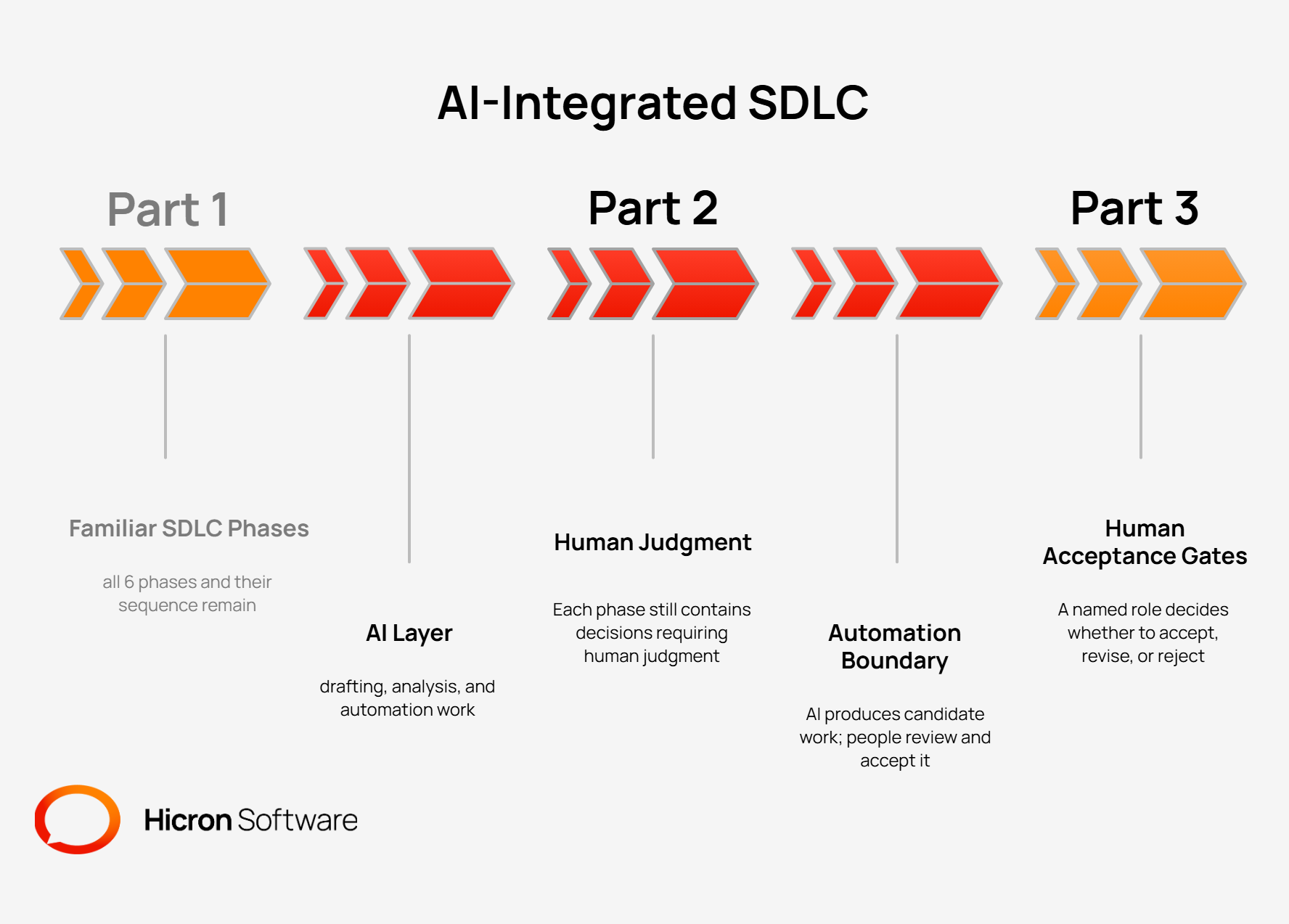
An AI software development lifecycle (AI SDLC) is a software delivery process that follows the standard SDLC phases but uses AI in each phase to support drafting, analysis, and bounded automation, while people retain responsibility for review, approval, and final decisions.
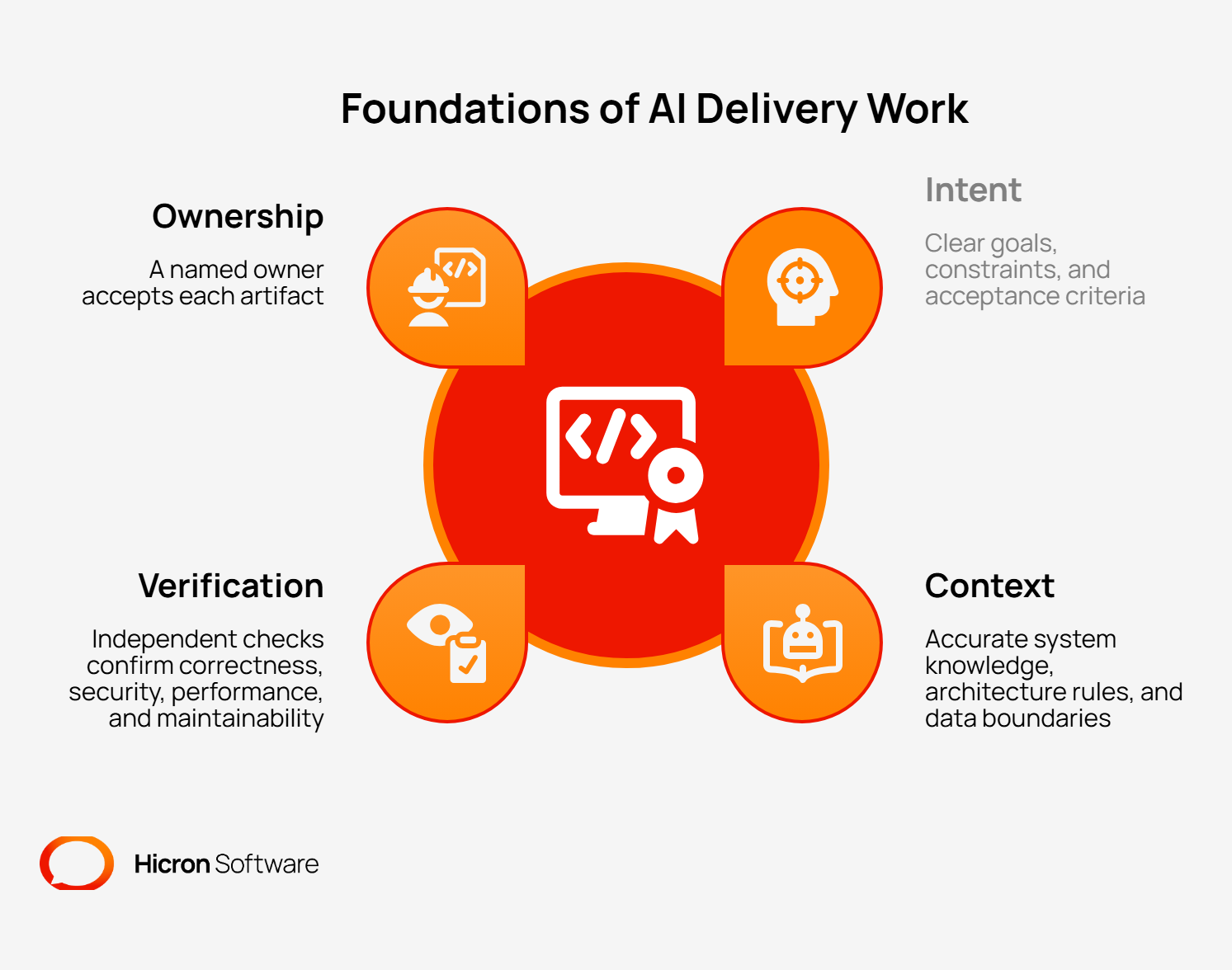
The requirements, design, development, testing, release, and operations phases stay the same. Within each phase, generating code, tests, and documents becomes faster and cheaper. Intent, context, verification, and ownership become the scarce inputs that decide what reaches production.
Because AI tools and agents play various roles across most stages of software delivery, a pragmatic question arises: what does this model actually include, and how does it connect to established practice? This article answers the question by walking through one central model in four steps. It defines the AI SDLC as a framework with three connected parts, and explains what AI in the software development process means phase by phase. After that, it compares the AI integrated SDLC with the traditional SDLC across four dimensions and identifies the inputs that determine whether the model produces high-quality software at scale.
To understand the AI integrated SDLC, it helps to think of it as one delivery model built on three parts that work together. Each part has a distinct job. The phase structure gives the cycle its shape. The AI layer does the drafting, analysis, and automation. The human acceptance gates decide what moves forward. Remove any one of these parts and the model breaks down.
The phase names and their order do not change in the AI integrated SDLC. Requirements still precede design, and code still passes review before release. However, some things stay in place:
Incorporating AI supports delivery work inside this structure. It does not rearrange how phases connect or relate to each other.
The AI layer sits inside each phase of the SDLC and handles drafting, analysis, and automation work without touching the phase structure itself. It operates at 3 levels:
Together, these capabilities can automate a wide range of repetitive and bounded work throughout the SDLC, from boilerplate code to change summaries.
AI can automate many structured tasks and procedures across the software development lifecycle. What it cannot do is automate the entire software development lifecycle. Each phase still contains decisions that require human judgment. 3 examples make this clear:
AI takes on the drafting and execution of bounded work. People retain authority over the decisions that carry real consequences for the software project and the teams responsible for this.
Understanding the scope here matters a lot. AI can automate task execution at every step of development, but it does not remove the need for human judgment. 3 points define where that boundary sits:
The final component is what ensures the model’s integrity. Human acceptance gates define where AI output becomes a trusted delivery artifact. Each gate works the same way across every phase:
Without these gates, AI output remains a draft. With them, it becomes something the team can stand behind.
When people refer to the AI SDLC, they can mean two related but distinct things. It helps to be clear about the distinction before going further.
The first meaning describes the lifecycle for building and operating AI systems as products. That lifecycle adds data preparation, model evaluation, drift monitoring, and retraining to the picture. It applies when the delivered application contains an AI model or an agent at its core. Both meanings share the same human approval principles, but they address different engineering problems. A separate article in this series covers the AI product lifecycle in detail.
Here, though, we focus on the first meaning: AI embedded directly in the delivery process. It includes the tools and agents that draft, analyze, and automate work at every stage of the standard software development lifecycle. The goal of each software project remains the same: working, maintainable software that meets business needs. What changes is how the team produces and validates each artifact along the way.
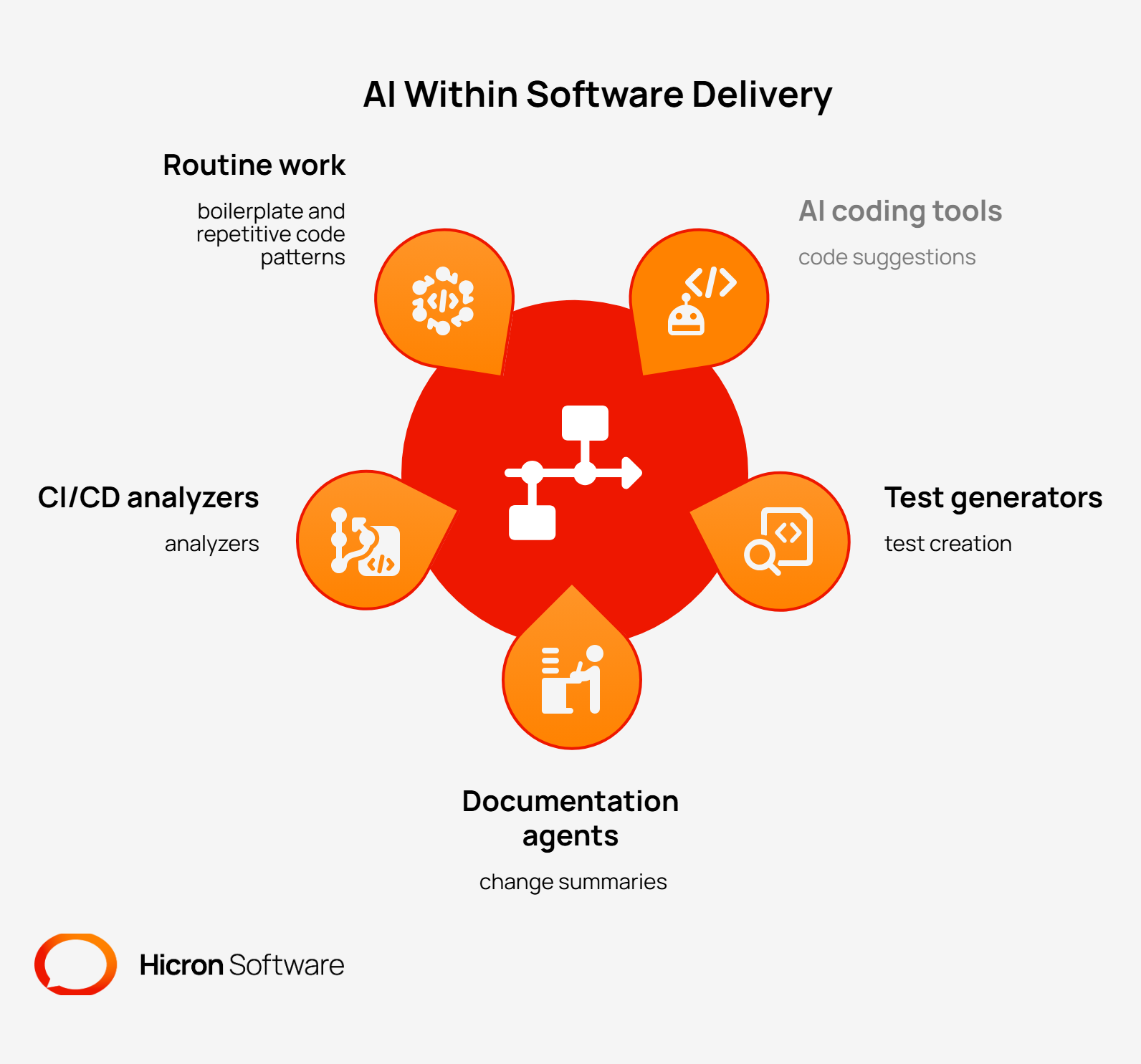
In practice, AI within delivery work means AI coding tools, test generators, documentation agents, and CI/CD analyzers. These development tools sit inside the development environment that engineers already use. Examples include GitHub Copilot for code suggestions and Azure AI services for building internal assistants. At the task level, these tools speed up software production activities such as scaffolding, test creation, and change summaries.
The broader effect is that AI can accelerate routine work at every step of development, from drafting user stories to writing release notes. When AI automates boilerplate and repetitive code patterns, engineers spend more time on architecture, edge cases, and product decisions. Using AI in the software delivery cycle this way supports faster development while keeping control over quality and risk in human hands.
A common question at this point is how the AI integrated SDLC actually differs from the traditional SDLC that most teams already follow. The short answer is that the phases do not change, but what happens inside them does. In the traditional software development lifecycle, people write, test, and review nearly everything directly. In the AI integrated model, AI takes on drafting and analysis work within each phase, while human approval points become more deliberate and traceable. Governance expands to cover AI generated artifacts, and the delivery loop extends past release into ongoing monitoring and feedback. Looking at four specific dimensions helps explain where and how those differences appear.
In the AI integrated model, people retain direction and decision authority in every phase while AI handles drafting, analysis, and repetitive execution within team-defined limits.
Established verification practices remain fully in place, with AI output requiring additional checks beyond those needed for deterministic code alone.
Existing controls such as access management and audit trails remain the base layer, with AI integration expanding governance to cover the full traceability of AI generated artifacts.
Delivery continues after software is deployed, with monitoring and feedback connecting each release back into the development process.
|
Dimension |
AI Integrated SDLC Impact |
|
Executor |
People direct the work, while AI drafts, analyzes, and automates within defined limits |
|
Quality |
Established tests and reviews, plus validation of AI output quality, robustness, and drift |
|
Governance |
Existing change management and code review, plus traceability of AI generated artifacts |
|
Loop continuity |
Monitoring, feedback, and revalidation that continue after each release |
Having established what the model is and how it extends traditional practice, the next question is what this looks like inside each phase of the software development life cycle.
The answer is consistent across every phase. The phase name and its purpose stay the same. However, 2 aspects shift inside it:
Let’s see how both change across every phase of the SDLC, from requirements through to operations:
|
Phase |
AI Contribution |
The Output Reviewer |
|
Requirements |
Drafts user stories, extracts requirements from meetings, flags ambiguities |
Product owners confirm scope, priorities, and business rules |
|
Design and architecture |
Proposes architecture options, data models, and API contracts |
Architects assess tradeoffs, security, cost, and compliance |
|
Development |
Generates code, boilerplate, migrations, refactors, and documentation |
Developers review diffs, run tests, and own merge decisions |
|
Testing and QA |
Creates unit, integration, and regression tests, plus fixtures |
QA confirms coverage, edge cases, and realistic behavior |
|
CI/CD and release management |
Explains build failures, summarizes changes, runs policy checks |
Release managers approve changes and keep audit trails |
|
Operations |
Detects anomalies, summarizes incidents, suggests fixes |
SREs approve actions on production systems |
Looking across the table, a clear pattern emerges. AI can automate work generation in every phase of the SDLC, while each artifact still passes through a defined human decision point before moving forward. Such a structure helps catch issues early in the development cycle, when the cost of fixing them is lowest. It also scales across software systems of different sizes, from a single feature to a large platform release.
The bottleneck shifts when AI takes on drafting and generation tasks inside the development process. It can produce code, tests, and documentation in minutes, so the output quality now depends less on how fast a team can write and more on how well it can specify, verify, and own what AI produces.
This is why four inputs carry the most weight throughout the entire software development lifecycle. Each one addresses a different point where AI output can go wrong or fall short of what the software project actually needs.
Clear goals, constraints, and acceptance criteria shape useful AI output more than any other single factor. When intent is vague, AI produces plausible work that misses the actual requirement.
AI performs better when it has access to accurate system knowledge, architecture rules, and data boundaries. Without that context, it fills gaps with assumptions that may not match the production environment.
As AI output volume grows, code review and software testing become the main constraint on delivery speed.
A named owner accepts each artifact and answers for shipped work, keeping accountability clear as AI output grows.
The phase structure stays in place, so the most visible changes happen inside the daily work of engineering teams. As AI takes on more drafting and execution tasks, the role of software developers shifts toward 3 core activities:
The difference between AI assistants and agentic systems comes down to scope. Assistant-style tools support developers at the task level, offering code suggestions or completions as work progresses. Agentic systems operate at a broader level. A single agent can open a backlog item, inspect the repository, write a change, run tests, summarize failures, and prepare a pull request for review. The developer approves every consequential step, but the volume of work between those approval points grows substantially.
As a result, daily engineering work now centers on a different set of recurring activities:
A development team that builds these habits can reduce development time while keeping decisions firmly with people. Developer workflow and team structure each receive a dedicated article in this series.
The AI integrated SDLC gives engineering leaders a clear and stable model to work from familiar phases, an AI layer, and explicit human acceptance gates at each step. Teams that invest in managing intent, context, verification, and ownership well are better positioned to get consistent value from AI in software development over time.
The main challenges in the software development cycle at this stage are not technical. They involve building the review capacity, accountability structures, and documentation practices that make AI output trustworthy at scale.
Most teams begin by applying AI to low-risk, high-volume tasks such as test generation and documentation early in the development cycle. These tasks build familiarity with AI output and create a measurable baseline before broader adoption of AI in software engineering. Once results prove stable, teams can expand AI use across more phases with confidence. Related articles in this series cover developer workflow, delivery risks, team structure, and AI product lifecycles.

The two terms are closely related but carry slightly different emphasis. AI in the SDLC usually refers to tools used within individual delivery phases. The life cycle term stresses the full structured model, with phases, an AI layer, and explicit approval gates connecting them. In this primer, both describe AI embedded in delivery work, and we use the terms accordingly throughout.
No, and that is an important point for teams evaluating this approach. The AI integrated SDLC works inside an existing software development methodology, whether that is Scrum, Kanban, or DevOps. The AI layer operates within each phase and each sprint. Planning, review, and release rituals stay in place, with AI contributing inside them rather than changing the rhythm around them.
Development and testing often show the most visible gains, since AI can draft code and generate tests quickly within those phases. That said, teams that use generative AI in requirements and operations can also speed up analysis of meeting transcripts, logs, and incident reports. Regardless of phase, the same principle applies: AI contributes the draft, and a human approves the artifact before it moves forward.
AI can speed up development, shifting the main quality constraint to review capacity. Peer review, independent test suites, and named ownership are what keep AI output trustworthy over time. The model is designed so that speed and quality can grow together, as long as every artifact has a defined approver and a clear traceability chain back to the original requirement.
Building an AI system as a product adds data preparation, model evaluation, and drift monitoring to the delivery process. That product lifecycle applies to application development where the software itself uses an AI model at its core. Many enterprises run both cycles at the same time, and the same human approval principles apply throughout the software development lifecycle in both cases. A separate article in this series covers the AI system lifecycle in full.
Hicron Software proved to be a trusted partner with unmatched technical expertise, delivering a scalable and user-friendly web application that was pivotal to our successful U.S. market expansion.
Hicron’s contributions have been vital in making our product ready for commercialization. Their commitment to excellence, innovative solutions, and flexible approach were key factors in our successful collaboration.
I wholeheartedly recommend Hicron to any organization seeking a strategic long-term partnership, reliable and skilled partner for their technological needs.

After carefully evaluating suppliers, we decided to try a new approach and start working with a near-shore software house. Cooperation with Hicron Software was something different, and it turned out to be a great success that brought added value to our company.
With HICRON’s creative ideas and fresh perspective, we reached a new level of our core platform and achieved our business goals.
Many thanks for what you did so far; we are looking forward to more in future!

Hicron is a partner who has provided excellent software development services. Their talented software engineers have a strong focus on collaboration and quality. They have helped us in achieving our goals across our cloud platforms at a good pace, without compromising on the quality of our services. Our partnership is professional and solution-focused!

The IT system supporting the work of retail outlets is the foundation of our business. The ability to optimize and adapt it to the needs of all entities in the PSA Group is of strategic importance and we consider it a step into the future. This project is a huge challenge: not only for us in terms of organization, but also for our partners – including Hicron – in terms of adapting the system to the needs and business models of PSA. Cooperation with Hicron consultants, taking into account their competences in the field of programming and processes specific to the automotive sector, gave us many reasons to be satisfied.