AI Business Process Automation: The New Standard for Business
- November 13
- 15 min


How do companies actually pull off digital transformation? Enterprise AI does the heavy lifting by reinventing core business models and automating complex operations. If you want to move from experimental pilots to full-scale production, you need a resilient AI infrastructure. High scalability is also an absolute must. Core technologies driving competitive advantage and operational efficiency include:
Integrating enterprise AI presents distinct organizational limitations and demands realistic expectations. Consequently, change management becomes the make-or-break element for adoption across departments. Deploying these systems introduces operational risks, and you must particularly watch out for the danger of unmanaged AI agents overspending on computational tokens. By establishing strict cost control mechanisms, you can prevent budget overruns and secure a positive ROI.
|
Category |
Key Data Point |
Business Impact & Context |
|
Implementation Timeline |
12 to 18 months |
The average time required to finalize structural changes, department realignments, and new reporting hierarchies before yielding a positive ROI. |
|
Strategic Readiness |
70% of organizations |
Report high strategic readiness for digital transformation while remaining operationally unsure about data governance, risk, and talent availability. |
|
Project Scaling Failures |
75% of projects halted |
A lack of technical skills stops initiatives trying to move from an experimental pilot to full-scale production. |
|
Talent Strategy ROI |
60% higher success rate |
Effective upskilling and continuous change management elevate organizational AI fluency and ensure strict human-in-the-loop oversight. |
|
Token Overspending Risk |
30-day budget drained in under 2 hours |
Occurs when unmanaged AI agents get caught in self-directed reasoning loops without hard spend limits or API throttling. |
|
Fraud Detection Speed |
1 million transactions per second |
Machine learning and computer vision rapidly process vast datasets to flag fraudulent activity with greater accuracy than manual reviews. |
|
Operational Risks |
4 Main Vulnerabilities |
Deploying AI at scale introduces the following primary risks:
|
|
ROI Measurement |
3 Expense Categories |
Calculating true net ROI requires tracking specific financial variables alongside productivity gains:
|
Adopting enterprise AI requires substantial capital investments, such as hardware upgrades and cloud provisioning, before yielding a positive ROI, as implementing structural changes, including department realignments and new reporting hierarchies, takes an average of 12 to 18 months to finalize. I’ve seen firsthand that patience during this phase is just as critical as the technology itself. To build a strong technical foundation, you need a targeted talent strategy to secure skilled data scientists and machine learning engineers. Ultimately, initial returns typically appear as internal productivity gains through process automation rather than immediate revenue growth.
Industry studies indicate 70% of organizations report high strategic readiness for digital transformation while remaining operationally unsure about data governance, operational risk, and talent availability. To scale up successfully, you have to help your team adapt to the new tech through ongoing training. Deployment timelines remain predictable when leadership establishes clear operational benchmarks during the early planning stages.
Enterprise AI faces integration barriers, including legacy infrastructure limitations, systemic brittleness, and model hallucinations. This is a massive challenge. Integrating modern machine learning and deep learning applications with outdated data architectures creates structural bottlenecks. Complex AI infrastructure remains vulnerable to systemic failures when poorly integrated components interact without strict data governance.
Large language models generate inaccurate outputs, such as false facts and fabricated statistics, which the industry calls hallucinations. If you’ve ever had a chatbot confidently lie to you, you know exactly what this looks like in practice. These errors introduce severe operational risk. Mitigating them requires continuous model monitoring and human-in-the-loop validation processes. Overcoming these technical limitations through modernized data pipelines is the only way your team can trust the system to deliver real business value.
When you deploy AI at scale, you’ll face four main risks:
Think about what happens when a marketing team quietly buys an unvetted analytics tool that’s Shadow AI. This happens far more often than most IT leaders would like to admit. This decentralized adoption creates fragmented data silos that directly compromise data governance and data privacy.
Autonomous agents operating without oversight execute unintended actions that compromise business integrity. Examples include unauthorized database modifications and incorrect external communications. Because of this, these unmanaged systems cause severe business disruptions and generate inaccurate outputs if enterprises deploy them without strict human validation protocols. Maintaining regulatory compliance and ethical AI standards requires strict access controls.
It’s easy to lose track of costs when AI runs on autopilot. Self-directed reasoning loops cause AI agents to overspend tokens. These agentic workflows use large language models like GPT-4 and Claude 3, and each independent action consumes computational tokens.
A system caught in a reasoning loop drains a 30-day budget in under 2 hours if an organization lacks strict cost control mechanisms, such as hard spend limits and API throttling, which automatically sever the model’s access once a specific token threshold is breached. To scale safely, you have to monitor your models for weird API spikes.
Organizations manage computing resources by using centralized dashboards to track and cap API token consumption per business unit. You need to restrict token usage for autonomous AI agents performing agentic workflows. Doing so ensures the operational risk of token overspending doesn’t spiral out of control.
Active resource management and continuous model monitoring keep your AI projects financially viable by preventing unexpected billing spikes. Putting these guardrails in place lets you grow your AI usage without the financial panic.
Ignoring organizational change management causes enterprise AI initiatives to fail by generating human barriers, deep-seated mistrust, and organizational inertia. To transition successfully to AI-augmented workflows, you need a complete cultural shift and a targeted talent strategy. This means you must continuously upskill employees to integrate human-in-the-loop validation processes effectively. While many leadership teams excel at mapping out high-level digital strategies, they often stumble when it comes to the practical realities of upskilling their workforce. I always remind my clients that the best algorithm in the world won’t deliver ROI if your staff is too intimidated to use it.
To achieve full scalability and maximize ROI, organizations must align their workforce with new automation tools. If they don’t? Employees will reject the new tools, and your operational risks will skyrocket. Human barriers like the fear of job displacement can completely stall deployment. Leadership can overcome this by providing structured support systems that guide teams through these complex realignments.
A strong talent strategy bridges the AI skills gap through continuous education. A lack of technical skills halts 75% of projects trying to move from pilot to scale during enterprise AI integration. Effective change management involves identifying specific operational deficiencies and developing targeted reskilling programs.
These upskilling initiatives align employee capabilities with complex AI infrastructure needs. Organizations train staff on advanced technical frameworks, including machine learning, data engineering pipelines, MLOps, and LLMOps. You can only scale your AI efforts if you constantly train your people.
Upskilling initiatives elevate organizational AI fluency by enabling non-technical employees to interact safely with automated tools like generative models and predictive analytics. Across departments like finance, marketing, operations, and HR, this fluency provides a foundational understanding of technology capabilities. Educating staff on system limitations also reduces mistrust and ensures process automation doesn’t stall.
Increased comprehension drives higher adoption rates and ensures strict human-in-the-loop oversight, which is why an effective talent strategy improves enterprise AI success rates by 60% when leadership prioritizes continuous change management. Raising organizational knowledge helps you scale safely while maintaining ethical standards. This digital transformation secures a positive ROI when companies implement targeted educational programs, such as technical workshops and compliance certifications.
You can’t move AI into production without mature data governance. This is essential for protecting data and avoiding legal issues. Moving a project from an experimental prototype to full-scale production frequently stalls due to unforeseen hurdles in data privacy reviews and compliance audits. This happens all the time. Pro-tip: bring your legal and security teams into the room on day one, rather than treating them as a final roadblock. Centralized control regulates data access and ensures data quality for complex algorithms, including large language models and machine learning pipelines. Poor data quality introduces severe operational risk and generates inaccurate outputs, such as biased analytical decisions and incorrect statistical forecasts.
Maintaining ethical AI relies on strong cybersecurity governance to protect sensitive information. When an enterprise implements strict access control, continuous model monitoring tracks data lineage and prevents unauthorized data exposure. Navigating the complex landscape of global AI regulations, such as the EU AI Act and regional data residency laws, requires strategic planning. Organizations maintain strategic independence by developing sovereign AI.
Sovereign AI keeps data processing and model training within localized physical environments, such as regional data centers and private cloud networks. Localized infrastructure inherently satisfies strict compliance rules while protecting your trade secrets and internal financial records.
Cybersecurity governance and data privacy frameworks protect sensitive enterprise data from unauthorized access by AI agents, allowing organizations to secure their information against vulnerabilities introduced by enterprise AI by establishing mature permission models. These protocols restrict the specific data types that autonomous systems process, such as proprietary company data and customer PII.
Unsecured data silos and shadow AI elevate operational risk by bypassing centralized data governance. Complex AI infrastructure inadvertently exposes sensitive information if a company lacks strict cybersecurity governance. To stop this, you must monitor models continuously. Maintaining regulatory compliance and ethical AI standards paves the way for safe growth when enterprises enforce strict access controls.
If you want to modernize your legacy architecture, you need a scalable AI infrastructure built on decentralized data management and a sound operational framework.
A resilient AI infrastructure requires specific core technological components. Developing sovereign AI protects proprietary assets by localizing computational resources, such as private cloud networks and regional servers.
Data engineering pipelines are the engine that keeps enterprise AI running. These automated conduits ensure the continuous, secure delivery of high-quality data, breaking down isolated silos to feed predictive models in real-time. Decentralized data architectures, such as a data mesh, rely on these automated pipelines to provide domain-owned data products directly to an AI model.
Data quality directly dictates the reliability of AI outputs, including precise natural language processing and accurate deep learning, which is why data engineering pipelines ensure AI models access the exact information at the correct moment by automating real-time ingestion processes. This continuous delivery supports advanced frameworks like retrieval-augmented generation and machine learning. Ultimately, integrating these conduits into an AI infrastructure ensures scalability and enforces strict data governance.
MLOps and LLMOps solve the bottleneck of moving an AI model from development to production by applying software engineering principles to artificial intelligence. Think of it as DevOps for AI. These frameworks provide the automation and operational efficiency required to deploy and maintain an enterprise AI system at scale. Integrating Continuous Integration and Continuous Deployment into the machine learning lifecycle streamlines the transition from data engineering pipelines to active model deployment. Central model registries track versioning and performance for complex algorithms, managing advanced technologies like machine learning algorithms and large language models.
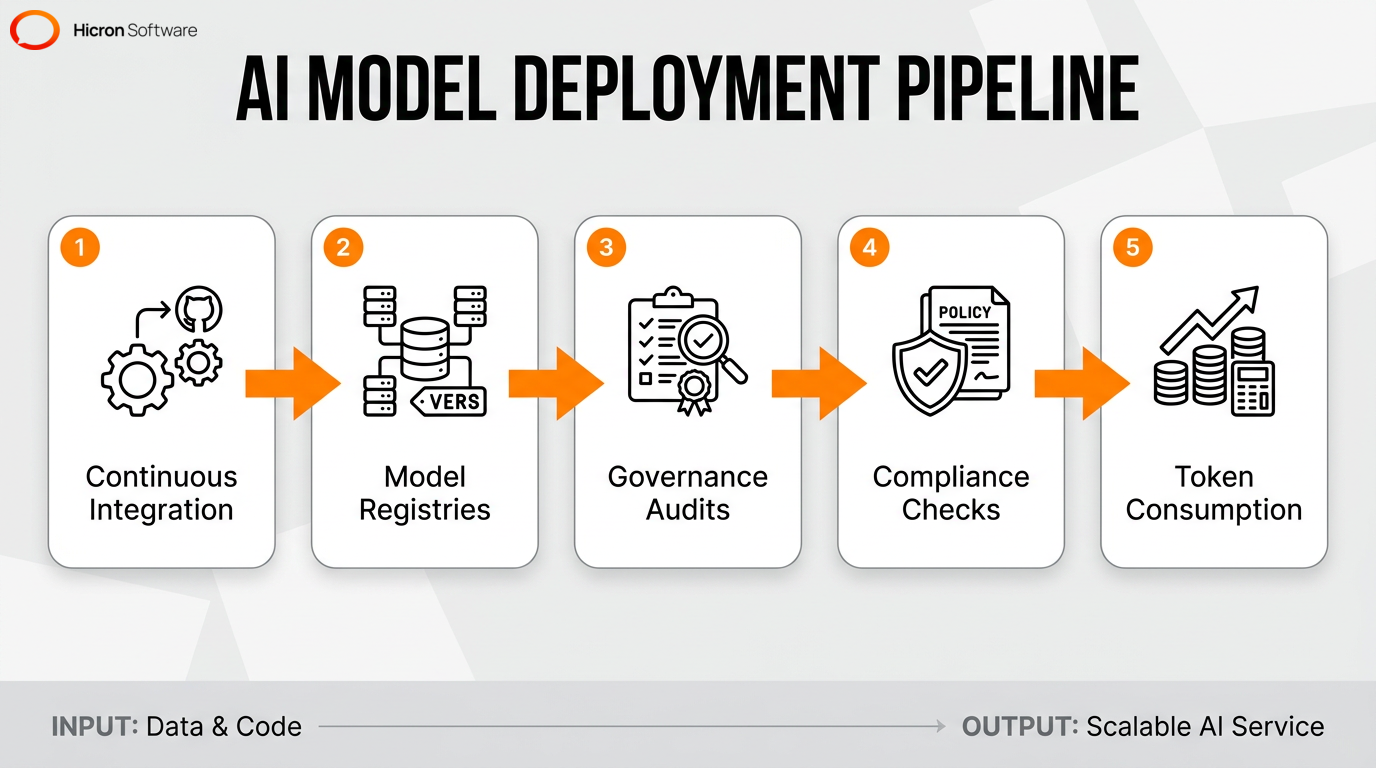
An MLOps pipeline automatically integrates 2 essential validation steps during the deployment phase: governance audits and compliance checks. By automating this integration, teams reduce manual bottlenecks and accelerate the release cycle. LLMOps frameworks specifically optimize generative models by tracking prompt performance and managing token consumption. Leadership can guarantee high scalability by prioritizing these standardized deployment protocols to drive operational efficiency.
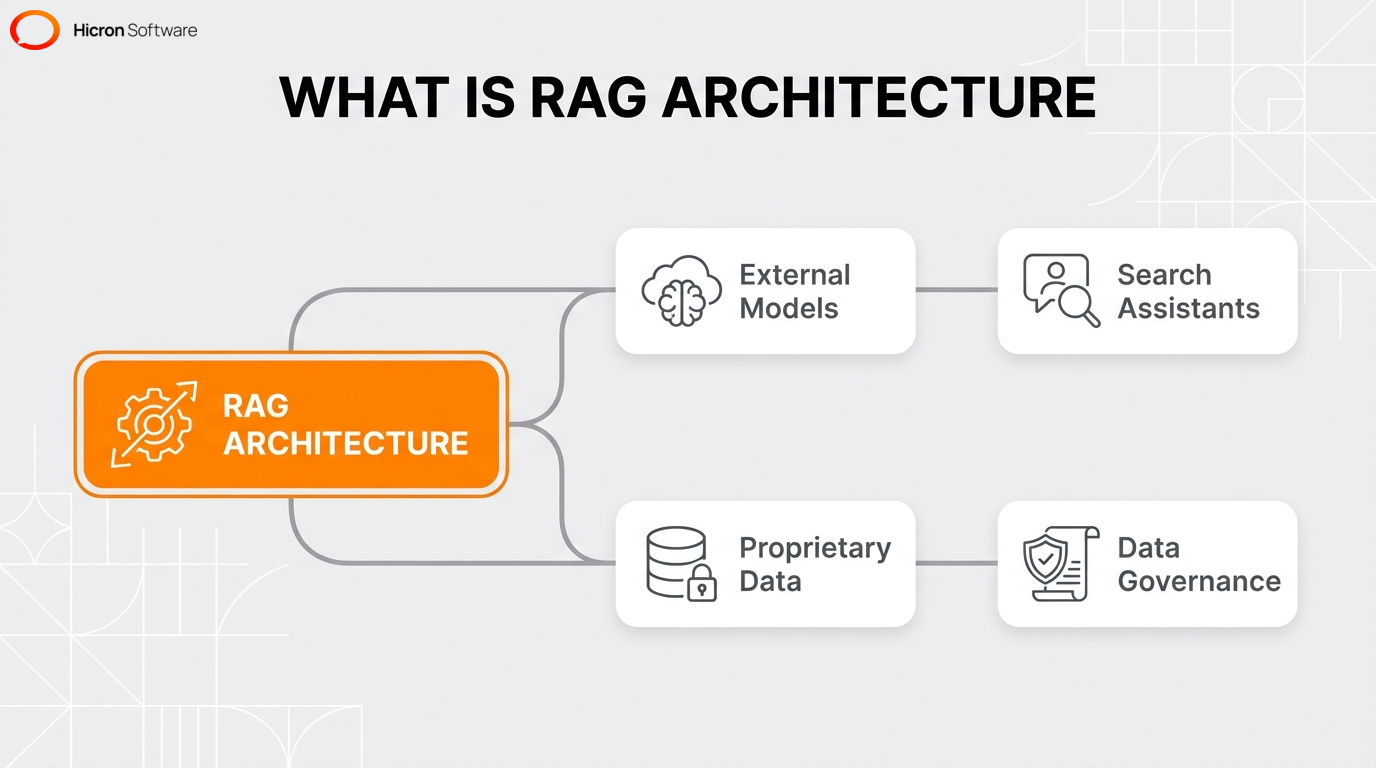
Retraining large language models on proprietary data is often cost-prohibitive. Retrieval-augmented generation (RAG) solves this by grounding external models in your secure, internal enterprise data. This architecture connects external models to proprietary internal knowledge bases through a scalable AI infrastructure. The system uses strict data governance to ensure natural language processing algorithms process only authorized, accurate information.
Enterprises deploy RAG to build highly accurate internal search assistants, such as automated query portals and IT helpdesks that reference specific company policies rather than generic internet data. Implementing this framework mitigates severe operational risks, such as data hallucinations, during continuous model deployment. This setup keeps your AI accurate and your data safe as you grow.
The transition to the third wave of AI introduces agentic workflows capable of executing complex tasks autonomously. But you can’t just let these workflows run wild; they require human-in-the-loop mechanisms to oversee outputs, correct system hallucinations, and mitigate operational risk. Fully autonomous actions introduce 3 severe vulnerabilities: unmanaged AI agents executing unauthorized commands, logic failures, and token overspending.
Enterprise agentic workflows can’t operate entirely without human supervision because large language models generate false information. Domain experts periodically assess AI outputs to guarantee accuracy and appropriateness in areas like financial forecasting and automated customer support. Relying solely on process automation is a massive risk. Organizations maintain ethical AI standards when leadership integrates human oversight into the enterprise AI deployment strategy.
Human oversight is what keeps AI ethical because it ensures algorithmic decisions remain unbiased and transparent. A human reviewer executes 3 specific roles to maintain ethical integrity: detecting inherent bias, validating algorithmic fairness, and mitigating data privacy violations. Governance frameworks use human-in-the-loop assessments to enforce regulatory compliance. Active model monitoring allows human experts to correct unethical outputs before automated systems amplify them.
Unmanaged AI agents, such as autonomous chatbots and generative algorithms, introduce severe operational risk, and this lack of oversight bypasses cybersecurity governance. Therefore, enterprise AI deployments maintain corporate standards when companies integrate continuous human validation. Change management is key for this integration by training employees to perform ethical audits. Data governance structures secure sensitive information effectively when human evaluators monitor automated workflows.
Data-heavy enterprise processes deliver the fastest and most significant returns from enterprise AI. Automating core operations drives significant operational efficiency and accelerates digital transformation. Beyond digital workflows, AI isn’t just for software; it’s moving into physical spaces too. Warehouses and manufacturing floors are deploying autonomous robotics and smart sensors to optimize logistics and assembly lines in real-time.
Machine learning algorithms analyze massive datasets to secure high scalability across global operations. Transitioning a workforce to operate alongside physical AI requires thorough employee training and support. This strategy is the only way to overcome the technical limitations of enterprise AI and secure long-term operational efficiency.
Machine learning algorithms analyze physical sensor data to forecast equipment failures and streamline logistics in real-time. Machine learning and computer vision algorithms translate this real-time information into actionable strategies by detecting anomalies like temperature spikes and vibration irregularities. Physical AI processes massive datasets from automated devices, including collaborative robots and inspection drones.
Deep learning models predict equipment failure before it occurs by evaluating these inputs continuously. By preventing unplanned downtime, this proactive approach to asset management saves industries millions. But scaling these predictive systems to achieve a positive ROI requires leadership to guide the workforce through the transition, ensuring teams trust and act on the AI’s recommendations.
Machine learning and computer vision enhance fraud detection by rapidly identifying complex anomalies across vast datasets, such as unusual login locations and erratic purchasing behavior. This advanced AI modality outperforms traditional methods by processing 1 million transactions per second, and this rapid analysis flags fraudulent activity with far greater accuracy than manual reviews. Deep learning algorithms monitor transactional data for irregularities in real-time.
Continuous data engineering pipelines supply this information directly through real-time streaming channels and automated ETL processes. Computer vision verifies document authenticity and detects identity fraud by analyzing visual inputs, such as altered identity documents and manipulated financial records. Maintaining regulatory compliance requires strict security protocols to secure sensitive customer data during automated investigations.
Businesses measure the ROI of enterprise AI by tracking immediate productivity gains and operational efficiencies before expecting long-term revenue growth. Accurate ROI calculation requires establishing 2 clear performance metrics: time saved through process automation and error reduction rates. Organizations evaluate digital transformation success by aligning these specific operational benchmarks with initial automation goals rather than focusing solely on immediate sales increases.
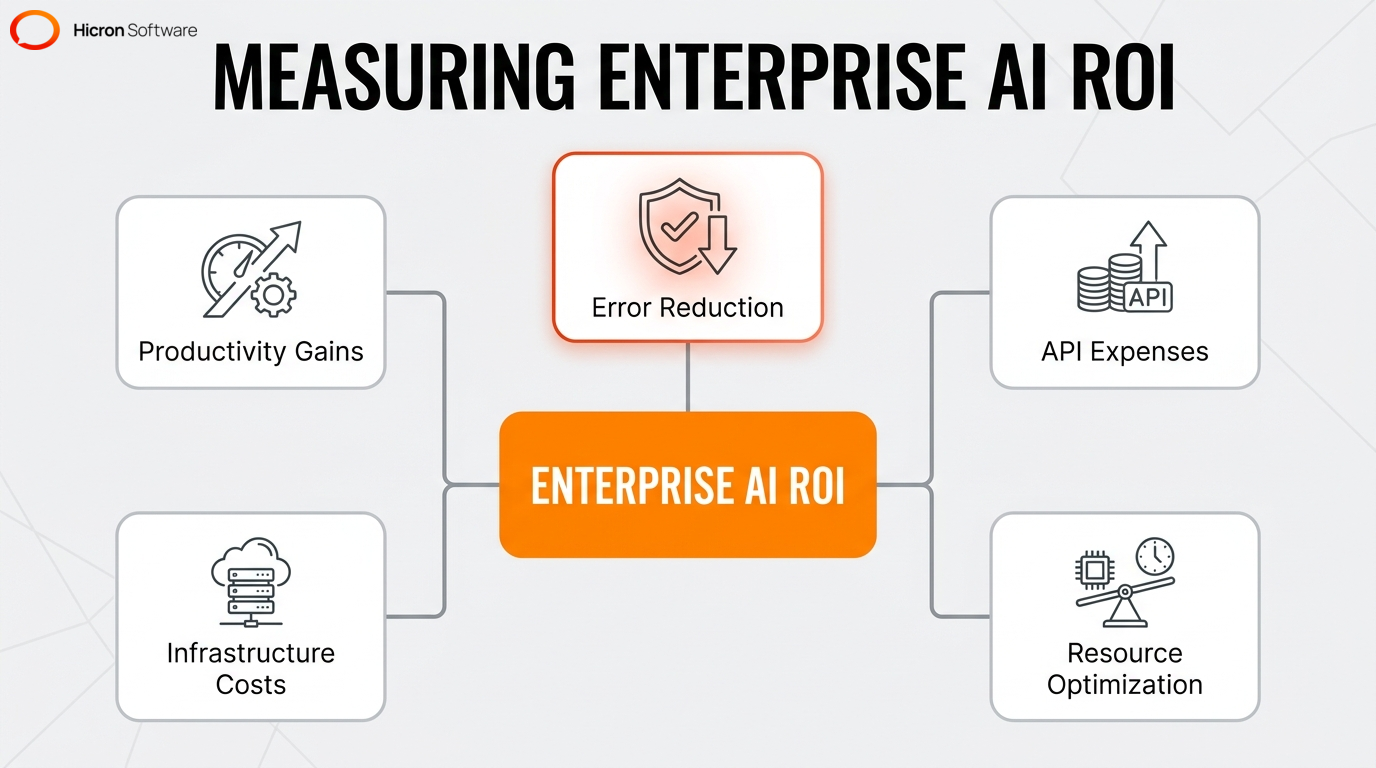
Calculating the true net ROI demands factoring in continuous API expenses, complex AI infrastructure maintenance, and the significant financial variables of high scalability, such as cloud storage fees.
To actually make money from AI, you have to control your costs and limit your risks. These financial guardrails prevent wasted computing resources and token overspending by unmanaged autonomous systems. Key financial considerations include tracking 3 specific expense categories to determine exact net value:
Active model monitoring ensures continuous resource optimization. If you set up these tracking protocols early, you’ll keep your costs down and your ROI positive.
Hicron Software proved to be a trusted partner with unmatched technical expertise, delivering a scalable and user-friendly web application that was pivotal to our successful U.S. market expansion.

Hicron’s contributions have been vital in making our product ready for commercialization. Their commitment to excellence, innovative solutions, and flexible approach were key factors in our successful collaboration.
I wholeheartedly recommend Hicron to any organization seeking a strategic long-term partnership, reliable and skilled partner for their technological needs.

After carefully evaluating suppliers, we decided to try a new approach and start working with a near-shore software house. Cooperation with Hicron Software House was something different, and it turned out to be a great success that brought added value to our company.
With HICRON’s creative ideas and fresh perspective, we reached a new level of our core platform and achieved our business goals.
Many thanks for what you did so far; we are looking forward to more in future!

Hicron is a partner who has provided excellent software development services. Their talented software engineers have a strong focus on collaboration and quality. They have helped us in achieving our goals across our cloud platforms at a good pace, without compromising on the quality of our services. Our partnership is professional and solution-focused!

The IT system supporting the work of retail outlets is the foundation of our business. The ability to optimize and adapt it to the needs of all entities in the PSA Group is of strategic importance and we consider it a step into the future. This project is a huge challenge: not only for us in terms of organization, but also for our partners – including Hicron – in terms of adapting the system to the needs and business models of PSA. Cooperation with Hicron consultants, taking into account their competences in the field of programming and processes specific to the automotive sector, gave us many reasons to be satisfied.