What is Azure Managed Services?
- November 07
- 10 min


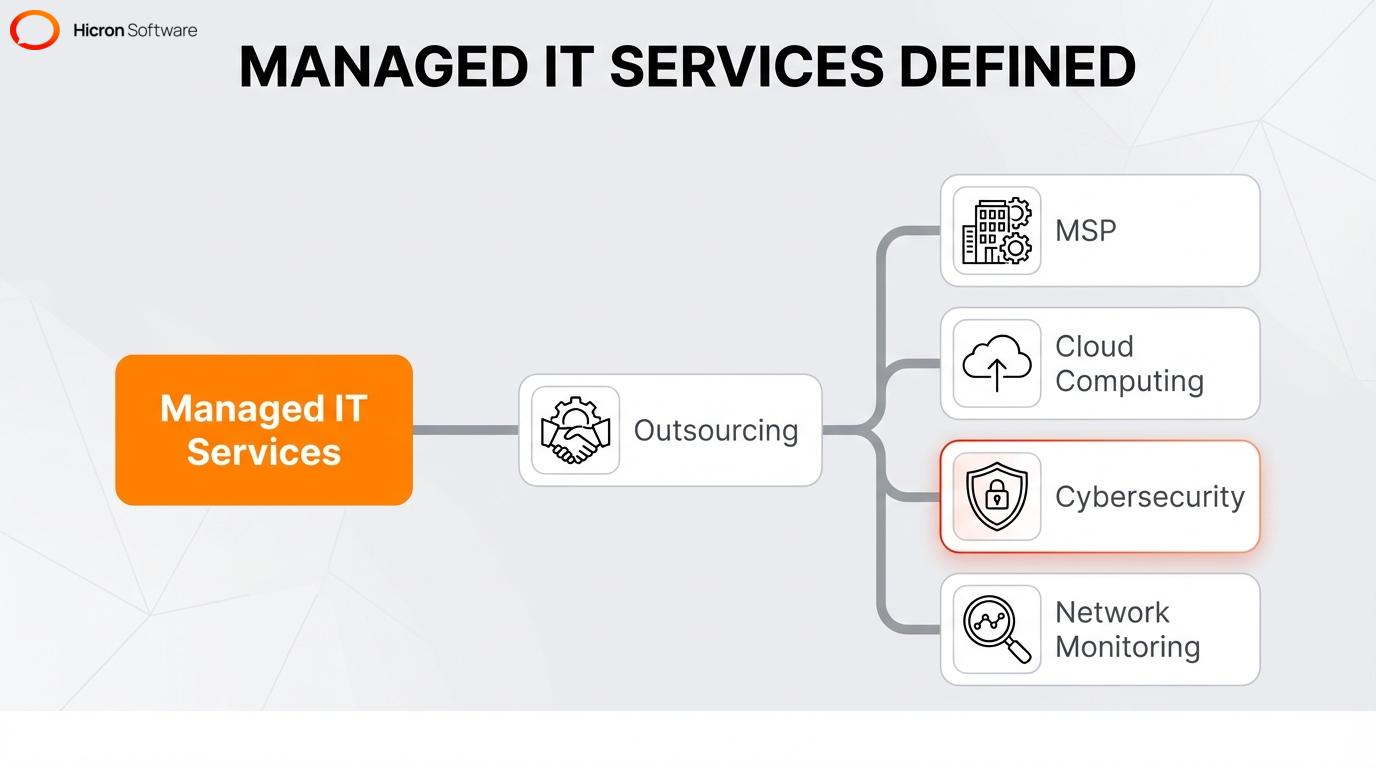
Managed IT services involve outsourcing specific technical operations to a third-party organization known as a Managed Service Provider (MSP). This model streamlines daily operations and proactively manages an organization’s IT infrastructure while significantly reducing costs by replacing expensive hardware purchases with predictable monthly expenses. IT service management (ITSM) typically covers core areas including:
Instead of waiting for a server to crash, providers spot vulnerabilities early to keep your business running smoothly.
|
Service Category |
Description & Key Features |
Business Benefits |
|
Managed IT vs. Break/Fix |
Replaces the reactive “break/fix” model with proactive maintenance and continuous network monitoring. |
|
|
Co-Managed IT Services |
A strategic partnership sharing daily administrative responsibilities between an MSP and an internal IT team. |
|
|
Cybersecurity & Compliance |
|
|
|
Infrastructure & Technology Management |
|
|
|
Pricing & Service Level Agreements (SLA) |
Subscription-based models (per-user or per-device) governed by strict ITIL-based SLA contracts. |
|
A Managed Service Provider (MSP) is a third-party company that remotely manages a customer’s IT infrastructure and end-user systems. Depending on the client’s needs, these providers oversee public, private, or hybrid cloud environments. IT professionals use specialized software platforms, such as Professional Services Automation (PSA) and remote monitoring and management (RMM) tools, to monitor client environments and resolve technical issues.
An MSP delivers technical support through a predictable subscription model, charging a flat recurring fee for continuous network administration and daily user support.
Think of the break/fix model like waiting for your car’s engine to smoke before visiting a mechanic. It’s a reactive approach, resolving system errors only after they occur, which often involves dealing with:
I’ve sat through enough emergency recovery operations to know that waiting for things to break is a costly gamble. Managed IT services replace this traditional method with proactive maintenance and a predictable cost structure, encompassing automated data backups, endpoint management, and user access provisioning.
An MSP protects your business by anticipating system vulnerabilities before they cause downtime. Automation and data analytics allow MSPs to monitor IT infrastructure continuously.
This means when something goes wrong, the team can fix it much faster. Modern IT service management relies on continuous oversight to uphold performance standards defined in a Service Level Agreement (SLA). These agreements typically track key metrics such as: uptime guarantees, response time limits, and resolution targets.
Co-managed IT services function as a strategic partnership where an MSP collaborates directly with an internal IT team. By sharing daily administrative responsibilities between in-house staff and external technical experts, this model bridges the talent gap. Co-managed teams deliver cost-effective access to specialized professionals without the financial overhead of hiring full-time personnel.
When your internal IT team is stretched too thin, bringing in a managed service provider can ease the burden. External providers support existing departments by taking over routine IT service management tasks, such as:
MSPs oversee primary categories of IT infrastructure, including: cloud environments, physical networks, and end-user devices. The scope of infrastructure management ranges from maintaining physical components to configuring complex cloud architectures.
This includes managing remote firewalls, local servers, and mobile devices. These tools are seamlessly integrated into your current setup to keep daily operations running without interruption.
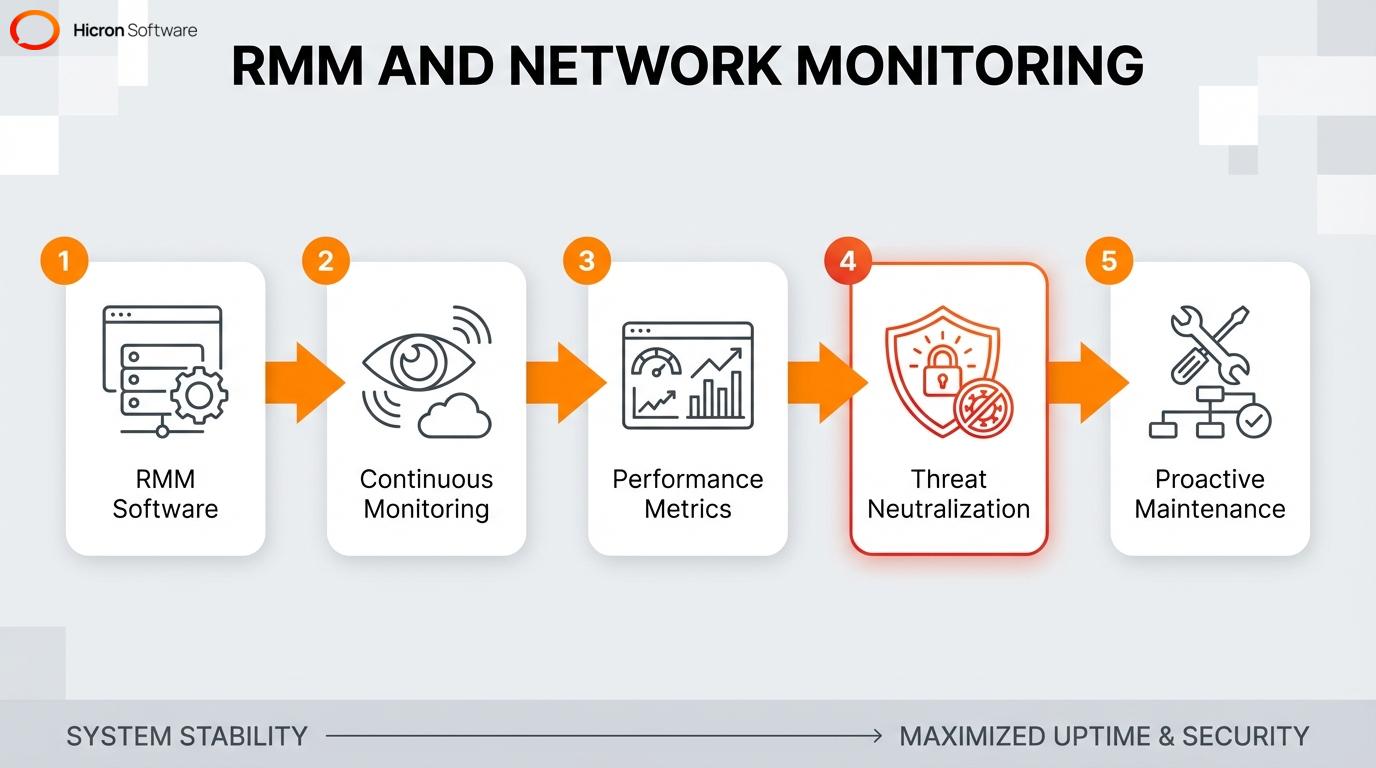
Remote monitoring and management (RMM) software is the main tool used for continuous network monitoring to ensure maximum uptime. An MSP uses these platforms to perform 24/7 proactive maintenance across an organization’s IT infrastructure. RMM tools enable IT teams to track system health by analyzing performance metrics like CPU utilization, bandwidth consumption, and memory availability.
By keeping a constant watch, IT teams can spot and neutralize security threats early. Integrating these tools ensures issues are resolved proactively, preventing critical system failures.
Managed cybersecurity protects your entire IT setup using continuous threat detection, endpoint security for remote devices, and rapid incident response. Managed IT services integrate advanced features to protect valuable data, using essential security measures like data encryption and multi-factor authentication (MFA).
Proactive maintenance and continuous network security monitoring defend against cyber threats. To maintain this defense, providers execute regular security updates and ensure compliance management when external regulations mandate strict data controls.
MSPs ensure smooth cloud migration and manage virtualized environments to help businesses grow and adapt easily. I always tell clients that migrating to the cloud shouldn’t feel like a leap of faith, but rather a carefully calculated step forward. Technical teams help businesses migrate legacy systems into modern cloud environments, whether that requires adopting Infrastructure-as-a-Service (IaaS), Platform-as-a-Service (PaaS), or Software-as-a-Service (SaaS) solutions. Providers continuously fine-tune hybrid cloud architectures for organizations maintaining distributed workloads.
IT teams set up virtual environments so employees can work securely from anywhere. For example, they use Azure Virtual Desktop to run desktop and app virtualization on the cloud.
BCDR strategies minimize downtime and protect data, ensuring your business stays operational during unexpected disruptions like cyberattacks or natural disasters. Cloud computing capabilities enable rapid system restoration.
Providers integrate BCDR with proactive maintenance and continuous network monitoring to detect threats early. This framework accelerates incident response and strengthens overall cybersecurity when sudden outages threaten daily operations. BCDR planning is a strict legal requirement for regulatory compliance in specific industries, including highly regulated sectors like finance and healthcare.
24/7 help desk support serves as the main point of contact for technical assistance. It resolves end-user IT issues promptly and ensures minimal downtime for employees during sudden system errors. An MSP integrates this continuous oversight with endpoint management to perform proactive maintenance across an organization’s infrastructure.
Modern IT service management (ITSM) relies on immediate incident response to uphold productivity. Remote monitoring and management (RMM) platforms facilitate smooth managed IT services and execute daily support tasks. These tasks cover common operations like password resets and application troubleshooting.
How do you protect what you can’t see? IT asset management and patch management are critical for maintaining an accurate device inventory and securing an IT infrastructure against vulnerabilities. You’d be surprised how often a forgotten, unpatched device sitting in a remote home office becomes the entry point for a major breach. The asset management process involves discovering and tracking connected network devices—such as local servers, mobile endpoints, and software applications—to monitor hardware life cycles.
Automated patch management systems distribute software updates to close security gaps when new cyber threats emerge. Proactive patch management functions as a core maintenance task that improves overall system performance and endpoint security. By using RMM platforms, providers can automate these updates. This continuous oversight within IT service management ensures strict network security and a strong defense against cyber threats.
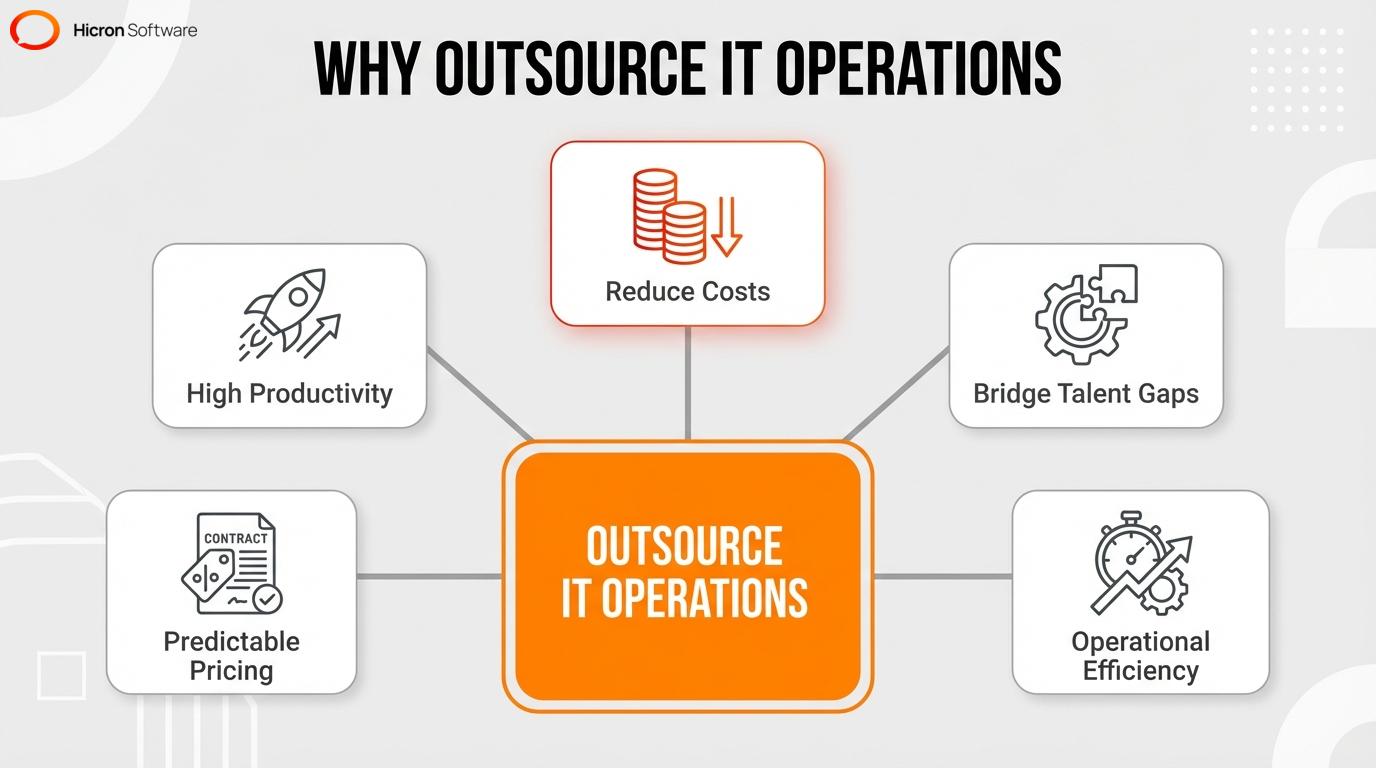
Organizations outsource IT operations to an MSP to reduce operating costs, bridge talent gaps, and improve overall operational efficiency. This strategy delivers direct financial benefits by eliminating expensive hardware purchases and using predictable pricing structures, allowing businesses to access expert knowledge without the overhead of full-time hires.
Outsourcing IT helps enterprises maintain high productivity despite the global tech talent shortage. Companies implement co-managed IT to get the most out of their technology when internal teams lack specific technical skills.
Proactive maintenance improves overall business efficiency by anticipating and resolving IT issues before they cause system downtime. Instead of waiting for things to break, modern ITSM focuses on keeping systems running smoothly around the clock. Remote monitoring and management (RMM) platforms utilize automation and data analytics to predict technical problems.
By using continuous network monitoring and systematic patch management, businesses can eliminate operational risks as soon as vulnerabilities emerge. Preventing major threats like data breaches and server crashes accelerates incident response and maximizes daily productivity.
Managed IT services help businesses modernize faster by driving the adoption of new technologies, such as artificial intelligence and automated workflows. Managed providers handle the full lifecycle of a technology solution to enable smooth business growth during rapid organizational growth.
These experts drive digital evolution by smoothly connecting new tools with modern productivity suites and scalable cloud environments. To modernize legacy infrastructure, technical teams execute continuous cloud migration strategies. Providers deploy advanced virtualization to connect internal networks with various cloud computing models.
Managed service providers ensure regulatory compliance management by implementing stringent data governance, advanced security protocols, and reliable disaster recovery plans. These experts bring the technical know-how needed to manage your data properly. This helps you pass strict compliance audits without the stress. Providers navigate complex industry-specific standards, such as HIPAA in healthcare and GDPR for global data privacy, to protect sensitive information.
The intersection of cybersecurity and compliance management relies on continuous network security monitoring to defend an IT infrastructure against unauthorized access. Strict endpoint security measures—such as MFA and data encryption—are deployed to maintain these legal standards. Integrating these managed IT services establishes complete business continuity when sudden disruptions threaten operational stability.
The Information Technology Infrastructure Library (ITIL) provides a standardized framework of best practices that guides and optimizes IT service management (ITSM). This methodology aligns IT infrastructure with core business goals, ensuring your technology directly supports company growth and daily operations. Many providers of managed IT services adopt ITIL-based processes to deliver high-quality, consistent service.
These standardized protocols help satisfy demanding Service Level Agreement (SLA) requirements during unexpected network disruptions. The ITIL framework improves key technical tasks, including proactive maintenance, rapid incident response, 24/7 help desk support, and systematic asset management.
An MSP typically uses per-user or per-device pricing models. A per-user model charges a flat monthly fee per employee regardless of how many devices they use, while a per-device model bills for each endpoint. The final recurring cost depends on factors like the number of active users, total device count, required cybersecurity levels, and the overall complexity of an IT infrastructure. You can significantly reduce your overall expenses compared to maintaining full-time internal staff.
Using an external provider eliminates major financial overheads such as: employee salaries, healthcare benefits, and ongoing training costs. A business implements co-managed IT to control labor costs while accessing specialized expertise when an existing technical department reaches maximum capacity.
A subscription-based pricing model provides predictable, flat-rate monthly IT costs through tiered packages, offering distinct financial advantages over unpredictable hourly billing. From what I’ve witnessed, making the switch to a predictable monthly bill is often a massive relief for budgeting teams. The traditional break/fix model generates sudden, expensive invoices when critical system failures occur.
Your provider structures this flat-rate billing to deliver continuous managed IT services. Tiered pricing typically offers distinct levels of technical support and automation: basic network monitoring, advanced cybersecurity defense, and complete infrastructure administration.
The subscription model guarantees the exact quality of service defined in a Service Level Agreement (SLA) while keeping organizational budgets predictable. Moving to managed cloud computing significantly lowers operating costs by eliminating expensive physical hardware purchases. By migrating legacy systems to the cloud, an MSP can further reduce your monthly expenses. Scalable cloud computing resources are integrated into these recurring plans for enterprises requiring flexible digital environments across various cloud computing models.
Think of a Service Level Agreement (SLA) as your safety net. This contract outlines exactly what you can expect from your MSP, holding them accountable to specific standards of service. It establishes clear accountability by outlining specific metrics, such as guaranteed network uptime percentages, maximum response times for support tickets, and target resolution windows for critical system failures.
As a quick piece of advice, always treat your initial conversations with a potential provider as a two-way interview. Selecting an MSP requires evaluating key criteria to ensure alignment with organizational goals: service offerings, Service Level Agreement (SLA) commitments, security expertise, and strategic support capabilities. Organizations assess an external provider based on their capacity to manage critical IT functions during major technology upgrades. This includes essential operations like: compliance management, advanced cybersecurity, and reliable disaster recovery.
Look for a partner that keeps your business running around the clock with 24/7 monitoring and fast response times. Advanced security features—such as data encryption and multi-factor authentication—prevent unauthorized access when cyber threats target the network.
The selection process involves reviewing the exact metrics defined within a Service Level Agreement (SLA) to guarantee high performance standards, focusing on specific guarantees like: uptime percentages and resolution targets. A business evaluates an MSP’s ability to support long-term strategic goals as the enterprise integrates scalable cloud technologies. This alignment ensures your technology supports your business growth for years to come.
Hicron Software proved to be a trusted partner with unmatched technical expertise, delivering a scalable and user-friendly web application that was pivotal to our successful U.S. market expansion.
Hicron’s contributions have been vital in making our product ready for commercialization. Their commitment to excellence, innovative solutions, and flexible approach were key factors in our successful collaboration.
I wholeheartedly recommend Hicron to any organization seeking a strategic long-term partnership, reliable and skilled partner for their technological needs.
After carefully evaluating suppliers, we decided to try a new approach and start working with a near-shore software house. Cooperation with Hicron Software House was something different, and it turned out to be a great success that brought added value to our company.
With HICRON’s creative ideas and fresh perspective, we reached a new level of our core platform and achieved our business goals.
Many thanks for what you did so far; we are looking forward to more in future!

Hicron is a partner who has provided excellent software development services. Their talented software engineers have a strong focus on collaboration and quality. They have helped us in achieving our goals across our cloud platforms at a good pace, without compromising on the quality of our services. Our partnership is professional and solution-focused!

The IT system supporting the work of retail outlets is the foundation of our business. The ability to optimize and adapt it to the needs of all entities in the PSA Group is of strategic importance and we consider it a step into the future. This project is a huge challenge: not only for us in terms of organization, but also for our partners – including Hicron – in terms of adapting the system to the needs and business models of PSA. Cooperation with Hicron consultants, taking into account their competences in the field of programming and processes specific to the automotive sector, gave us many reasons to be satisfied.