What is a Vendor Management System (VMS)? 2026 Guide
- October 03
- 12 min

A vendor management system cost-reduction strategy involves using a centralized platform to reduce expenses across your supply chain. With rising input costs and supply volatility, controlling spending has become a critical business priority. Many expenses are hidden in operational friction, like manual administrative work, communication gaps, and poor inventory visibility.
This article provides a practical look at how a modern vendor management system (VMS) directly reduces total landed costs. We will explore how improving supplier collaboration, automating the order lifecycle, and optimizing inventory levels can create durable savings and strengthen your supply chain against disruption. You will learn specific methods to prevent waste and quantify the return on your investment.
Achieving cost reduction in the vendor management system requires looking beyond the purchase price and identifying the hidden operational costs. These expenses often accumulate from small, recurring issues within supplier interactions. They are the friction points that inflate budgets and disrupt production schedules.
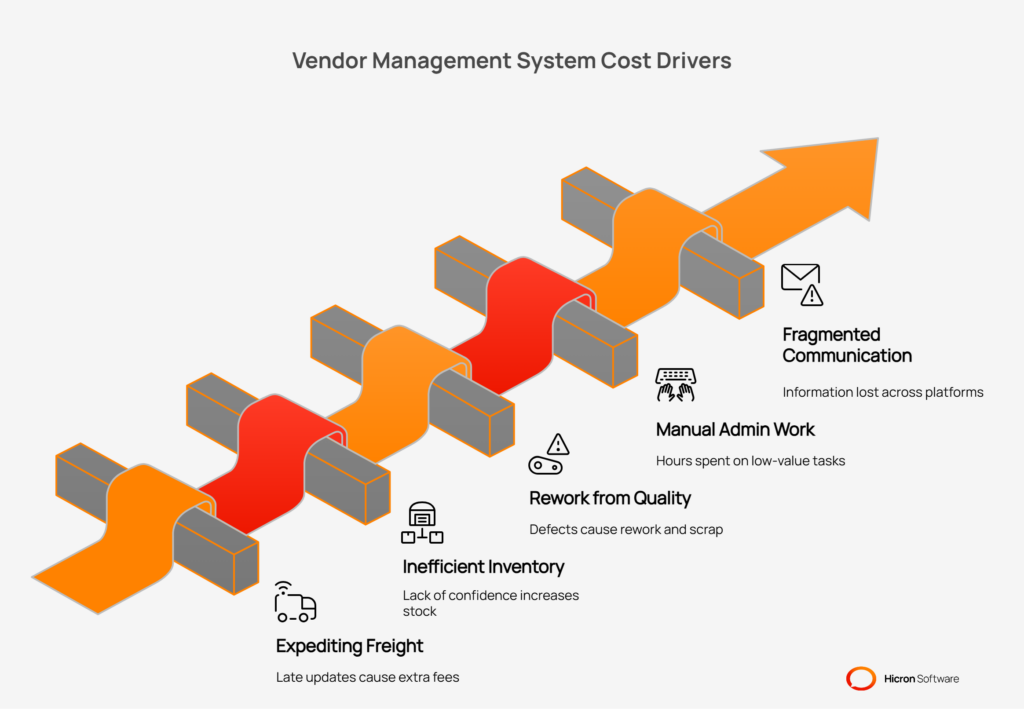
Understanding where to find these drivers of spend and waste is the first step toward controlling them. Many of these costs are symptoms of poor visibility, manual processes, and fragmented communication across the supply chain.
A vendor management system (VMS) achieves cost reduction by creating a self-reinforcing cycle of improvement. This cost-saving flywheel builds momentum as enhanced visibility, collaboration, automation, and continuous improvement work together.
Each element strengthens the next, turning small operational wins into sustained financial benefits. The key is to connect these process gains directly to measurable KPIs and budget lines, making the return on investment clear.
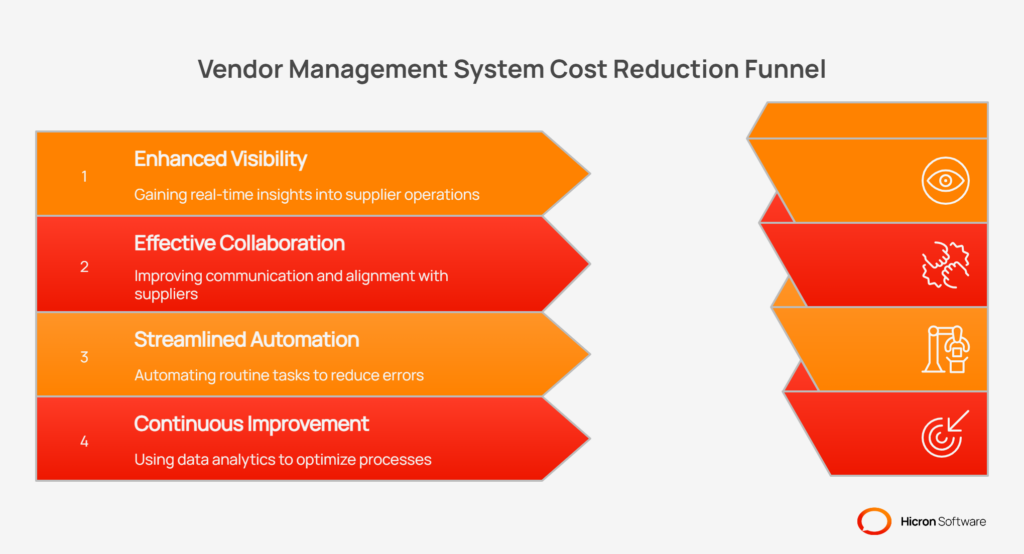
This flywheel effect begins with a foundation of shared information and progresses toward proactive, data-driven decision-making.
Poor communication is a primary source of waste in the supply chain, leading to errors, delays, and strained relationships. A key part of any vendor management system cost reduction effort is to replace disorganized communication channels like email and spreadsheets with a centralized supplier portal. This creates a single, shared environment for all interactions, which builds trust and drives operational efficiency. By giving both your team and your suppliers access to the same information and tools, you can prevent misunderstandings before they turn into costly problems.
A VMS portal establishes a single source of truth for all transactional data. When everyone works from the same playbook, confusion and discrepancies disappear. Instead of relying on multiple spreadsheet versions or hunting through email attachments, buyers and suppliers can view shared purchase order details, submit and approve change requests, and track acknowledgements in one place. This shared visibility ensures that both parties are aligned on quantities, prices, and delivery dates. As a result, this alignment directly reduces the risk of incorrect shipments, invoice mismatches, and the need for expensive rework.
A supplier portal brings structure to communication that is often chaotic. It allows for contextual conversations tied directly to specific purchase orders or line items. This means no more sifting through long, confusing email threads to find a specific detail. Questions, clarifications, and updates are all logged in the relevant context. Furthermore, you can assign specific tasks with clear owners and due dates, ensuring accountability. This approach effectively ends the endless “ping-pong” of emails, makes follow-up easier, and ensures that critical actions are not overlooked.
A VMS helps move your team from a reactive to a proactive operational model. You can configure automated alerts based on your service level agreements (SLAs) with suppliers. For example, the system can automatically send reminders for unacknowledged orders or upcoming shipment deadlines. If a deadline is missed, the system can trigger an escalation to the appropriate manager. These proactive alerts act as a safety net, helping you and your suppliers identify at-risk orders early. This allows you to resolve potential issues before they require urgent intervention, avoiding the high costs associated with expediting and last-minute firefighting.
Manual processes are a major cause of delays and errors in the supply chain. Integrating your Vendor Management System (VMS) with your ERP and automating key stages of the order lifecycle are fundamental to achieving vendor management system cost reduction. Automation minimizes administrative overhead, increases accuracy, and provides the speed needed to respond to operational changes. This allows your team to shift from managing routine transactions to focusing on strategic exceptions and value-added activities.
Integrating your ERP system directly with your VMS streamlines information flow, eliminating the need for manual data entry. This synchronization is a critical step in building a reliable and efficient procurement process.
| Feature | Description | Cost-saving benefit |
| Automatic PO transmission | Purchase orders created in the ERP are automatically sent to suppliers through the VMS portal. | Eliminates data entry errors, reduces PO processing time, and ensures suppliers receive orders instantly. |
| Real-time status updates | Supplier confirmations, shipment updates, and delivery information from the VMS are automatically updated back into the ERP. | Provides planners and buyers with accurate, real-time data without manual lookups, improving decision-making. |
| Invoice synchronization | Supplier invoices submitted via the VMS can be automatically matched against POS and goods receipts in the ERP (2-way or 3-way matching). | Drastically reduces invoice processing time, minimizes payment errors, and allows for capturing early payment discounts. |
Managing inbound logistics effectively prevents bottlenecks at your receiving docks and ensures a smooth flow of materials. A VMS provides tools for suppliers to schedule deliveries and provide advance shipping notices (ASNs), bringing predictability to your inbound operations.
| Feature | Description | Cost-saving benefit |
| Advance shipping notices (ASN) | Suppliers create a digital packing list (ASN) with details on contents, quantities, and tracking information before the shipment arrives. | Allows receiving teams to plan labor and space accordingly, accelerating the unloading and put-away process. |
| Dock and time-slot booking | Suppliers reserve specific delivery windows through the portal based on your dock’s capacity and operating hours. | Prevents dock congestion, reduces truck dwell time and detention fees, and creates a predictable receiving schedule. |
| Barcode and label generation | The system generates standardized barcode labels for pallets and cartons, which suppliers are required to use. | Speeds up the receiving process through simple barcode scanning, reduces receiving errors, and improves inventory accuracy from the moment materials arrive. |
Even with automation, exceptions will occur. The value of a VMS is its ability to detect these issues early and guide a swift resolution, preventing them from escalating into major disruptions that require premium freight or cause production downtime.
| Feature | Description | Cost-saving benefit |
| Rule-based alerts | You can configure rules to automatically flag at-risk orders, such as late confirmations, delayed shipments, or quantity mismatches. | Provides early warnings, allowing your team to address potential problems proactively before they impact production schedules. |
| Guided resolution | The system provides a structured workflow for resolving exceptions, documenting communication and tracking actions taken by both the buyer and the supplier. | Ensures accountability and a fast, consistent resolution process, minimizing the time it takes to get an order back on track. |
| Prevention of line stops | By catching delays early, you can take corrective action, like arranging an alternative shipment, long before a component shortage threatens to stop the production line. | Avoids the massive costs associated with production downtime and eliminates the need for last-minute, high-cost premium freight to fix the problem. |
One of the most effective strategies for reducing vendor management system costs is through inventory optimization. Holding too much inventory ties up working capital and increases carrying costs, while holding too little risks stockouts and production stoppages. A Vendor Management System (VMS) provides the data and tools needed to strike the right balance, allowing you to lower inventory levels without compromising service. By improving visibility and leveraging analytics, you can make smarter, data-driven decisions about how much stock to keep on hand.
Confidence in your supply chain data is the foundation of inventory optimization. A VMS provides a real-time, shared view of demand and supply, reducing the uncertainty that leads to excessive safety stock.
| Feature | Description | Inventory optimization benefit |
| Real-time confirmations | Suppliers confirm purchase orders directly in the VMS, providing immediate commitment on quantities and delivery dates. | Reduces the need to buffer for supplier non-responsiveness and provides a more accurate picture of inbound supply. |
| Lead-time tracking | The system automatically tracks actual lead times from order placement to delivery, comparing performance against contracted lead times. | Allows you to set safety stock levels based on actual, historical supplier performance rather than unreliable estimates. |
| In-transit visibility | Through Advance Shipping Notices (ASNs), you can track inventory that has left the supplier’s facility but has not yet arrived at your own. | Provides a clearer view of your total inventory position, including goods in transit, enabling more precise planning. |
A VMS transforms raw data into actionable insights, helping you pinpoint specific areas for inventory reduction. Instead of applying broad, ineffective inventory policies, you can take a targeted approach based on real-time analytics.
| Feature | Description | Inventory optimization benefit |
| Over-stock and excess alerts | The system identifies and flags inventory that exceeds demand forecasts or has been sitting for too long, often displayed in a visual heatmap. | Enables planners to take targeted action, such as canceling or pushing out open orders to prevent further excess inventory. |
| Shortage risk analysis | Analytics highlight parts at risk of a stockout due to supplier delays, quality issues, or sudden demand spikes. | Allows your team to focus on expediting efforts on the most critical items, preventing production disruptions. |
| Days of supply (DOS) monitoring | The VMS calculates and displays current and projected Days of Supply for each component based on real-time supply and demand data. | Provides a forward-looking view that helps planners maintain inventory within target policy ranges. |
For mature supplier relationships, a VMS can facilitate more advanced inventory models like Vendor-Managed Inventory (VMI) or consignment. These approaches can dramatically improve working capital efficiency while ensuring material availability.
| Model | Description | Inventory optimization benefit |
| Vendor-managed inventory (VMI) | You provide suppliers with access to your real-time inventory levels and demand signals. The supplier then takes responsibility for replenishing stock to agreed-upon levels. | Shifts the administrative burden of inventory planning to the supplier and ensures high material availability with lower overhead for your team. |
| Consignment stock | The supplier owns the inventory held at your facility. You only pay for the materials as you consume them in production. | Frees up a substantial amount of working capital by not paying for inventory sitting on your shelves. This directly improves cash flow. |
The cost of poor quality (COPQ) can be a substantial drain on resources, encompassing everything from scrap and rework to warranty claims and lost sales. An effective vendor management system cost reduction strategy must address quality issues at their source: within the supply base. Integrating quality management processes directly into your vendor management system (VMS) allows you to move from a reactive, inspection-based approach to a proactive, prevention-focused one. By embedding quality workflows into your daily supplier interactions, you can identify and resolve issues faster, preventing them from escalating into expensive problems downstream.
When a quality issue is discovered, speed is essential. A VMS provides a centralized platform for documenting and managing supplier complaints and non-conformance reports (NCRs). Instead of relying on disconnected emails and phone calls, quality teams can log an issue directly in the system, attaching relevant photos and documentation. The supplier is immediately notified and can collaborate within the same platform to manage containment actions. This structured process ensures faster containment of defective materials, which limits the amount of scrap and rework required. It also creates a clear, auditable record of the issue and its initial resolution steps.
Containing a defect is only the first step; preventing it from happening again is where real savings are found. A VMS facilitates a collaborative Corrective and Preventive Action (CAPA) process with your suppliers. Within the system, you can assign CAPA requests, track the supplier’s root cause analysis, and monitor the implementation of systemic fixes. This ensures that problems are not just patched over but are solved permanently. By tracking the effectiveness of these actions over time, you can methodically reduce recurring defects, lower your warranty exposure, and improve the overall reliability of your supply chain.
Not all suppliers present the same level of risk. An integrated VMS allows you to focus your quality resources where they will have the greatest impact. The system can manage supplier audit schedules, track findings, and monitor the closure of any resulting action items. Furthermore, performance data on quality, delivery, and responsiveness is automatically captured in supplier scorecards. These scorecards provide an objective view of performance, helping you identify high-risk suppliers who may need more development or low-performing suppliers who may need to be replaced. This data-driven approach ensures you protect your throughput by focusing development efforts on the most critical risks to your operation.
A significant portion of any procurement team’s day is consumed by administrative tasks, from onboarding new suppliers to generating reports. Achieving vendor management system cost reduction is not just about cutting direct spending but also about improving your team’s efficiency.
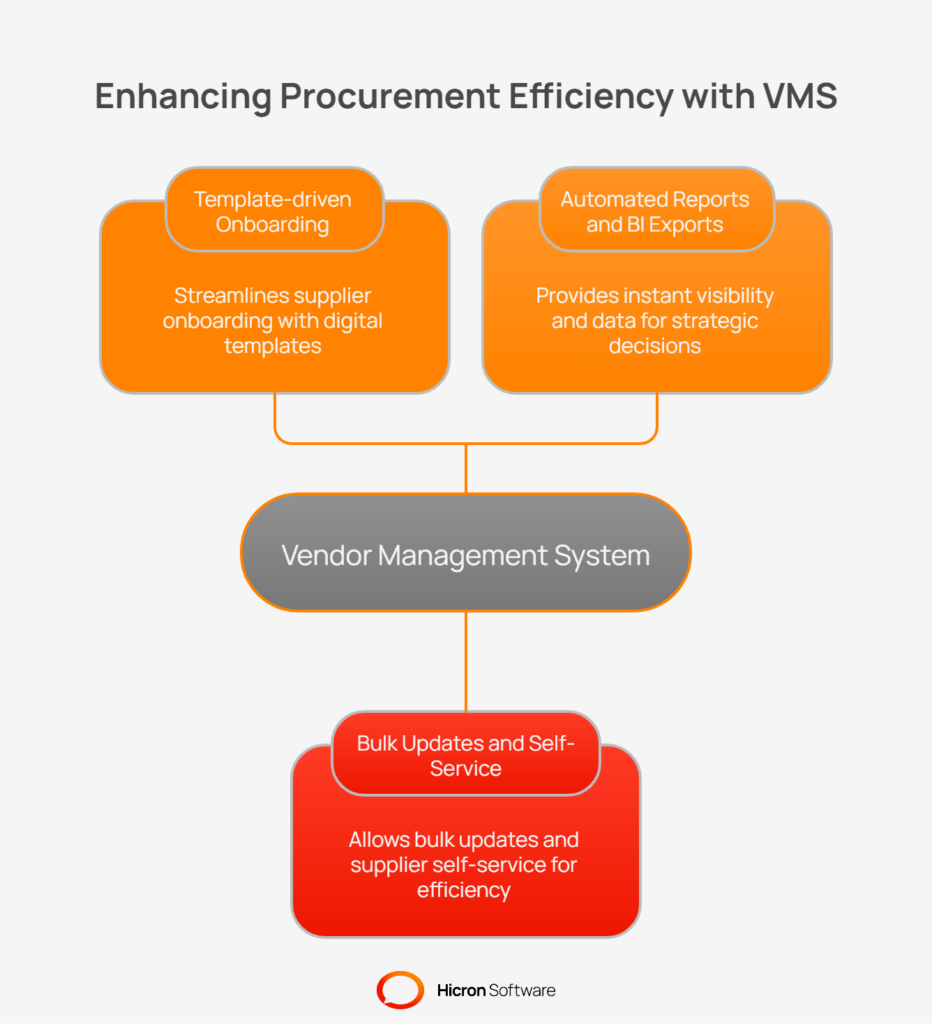
A Vendor Management System (VMS) automates and simplifies these routine tasks, freeing up your team to focus on strategic initiatives like supplier development and risk management instead of paperwork. This allows you to scale operations and handle more complexity without increasing headcount.
Implementing a Vendor Management System is a strategic investment, and proving its value requires tracking the right key performance indicators (KPIs). A VMS makes this process straightforward by capturing structured data across all supplier interactions, allowing you to quantify improvements and demonstrate a clear return on investment. A successful vendor management system cost-reduction program relies on measuring progress across procurement, inventory, quality, and finance to demonstrate tangible savings.
#1 Procurement efficiency: The VMS automates and streamlines the entire procure-to-pay cycle, and its impact can be measured through metrics that show increased speed and reduced friction.
#2 Inventory Optimization: By improving supply chain visibility and data accuracy, a VMS allows you to lower inventory costs without raising the risk of stockouts.
#2 Quality improvement: An integrated quality module helps you track and reduce the cost of poor quality (COPQ) by addressing issues at their source.
#4 Financial controls: The VMS brings efficiency and accuracy to the financial side of procurement, leading to direct bottom-line benefits.
By tracking these metrics, you can create a clear business case and demonstrate ongoing value.
| KPI category | Key metric | How a VMS drives cost savings |
| Procurement | Premium freight rate | Proactive alerts on at-risk orders prevent delays, eliminating the need for expensive expedited shipping. |
| Inventory | Days of supply (DOS) | Real-time lead-time tracking and supply visibility build confidence, enabling lower safety stock levels. |
| Quality | Rework/scrap cost | Centralized NCR management enables faster defect containment, limiting the spread of bad parts. |
| Finance | Invoice match rate | Automating the 2/3-way match process eliminates manual data entry and errors, reducing invoice processing costs. |
A successful vendor management system cost reduction initiative depends on a well-planned implementation that delivers value quickly. Instead of a “big bang” rollout, a phased approach allows your team to master core functionalities, build supplier adoption, and realize tangible savings within the first few months. This roadmap breaks the process into manageable stages, each building on the last to create a foundation for long-term success.
The initial phase focuses on establishing core connectivity and visibility to address the most common sources of friction. The goal is to create a single source of truth for purchase orders and gain early control over potential disruptions.
With the foundation in place, the second phase focuses on improving the efficiency of inbound logistics and introducing performance monitoring. This stage moves your team from reactive problem-solving to proactive management.
In the final phase, you will leverage the data and processes established earlier to drive more advanced cost-saving activities in inventory and quality. This is where the VMS transitions from an operational tool to a strategic asset.
A critical component across all phases is change management. Success requires preparing both your internal team and your external partners. Develop a supplier enablement kit with training guides and FAQs. Create internal playbooks for buyers that define new standard operating procedures. Crucially, establish KPI baselines before you begin so you can clearly measure and report the impressive ROI you achieve at each stage.
| Phase | Key activities | Quick wins |
| Phase 1 (0–60 days) | ERP sync, supplier onboarding and acknowledgements, basic alerts for at-risk orders | Rapid PO processing, real-time confirmation, fewer delays |
| Phase 2 (60–120 days) | ASN implementation, delivery scheduling, exception rules, and rollout of supplier scorecards | Reduced dock congestion, timely deliveries, and proactive issue resolution |
| Phase 3 (120–180 days) | Inventory analytics, integrated quality workflows (NCR/CAPA), supplier audits, and tracking | Lower inventory, reduced COPQ, targeted supplier development |
Strong governance is not just an IT requirement; it is essential for maintaining data integrity, ensuring compliance, and protecting sensitive commercial information. A VMS provides a governance framework through controlled access, transparent processes, and complete visibility into all system activities. This ensures that the benefits you achieve are protected for the long term.
Implementing a vendor management system (VMS) can deliver transformative results, but success is not automatic. To achieve strong, rapid vendor management system cost reduction, it is crucial to avoid common pitfalls that can derail projects, delay ROI, and frustrate users.
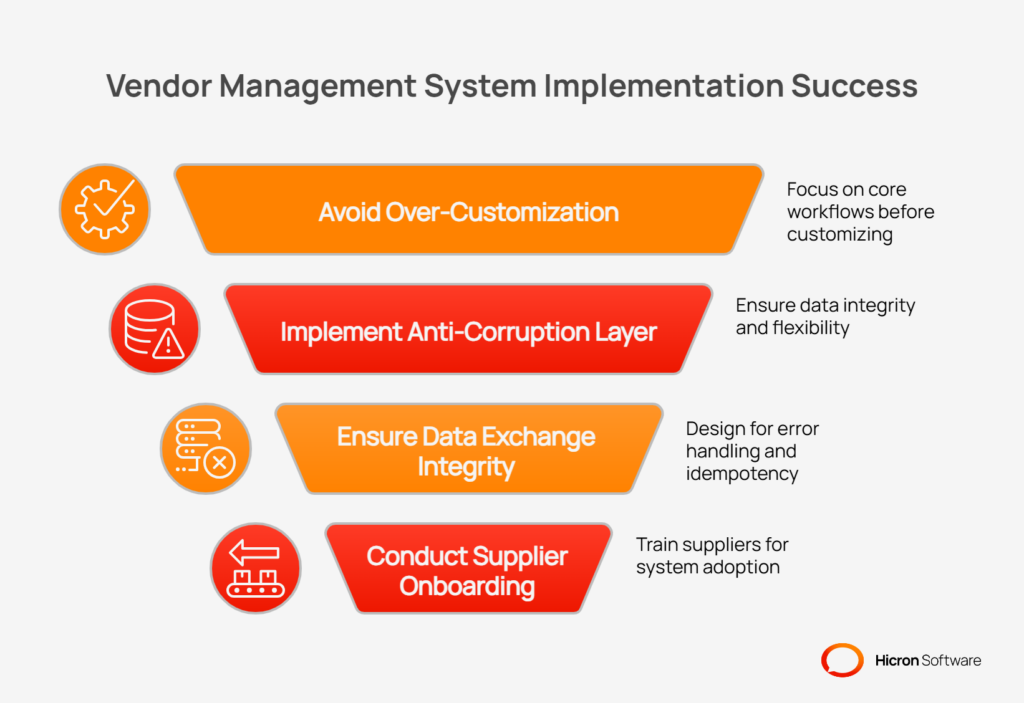
By staying focused on creating value from day one, you can navigate these challenges and ensure your implementation is a long-term success.
One of the most common mistakes is trying to tailor the VMS to replicate every detail of your old, inefficient processes. This leads to scope creep, extended timelines, and a difficult-to-maintain system.
How to avoid it? Focus on adopting the VMS’s core, standardized workflows first. Stabilize these essential processes, like PO transmission, acknowledgements, and ASNs, before considering customizations. Often, you will find the system’s best practices are more efficient than your legacy methods.
A simple 1:1 replication of your ERP’s data structure within the VMS can perpetuate existing data silos and limitations. This misses the opportunity to create a more flexible and user-friendly environment for collaboration.
How to avoid it? Work with your VMS provider to implement an “anti-corruption layer.” This is a conceptual layer that translates data between the rigid structure of your ERP and the more dynamic, network-oriented model of the VMS. This ensures data integrity while allowing for a more intuitive user experience for both internal teams and external suppliers.
Without proper technical design, integrations can fail silently or create significant problems. A lack of exception handling can result in lost data, while failing to ensure idempotency (an operation can be repeated multiple times without changing the result) can cause duplicate orders or invoices, leading to widespread confusion and rework.
How to avoid it? Ensure your integration plan includes error and exception handling from the start. All data transmissions should be designed with idempotency in mind, so if a message is sent twice, it doesn’t create a duplicate transaction. This technical discipline is critical for building trust in the system’s data.
A VMS is only as powerful as its network. If your suppliers do not understand how or why to use the system, adoption will be low, and you will not achieve the desired efficiencies.
How to avoid it? Treat supplier enablement as a critical project milestone. Develop a comprehensive onboarding program that includes clear documentation, training videos, and live support. Communicate the “what’s in it for them” benefits, such as faster payments and better communication, to drive engagement and ensure the system becomes the single source of truth for everyone.
Achieving significant, lasting vendor management system cost reductions requires transforming how you collaborate with your suppliers. A modern Vendor Management System (VMS) is at the heart of this transformation. It streamlines your procure-to-pay lifecycle by automating routine tasks, reducing manual errors, and boosting process efficiency.
The system fosters better communication, breaks down silos, and helps you build stronger supplier partnerships. With integrated quality management, you can address costly issues before they impact your business, and powerful analytics turn data into actionable insights to optimize inventory and prove your return on investment. When these elements work together, they drive sustainable savings that grow with your organization.
Getting started on this journey is more straightforward than it may seem. By taking a thoughtful, strategic approach, you can begin to realize measurable value within just a few months.
Start by identifying where your greatest pains and costs occur in your current supply chain, perhaps in premium freight, excessive rework, or administrative overhead. From there, focus on a few high-impact workflows that stand to benefit most from VMS integration, such as purchase order acknowledgements, Advance Shipping Notice (ASN) adoption, or streamlining invoice automation.
Partner with your VMS provider to launch a 90-day pilot program with a core group of suppliers. This pilot will help you prove value quickly, refine your processes, and build a strong foundation for further success across your entire supply network.
With the right plan in place, your VMS becomes much more than a tool; it becomes a true engine for ongoing cost reduction and operational excellence.

A vendor management system (VMS) drives cost reduction in several key areas. It automates manual procurement and accounts payable processes, which lowers administrative overhead. It provides real-time supply chain visibility, allowing you to optimize inventory levels and reduce carrying costs. Furthermore, by integrating quality management tools, a VMS helps you proactively address and prevent costly defects, rework, and scrap, directly lowering the Cost of Poor Quality (COPQ).
With a phased implementation approach, you can start seeing a tangible ROI within 90 days. The initial phase focuses on high-impact areas, such as automating purchase order acknowledgements and preventing premium freight by issuing at-risk order alerts. These quick wins generate immediate savings while you roll out more advanced features, such as inventory analytics and quality workflows, in subsequent phases for even greater returns.
Supplier adoption is crucial for success, which is why a modern VMS is designed to be a collaborative tool with clear benefits for suppliers. When you provide comprehensive onboarding, training, and support, suppliers quickly see the value. A VMS offers them clearer communication, better visibility into demand, faster invoice processing, and quicker payments, all of which create strong incentives for them to participate actively.
Yes, ERP integration is a core function of any modern VMS. The system is designed to sync with your ERP to automate data flow, including purchase orders and invoices, eliminating manual data entry and ensuring a single source of truth. This integration is designed to exist with features such as an anti-corruption layer to ensure data is accurate and presented in a user-friendly way for all parties.
A VMS comes with built-in analytics and dashboards to track Key Performance Indicators (KPIs) across your operations. You can measure improvements in procurement (e.g., reduced premium freight), inventory (e.g., lower days of supply), quality (e.g., reduced scrap costs), and finance (e.g., higher invoice match rates). This data-driven approach allows you to clearly quantify savings and prove the system’s value to stakeholders.
Hicron Software proved to be a trusted partner with unmatched technical expertise, delivering a scalable and user-friendly web application that was pivotal to our successful U.S. market expansion.

Hicron’s contributions have been vital in making our product ready for commercialization. Their commitment to excellence, innovative solutions, and flexible approach were key factors in our successful collaboration.
I wholeheartedly recommend Hicron to any organization seeking a strategic long-term partnership, reliable and skilled partner for their technological needs.

After carefully evaluating suppliers, we decided to try a new approach and start working with a near-shore software house. Cooperation with Hicron Software House was something different, and it turned out to be a great success that brought added value to our company.
With HICRON’s creative ideas and fresh perspective, we reached a new level of our core platform and achieved our business goals.
Many thanks for what you did so far; we are looking forward to more in future!

Hicron is a partner who has provided excellent software development services. Their talented software engineers have a strong focus on collaboration and quality. They have helped us in achieving our goals across our cloud platforms at a good pace, without compromising on the quality of our services. Our partnership is professional and solution-focused!

The IT system supporting the work of retail outlets is the foundation of our business. The ability to optimize and adapt it to the needs of all entities in the PSA Group is of strategic importance and we consider it a step into the future. This project is a huge challenge: not only for us in terms of organization, but also for our partners – including Hicron – in terms of adapting the system to the needs and business models of PSA. Cooperation with Hicron consultants, taking into account their competences in the field of programming and processes specific to the automotive sector, gave us many reasons to be satisfied.