What is a Vendor Management System (VMS)? 2026 Guide
- October 03
- 12 min


An on-premises Vendor Management System (VMS) is a dedicated software platform that organizations choose to install and maintain within their private data centers. Unlike cloud-based solutions, an on-prem VMS is owned, managed, and customized in-house. This approach appeals to companies with strict data handling requirements, established IT environments, or industry regulations. Businesses selecting an on-premises VMS often do so to maintain strict control, data residency, and direct integrations with existing infrastructure.
The conversation around enterprise software often centers on the cloud. Yet, for many organizations, the best solution isn’t found in a multi-tenant public cloud but within their own data centers. Despite the cloud’s popularity, on-premises Vendor Management Systems (VMS) remain essential for organizations that prioritize uncompromising security, deep customization, and integration with their existing IT infrastructure. A self-hosted VMS provides a level of control that cloud alternatives simply cannot match, making it the right choice for businesses with specific operational and regulatory needs.
This article explores the enduring value of an on-premises Vendor Management System. We will examine why some of the world’s most demanding industries continue to rely on this deployment model and what it takes to build and maintain a successful on-prem VMS.
Key Takeaways:
An on-premises Vendor Management System is a software platform that an organization licenses and operates on its own servers, within its own data center. Unlike a cloud-based VMS, which is hosted and managed by a third-party vendor, an on-prem VMS is managed entirely by the company’s internal IT department. This self-hosted VMS approach gives the organization complete authority over the application, its data, and the underlying infrastructure.
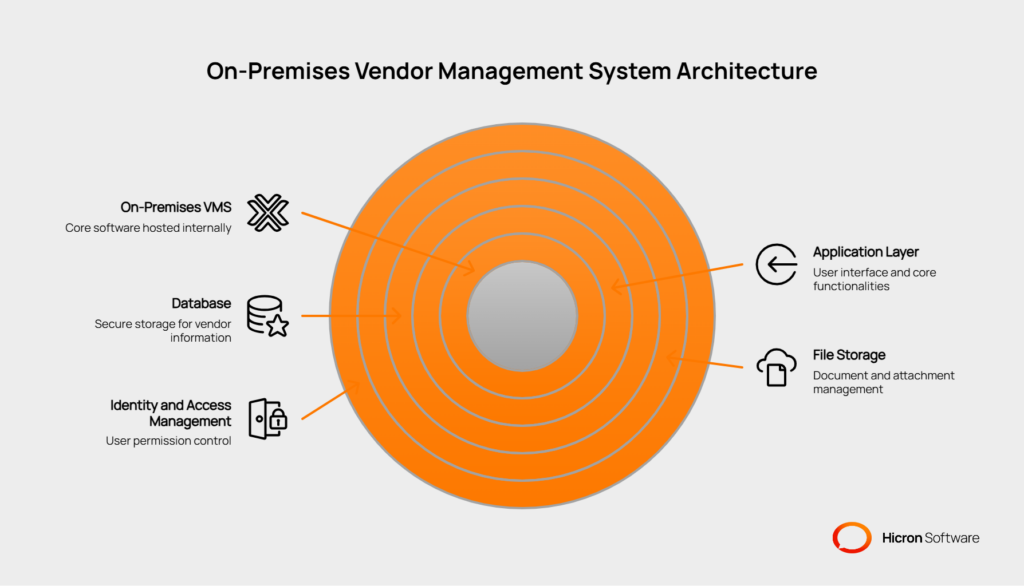
A typical on-prem VMS includes several core components:
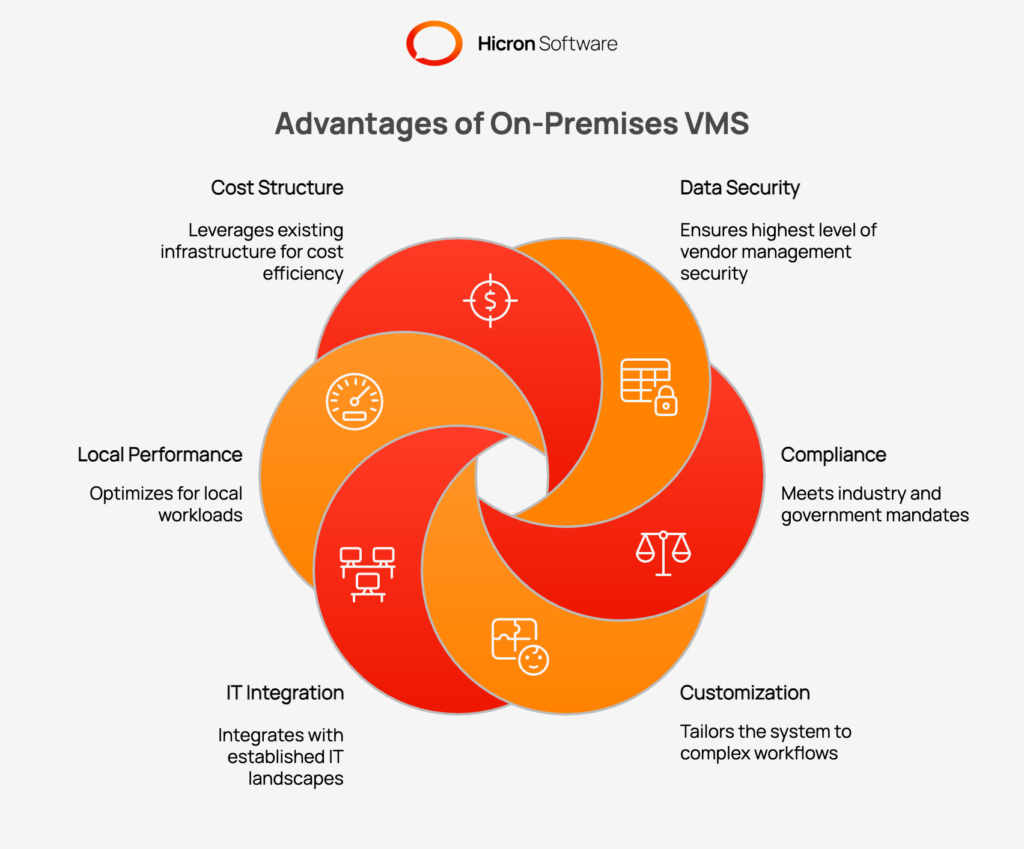
While cloud solutions offer convenience and lower upfront costs, an on-premises VMS provides distinct advantages that are critical for certain business contexts. The decision often comes down to balancing control, security, and long-term strategy.
For many companies, vendor information is just as sensitive as customer data. An on-prem VMS ensures the highest level of vendor management security. By hosting the system internally, you maintain absolute control over data sovereignty. This means you dictate exactly where your data resides, who can access it, and how it’s protected. In some cases, organizations can even operate their VMS in an “air-gapped” environment, completely isolated from public networks. This dramatically reduces exposure to third-party data breaches and gives security teams full visibility into access logs and system activity.
Highly regulated industries like defense, healthcare, and finance face stringent VMS compliance requirements. Government mandates and industry frameworks such as GDPR, HIPAA, or ITAR often impose strict rules about data residency, privacy, and physical control. An on-premises Vendor Management System allows organizations to meet these obligations without ambiguity. Auditors can verify physical security controls, and compliance teams can guarantee that data never leaves a specific jurisdiction. This simplifies audits and removes the risks associated with a third-party vendor’s compliance posture.
Every business has unique processes. A key limitation of multi-tenant cloud software is that customization is often restricted to what the vendor allows. With a self-hosted VMS, you have the freedom to tailor the system to your exact workflows. This could mean developing custom modules, modifying the database schema, or fine-tuning performance for specific tasks. You also control the update schedule, avoiding forced updates that might disrupt established processes. This deep level of customization ensures the VMS works for your business, not the other way around.
Large enterprises have complex, established IT environments. An on-premises VMS can integrate directly and efficiently with other core systems running in the same data center. This low-latency ERP integration with platforms like SAP and Oracle is a significant advantage. Direct connections to Product Lifecycle Management (PLM) systems or internal identity providers are faster and more reliable. Using architectural patterns like an anti-corruption layer, an on-prem VMS can communicate with legacy applications without creating tight dependencies, ensuring stability and long-term maintainability.
When a VMS is used primarily by employees within a specific facility or region, hosting it locally provides a superior user experience. An on-prem VMS delivers stable, low latency for internal users, which is crucial for data-heavy operations. Whether processing large engineering files from a supplier or running complex analytics, performance is predictable and consistent. This is especially important for sites with limited or unreliable internet connectivity, where reliance on a cloud service would introduce unacceptable risk.
For organizations that have already made significant investments in data centers, servers, and network hardware, an on-premises VMS allows them to maximize the return on those investments. In environments that favor Capital Expenditures (CapEx) over Operational Expenditures (OpEx), the cost structure of a self-hosted VMS is more predictable. You avoid the variable monthly fees associated with cloud usage, and costs are tied to owned hardware with a clear depreciation schedule.
Certain business scenarios strongly favor the on-premises model. If your organization fits one or more of these profiles, a self-hosted VMS is likely the most strategic choice.
A modern on-premises VMS is far from a monolithic legacy application. To deliver value, it must be built with enterprise-grade capabilities that ensure security, reliability, and scalability.
|
Capability |
Description |
|
Enterprise-Grade Identity and RBAC |
Integrates with identity providers like LDAP or Active Directory for Single Sign-On (SSO). Supports Role-Based and Attribute-Based Access Control (RBAC/ABAC) to enforce least privilege, with comprehensive audit trails and data encryption. |
|
Design for Uptime |
Ensures business continuity through high-availability architecture. This includes multi-node clustering, load balancing, data replication, automated backups, and a clear disaster recovery plan to eliminate single points of failure. |
|
Scale and Evolve Without Disruption |
Features a modular architecture where independent services (e.g., onboarding, orders) can be updated or scaled individually. Asynchronous communication between modules improves system resilience and flexibility. |
|
Centralized, Real-Time Insights |
Provides real-time dashboards for monitoring Key Performance Indicators (KPIs) like supplier performance and costs. Includes robust data export capabilities to feed business intelligence (BI) tools for deeper analysis. |
|
Stable Connections to ERPs and Legacy Apps |
Offers well-documented APIs and messaging protocols for effective integration with ERPs and other business systems. May use an anti-corruption layer to decouple the VMS from other applications, ensuring stability. |
Security starts with identity. Your on-prem VMS must integrate seamlessly with enterprise identity providers like LDAP, Active Directory, or Keycloak for Single Sign-On (SSO). It should support robust Role-Based Access Control (RBAC) and Attribute-Based Access Control (ABAC) to enforce the principle of least privilege. Comprehensive audit trails logging all user actions are non-negotiable for vendor management security, as is encryption for data at rest and in transit.
A high-availability VMS is critical for business continuity. The architecture should be designed to eliminate single points of failure. This involves running the application in a multi-node cluster with load balancing to distribute traffic. Data replication across servers, automated backup procedures, and a well-documented disaster recovery plan are essential. Continuous health checks and monitoring ensure that any potential issues are detected and addressed before they impact users.
To avoid becoming a rigid, outdated system, a modern on-prem VMS should feature a modular VMS architecture. By breaking the system into independent services, such as supplier onboarding, order management, quality control, and performance analytics, you can update, scale, or replace individual components without affecting the entire platform. Using asynchronous communication with tools like message queues allows these modules to interact reliably without being tightly coupled, improving resilience and flexibility.
A VMS is a rich source of operational data. The system should provide centralized, real-time dashboards for tracking Key Performance Indicators (KPIs) related to supplier performance, costs, and compliance. It must also include robust data export pipelines that can feed information into corporate Business Intelligence (BI) tools for deeper analysis, empowering leaders to make data-driven decisions.
Effective ERP integration is a cornerstone of a successful VMS. The system must provide stable, well-documented APIs and support messaging protocols for connecting to other business systems. An anti-corruption layer is a valuable pattern here, acting as a translator between the VMS and other applications. This decouples the systems, allowing either one to be updated or replaced without breaking the integration.
The technology stack for a self-hosted VMS should be chosen for its stability, performance, and support within an enterprise environment.
While powerful, an on-premises approach comes with its own set of challenges. Proactive planning can help mitigate them.
The choice is not always binary. A hybrid approach can offer the best of both worlds. Organizations can keep their core vendor data and sensitive processes in their on-prem VMS while offloading less critical workloads, like analytics or a supplier-facing portal, to the cloud. This strategy enables a staged modernization path, allowing you to gradually introduce cloud services without a risky “big-bang” migration.
The rush to the cloud has overshadowed the unique strengths of on-premises solutions. For businesses where data security, regulatory compliance, deep customization, and control over the IT environment are paramount, an on-premises Vendor Management System remains the superior choice. It provides a level of assurance and integration that is difficult to achieve with a third-party service.
Before making a decision, conduct a thorough readiness audit of your organization’s needs and capabilities. Assess your security requirements, integration landscape, and internal IT expertise. By planning for a modular, high-availability architecture tailored to your specific environment, you can build a self-hosted VMS that serves as a powerful strategic asset for years to come. Feel free to contact us; we will be happy to help you address any concerns, plan the architecture, and set up your vendor management system on premises.
An on-premises Vendor Management System (VMS) is a software solution that an organization hosts and manages within its own IT infrastructure, rather than on a third-party cloud server. This self-hosted approach gives you complete control over the system, enhancing vendor management security and ensuring data remains within your private network.
An on-premises VMS is deployed in your organization’s data center, where you maintain full control. A cloud VMS is hosted by a third-party vendor and accessed over the internet.
Organizations facing high regulatory demands, those with in-house technical capabilities, or those with strict data sovereignty policies are best suited for on-premises solutions.
Yes, modern on-premises VMS platforms support direct integration with ERP systems like SAP and Oracle, helping unify procurement and supply chain data.
A modular VMS uses separate, independent functional blocks (such as onboarding, compliance, and quality management) that communicate as needed. This provides flexibility for updates, scaling, and future integration needs.
Yes. Many organizations run core, sensitive workloads on-premises while taking advantage of cloud services for non-sensitive functions like analytics, reporting, or supplier portals.
Hicron Software proved to be a trusted partner with unmatched technical expertise, delivering a scalable and user-friendly web application that was pivotal to our successful U.S. market expansion.

Hicron’s contributions have been vital in making our product ready for commercialization. Their commitment to excellence, innovative solutions, and flexible approach were key factors in our successful collaboration.
I wholeheartedly recommend Hicron to any organization seeking a strategic long-term partnership, reliable and skilled partner for their technological needs.

After carefully evaluating suppliers, we decided to try a new approach and start working with a near-shore software house. Cooperation with Hicron Software House was something different, and it turned out to be a great success that brought added value to our company.
With HICRON’s creative ideas and fresh perspective, we reached a new level of our core platform and achieved our business goals.
Many thanks for what you did so far; we are looking forward to more in future!

Hicron is a partner who has provided excellent software development services. Their talented software engineers have a strong focus on collaboration and quality. They have helped us in achieving our goals across our cloud platforms at a good pace, without compromising on the quality of our services. Our partnership is professional and solution-focused!

The IT system supporting the work of retail outlets is the foundation of our business. The ability to optimize and adapt it to the needs of all entities in the PSA Group is of strategic importance and we consider it a step into the future. This project is a huge challenge: not only for us in terms of organization, but also for our partners – including Hicron – in terms of adapting the system to the needs and business models of PSA. Cooperation with Hicron consultants, taking into account their competences in the field of programming and processes specific to the automotive sector, gave us many reasons to be satisfied.