What is ERP Real-time Data Synchronization & How to Sync Your ERP System
- May 21
- 15 min

A data fabric is an architectural approach that connects data across the enterprise without forcing every dataset into one physical location. It sits above your existing systems and creates a unified layer for data access, data integration, and data delivery.
Global data creation is expected to reach 181 ZB in 2025, and as that data spreads across more systems, platforms, and cloud environments, the risk of fragmentation grows with it. More data in more places means more silos, more inconsistency, and more integration work. This article explains whatc a data fabric is, how the architecture works, how it compares to a data mesh, and where it delivers real business value. You will learn the core components, the main use cases, and the practical steps toward building a data fabric that supports trusted, real-time data.
Key Takeaways
A data fabric is an architectural design that unifies data across different systems through a connected metadata layer. It links data sources such as databases, applications, a data lake, and cloud services into one accessible view. The goal is to make data available to the people who need it, regardless of where that data physically lives.
Most enterprises hold their data in dozens of disconnected systems. A data warehouse feeds reporting, a data lake holds raw files, and operational applications keep their own records. Each of these data silos solves a local problem while creating a wider one. Teams cannot get a consistent view of data across multiple systems, so decisions rely on partial or stale information. According to the State of Data and AI Literacy Report 2025 by DataCamp, 40% of US and UK leaders cited decreased productivity and 39% cited inaccurate decision-making as primary risks of poor data capability. These outcomes trace directly to disconnected systems and outdated data.
The reason it matters is practical. Enterprises collect large amounts of data across many platforms, yet most of it stays trapped in silos. A data fabric integrates data from various sources and presents it as a coherent whole. It reduces the manual effort of stitching systems together and improves how quickly teams access data.
A data fabric also matters because data volumes keep growing. Traditional data integration methods struggle as new data sources appear. A data fabric provides an adaptive framework that scales with the enterprise, connecting new systems without rebuilding the entire data architecture each time.
A data fabric overlays an active metadata layer across your existing data infrastructure, spanning databases, data lakes, data warehouses, applications, and cloud services. That layer maintains a catalog for every data source, maps relationships between datasets, and applies governance rules (access controls, quality checks, and lineage tracking) consistently across all connected systems. Rather than physically consolidating data into a central warehouse, the fabric uses data virtualization to retrieve data at its source, reducing storage overhead and the risk of stale duplicates spreading across the enterprise.
Active metadata is the engine behind this. The fabric continuously reads metadata about how data is structured, used, and related across systems, then uses that intelligence to automate data integration tasks, recommend datasets, and enforce policy as data moves between sources. This closed-loop, metadata-driven automation, rather than manually hand-coded connections between systems, is what separates a data fabric from a simple integration tool.
Metadata is the foundation of how a data fabric functions. It records where data sits, what it means, and who owns it. The system reads this metadata continuously and uses it to automate data discovery, mapping, and delivery.
Automation reduces the burden on data engineers. Instead of hand-coding every connection, teams rely on the fabric to manage data pipelines. It speeds up onboarding of new data sources and keeps the wider data environment consistent as it grows.
The automation layer typically handles several recurring tasks:
A data fabric brings together several capabilities into one connected architecture. Each component of a data fabric handles a specific part of the data management challenge. Together they turn disparate data into a governed, accessible resource.
| Component | Function | Importance |
| Data catalog | Inventories all data assets with definitions, ownership, and context | Makes data discoverable and understandable across the enterprise |
| Data integration | Connects and combines data from various sources | Removes manual effort and reduces fragmented data pipelines |
| Data virtualization | Provides access to data in place without physical movement | Keeps information current and reduces storage overhead |
| Data governance | Applies policies that control data access, quality, and compliance | Ensures consistent rules across every connected source |
| Data lineage | Records how data flows and transforms across systems | Supports auditing, trust, and data quality assurance |
These pieces do not work in isolation. The data catalog feeds the governance layer, while data virtualization relies on accurate metadata to locate sources. Remove one component, and the architecture loses coherence.
Each component contributes to trusted data. The data catalog makes assets discoverable and understandable. Data lineage shows where information came from, which supports auditing and confidence in results.
Data governance ties these together by enforcing rules on sensitive data and data quality. When teams know a dataset is governed and traceable, they use it with confidence. The Agility PR survey found that 85% of companies blamed stale data for bad decision-making and lost revenue. A figure that has held consistent across multiple studies and points to how directly data trust connects to business outcomes. This is how a data fabric produces high-quality data rather than just more data.
Data virtualization is a key technique within a data fabric that provides access to data without moving it. It creates a unified view of data from multiple systems in real time, letting users query that view as if it were a single database while the data itself stays put in its original source.
Because the fabric connects to sources directly instead of copying records into a central warehouse, this approach also cuts storage and replication costs. Information stays current, and the risk of stale duplicates spreading across the enterprise falls with it.
Data virtualization has limits worth understanding, though. It supports reporting and analytics well, but it does not guarantee transactional integrity across systems. For that reason, a data fabric often pairs virtualization with selective data ingestion and change data capture where real-time data movement is required.
A data fabric and a data mesh both address distributed data, but they take different approaches. A data fabric is a technology-driven architecture that connects data through an intelligent metadata layer. A data mesh is an organizational approach that assigns data ownership to individual business domains.
The distinction comes down to focus. A data fabric emphasizes automation, integration, and a unified technical layer across the enterprise. A data mesh emphasizes people and process, treating data as a product owned by the teams that know it best.
The two models are not mutually exclusive. Many organizations combine them, using a data fabric to provide the technical foundation while adopting data mesh principles for ownership. The fabric connects data across domains, and the mesh defines who is accountable for each data product.
Choosing between data fabric and data mesh depends on your priorities:
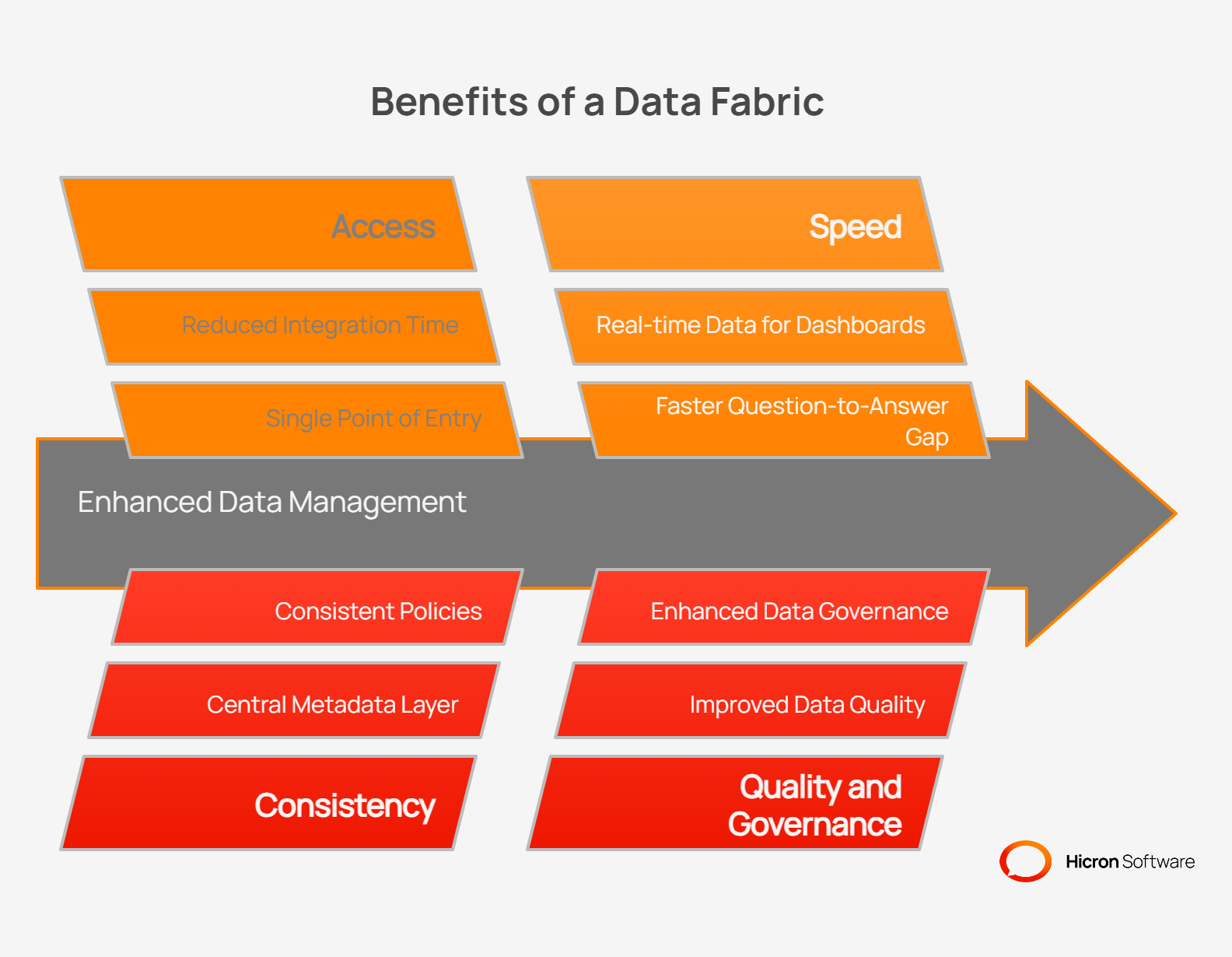
Access, consistency, and speed sit at the center of what a data fabric delivers. Teams find the data they need without lengthy integration projects, since the fabric connects systems that would otherwise stay siloed, shortening the gap between a question and a reliable answer.
At the same time, a data fabric also improves data quality and governance. Because policies apply through a central metadata layer, rules stay consistent across every source. Sensitive data receives the same protection whether it sits in a data lake or an operational system.
Beyond access, a data fabric supports both operational and analytical work. Data scientists gain a single point of entry to structured and unstructured data. Analysts get real-time data for dashboards, while engineers spend less time maintaining brittle data pipelines.
These gains compound over time. As the fabric learns from metadata, it automates more integration work and simplifies data delivery further. The result is a data environment that becomes easier to manage as it grows, rather than harder.
Data fabric use cases appear wherever an organization needs a unified view of data across many systems. The sections below cover the most common scenarios, each representing a different pressure point that a data fabric is built to address.
Enterprise analytics is the most widely adopted data fabric use case. Finance, operations, and sales teams need to combine data from multiple sources for reporting and forecasting. Without a unified layer, that work depends on manual extraction, inconsistent definitions, and slow turnaround before any analysis can begin.
Implementing a data fabric for enterprise analytics delivers three concrete benefits:
Compliance teams need clear, structured visibility into where sensitive data lives and how it moves. A data fabric provides the data lineage and governance controls that auditors require, recording and classifying every data movement across the enterprise.
In practice, this means the data fabric:
Operational systems in retail, logistics, and financial services require data that reflects current conditions. Scheduled batch loads introduce latency that real-time decisions cannot accommodate. A data fabric connects live sources directly and delivers current data to the systems that act on it.
The benefits show up directly in operations like:
Machine learning models depend on data that is clean, consistent, and traceable. A data fabric provides a trusted data supply across the full enterprise, covering both structured and unstructured sources, so the quality problem is solved before it reaches the model.
This means AI and ML initiatives get a foundation that:
Organizations running separate CRM, ERP, and digital channel platforms often hold fragmented views of the same customer. A data fabric connects these systems into a single, unified customer record without requiring a costly platform consolidation.
In practice, this means the data fabric:
Mergers and acquisitions force two or more independent data environments together almost overnight. Each company arrives with its own ERP, CRM, and reporting tools, often built on incompatible data models and naming conventions. Consolidating these systems through a traditional migration can take years and frequently stalls the synergies the deal was meant to deliver.
A data fabric shortens this timeline by connecting the acquired systems into a unified view before any physical consolidation happens. Finance and operations teams can report across both entities from day one, while the underlying systems are migrated or retired on a slower, lower-risk schedule. This turns integration from a blocking dependency into a background process that runs alongside, rather than ahead of, the rest of the deal.
In an M&A context, a data fabric:
A unified metadata layer for discovery, lineage, governance, and integration underlies every use case covered here. Analytics teams, compliance teams, operations teams, and data scientists all draw from that same architectural layer, and its value compounds with each new team or use case that joins. Treat it as a one-time departmental project, though, and you’ll only capture a fraction of what it can deliver.
A data fabric creates compounding value because its foundation is shared. The same metadata layer, lineage records, and governance policies that serve one team serve every other team. Each new use case that connects to the fabric strengthens it rather than adding complexity. Organizations that treat a data fabric as shared infrastructure rather than a departmental fix are the ones that realize its full potential over time. The same visibility supports application rationalization, since a data catalog that inventories every connected source makes it clear which systems overlap, which are redundant, and which no longer deliver enough business value to justify keeping.
A data fabric differs fundamentally from a data lake or data warehouse. These storage solutions serve as destinations where data is collected. In contrast, a data fabric acts as an architectural layer that links these storage destinations and other systems into a unified, accessible view. Planning must recognize a key distinction: a data warehouse structures data for reporting purposes, while a data lake stores raw, unprocessed data for analysis. Although both are useful, neither alone connects data across the entire organization.
A data fabric complements these systems instead of replacing them. It integrates the data lake, data warehouse, and operational applications through metadata and virtualization, unifying existing investments without requiring a costly rebuild of your data infrastructure. This logic underpins a clean core ERP strategy, where the standard application layer stays close to its vendor-delivered state and custom logic is pushed into an extension layer, so the data fabric draws from the ERP remains consistent and trustworthy rather than distorted by unmanaged modifications.
Governance in a data fabric doesn’t sit off to the side as its own system. It runs through the same metadata layer that powers integration. That’s what lets the fabric apply data governance rules centrally and enforce them consistently across every connected source, instead of leaving each system to follow its own patchwork of policies.
But governance is only as strong as what you can see. That’s where the data catalog and data lineage come in: together, they show what data exists and how it moves through the enterprise. With that visibility, governance teams can classify sensitive data, control access, and monitor data quality, all from a single point of oversight, rather than chasing consistency system by system.
Governance is what turns raw connectivity into trusted data. When rules apply consistently, teams trust the results they pull from the fabric. Adoption follows naturally, because a data fabric only delivers value when people rely on it. Effective governance also balances control with access. Overly strict rules block the data teams need, while loose rules risk exposure of sensitive data. A well designed data fabric provides granular controls that protect data security without slowing legitimate work.
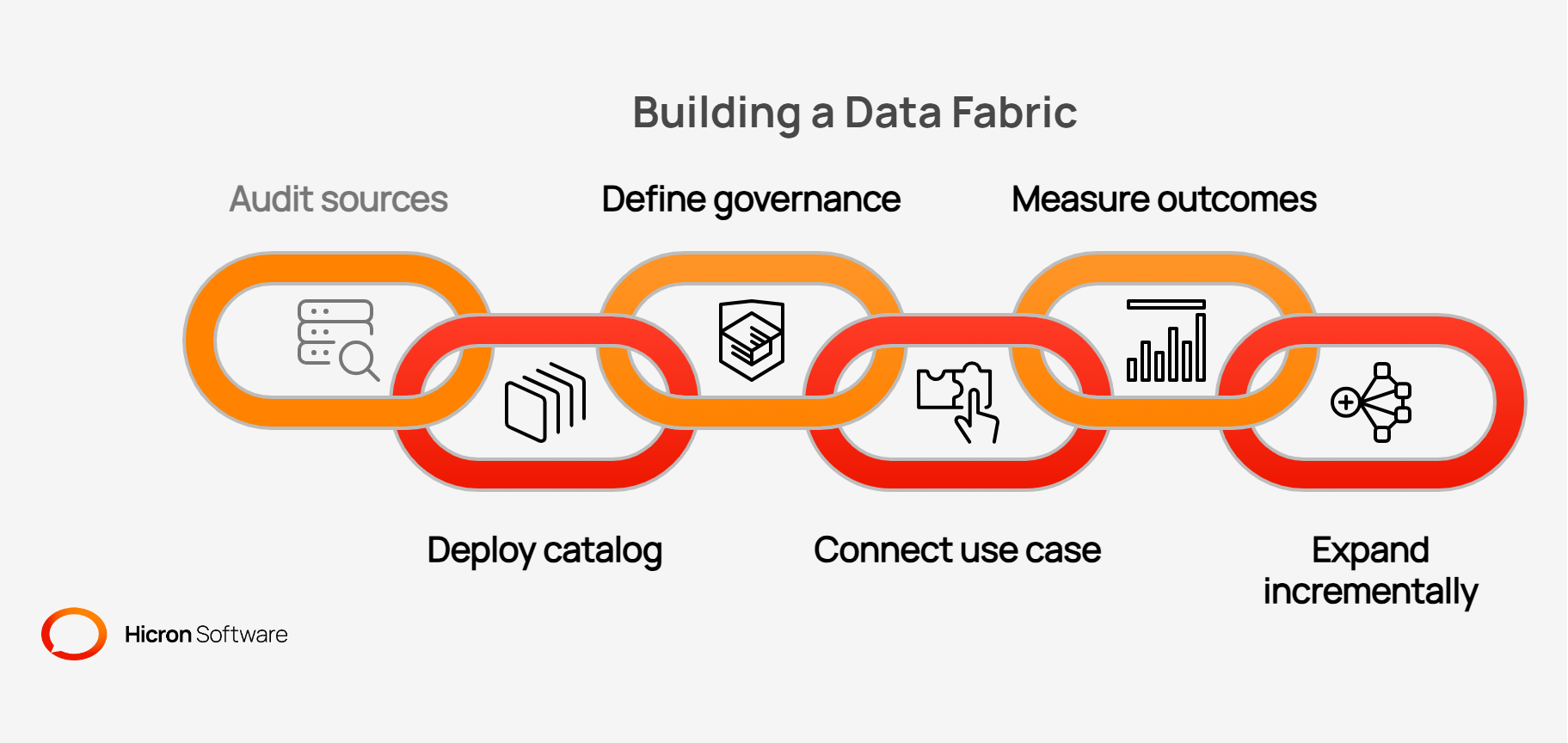
Building a data fabric begins with a clear inventory of your data assets:
A data fabric is best built in phases rather than one large project. Start with a high value use case, connect its data sources, and prove the model. Then extend the fabric to new data sources and domains as confidence grows. A practical build sequence follows this order:
Such an approach reduces risk and builds momentum. Each phase delivers usable results while expanding the connected data environment. Over time, the fabric grows into a comprehensive layer that unifies data across the enterprise.
A data fabric delivers durable value because its components are interdependent. Active metadata drives integration decisions, data virtualization provides access without unnecessary data movement, and governance enforces consistent rules across every connected source. These elements do not function as separate tools. They operate as a single coordinated layer. When one part strengthens, the others benefit. As data sources multiply and business requirements shift, that interconnected foundation adapts without requiring a full architectural rebuild. This is what makes a data fabric a long-term enterprise capability rather than a project with a fixed endpoint
Unlike a conventional integration project, a data fabric does not have a fixed endpoint. Data sources change, volumes grow, and business requirements shift. Because the architecture is metadata-driven, it adapts to these changes incrementally rather than requiring structural rebuilds. New systems connect through the existing governance and catalog layer. Existing pipelines update without disrupting downstream consumers. Organizations that treat a data fabric as shared, evolving infrastructure are better positioned to manage complexity over time, turning what was once a fragmented data environment into a reliable, enterprise-wide resource.
Sources:

Hicron Software proved to be a trusted partner with unmatched technical expertise, delivering a scalable and user-friendly web application that was pivotal to our successful U.S. market expansion.

Hicron’s contributions have been vital in making our product ready for commercialization. Their commitment to excellence, innovative solutions, and flexible approach were key factors in our successful collaboration.
I wholeheartedly recommend Hicron to any organization seeking a strategic long-term partnership, reliable and skilled partner for their technological needs.
After carefully evaluating suppliers, we decided to try a new approach and start working with a near-shore software house. Cooperation with Hicron Software House was something different, and it turned out to be a great success that brought added value to our company.
With HICRON’s creative ideas and fresh perspective, we reached a new level of our core platform and achieved our business goals.
Many thanks for what you did so far; we are looking forward to more in future!

Hicron is a partner who has provided excellent software development services. Their talented software engineers have a strong focus on collaboration and quality. They have helped us in achieving our goals across our cloud platforms at a good pace, without compromising on the quality of our services. Our partnership is professional and solution-focused!

The IT system supporting the work of retail outlets is the foundation of our business. The ability to optimize and adapt it to the needs of all entities in the PSA Group is of strategic importance and we consider it a step into the future. This project is a huge challenge: not only for us in terms of organization, but also for our partners – including Hicron – in terms of adapting the system to the needs and business models of PSA. Cooperation with Hicron consultants, taking into account their competences in the field of programming and processes specific to the automotive sector, gave us many reasons to be satisfied.