How to Design an Agile Application Ecosystem Around Your ERP
- June 29
- 18 min


Application rationalization is the process of reviewing every application in your estate and deciding what to keep, retire, consolidate, or modernize. It brings structure to application portfolio management and ties each tool to real business value. Without a structured way to evaluate the portfolio, technical debt compounds quietly until it limits every modernization effort. This article explains what application rationalization is, why application sprawl builds technical debt, how to design a framework, and how the rationalization process works in practice.
Most organizations run far more software than they can manage well. Applications accumulate through mergers and acquisitions, departmental purchases, and years of piecemeal buying. Over time, the portfolio grows into a tangle of overlapping tools, redundant functions, and quiet costs. The core systems still work, yet the surrounding software slows every business process it touches. This is the problem application rationalization sets out to solve.
Application rationalization is the process of evaluating your full application portfolio to align software with business needs.
It identifies which applications deliver business value, which duplicate each other, and which no longer earn their cost. The goal is a leaner, more coherent application stack that supports business goals rather than obstructing them.
The reason it matters is measurable. Every application carries a cost in licensing, maintenance, integration, and staff time. When the number of applications grows without oversight, that cost compounds. Technical debt alone can account for 20 to 40 percent of a technology estate’s total value before depreciation. A bloated portfolio also increases risk, because more systems mean more integration points, more failure modes, and a larger security surface to govern.
Application rationalization gives leaders a defensible basis for decisions. Instead of retiring tools by instinct, teams evaluate each application against consistent criteria. This turns a vague cleanup effort into a structured initiative with trackable outcomes, including the percentage of applications with confirmed ownership, the share classified by lifecycle status, and the number flagged for retirement or consolidation.
Application sprawl occurs when organizations acquire software faster than they retire it. New departments adopt their own tools. Cloud subscriptions appear on expense reports. Mergers and acquisitions overnight introduce entire duplicate systems into the estate. The result is a wide, redundant portfolio with unclear ownership and compounding overhead.
Technical debt grows alongside. Legacy systems remain in place because replacing them feels risky. Custom integrations pile up to connect tools that were never designed to work together. Each redundant application increases the maintenance burden and draws budget away from modernization. A data fabric architecture addresses this directly. Instead of maintaining a growing web of point-to-point integrations, a data fabric layer provides a unified way to access, connect, and govern data across applications regardless of where it lives. Rationalization and data fabric reinforce each other: reducing the number of applications shrinks the integration surface, while a data fabric makes the remaining connections easier to manage and monitor.
Redundancy is the most common symptom of an unmanaged portfolio. Several applications often perform the same function across different business units. In a portfolio of several hundred applications, even a small layer of overlap across workflow tools, reporting utilities, and legacy custom builds can create meaningful licensing, support, and security-review overhead before any modernization work begins. This redundancy inflates total cost of ownership and confuses users about which system holds accurate data.
Eliminating redundant tools does more than reducing costs. It clarifies where authoritative data lives and simplifies the integration map. Rationalization reduces the surface area that IT teams have to support, monitor, and secure.
Accumulated debt slows every future change. When systems are tightly coupled and poorly documented, even small updates carry serious risk. Teams spend more time keeping legacy systems alive than improving them. A portfolio weighed down by debt cannot adapt quickly to new business needs. Rationalization frees capacity by removing the tools that generate the most debt for the least return.
An application rationalization framework gives structure to how you evaluate and score each tool. It defines the criteria, the scoring model, and the decision rules that guide the effort. A clear framework keeps decisions consistent across departments and stakeholders.
Most frameworks assess applications along two axes: business value and technical fit. Business value covers how well an application supports business goals and daily operations. Technical fit covers stability, security, integration quality, and total cost of ownership. Scoring on both axes reveals which tools to invest in and which to phase out.
The framework then maps each application to a defined disposition. Many rationalization frameworks build on Gartner’s TIME model, which defines four core categories: Tolerate, Invest, Migrate, and Eliminate. Some organizations add a fifth category, Consolidate, to handle applications that overlap with others in the portfolio. The value of this approach is not just conceptual clarity. It produces a reportable baseline, showing how many applications the organization will tolerate, invest in, migrate, or eliminate across a defined planning horizon. Together, these categories give every application owner a clear disposition and a documented rationale.
| Disposition | Meaning | Action |
| Tolerate | The application still meets a real need but has limited value or aging technical fit. | Keep in place, monitor, and revisit as priorities or risk shifts. |
| Invest | The application delivers strong business value and sits on a healthy, well-supported technical foundation. | Prioritize funding, enhancement, and continued modernization. |
| Migrate | The application remains valuable, but its current platform or architecture no longer fits. | Move to a modern platform, cloud, or better-supported architecture. |
| Eliminate | The application no longer justifies its cost, risk, or maintenance burden. | Retire the application and reallocate the budget and effort. |
| Consolidate | The application overlaps with other tools in the portfolio, creating redundancy and wasted spend. | Merge capabilities into a single system and decommission the duplicate. |
A framework works best when it reflects your own business context. The categories above are a starting point, not a fixed rule. Effective application rationalization adapts the model to the organization’s priorities and technical maturity. For ERP-centric estates, clean core adds a further filter to the Migrate and Eliminate categories: any application whose function depends on customizing the ERP core directly is a strong candidate for migration to a decoupled extension or third-party tool, rather than being tolerated in place.
The application rationalization process moves from audit to discovery to decision to execution. It begins with a structured application audit, progresses to a comprehensive inventory, and culminates in a documented rationalization roadmap. Each phase produces evidence that supports the next set of decisions.
The process depends on accurate data. Guesswork about application usage and costs leads to poor rationalization decisions. A disciplined audit provides a factual foundation for the effort. According to McKinsey, technical debt can account for 20 to 40 percent of a technology estate’s total value, so decisions based on incomplete data carry real financial consequences. In IT, an application audit is a structured review of each tool in the portfolio. Teams collect verified facts across key dimensions: ownership, active usage, business criticality, integration dependencies, security posture, supportability, and total cost. Only after that evidence is gathered can rationalization decisions be made with confidence.
The first task is to catalog every application in the estate. This application inventory records ownership, cost, usage, and application dependencies. Portfolio management tools can automate discovery and surface tools that no one formally tracks.
A thorough inventory often reveals surprises. In a portfolio of 200 to 500 applications, teams frequently uncover dozens of forgotten subscriptions, tools with no confirmed owner, and duplicate systems performing the same function across different business units. The inventory turns an invisible sprawl problem into a visible, measurable one. A complete inventory should produce concrete outputs: the total application count, the percentage of applications with a confirmed owner, the share with a documented lifecycle status, and the number of tools flagged as potentially redundant or unsupported.
Before scoring begins, teams conduct a structured audit of each application in the portfolio. This audit collects verified evidence across key dimensions: ownership, usage patterns, business criticality, integration dependencies, security and compliance requirements, supportability, and total cost of ownership.
Those findings then feed directly into the evaluation. Application scoring combines business value, technical health, and TCO into a single view, grounded in the audit evidence rather than assumption. Stakeholder input from business units and application owners keeps the scoring aligned with real operational context.
Consistent scoring depends on documented audit evidence, not reputation or assumption. When scores reflect verified data, favored tools cannot survive on familiarity alone. The process should produce measurable outputs: the number of applications scored and classified, the share placed into each TIME category, the count of migration candidates identified, and the number of tools flagged for retirement or consolidation. These figures give leaders a clear, reportable view of where the portfolio stands.
With scores in hand, teams prioritize rationalization actions. High-cost, low-value tools become candidates for retirement. Overlapping tools become candidates to consolidate. The output is a rationalization plan sequenced by impact and risk.
Use this sequence to move from analysis to action:
Documenting rationalization decisions matters as much as making them. A clear record helps future teams understand why a tool was kept or removed. It also protects the initiative when priorities shift.
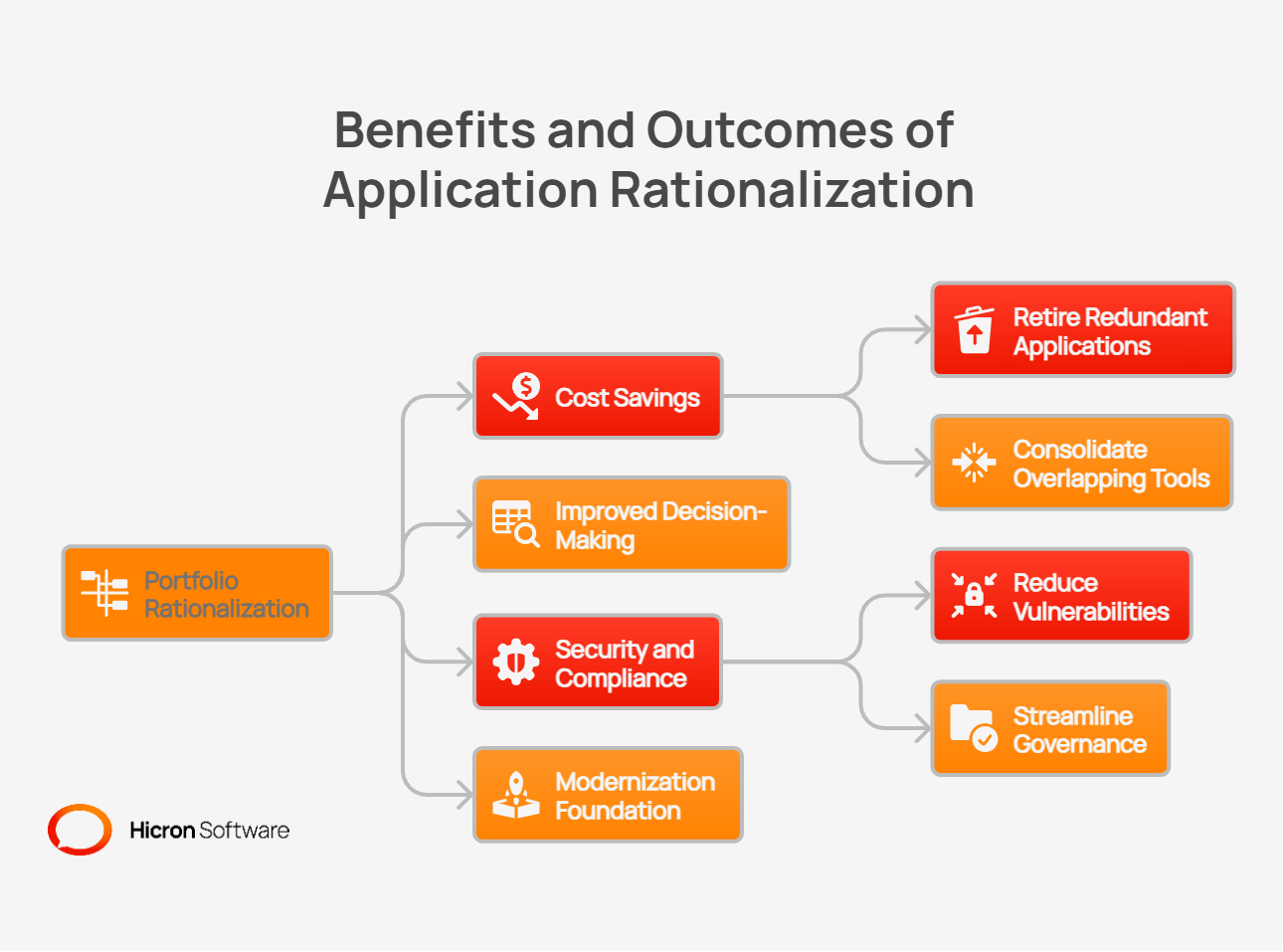
The benefits of application rationalization extend well beyond a shorter application list. Rationalization reduces cost, lowers risk, and improves how the whole portfolio supports the business. Success should be measured in operational terms: fewer redundant applications, fewer unsupported systems, lower license and maintenance exposure, and a larger share of the estate aligned to a clear modernization path. These benefits compound as the estate becomes simpler to manage.
Cost savings are usually the first visible outcome. Retiring redundant applications cuts licensing and maintenance spend directly. Consolidating overlapping tools reduces integration work, support overhead, and the number of vendor relationships IT teams have to manage.
Rationalization also improves decision-making across IT and business units. A clean portfolio gives leaders a clear view of what they own, what it costs, and which tools have confirmed owners and current lifecycle classifications. That clarity makes future investment and modernization choices far easier.
Beyond cost, rationalization strengthens security and compliance. Fewer systems mean fewer vulnerabilities, fewer integration points to monitor, and a smaller audit scope. A streamlined application stack is easier to protect and govern.
Rationalization creates room to modernize. Budget freed from legacy maintenance can fund application modernization and new capabilities. In this way, portfolio rationalization turns a defensive cleanup into a foundation for growth.
SaaS and cloud migration are closely tied to any modern rationalization strategy. Many redundant tools in a portfolio are unmanaged SaaS subscriptions. Project management tools adopted by one team and then duplicated by three others, reporting utilities that overlap with existing ERP capabilities, or collaboration platforms running in parallel with no central owner. Rationalization brings these tools into view and evaluates them against the same criteria as any other application.
Cloud migration often becomes the natural outcome for applications marked to migrate. Moving valuable tools off aging infrastructure lowers total cost of ownership and reduces the maintenance burden tied to on-premise legacy systems.
SaaS makes adoption easy, which is exactly why it drives sprawl. Teams sign up for tools without central review, leading to overlapping subscriptions, duplicated functionality, and spend that no single team fully tracks. In a portfolio of 200 to 500 applications, SaaS tools frequently account for a disproportionate share of redundancy, with multiple subscriptions covering the same workflow category across different departments.
An application rationalization initiative maps these tools and removes duplicates. Controlling SaaS spend requires ongoing discipline, not a single cleanup. Rationalization establishes the review habit that keeps subscriptions in check and prevents the portfolio from drifting back into clutter after the first effort ends.
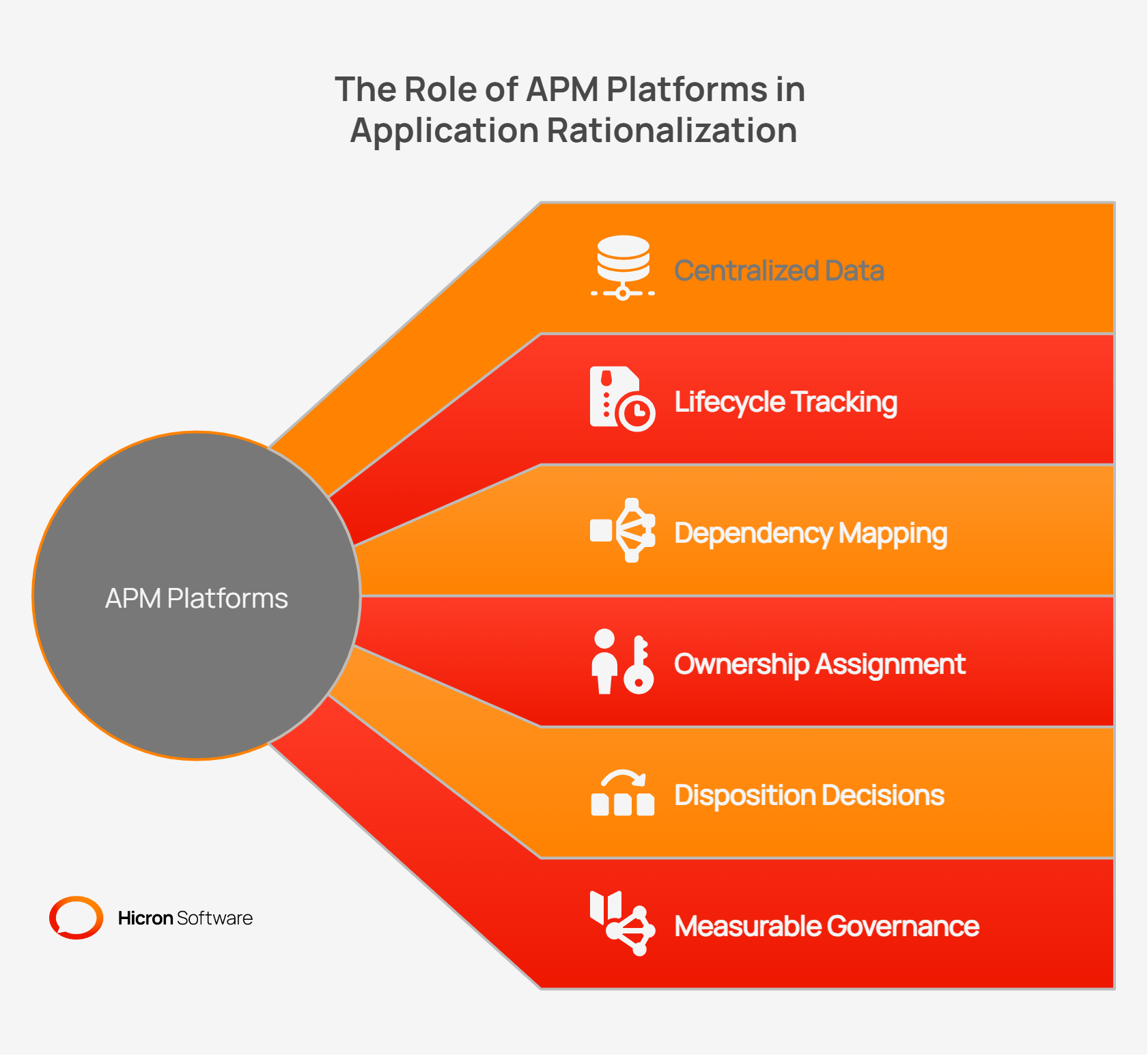
An application portfolio management platform gives IT and business teams one place to manage all applications across the enterprise. Tools like LeanIX help teams keep track of ownership, lifecycle status, usage, costs, and dependencies in a single system. That makes it easier to see which applications still add value, which ones overlap, and which ones may need to be retired, replaced, or modernized.
For application rationalization, the platform acts as a shared source of truth. Teams can review each application, see how it connects to other systems, and document the reason behind every decision. This creates a more consistent process than using spreadsheets, especially in large application estates.
The platform also supports governance. Teams can monitor whether each application has an owner, a current lifecycle status, and documented evidence behind its disposition. But the tool is only part of the process; human judgment is still needed to weigh business priorities and make the final call.
A rationalized portfolio stays healthy only through continuous attention. Application rationalization is not a one-time project but an ongoing discipline. Without regular review, sprawl and redundancy return within a few years.
The most durable programs treat rationalization as a repeatable cycle. They revisit the app inventory on a fixed schedule. They rescore applications as business needs and technology change. This keeps the portfolio aligned with business goals over time.
A successful application rationalization program follows a clear, repeatable sequence:
Each step depends on the one before it. Skip the inventory, and scoring loses accuracy. Skip documentation, and future teams repeat old mistakes. The sequence works as a connected system rather than a list of separate tasks.
App rationalization works because its parts reinforce each other. A complete inventory feeds accurate scoring. A consistent framework produces defensible rationalization decisions. Those decisions reduce redundancy, lower maintenance exposure, and free budget for modernization. The outcomes are measurable: a higher share of applications with confirmed owners, fewer unsupported or duplicate tools, a clearer lifecycle classification across the estate, and a portfolio positioned for structured modernization rather than reactive firefighting. Remove any one element, and the model weakens.
The right mindset treats rationalization as continuous evolution rather than a single event. Portfolios change as the business grows, adopts SaaS, and completes cloud migration. A recurring rationalization cycle keeps the application portfolio lean, governed, and ready for what comes next. This is how organizations turn a bloated application estate into a strategic asset with visible, trackable outcomes.
At Hicron Software, we help organizations plan and run application rationalization across complex ERP-centered estates. Our teams build the app inventory, apply a scoring framework, and guide the rationalization roadmap from audit through modernization. We combine deep technical expertise with a practical view of your business goals and stakeholders. If you want to optimize your application portfolio and reduce technical debt, contact our team to start the conversation.
Hicron Software proved to be a trusted partner with unmatched technical expertise, delivering a scalable and user-friendly web application that was pivotal to our successful U.S. market expansion.

Hicron’s contributions have been vital in making our product ready for commercialization. Their commitment to excellence, innovative solutions, and flexible approach were key factors in our successful collaboration.
I wholeheartedly recommend Hicron to any organization seeking a strategic long-term partnership, reliable and skilled partner for their technological needs.

After carefully evaluating suppliers, we decided to try a new approach and start working with a near-shore software house. Cooperation with Hicron Software House was something different, and it turned out to be a great success that brought added value to our company.
With HICRON’s creative ideas and fresh perspective, we reached a new level of our core platform and achieved our business goals.
Many thanks for what you did so far; we are looking forward to more in future!

Hicron is a partner who has provided excellent software development services. Their talented software engineers have a strong focus on collaboration and quality. They have helped us in achieving our goals across our cloud platforms at a good pace, without compromising on the quality of our services. Our partnership is professional and solution-focused!

The IT system supporting the work of retail outlets is the foundation of our business. The ability to optimize and adapt it to the needs of all entities in the PSA Group is of strategic importance and we consider it a step into the future. This project is a huge challenge: not only for us in terms of organization, but also for our partners – including Hicron – in terms of adapting the system to the needs and business models of PSA. Cooperation with Hicron consultants, taking into account their competences in the field of programming and processes specific to the automotive sector, gave us many reasons to be satisfied.