How to Plan an Enterprise Legacy System Modernization While Minimizing Operational Risk?
- March 17
- 15 min

Clean core means keeping the standard ERP core as close to its vendor-delivered state as possible, with all custom logic moved outside the core through modern extensibility rather than embedded directly into vendor code. It keeps upgrades clean and low-risk, since there’s no custom code inside the core for an update to break. At the same time, the business doesn’t lose flexibility. It simply relocates that flexibility to a dedicated extension layer, where custom logic can evolve independently without threatening the stability of the core
This article breaks down the clean core approach in detail: what clean core means in practice, the extensibility technologies that make it possible, the benefits of a clean core, and the steps involved in adopting a clean core over the long term. Whether you’re planning a migration or reassessing an existing ERP system, this guide lays out a practical path to maintaining a clean core while still meeting the demands of a changing business.
Key takeaways:
A clean core ERP system is one where the standard application code remains intact. Business-specific requirements are addressed through configuration, released extension points, and platform-based applications that run alongside the core. The core does not carry custom objects, modified standard programs, or unsupported database changes. It remains in the state the vendor delivered it, capable of receiving updates without manual intervention.
Keeping the core standard protects long-term agility in a direct and measurable way. When vendor updates arrive, they apply without triggering remediation cycles. Security patches, compliance changes, and new features can be adopted on the vendor’s schedule rather than after months of internal rework. Organizations that maintain a clean core can respond to regulatory shifts and competitive pressure faster than those whose upgrade cycle is blocked by accumulated custom code.
The case for clean core becomes clearest when looking at the cost of the alternative. According to Gartner, more than 70% of recently implemented ERP initiatives will fail to fully meet their original business case goals by 2027, with as many as 25% failing catastrophically. Heavy customization is a primary structural contributor to those outcomes. Every modification to the standard codebase creates a dependency the organization must maintain indefinitely. As those dependencies accumulate, the cost of change rises, and the pace of change slows.
The tension between short-term flexibility and long-term upgrade safety sits at the center of every ERP customization decision. A modified standard report, a direct table write, a hardcoded business rule: each feels like a reasonable trade-off at the time. The cost becomes visible only later, when the next upgrade requires months of regression testing to determine what the modification broke. Short-term flexibility purchased by modifying the core ERP is borrowed against future upgrade safety, and the interest compounds with every release cycle.
A clean core blueprint defines a clear architectural boundary. Standard functionality remains within the core. New capabilities, unique process requirements, and competitive differentiators are built on an extension platform that runs alongside the core. That keeps the business free to build what it needs without putting the record layer’s stability at risk. Clean core is a set of guiding principles that enable ongoing business flexibility while maintaining a stable, upgrade-capable digital core.
What makes a blueprint effective is not the initial cleanup it enables, but the ongoing governance it requires. Removing existing modifications from the core is a project. Maintaining a clean core after that removal is a discipline. Without enforcement, new modifications enter the system each time a developer takes a shortcut, a project team bypasses the extension model, or a business requirement is addressed with a quick fix rather than an approved method. A blueprint without governance is a one-time event followed by gradual regression.
Technical debt in an ERP environment accumulates through a series of individually small decisions that collectively reduce the system’s flexibility and upgrade readiness. A custom field added directly to a standard table, a report modified rather than replicated, a workflow hardcoded rather than parameterized: none of these feel significant in isolation. Over years, they produce a system where almost every upgrade requires investigation, remediation, and re-testing of components that were never designed to be changed.
Each modification to the core is a point where standard and custom code intersect. When the vendor changes the standard code around that intersection, the modification may no longer work as intended, may conflict with the new code, or may produce errors in connected processes. The more intersections exist, the more the upgrade team must examine, test, and repair before a release can go live. Cost and risk grow proportionally to the number of modifications the organization carries.
McKinsey research found that CIOs estimate 10% to 20% of the technology budget earmarked for new products gets diverted to resolving technical debt instead. In heavily customized ERP environments, that diversion isn’t a temporary drag; it’s structural.
A quick fix typically skips the governance process that would route the requirement to an approved extension method. It enters the core without documentation, without alignment to the clean core framework, and without a plan for how it will be maintained across upgrades. When the person who wrote it leaves the organization, the fix becomes an unexplained object that no one can safely remove or modify. These objects accumulate quietly until an upgrade or audit makes them impossible to ignore.
Direct database modifications represent the most damaging form of this pattern. They bypass the application layer entirely, writing to or reading from standard tables without using the APIs and business logic the vendor designed to protect data consistency. When the vendor restructures those tables (which cloud ERP vendors do regularly as part of their release cycle), direct modifications either stop working or produce corrupted data. They are also invisible to standard compliance tooling, meaning they often go undetected until a failure surfaces them. Modifying the ERP core this way undermines the integrity of the core system at its most fundamental level.
The clean core boundary is a governance rule, not a technical barrier. It states that no new custom logic may enter the standard codebase. Every requirement that cannot be addressed through configuration or standard functionality must be routed to an approved extension method. When this rule is enforced consistently through change request classification, architecture review, and deployment gates, debt cannot re-enter the core. It is built on the extension platform instead, visible, governed, and decoupled from the core upgrade cycle.
When custom logic lives outside the core, the core itself remains a near-standard object. The vendor can deliver an update and the organization can apply it with minimal regression testing, because there is no custom code inside the core that the update might break. Extensions that interact with the core through released APIs continue to work as long as the API contract is honored, which versioned, published APIs are designed to guarantee. This is precisely why the clean core approach treats the boundary between core and extension layer as non-negotiable.
Clean core governance is structured around five principles, each addressing a specific failure mode. Together, they form a closed system. Remove any one principle and the failure mode it addresses returns. Each clean core principle plays a specific role in maintaining the stability and upgrade readiness of the ERP core.
Requires evaluating every process requirement against standard ERP functionality before approving any custom development. The question isn’t whether a custom solution is possible, but whether the standard process, properly configured, already meets the business need. This principle forces early engagement with vendor-delivered functionality and reduces the number of requirements that reach the extension layer without first being tested against standard options. Common tasks that align with clean core principles here include:
Requires that all custom development interact with the core exclusively through APIs and extension points the vendor has published and committed to maintaining. Developers cannot write directly to standard tables, call internal functions not exposed through the API layer, or depend on undocumented behavior. When every interaction with the core runs through a released, versioned API, the vendor can change the underlying implementation without breaking the extensions built outside the core.
Establishes that each data domain has a single authoritative source, with every other system reading from or synchronizing with that source through governed integration patterns. When multiple systems write to the same data domain without a defined owner, data consistency breaks down. Assigning that ownership is what keeps downstream outputs, including AI-driven ones, reliable and accurate.
Means connections between the ERP core and adjacent systems are built as discrete, independently maintainable links rather than a tangled web of point-to-point logic. Each integration has a defined interface, a clear data contract, and a single responsibility, so when one connected system changes, only the integration tied to it needs updating.
Applies a structured process to every extension from proposal through retirement. A proposed extension is classified, reviewed for alignment with the extension model, approved before development begins, and documented before deployment. Existing extensions are reviewed on a regular cadence to confirm they still serve their original purpose, and extensions that no longer do are retired rather than left to accumulate.
These principles function as a system, not a checklist. An organization that governs extensions rigorously but ignores data ownership will still produce unreliable outputs from an otherwise clean core environment. One that standardizes processes but skips lifecycle management will find its extension layer accumulating the same debt the core used to carry. Satisfying four of the five principles doesn’t count as mostly there, since the missing one is exactly where debt finds its way back in.
Without a structured extension model, each developer or project team makes an independent decision about where to build custom logic. Some place it inside the core because it is faster. Others build on the extension platform. The result is an inconsistent posture where some extensions comply with clean core practices, and others do not. A structured extension model removes that ambiguity by defining a decision sequence that every custom requirement follows before development begins.
Standard configuration is the default starting point for every requirement. Modern ERP systems carry extensive configuration options (workflow parameters, approval hierarchies, output formats, business rules) that can address many requirements without any custom development. Configuration changes are upgrade-safe by definition, because they operate within the standard application layer. Making configuration the mandatory first step reduces the volume of requirements that ever reach the extension layer.
When configuration is insufficient, in-app extensibility is appropriate for targeted adjustments to standard behavior: adding a custom field to a standard business object, applying a business rule at a specific process step using a released enhancement point, or adjusting an interface element without disrupting core application code. These adjustments use vendor-released extension points and survive upgrades because the vendor maintains the points they rely on.
Side-by-side extensibility becomes the right home when the requirement involves logic, data, or a user experience that is genuinely distinct from what the standard application can provide. Complex calculation engines, specialized approval workflows, industry-specific process modules, and customer-facing applications built on ERP data all fit this category. These extensions run on a dedicated platform (the PaaS or low-code environment the ERP vendor provides) and interact with the core exclusively through released APIs. They are fully decoupled from the core and sit outside the core ERP upgrade cycle entirely.
Integration extensions handle the flow of data and events between the ERP core and adjacent systems: finance platforms, supply chain applications, CRM systems, data warehouses, and third-party services. These use the vendor’s published API layer and standard integration tools rather than direct database connections or proprietary internal interfaces. Extensions outside the core system follow the same governance standards as any other approved extension type.
Every custom requirement should pass through the model before development begins. The extension model is a decision gate, not a retrospective audit. A requirement that bypasses it and goes directly into the core creates a modification that will eventually need to be removed or refactored, at cost, under time pressure, and with risk to adjacent processes. Left unchecked, these ad hoc decisions about where to build custom logic add up to the exact structural debt a clean core strategy was designed to prevent.
Point-to-point links between ERP modules and adjacent systems create brittle architecture. When either system changes its internal structure, the link breaks. In a large ERP environment with many systems and many direct links, this creates a maintenance burden that grows faster than the team’s capacity to manage it. Each change to one system requires a coordinated change to every link that connects to it.
API-first integration addresses this directly. The interface between two systems (the data it exchanges, the operations it supports, and the format it uses) is defined and agreed before either system begins building its side of the connection. The contract is the starting point, not the output. Approaching this way ensures that both sides build to a shared specification rather than discovering incompatibilities after implementation. The contract can be published and versioned independently of the systems it connects, so changes to either system do not automatically invalidate the integration. This is a best practice that clean core ensures organizations adopt as a structural standard rather than an occasional preference.
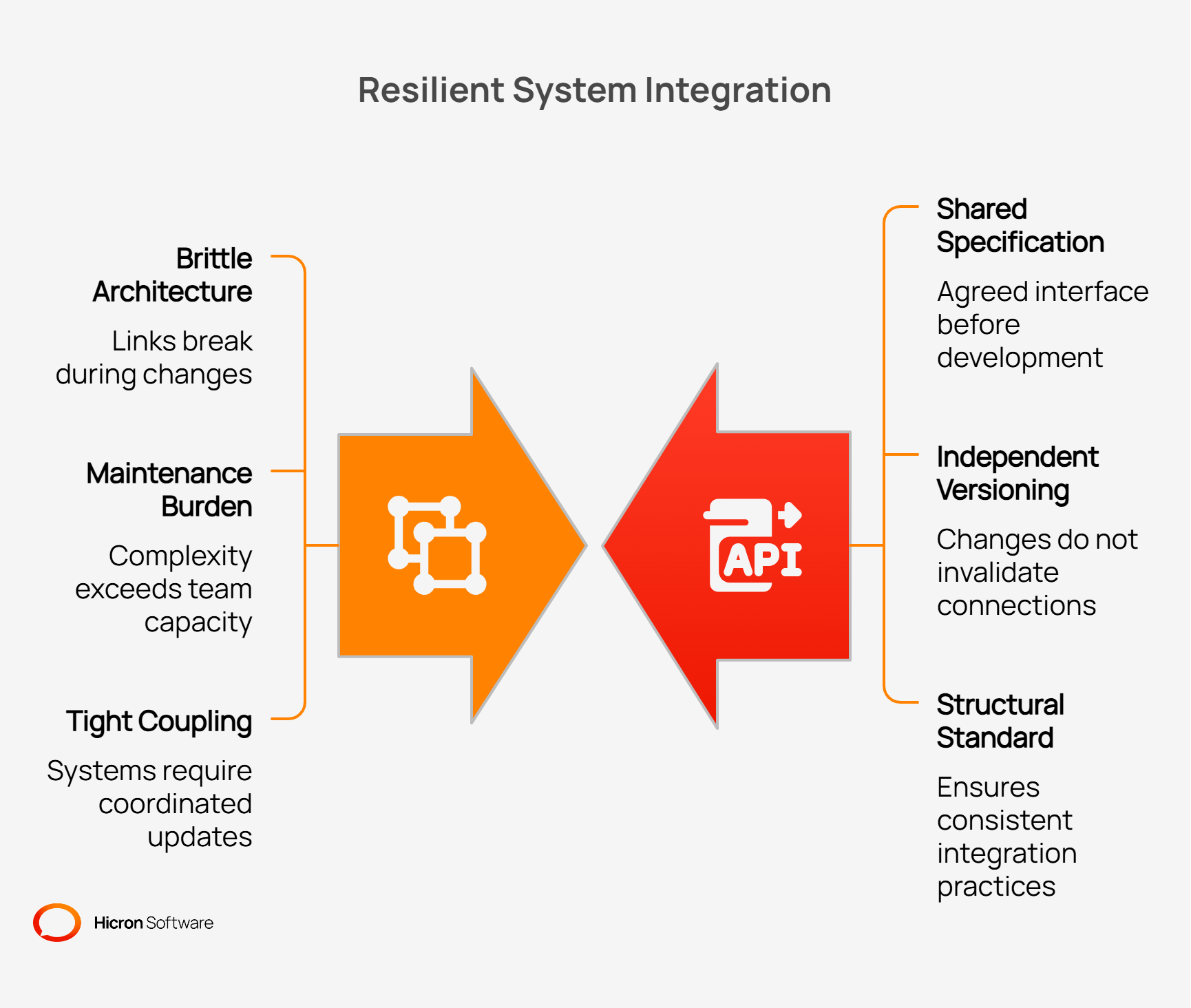
When the ERP core publishes a versioned API, it commits to maintaining that API’s behavior across upgrades for a defined period. Extensions built outside the core interact with the core through that API and rely on the contract remaining stable even as the vendor changes the internal implementation. This is the technical mechanism through which upgrade safety is achieved at scale.
Event-driven communication complements API-first integration by adding real-time responsiveness without tight coupling. The ERP core publishes notifications when important business events occur: a purchase order confirmed, an invoice posted, an inventory level crossed. Consuming systems subscribe to the events they need and process them independently. Each system remains independently deployable and maintainable.
A central API gateway routes all integration traffic through a single managed layer. Architects can see which systems are consuming which APIs, at what volume, and with what error rates. Authentication and authorization policies apply consistently across all integrations. Without a gateway, integration traffic is distributed and invisible. With one, it is observable and governable, which is a prerequisite for the kind of ongoing compliance monitoring a clean core strategy requires.
Go-live marks the point at which the initial clean core posture is established. Without ongoing governance, it also marks the beginning of slow regression. Delivery pressure, staff turnover, undocumented exceptions, and informal workarounds all push custom logic back toward the core over time. Organizations that treat clean core as a project outcome rather than an operational standard find that the core they cleaned at go-live is measurably less clean eighteen months later. Practices for maintaining a clean core must be built into day-to-day operations, not reserved for audit events.
Meaningful compliance monitoring tracks a defined set of metrics over time. A rising count of custom objects in the core signals that the extension model is being bypassed. A falling rate of API-compliant integrations signals that direct connections are being created outside the governed layer. Both trends, if left unaddressed, lead to upgrade complications and increased technical debt.
| Metric | Clean Core Signal | Risk Signal |
| Custom Objects in Core | Zero or near-zero | Rising count per release cycle |
| API Compliance Rate | All integrations use released APIs | Direct database connections present |
| Modification to Standard Programs | None | Any count, especially undocumented |
| Extension Retirement Rate | Active review and retirement cycle | Extensions accumulate without review |
| Time to Apply Vendor Update | Minimal regression testing required | Multi-week remediation required |
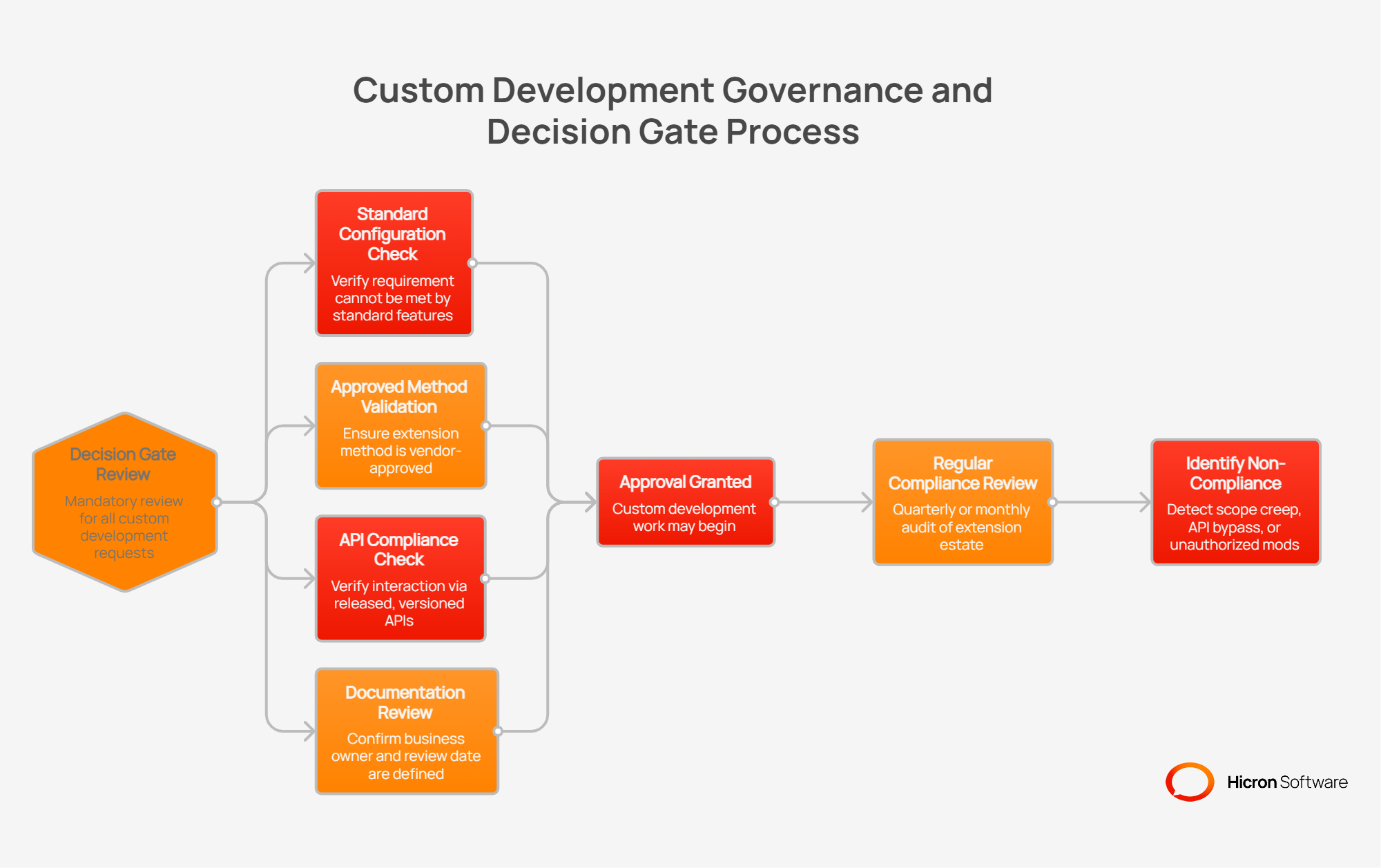
A decision gate is a mandatory review point that every custom development request must pass before work begins. The gate confirms that the requirement cannot be addressed through standard configuration, that the proposed solution uses an approved extension method, and that the extension has been documented with a business justification. The following conditions must be evaluated before any custom development is approved:
Regular reviews (quarterly at minimum, monthly in active development periods) examine the extension estate against clean core compliance criteria. They identify extensions that have grown beyond their original scope, integrations that have bypassed the API layer, and modifications that entered the core without passing through the decision gate.
Effective governance requires defined ownership at multiple levels. An ERP architecture lead sets and enforces the extension model and API standards. A clean core compliance owner tracks metrics, runs review cycles, and manages the decision gate process. Business process owners ensure that requirements are assessed against standard functionality before reaching the extension layer. Development leads are accountable for ensuring that their teams build within approved methods and comply with clean core at every stage of delivery. Without clear role ownership, governance becomes a shared responsibility that no one actively maintains.
The clean core blueprint governs the standard application layer: what may and may not exist inside the core, how changes are managed, and how compliance is measured. Everything inside the clean core boundary operates under the vendor’s standard release cycle and support model. Clean core isn’t a constraint on what the business can build; it is a governance discipline that determines where the business builds it.
The extension layer is designed to work alongside a stable, standard core. Extensions interact with the core through released APIs and expect those APIs to behave consistently. If the core boundary fails (if custom logic re-enters the standard codebase) it becomes unclear which behaviors belong to the vendor’s implementation and which belong to the modification. The extension layer’s reliability is contingent on the integrity of the core system, while a data fabric helps govern and unify the information flowing across the broader ERP ecosystem.
A core that operates close to its standard state uses the vendor’s standard data model, business logic, and validation rules. Data written through standard processes is consistent, traceable, and validated before it reaches adjacent systems. When the data layer is governed, downstream systems (reporting platforms, analytics tools, AI applications) receive inputs they can trust. A core that carries uncontrolled modifications produces data whose provenance and consistency are harder to verify, which degrades the quality of every system that depends on it.
This matters especially for AI. AI applications that operate on ERP data are only as reliable as the data they receive. If the ERP core carries modifications that alter standard data structures, validation logic, or business rules, the data flowing into AI models may be inconsistent, incomplete, or incorrectly structured. A clean core ensures that data leaving the ERP through its published APIs conforms to the vendor’s standard model, which is the model the AI tooling is designed to interpret. Clean core enables trustworthy AI outputs by providing a stable, well-governed data foundation. Without that conformance, AI outputs require additional validation before they can be acted on, which reduces their operational value.
Clean core also supports application rationalization, the process of reducing the number of systems in the enterprise technology estate to those that deliver clear business value. A clean core strategy helps make the ERP’s capabilities legible: it is clear what the standard application delivers, what the extension layer adds, and where gaps exist. The data layer depends on consistent inputs from a clean ERP to produce reliable outputs. Clean core, application rationalization, and the data layer are three complementary disciplines that reinforce rather than compete with each other.
The governance model separates change into two categories. Changes that belong to the extension layer (new capabilities, process improvements, competitive differentiators) move at the pace of the business. They are built on the extension platform, governed through the lifecycle management process, and deployed without changing the core. Changes that belong to the core (vendor updates, security patches, compliance changes) arrive on the vendor’s schedule and apply without manual remediation because the core remains close to its standard state. The record layer stays stable while the capability layer evolves. This is the operating model that a clean core journey makes possible, and the destination that a clean core blueprint is designed to reach.
Sources

Hicron Software proved to be a trusted partner with unmatched technical expertise, delivering a scalable and user-friendly web application that was pivotal to our successful U.S. market expansion.

Hicron’s contributions have been vital in making our product ready for commercialization. Their commitment to excellence, innovative solutions, and flexible approach were key factors in our successful collaboration.
I wholeheartedly recommend Hicron to any organization seeking a strategic long-term partnership, reliable and skilled partner for their technological needs.
After carefully evaluating suppliers, we decided to try a new approach and start working with a near-shore software house. Cooperation with Hicron Software House was something different, and it turned out to be a great success that brought added value to our company.
With HICRON’s creative ideas and fresh perspective, we reached a new level of our core platform and achieved our business goals.
Many thanks for what you did so far; we are looking forward to more in future!

Hicron is a partner who has provided excellent software development services. Their talented software engineers have a strong focus on collaboration and quality. They have helped us in achieving our goals across our cloud platforms at a good pace, without compromising on the quality of our services. Our partnership is professional and solution-focused!

The IT system supporting the work of retail outlets is the foundation of our business. The ability to optimize and adapt it to the needs of all entities in the PSA Group is of strategic importance and we consider it a step into the future. This project is a huge challenge: not only for us in terms of organization, but also for our partners – including Hicron – in terms of adapting the system to the needs and business models of PSA. Cooperation with Hicron consultants, taking into account their competences in the field of programming and processes specific to the automotive sector, gave us many reasons to be satisfied.