Microservices Architecture Style: Pros & Cons
- June 25
- 28 min

When the core ERP system cannot adapt without breaking, every business change becomes a full IT project. An agile application ecosystem resolves that tension by design: the ERP core stays untouched and stable, while a surrounding layer of applications, integrations, and extensions absorbs the actual work of evolving, integrating, and scaling with the business.
Organizations running outdated ERP software often face a difficult trade-off: keep the core stable or risk breaking it with constant customization. Escaping that dilemma requires an application ecosystem built from specific architectural components, integration patterns, and governance frameworks. Each one designed to keep the ERP core upgrade-safe while the surrounding system stays data-driven and ready for the AI era.
A resilient ERP architecture resolves the tension between agility and stability by treating the core ERP system as a stable record layer and pushing innovation to the outer edge. Today’s ERP systems support this model through published APIs and extension frameworks. The ERP ecosystem wraps the core rather than modifying it, keeping the core upgrade-safe while extending its functionality into new workflows, analytics, and engagement channels. Heavy customization runs counter to this model: each layer of custom code added to the core makes upgrades riskier and more expensive.
Technical debt accumulates when quick, inefficient solutions are chosen over high-quality implementations, and the same logic applies directly to ERP customization. Legacy custom code impedes migration to modern ERP platforms, reduces visibility into the true state of business operations, and slows every improvement project. Enterprise management teams that adopt the outer-edge model gain both the governance of a centralized system and the speed of a composable platform.
IBM research describes a broader shift underway in enterprise IT: organizations are moving from systems of record to systems of engagement that support more interactions and collaborations with users and partners.
For ERP platforms, this shift means moving beyond accurate transaction storage toward generating insight from that data. When ERP architecture places intelligence layers above a clean core, enterprise software begins generating forward-looking insights rather than only backward-looking reports. Organizations that treat the ERP platform as a strategic asset rather than a legacy liability gain a competitive advantage through predictive analytics and AI-driven recommendations.
Before expanding the ERP portfolio, architects need a clear inventory of what already exists. An application rationalization audit maps every current application across departments, scores each against business value and technical fitness, and produces a prioritized plan for retiring, retaining, replatforming, or rebuilding. Without this step, implementing an ERP system on top of an unmapped estate creates integration conflicts and duplicate data flows, undermining the benefits of ERP standardization.
The Gartner TIME framework (Tolerate, Invest, Migrate, Eliminate) offers a structured lens for this audit. Each application is assessed on two dimensions: technical fit and functional fit. Applications with low scores on both dimensions are candidates for elimination, while those with high scores on both receive investment. Applications classified for elimination often contain outdated custom code that actively impedes ERP modernization, as those dependencies prevent clean API contracts from replacing brittle point-to-point connections. Evaluating ERP software against the TIME framework provides enterprise platforms with a clear roadmap for rationalization rather than a vague modernization wish list.
The Azure 6 Rs framework (Rehost, Replatform, Refactor, Rebuild, Retire, Retain) extends this thinking to cloud migration decisions. Architects assign each workload to one of these paths based on factors such as application complexity, technical debt, cloud readiness, and business priority. Cloud ERP workloads that score well for replatforming can migrate with moderate effort, while heavily customized on-premises ERP modules may require a full rebuild before they can support clean core alignment. Each path has different implications for time, cost, and scalability, so the 6 Rs work best when applied alongside the TIME classification rather than as a standalone tool.
When combining both frameworks in practice, ERP architects teams typically move through a consistent sequence of decisions:
This approach keeps core components upgrade-safe, reduces the long-term cost of ERP maintenance, and allows the enterprise to adopt new features, security patches, and regulatory updates as soon as they become available. Viewing ERP architecture through this lens shifts the conversation from “what can we customize” to “what can we configure or extend without touching the core.”
Gartner’s pace-layered application strategy, a separate but complementary framework, organizes an enterprise system into three tiers that operate at different speeds. The first tier, systems of record, covers stable, slow-changing processes such as financial accounting and procurement. The second tier, systems of differentiation, includes processes with a medium lifecycle of one to three years that require frequent reconfiguration to accommodate changing business practices or customer requirements. The third tier, systems of innovation, supports experimental capabilities that typically change within a zero-to-twelve-month horizon and feed new business models back into the enterprise platform.
An ERP system spanning all three layers must be designed so each tier operates at its own pace without destabilizing the others.
Composable ERP architectures fragment without governance. When teams independently add extensions, the ERP ecosystem quickly fills with undocumented integrations, inconsistent naming, and unmaintained API versions. Clean core governance prevents this by establishing five principles that keep the ERP system aligned with vendor standards and reduce the total cost of ownership across the enterprise software estate.
| Clean Core Principle | Meaning | Impact |
| Business Process Standardization | Adopt vendor-standard processes wherever possible; avoid custom logic for standard workflows | Reduces upgrade risk and maintenance cost across the ERP estate |
| Extensibility Through Released APIs | All custom extensions communicate with the core only through stable, published APIs | Keeps the core upgrade-safe and prevents direct database modifications |
| Data Integrity and Ownership | Each data domain has a defined owner and a single authoritative source within the system of record | Prevents duplicate, inconsistent, or ungoverned data across the ecosystem |
| Modular Integration | Services expose only the data and functions that other services strictly need | Reduces inter-service dependencies and improves overall system resilience |
| Lifecycle Management | Every extension is classified, versioned, and reviewed against the clean core framework before entering production | Prevents technical debt from re-accumulating after each project cycle |
Naming standards, API versioning rules, and consistent documentation prevent technical debt from accumulating across projects. Every new extension added to the ERP platform is classified against the clean core framework before entering the production environment. Architectural guardrails enforce loose coupling over time by requiring all ERP integrations to use standard APIs rather than direct database access. The share-as-little-as-possible principle further strengthens this: each service exposes only the data and functions that other services strictly need, reducing dependencies and improving the overall architecture’s resilience. ERP success at the enterprise level depends on these guardrails being enforced consistently, not just during the initial system design phase.
An external extension layer keeps the core ERP system upgrade-safe by running custom logic outside the standard codebase. Rather than modifying core code, enterprises build extensions that communicate with the core via stable, versioned APIs. This pattern supports both cloud-based and on-premises ERP deployments, preserving the benefits of ERP standardization while enabling enterprise teams to add differentiated functionality. Two-tier ERP approaches for subsidiaries fit naturally within this architecture when the extension layer enforces consistent integration contracts and centralized governance controls across the enterprise.
Point-to-point links between ERP modules create a brittle architecture because each direct connection becomes a dependency that breaks when either system changes. An enterprise with dozens of point-to-point connections across its ERP ecosystem spends more time maintaining those links than building new capabilities. ERP integration through a central API gateway replaces this fragility with a governed, observable contract layer, giving architects visibility into every data flow.
API-first integration means the contract is defined before any implementation begins. As Microsoft’s engineering guidance on API design-first development explains, teams define data structures, endpoints, and versioning rules upfront, before writing a single line of application code. This contract-first discipline prevents the underlying framework from driving design decisions that accumulate debt. By contrast, code-generated contracts tend to introduce inconsistencies and erode trust between teams when implementations change frequently. For modern ERP solutions, a contract-first approach means integration with other systems follows predictable, versioned patterns that are easier to govern, audit, and evolve without breaking dependent services.
Event-driven architecture adds real-time responsiveness on top of the API contract layer. This pattern uses asynchronous, decoupled communication, with producers and consumers interacting without direct knowledge of one another. When a procurement order is placed, an event triggers simultaneous updates across inventory, finance, and supply chain modules without the system waiting for a synchronous API call to complete. Because each service responds to events independently, the architecture prevents cascading failures and improves overall scalability. A microservices architecture extends this further by decomposing ERP functionality into individually deployable services that scale and evolve without affecting the core ERP platform. However, this introduces its own complexity around data consistency and operational observability that teams need to plan for explicitly.
A well-structured API integration layer delivers several concrete benefits across the ERP ecosystem:
API versioning rules prevent breaking changes from propagating to dependent services during upgrades,
Data accessibility across the ERP system is one of the most challenging architectural issues for large enterprises. When data resides in separate databases for CRM, ERP software, procurement systems, and external partners, teams cannot get a consistent view of business operations. A data fabric provides a unified, intelligent layer that connects all data sources without physically moving data, giving the enterprise a single source of truth that flows through every connected application.
Data virtualization creates a unified view of data from multiple sources to support reporting and analytics queries. However, it does not provide transactional integrity across multiple systems: it is a tool for accessing and presenting data, not for safely modifying it across boundaries. A full data fabric goes further by applying AI-driven metadata management, automated data discovery, and governance controls across the entire platform. This creates a unified data view that flows from the ERP platform through CRM and external systems, giving every team access to the same verified data set and making information available at the speed of decision-making rather than the speed of manual reporting cycles.
Predictive systems move ERP reporting from reactive to anticipatory by applying machine learning models to the data fabric layer. Instead of reporting on what happened last quarter, the ERP system begins forecasting demand, flagging supply chain risks, and recommending adjustments to resource utilization before problems occur. This is where an enterprise resource planning system evolves from an ERP record-keeper into a system of intelligence. Centralizing both operational data and forward-looking insights into a single, observable, governed layer supports the resource management needs of every business unit.
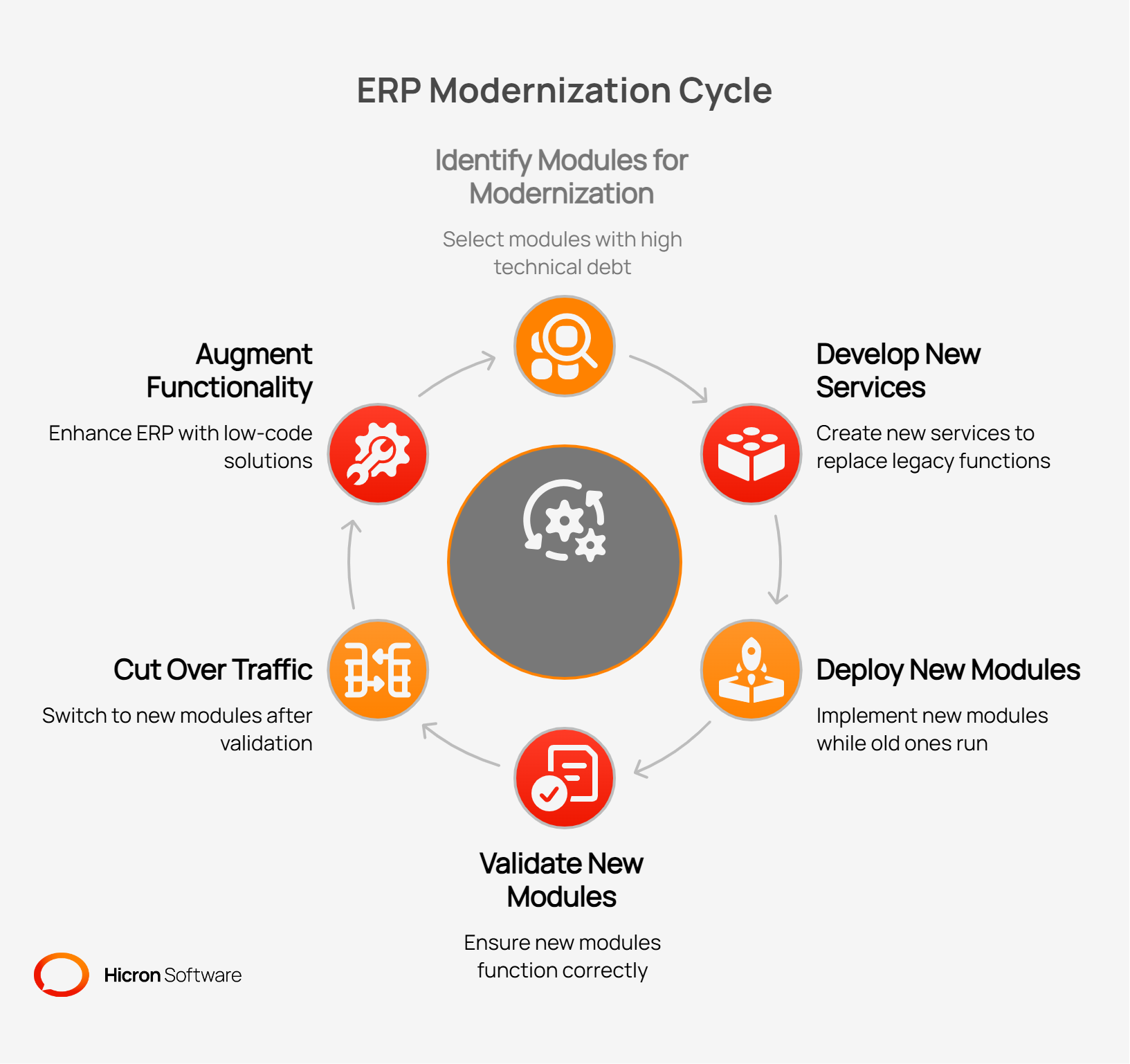
Big-bang ERP deployment carries risk. Organizations that attempt to replace every ERP module at once face cost overruns, data migration failures, and adoption problems that can halt core business operations for months. The Strangler Fig pattern offers a phased alternative: new services grow around the existing ERP core and gradually replace legacy functions, module by module, without a single cutover that puts the entire enterprise ERP system at risk.
The pattern identifies which ERP modules to modernize first, typically those with the highest technical debt and the clearest business case for improvement. Each modernized module delivers measurable benefits: better data quality, faster workflow automation, and reduced manual intervention in procurement and supply chain processes. Teams deploy the new module while the old one continues to run, then cut over traffic once the new version is validated.
This incremental migration approach reduces risk and allows enterprise teams to build confidence before tackling more complex parts of the ERP environment. Successful ERP transitions at scale often follow this incremental logic rather than a single wholesale replacement, though the right approach will always depend on the organization’s specific constraints and risk tolerance.
Low-code augmentation supports this pattern by enabling non-technical users to build workflows and extend ERP functionality without writing custom code. Business analysts configure process rules, approval chains, and notifications directly within the ERP platform, without engaging software development resources. This reduces the volume of custom code in ERP modules, lowers technical debt over time, and accelerates the enterprise’s ability to adapt workflows to changing business conditions. Extending ERP functionality through configuration rather than code is what makes new ERP capabilities sustainable after the initial ERP implementation project closes.
AI agents interacting with ERP data require a structured governance model that goes beyond standard access controls. Multi-layer governance applies role-based permissions, maintains auditable access logs, and enables event tracing at each layer of the ERP ecosystem. Every action an AI agent performs against core ERP data is recorded in an immutable audit trail. This gives compliance teams the visibility needed to trace decisions to their source, a baseline requirement for regulated industries.
Explainable AI (XAI) places specific demands on ERP architecture. Regulatory frameworks expect organizations to demonstrate why an AI agent made a particular decision, not just what it decided. ERP systems supporting XAI requirements need to expose contextual metadata alongside transactional data, so model outputs can be traced to specific inputs stored in the system of record. Without this traceability layer, AI-driven recommendations become opaque outputs that auditors cannot verify or challenge.
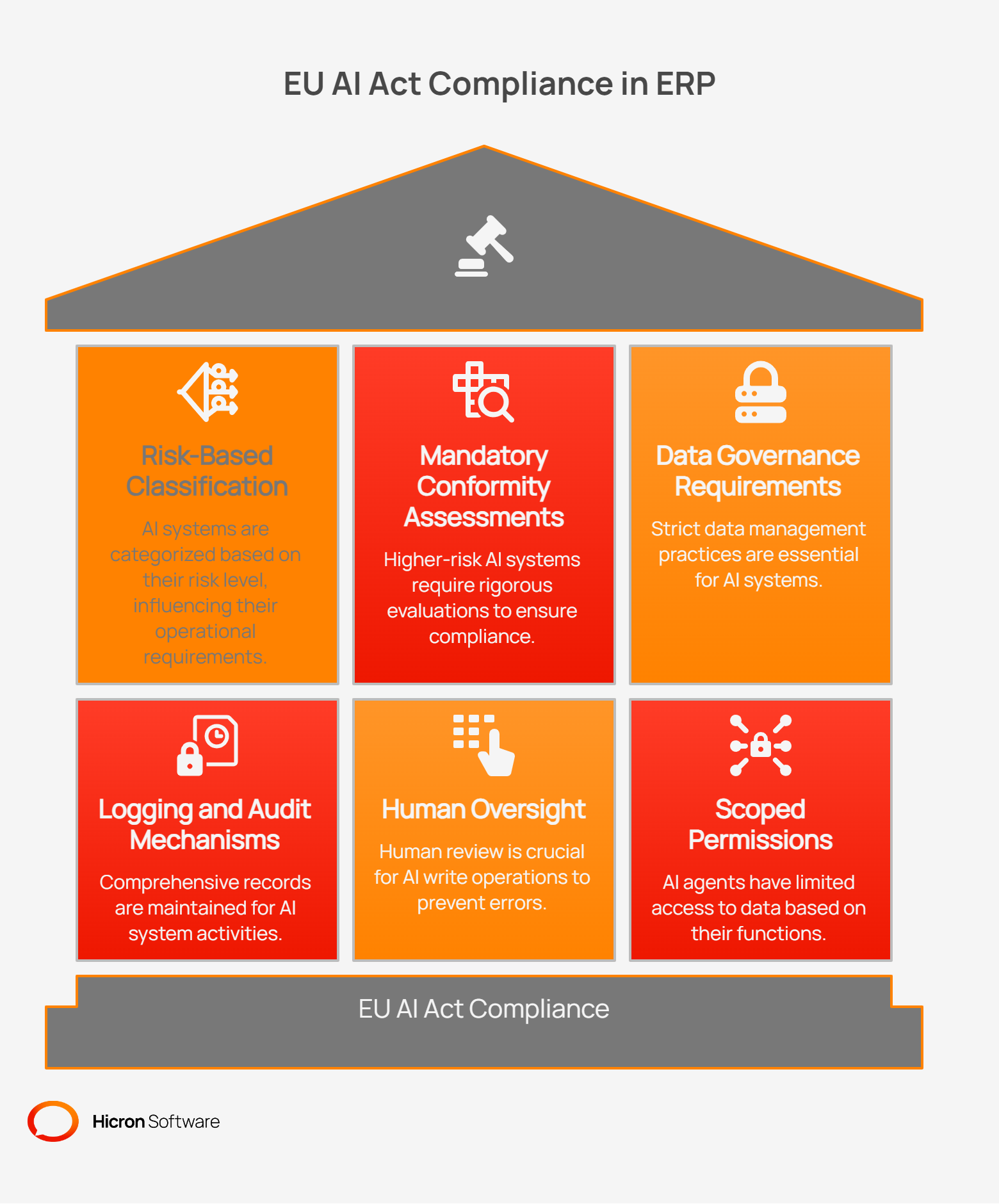
The EU AI Act introduces risk-based classifications that directly shape how AI agents operate within ERP environments. AI systems used for procurement decisions, financial forecasting, or workforce management may fall into higher-risk categories depending on their deployment context, triggering obligations such as mandatory conformity assessments, data governance requirements, and logging. ERP architecture teams need to map each AI use case to its applicable risk classification and ensure that the underlying data pipelines, access controls, and audit mechanisms meet the corresponding obligations. This alignment work occurs at the integration layer, not within the AI model itself.
Ethical oversight applies whenever an AI agent reads or writes core ERP data. Write operations carry higher risk because an agent that modifies financial records, inventory levels, or supplier data without human review can propagate errors across the entire enterprise. Governance frameworks address this by requiring human-in-the-loop checkpoints for all write operations above a defined risk threshold. Read operations still require scoped permissions that limit the data the agent can access based on its assigned function.
Combining auditable access layers, XAI traceability, EU AI Act alignment, and human oversight checkpoints creates a governance architecture that keeps AI agents accountable at every point of contact with the ERP core.
An ERP system delivers value only when it mirrors how work actually happens. The right solution starts with real workflows and shapes the system around them, not the other way around. Poor alignment is why teams build spreadsheets and shadow processes around the ERP system instead of using it directly.
Value stream mapping traces every step a process takes from request to completion. It documents each handoff, approval, and wait time across the workflow. This view exposes where work stalls, where data is re-entered, and where steps add no business value. Teams often discover duplicate approvals or manual transfers between disconnected systems. Mapping these streams before configuring the ERP system prevents the common mistake of automating broken processes. The goal is to redesign the flow first, then encode the improved version into the platform. This keeps the ERP system aligned with lean operations rather than locking in existing inefficiencies.
Operational policies define how decisions are made across the enterprise. Approval thresholds, segregation of duties, and escalation rules are codified in written policy. Automated workflows translate those rules into executable logic within the ERP platform. A purchase request above a set amount is automatically routed to the appropriate approver.
This approach removes ambiguity from daily operations and enforces policy consistently, without relying on manual judgment at each step. Audit trails capture every routing decision, supporting compliance reviews and reducing the training burden by guiding each action rather than relying on individual judgment. Custom code is the main source of technical debt in ERP environments, and standardization is the primary tool for controlling it. Adopting proven process templates instead of building bespoke logic for every requirement keeps the core clean and reduces long-term maintenance costs.
LEAN principles translate directly into configurable ERP parameters. Batch size reduction is one clear example: teams configure smaller lot sizes in the planning module, and the ERP system schedules production and procurement around these reduced quantities. Smaller batches cut inventory holding costs and shorten lead times. Reorder points, safety stock levels, and minimum order quantities become tunable parameters that embed continuous flow as a built-in operational default.
A modern ERP ecosystem is built to absorb change without breaking. The seven capabilities covered in this guide each remove a specific point of fragility, from redundant applications to brittle integrations. Designing for continuous change means assembling these layers into a single, coherent, governed system.
The seven steps covered here build on one another to produce a coherent architecture:
Together, these steps deliver an ERP system that remains stable at the core and flexible at the edge. Removing any one layer weakens the others, for example, API-first integration loses its governance value without the clean core boundary it depends on. A project mindset treats ERP as a one-time deployment with a fixed end date. A product mindset treats it as a continuously evolving capability. Markets shift, regulations change, and business models adapt. An ERP system managed as a living product responds to these shifts through ongoing iteration rather than large-scale replacement cycles. This means maintaining a product backlog of improvements, measuring outcomes, retiring unused features, and extending capabilities as needs emerge. The clean core and extension layers make this iteration safe because changes occur outside the core. A living product continues to generate value long after the initial implementation closes.
Hicron Software brings years of enterprise architecture experience to ERP integration. Our teams apply clean core principles to keep the central system upgrade-safe throughout migration. We design API-first integrations and event-driven flows that connect ERP modules to surrounding systems. We also help map application estates and plan phased modernization using the TIME framework, the 6 Rs, and proven incremental patterns. We support organizations from initial assessment through migration and ongoing application management. The result is an ERP ecosystem your team can modify confidently, without each change threatening the rest of the system.
Contact Hicron Software to discuss your ERP integration!
*https://research.ibm.com/projects/systems-of-engagement

Hicron Software proved to be a trusted partner with unmatched technical expertise, delivering a scalable and user-friendly web application that was pivotal to our successful U.S. market expansion.

Hicron’s contributions have been vital in making our product ready for commercialization. Their commitment to excellence, innovative solutions, and flexible approach were key factors in our successful collaboration.
I wholeheartedly recommend Hicron to any organization seeking a strategic long-term partnership, reliable and skilled partner for their technological needs.
After carefully evaluating suppliers, we decided to try a new approach and start working with a near-shore software house. Cooperation with Hicron Software House was something different, and it turned out to be a great success that brought added value to our company.
With HICRON’s creative ideas and fresh perspective, we reached a new level of our core platform and achieved our business goals.
Many thanks for what you did so far; we are looking forward to more in future!

Hicron is a partner who has provided excellent software development services. Their talented software engineers have a strong focus on collaboration and quality. They have helped us in achieving our goals across our cloud platforms at a good pace, without compromising on the quality of our services. Our partnership is professional and solution-focused!

The IT system supporting the work of retail outlets is the foundation of our business. The ability to optimize and adapt it to the needs of all entities in the PSA Group is of strategic importance and we consider it a step into the future. This project is a huge challenge: not only for us in terms of organization, but also for our partners – including Hicron – in terms of adapting the system to the needs and business models of PSA. Cooperation with Hicron consultants, taking into account their competences in the field of programming and processes specific to the automotive sector, gave us many reasons to be satisfied.