What The API Says & What It Shouldn’t – The Hidden Dangers of Excess Data
- April 07
- 6 min

Much like a logistics dispatcher routing delivery trucks to the correct warehouse docks, an API Gateway acts as a centralized entry point, taking client requests and directing them to the appropriate backend services. It’s the primary interface between external clients and internal services to decouple client-side complexity from the underlying architecture. The gateway supports environments including microservices and monolithic architectures. Operating at the application layer allows it to focus on application logic rather than basic network routing. I often tell engineering teams that adopting a gateway is the first step toward regaining control over a sprawling architecture.
It serves as an advanced reverse proxy handling system-wide responsibilities at a central level:
The data plane intercepts north-south traffic to execute routing rules, while the control plane manages the overall configuration. This configuration ensures client requests reach the correct backend system seamlessly.
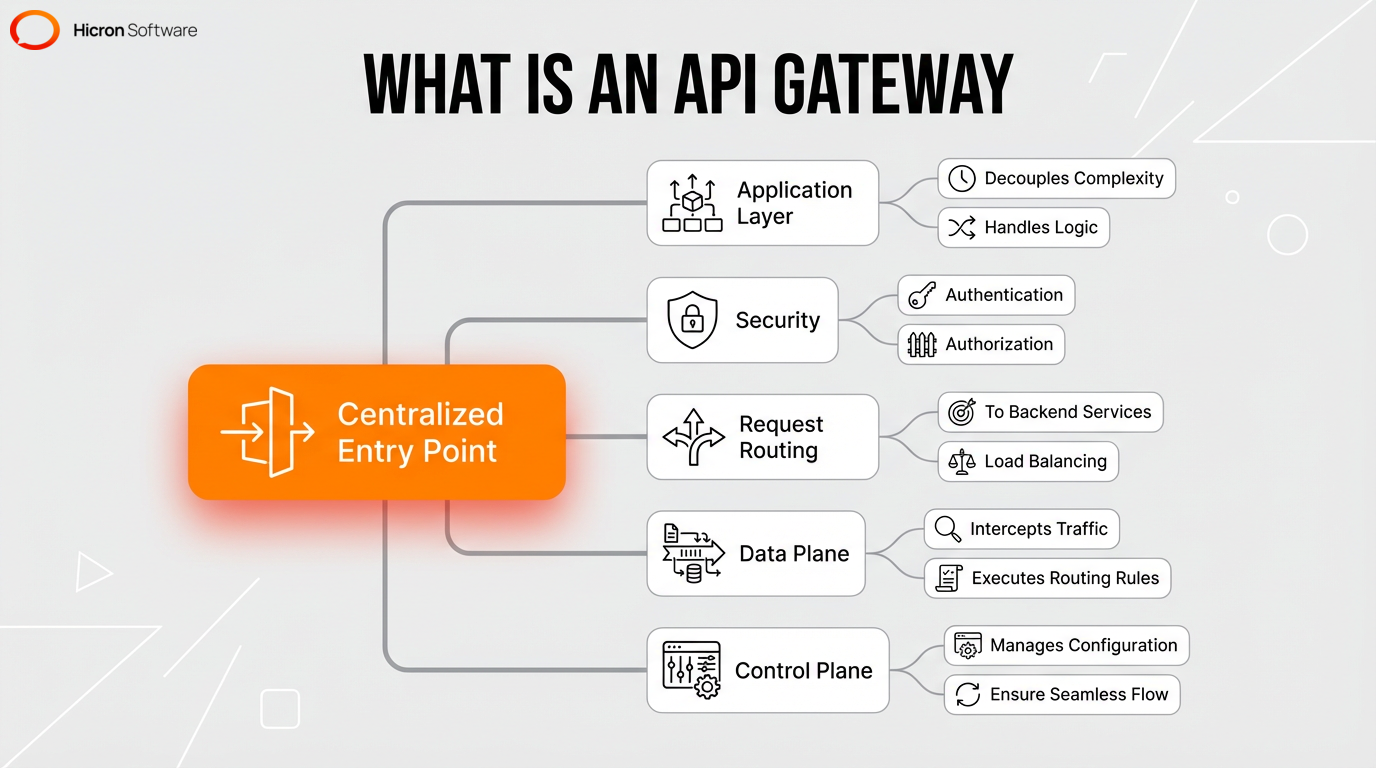
A reverse proxy primarily handles basic traffic forwarding, load balancing, SSL termination, and caching. An API Gateway extends these capabilities with complex application-layer logic for advanced traffic management. To implement precise request routing, request aggregation, and strict security policies across every endpoint, organizations choose an API Gateway over a standard reverse proxy. Think about protocol translation: an API Gateway can convert a REST API request into gRPC, whereas a standard reverse proxy simply forwards the original HTTP request.
|
Core Area |
Key Features & Components |
Description & Impact |
|
Architecture |
|
The control plane acts as the management layer defining configurations and security policies. The data plane intercepts north-south traffic to execute routing rules and handle real-time data packets. |
|
Traffic Management |
|
Evaluates parameters (URLs, headers) to direct calls, merges multiple backend responses into a single client payload to reduce network overhead, and converts formats like REST, gRPC, and WebSockets. |
|
Security |
|
Provides a centralized security enforcement point using zero-trust principles. Validates tokens, blocks malicious attacks via deep packet inspection, and decrypts TLS traffic to offload backend processing. |
|
Performance & Reliability |
|
Distributes incoming requests across multiple service instances, stores frequent responses to prevent server overload, and temporarily halts requests to unresponsive microservices to prevent cascading system crashes. |
|
Network Flow |
|
API Gateways manage external client-to-internal service (north-south) communication. A service mesh is typically deployed to handle internal microservice-to-microservice (east-west) communication. |
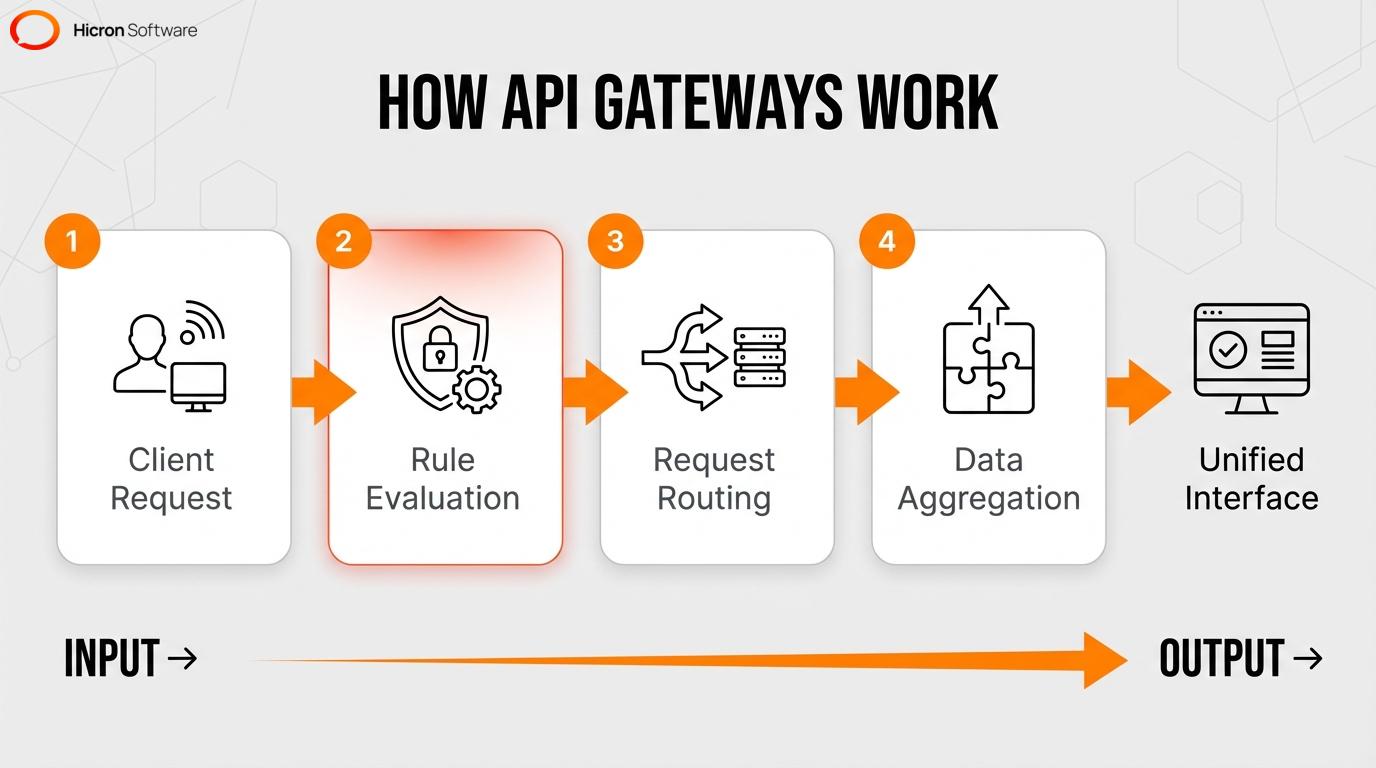
Serving as the frontline defense, the system intercepts incoming client requests, applies predefined security policies like rate limiting and authentication, and coordinates backend service calls to return a single, consolidated response. When a request comes in, the gateway executes a rapid four-step process:
Hiding the messy internal microservices from your clients, external applications interact with one unified interface instead of tracking individual internal service addresses. Because clients aren’t making multiple round trips, network latency drops significantly.
The control plane and data plane serve distinct, complementary functions within the gateway architecture. The control plane acts as the management layer, defining configurations and security policies like authorization, authentication, and rate limiting. It relies on observability data to adjust request routing rules.
The data plane processes and routes real-time API Gateway traffic based on these rules. It handles the movement and transformation of data packets to perform tasks like load balancing and packet forwarding.
North-south traffic happens when an external client talks to an internal service, such as an external mobile app calling a public endpoint. An API Gateway provides traffic management for this exact flow.
East-west traffic is internal communication between microservices, like a billing microservice calling an inventory microservice. Because these traffic flows are so different, you need specific tools for each to keep latency low. A service mesh typically manages the internal east-west data exchange within a Kubernetes environment. Mixing up these two traffic types is a common pitfall I see in early-stage architecture planning, so keeping their management separate is crucial.
Smooth communication depends on five core functions orchestrated by the gateway:
Centralizing traffic control optimizes backend performance and prevents system overload. The gateway spreads incoming requests across 2 or more service instances, such as a primary microservice and a backup server node.
Spreading the load instantly boosts scalability and stability. Managing the request flow for a specific endpoint reduces network latency, while the centralized control mechanism keeps things running smoothly even when traffic spikes.
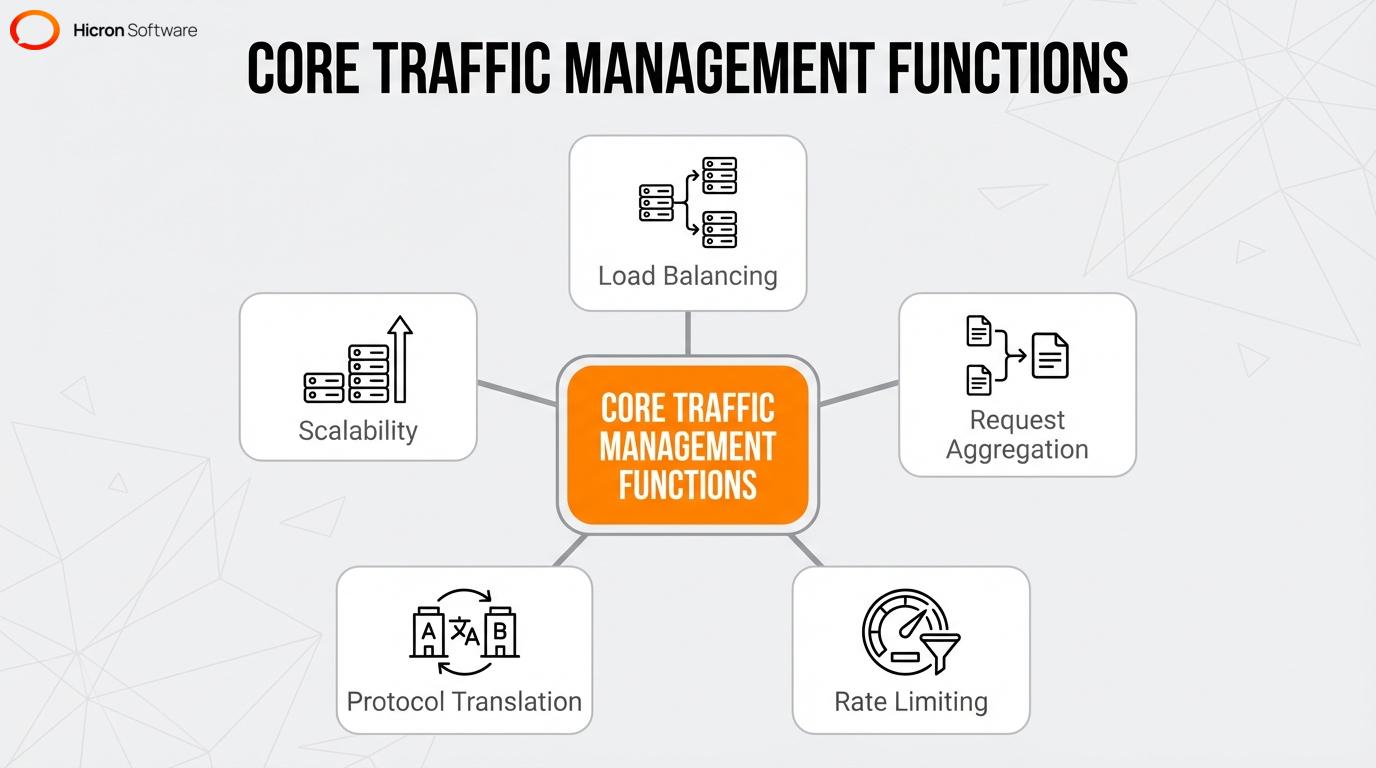
Request routing evaluates specific parameters, such as URLs, headers, and HTTP methods, to direct an incoming call to the correct backend service. Essentially, it makes sure every request lands exactly where it needs to go.
Request aggregation merges multiple backend responses into a single client payload to reduce network overhead. For example, an API Gateway can query separate billing, account, and preference microservices simultaneously to construct one user profile. Constructing one user profile directly boosts client application performance by reducing client-side complexity. If you are building mobile applications where bandwidth is at a premium, this feature alone is an absolute lifesaver. Fewer round trips mean lower latency and a much more scalable system.
Protocol translation enables communication between diverse clients and services by converting requests across various formats, such as REST, gRPC, and WebSockets. This data plane function ensures compatibility between modern web clients and specialized backend services in a mixed microservices setup.
The gateway handles this by translating an incoming HTTP request from a web browser into a gRPC call for a high-performance internal microservice. This conversion process wraps legacy systems in modern RESTful interfaces, exposing a single unified endpoint.
Protecting backend services through authentication, authorization, rate limiting, and threat protection requires a centralized security enforcement point. This shielding protects internal microservices from direct external exposure and malicious traffic. At the gateway level, zero-trust principles ensure every incoming request is verified.
These systems typically rely on a mix of security tools, including authentication, authorization, rate limiting, a WAF, SSL termination, and TLS encryption. The system validates client identities using standard security protocols. Modern gateways often employ behavioral anomaly detection to identify and block emerging cyber-attacks in real-time, going beyond static WAF rules.
Identity verification is centralized by validating standard security tokens, such as OAuth scopes and JWTs. Offloading authentication logic simplifies development for internal microservices like billing and inventory systems, stripping redundant security code out of your REST APIs.
Once the control plane defines an access policy to enforce a zero-trust architecture, the system verifies the JWT signature and extracts user claims, such as an administrator role and an account identifier. The gateway validates a JWT provided in the authorization header before routing a request to a protected billing endpoint.
Rate limiting controls the exact number of requests a client makes within a specific timeframe. This prevents system abuse and ensures scalability during traffic spikes. A Web Application Firewall (WAF) executes deep packet inspection and filters HTTP traffic to block malicious web-based attacks, such as SQL injection and cross-site scripting.
Integrating a WAF with an API Gateway provides real-time threat protection alongside standard rate limiting to mitigate DDoS attacks. Combined, they protect your API infrastructure by maintaining system stability while blocking malicious payloads before they reach a protected endpoint. Rejecting illegitimate traffic early reduces network latency and reinforces a zero-trust architecture. These mechanisms act as a perfect complement to standard authentication and authorization.
SSL termination at an API Gateway decrypts north-south traffic secured by TLS encryption. This process offloads the heavy lifting of decryption from backend microservices. Centralizing cryptographic operations, such as decryption and certificate validation, improves backend performance and system scalability.
Gateway SSL termination efficiently eliminates redundant processing across internal servers. The data plane executes this decryption before enforcing authentication and authorization. Because decryption happens first, the gateway can easily inspect request headers and payloads for accurate routing. Evaluating the unencrypted content reduces network latency when complex security policies apply.
To handle sudden traffic spikes without crashing, systems rely on the gateway to distribute network traffic efficiently, cache responses, and minimize client-to-server latency. It speeds up applications using four main techniques: load balancing, caching, request aggregation, and a circuit breaker pattern. Centralizing performance optimization techniques at the data plane reduces the backend load for internal microservices.
The gateway stores frequently accessed responses to improve performance and prevent server overload. Directly storing these responses ensures high availability and system reliability during the dynamic scaling of service instances. Request aggregation lowers network latency by bundling multiple data fetches into a single payload.
Caching reduces latency by serving frequent requests directly from an API Gateway, while load balancing prevents bottlenecks by evenly distributing traffic across multiple backend servers, such as primary nodes and replica instances. The data plane stores response data at the gateway level to eliminate redundant internal routing. Eliminating redundant internal routing distributes incoming network traffic to ensure high availability and prevent single-server overload.
Load balancing is essential in a microservices architecture to handle the dynamic scaling of service instances during traffic fluctuations. Together, caching and load balancing optimize REST API response times by minimizing backend processing for every endpoint, keeping your system highly scalable even under heavy load.
The circuit breaker pattern ensures system reliability by detecting backend failures and temporarily halting requests to unresponsive microservices. Temporarily halting these requests prevents cascading system-wide crashes. The gateway encapsulates the logic to stop recurring failures during temporary outages through retries and timeouts.
If a service times out repeatedly at a specific endpoint, the data plane trips the circuit breaker and returns an immediate error to the client instead of waiting. Cutting off these timeouts early keeps latency low and protects the rest of the system. The control plane uses observability data to resume normal routing once the backend service recovers.
Serving as a critical component of a microservices deployment, this centralized interface provides a unified interface for clients, decoupling them from the complex, distributed nature of internal services. Acting as the primary entry point, it allows external applications to interact with independent backend systems. Moving to microservices usually brings up two big hurdles: increased client-side complexity and fragmented data retrieval.
The gateway resolves these issues by centralizing shared responsibilities—such as security policies and request routing for each endpoint—to prevent code duplication across every microservice. A microservices architecture uses request aggregation at the gateway level to provide a unified data view to the client. Consolidating data from distinct sources eliminates multiple consecutive client-to-server round trips. Furthermore, efficient management of north-south traffic through this centralized interface improves overall system scalability. If complex internal communication patterns emerge, organizations deploy a service mesh to handle internal east-west traffic between microservices.
While enterprise architects primarily deploy API Gateways for distributed environments, this component is also highly beneficial for a monolithic architecture. Placing a gateway in front of a monolithic application provides a centralized layer for security, rate limiting, and request transformation. The main benefits of placing an API Gateway in front of a legacy monolithic application include offloading SSL termination, centralizing authentication, enabling protocol translation, and paving the way for future migration.
Handling computationally heavy tasks like SSL termination and authentication frees up the monolith’s internal capacity. As a result, this approach wraps legacy systems—like an outdated billing platform—in a modern interface, exposing a standard REST API to external clients.
The gateway executes protocol translation to convert a modern client request into a compatible legacy format for a specific endpoint. Centralizing the routing layer also makes it easier to do a gradual migration to independent microservices, like payment or inventory microservices. The system safely routes network traffic for a newly isolated endpoint to a modern microservice while directing the remaining incoming traffic to the monolithic architecture. Decoupling cross-cutting operational logic improves overall system scalability and extends the lifespan of existing infrastructure. This way, your teams can slowly replace legacy parts without ever dropping a client request. In my experience, this approach to dismantling a monolith is vastly less stressful than attempting a massive overnight rewrite.
Unlike traditional network infrastructure components—like a reverse proxy or a standard load balancer—this component operates at the application layer to offer advanced features tailored for an API. These advanced features include request routing, security enforcement, and policy management. Even though it acts a bit like a load balancer, it executes complex application logic rather than simple IP and port routing. A standard network tool executes basic load balancing strictly at the transport layer.
Specific application-layer data, such as an HTTP header, a URL, and payload content, is evaluated to execute advanced traffic management. To really understand where an API Gateway fits, it helps to compare it to two other common tools: a service mesh and a Kubernetes ingress controller.
External north-south traffic entering a microservices architecture is managed at the edge. A service mesh controls the internal east-west traffic between 2 independent microservices, such as a billing application and an inventory system. A large organization uses both an API Gateway and a service mesh to handle traffic management across both network domains.
While the gateway enforces edge-level security policies for external connections, including client authentication and rate limiting, the service mesh steps in to secure internal microservices using a dedicated data plane and control plane to handle internal operations like mTLS encryption and backend routing. Deploying these components together provides complete observability across north-south and east-west traffic as a development team scales a Kubernetes environment.
A Kubernetes ingress controller handles basic external access to a service within a Kubernetes cluster. A dedicated API Gateway extends this capability by providing strict security policies—such as rate limiting and authentication—when an administrator requires finer API control. A Kubernetes ingress controller operates as a specific load balancing mechanism designed to manage external access to internal cluster resources, like a pod or a service.
Sitting at the edge of a Kubernetes environment, it directs north-south traffic by executing basic traffic management functions, including request routing and SSL termination for an exposed endpoint. An ingress controller successfully replaces a dedicated API Gateway if an enterprise requires only simple routing for internal microservices, such as an inventory service or a billing application. But as setups get more complex, many teams are moving toward the Kubernetes Gateway API standard to provide advanced routing capabilities like header-based matching and traffic splitting.
Connecting directly with modern cloud-native environments, the system manages external access to a Kubernetes cluster and triggers a serverless function invocation based on a client request. Acting as a middleman between an external client and an ephemeral cloud-native workload, it provides a stable HTTP endpoint for dynamic backend resources, such as a serverless function or a containerized microservice. It standardizes service networking and ingress management in a Kubernetes deployment to ensure consistent traffic management.
Expanding upon a basic ingress controller, the system executes advanced request routing for a dynamic pod when a cluster configuration changes rapidly. In serverless computing, the gateway manages an invocation request by translating an external HTTP call into a specific function trigger. Mitigating cold-start latency through response caching and connection pooling, it improves overall system scalability. Managing this invocation request directly at the edge improves overall system scalability and reduces network latency.
Within dynamic cloud environments, an API Gateway enables safe software releases by using advanced traffic management to route specific percentages of user traffic to new service versions, whether for minor patches or major feature updates. Centralizing this control allows for zero-downtime deployments by executing precise request routing rules—such as weight-based routing and header-based routing—to shift network traffic. These configurations support popular release strategies like canary and blue-green deployments.
A blue-green deployment is executed by instantly switching 100% of the active traffic from an older environment to a new production instance. In a canary release, the system minimizes deployment risk by testing new versions in production with real traffic. For instance, the gateway might route a small fraction—such as 5%—of incoming requests to a new canary microservice version while monitoring observability metrics for errors, such as error rates and response latency. Controlling traffic distribution in this way supports strict API versioning and maintains system scalability when developers introduce new microservices. Because all this routing happens at the edge, you can continuously validate connections, keeping your zero-trust architecture intact during updates.
Implementing an API Gateway comes with a few architectural risks: creating a single point of failure, causing performance bottlenecks, and adding system complexity. Handling high traffic volumes demands proper scaling of the data plane to execute active traffic management without degrading response times. I always caution teams that while gateways solve many problems, they aren’t a magic bullet; you still have to architect for resilience.
Integrating this centralized routing layer adds structural complexity to both monolithic architectures and distributed environments. The control plane requires constant monitoring using observability data to detect configuration errors and prevent system-wide crashes. Administrators configure a circuit breaker pattern to maintain strict system scalability and prevent these problems when backend resources experience temporary outages.
Organizations prevent an API Gateway from becoming a single point of failure by designing the infrastructure for high availability. Relying on strategies like redundancy, horizontal scaling, and reliable load balancing, administrators design the infrastructure for high availability. Clustering effectively mitigates this major architectural challenge. Administrators deploy multiple gateway instances across 3 different availability zones to ensure continuous operation if a localized server outage occurs.
The system uses external load balancers to distribute incoming network traffic evenly among the gateway instances. Distributing traffic evenly keeps the system scalable and prevents crashes for internal microservices. The control plane uses observability data to monitor these redundant nodes, while the data plane processes requests continuously without adding unwanted network latency. A circuit breaker pattern further protects this clustered environment by isolating faults if an upstream backend service fails.
While introducing a minor delay by adding 1 extra network hop, advanced traffic management optimizations offset this slight delay. The system uses caching to store frequent responses for a specific endpoint, which improves performance and reduces the latency of querying internal microservices.
These optimizations outweigh the initial delay by handling functions like request aggregation, load balancing, and SSL termination. These mechanisms reduce overall client-to-server response times and maintain strict scalability during traffic fluctuations.
Operating as the exact data plane component, it enforces runtime policies, whereas API management acts as the broader strategic framework overseeing the entire lifecycle, governance, and developer experience. A full API management solution uses the gateway to execute active traffic management and enforce strict administrative rules. In essence, the gateway enforces runtime policies, while the management platform dictates lifecycle governance. The gateway handles direct request routing and applies specific security protocols, such as authentication and authorization.
On the management side, API management encompasses the control plane to define these configurations while providing tools like a developer portal, comprehensive documentation, and API versioning. The API Gateway fits into this overarching ecosystem by serving as the primary enforcement mechanism for the policies defined within the management platform. The management layer collects observability data directly from the gateway to monitor system health and track usage metrics. Working together, they keep your system secure and fast, no matter how much you scale.
API management tools streamline the onboarding process for external developers by providing a dedicated developer portal. This portal makes API discovery easy and offers resources like interactive documentation, testing environments, and secure access keys. A developer portal allows users to interact with a REST API managed by an API Gateway, simplifying identity verification mechanisms—like authentication and authorization—for an exposed endpoint.
API versioning allows teams to iterate safely by running 2 or more API versions (such as version 1 and version 2) simultaneously without breaking existing client integrations. Structured versioning manages the lifecycle and deprecation of internal microservices, like a billing service or an inventory application. This level of control lets developers roll out new features while keeping a close eye on every release.
The API Gateway is the ideal location for implementing system-wide observability because it intercepts all incoming and outgoing network requests. Occupying this centralized position provides critical insights into system health by capturing key data like metrics, logs, and distributed traces for every endpoint. Monitoring this continuous traffic flow at the edge detects anomalies, debugs errors, and tracks response latency across internal microservices.
Full API management platforms use this exact observability data to inform system configurations and maintain strict scalability. If suspicious traffic patterns emerge, the control plane uses data from these observability tools to adjust request routing rules and security policies in real-time. The data plane then executes these updated parameters to ensure active traffic management. Staying in sync automatically keeps performance high and stops overloads before they happen.

Hicron Software proved to be a trusted partner with unmatched technical expertise, delivering a scalable and user-friendly web application that was pivotal to our successful U.S. market expansion.

Hicron’s contributions have been vital in making our product ready for commercialization. Their commitment to excellence, innovative solutions, and flexible approach were key factors in our successful collaboration.
I wholeheartedly recommend Hicron to any organization seeking a strategic long-term partnership, reliable and skilled partner for their technological needs.

After carefully evaluating suppliers, we decided to try a new approach and start working with a near-shore software house. Cooperation with Hicron Software House was something different, and it turned out to be a great success that brought added value to our company.
With HICRON’s creative ideas and fresh perspective, we reached a new level of our core platform and achieved our business goals.
Many thanks for what you did so far; we are looking forward to more in future!

Hicron is a partner who has provided excellent software development services. Their talented software engineers have a strong focus on collaboration and quality. They have helped us in achieving our goals across our cloud platforms at a good pace, without compromising on the quality of our services. Our partnership is professional and solution-focused!

The IT system supporting the work of retail outlets is the foundation of our business. The ability to optimize and adapt it to the needs of all entities in the PSA Group is of strategic importance and we consider it a step into the future. This project is a huge challenge: not only for us in terms of organization, but also for our partners – including Hicron – in terms of adapting the system to the needs and business models of PSA. Cooperation with Hicron consultants, taking into account their competences in the field of programming and processes specific to the automotive sector, gave us many reasons to be satisfied.