Responsible AI Engineering: Building Production-Ready Systems
- June 09
- 11 min



An AI PoC evaluation is valid when three conditions hold before the experiment begins: success criteria include a frozen economic baseline, test data is validated independently of the team against production noise, and a named P&L outcome owner holds the authority to call the result.
You have probably run an AI proof of concept that succeeded. The demo impressed the room. Leadership approved the next phase. The team moved forward with confidence.
Here is the harder question: was that confidence earned?
In most organizations, the answer requires checking whether anyone set a measurable threshold before the experiment started, whether the test data was validated by someone other than the development team, and whether the decision to continue was based on performance against criteria, or on a room’s reaction to a demo.
Most AI PoCs end without the conditions to determine whether they actually succeeded. The verdict arrives anyway. That verdict drives investment decisions worth months of engineering time and significant budget. And the foundation beneath it is a well-staged presentation, instead of evidence.
S&P Global Market Intelligence found that the average organization scrapped 46% of AI proof-of-concepts before production. The share of companies abandoning most of their AI initiatives rose from 17% to 42% in one year.
Key Takeaways:
A demo is a selection. The team chooses inputs the system handles well. The presentation is optimized for the best result the system can produce on the day.
That is reasonable preparation for a presentation. It produces no information about how the system behaves on the actual distribution of inputs it will face in production. A demo that lands well tells you the system can handle some cases under controlled conditions. It tells you nothing about the edge cases, the failure modes, or the variance across a representative sample.
Demos measure how well a team can present a system. Evaluation measures how well the system performs on data it has not seen.
These are different activities with different outputs. Treating one as a substitute for the other is where most AI investment decisions lose their evidentiary basis.
Three conditions hold before the experiment begins for an AI PoC evaluation to be valid.
When these three conditions are missing, the AI PoC has no valid evaluation. The verdict is a judgment call dressed as a conclusion.
The conditions are skipped because setting them up feels like overhead on a project that is supposed to be fast and cheap.
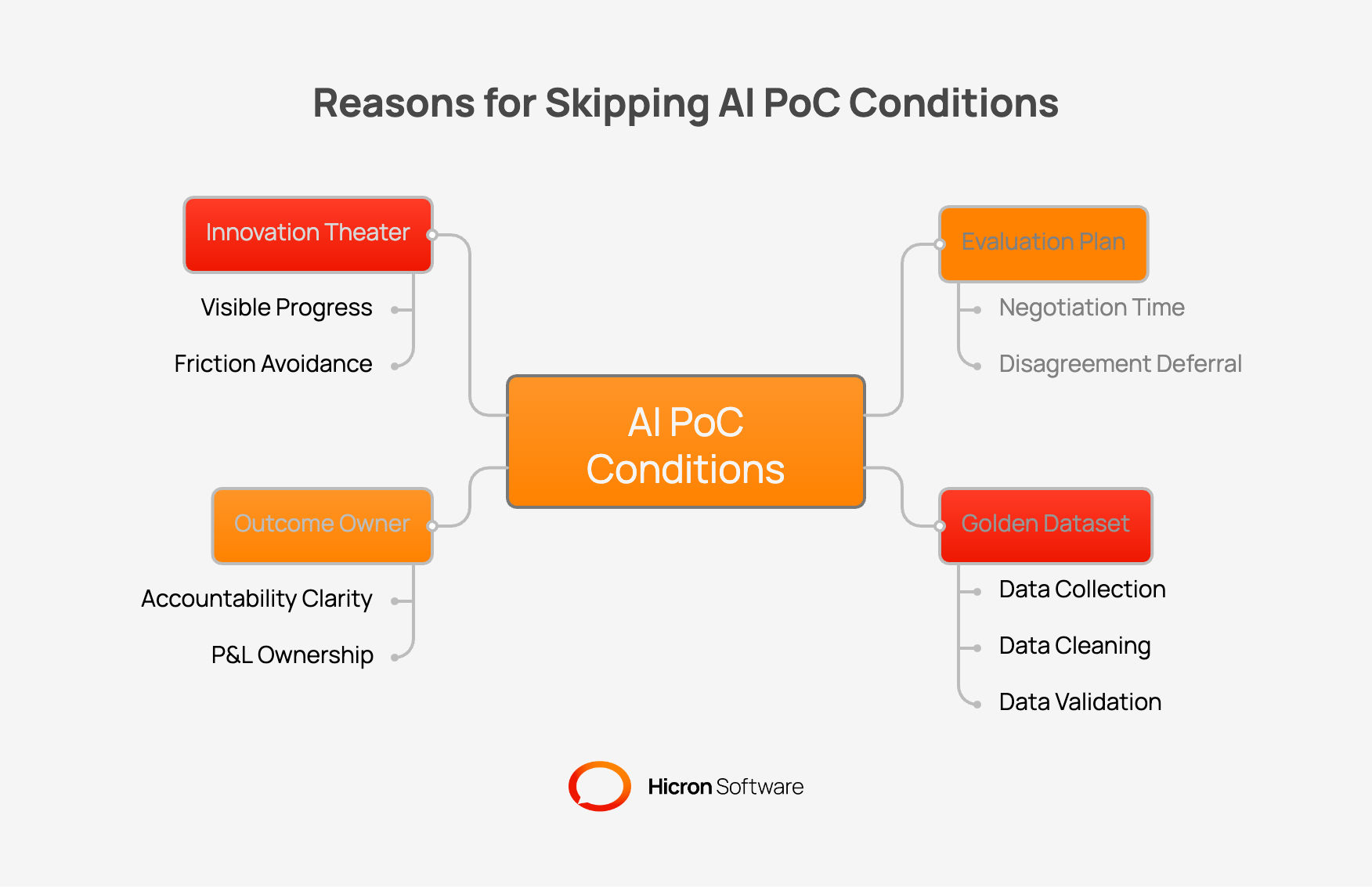
The Evaluation Plan takes time to negotiate. Agreeing on thresholds and an economic baseline requires the business and the technical team to share a view of what acceptable performance means. That conversation surfaces disagreements about the problem that most teams would rather defer.
The Golden Dataset requires data. Collecting, cleaning, and validating representative production inputs is real work. Organizations that commission AI PoCs without confirmed data availability regularly discover the constraint after the experiment budget has been spent.
The outcome owner requirement surfaces organizational discomfort. Naming one person who will call the result and own the P&L consequence forces clarity about accountability that many organizations prefer to leave ambiguous.
There is a quieter reason as well. Some AI PoCs exist as innovation theater: a visible experiment that signals progress without a real intent to deploy. In that setting, an Evaluation Plan, a noisy Golden Dataset, and a P&L owner create friction the sponsor never wanted. Skipping the conditions is then a rational choice when the project’s purpose stops at the demo.
The conditions feel expensive because they are. They are also what separates a valid investment decision from an expensive guess.
Skipping them does not eliminate the cost. It defers it to the point where continuing is harder to stop and the sunk cost argument starts winning.
When the three conditions hold, reading results is straightforward. The Validation Report answers three questions:
The three exits are structurally different.
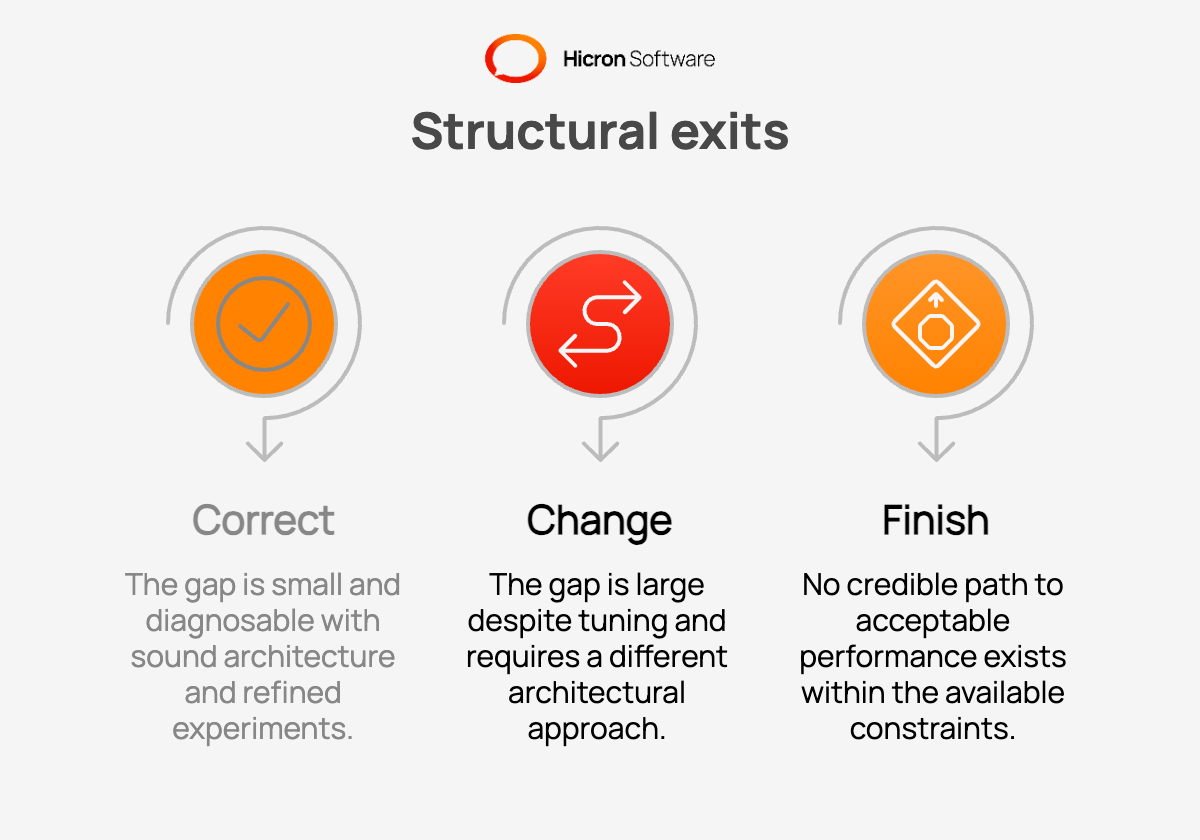
Correct and Change also price the last mile. Further investment includes monitoring, data drift handling, rollback, logging, and the operations work that keeps the system reliable after the AI PoC. A threshold met on the Golden Dataset can still fail the business case once that TCO sits next to the economic baseline. The Validation Report makes the performance call. The last mile cost makes the investment call.
Without both, the organization picks an exit based on how the team feels about the project rather than on what the evidence and the cost model show.
Less than it costs to run one without them.
An AI PoC that produces a valid evaluation takes longer to set up. The Evaluation Plan negotiation adds time. Building the Golden Dataset adds time and sometimes requires domain expert involvement. The structured decision point adds a review step.
In exchange, the organization gets a decision it can defend. It knows whether to continue, pivot, or stop, and it has the evidence to explain why. It also gets a reusable dataset and a methodology that transfers to the next experiment.
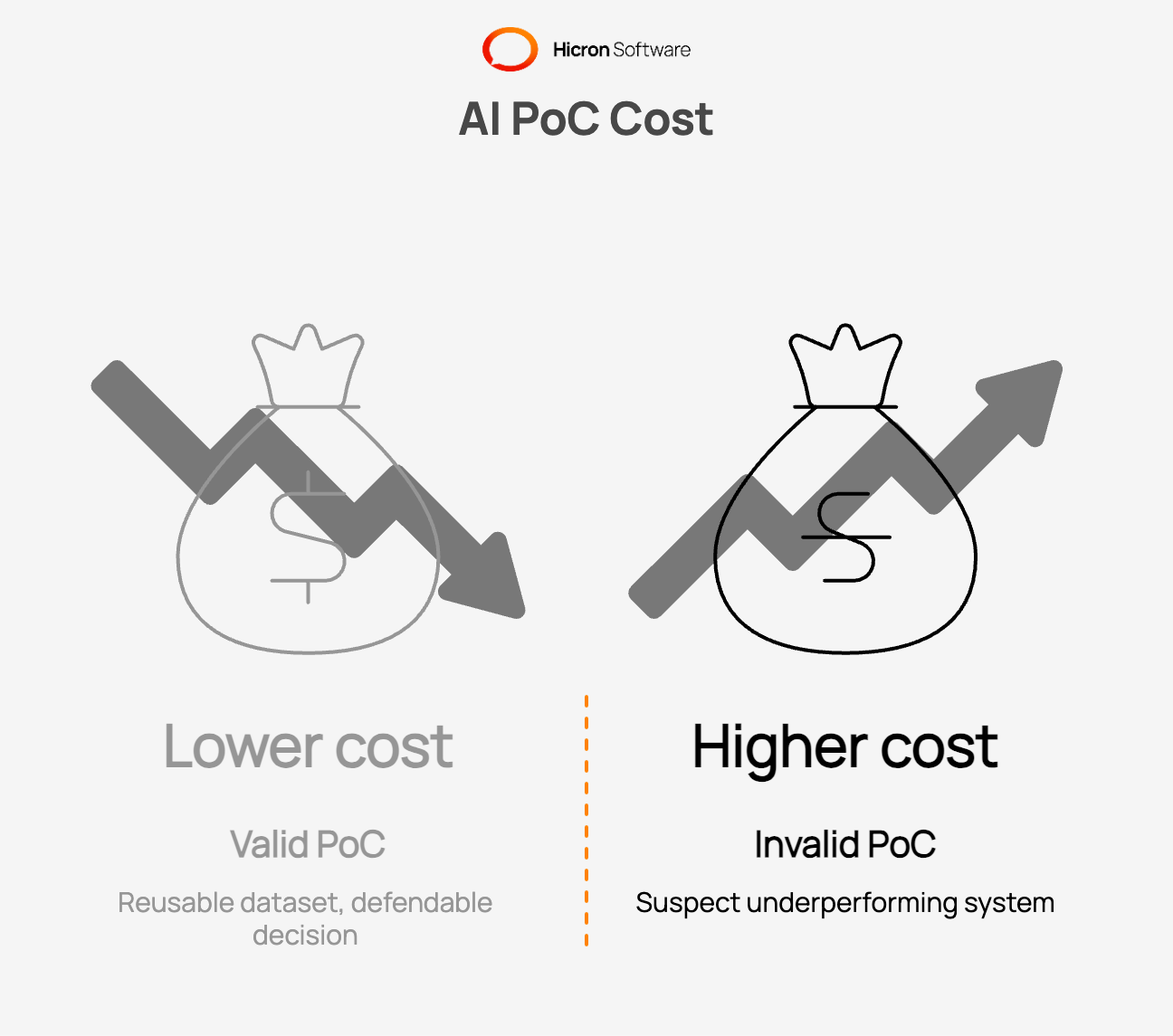
An AI PoC without valid conditions produces a verdict that cannot be challenged or reproduced. It also produces a higher probability of investing further in a system that the team already suspects is underperforming, because no one created the conditions to say so.
The overhead of rigorous evaluation is front-loaded. The cost of skipping it compounds.
After an AI PoC review, the useful question is whether the organization has the evidence to decide honestly.
Before the next experiment begins: write the Evaluation Plan with an economic baseline, validate a Golden Dataset that reflects production noise, and name the P&L outcome owner. Set the threshold at the level the business actually requires.
When the time box expires, read the Validation Report. Price the last mile TCO against the baseline. Take the exit the evidence supports.
The organizations that improve at AI delivery over time are the ones that run valid experiments, including the ones that end in a decision to stop.
A threshold set after results are visible describes what happened, not what was required. Post-hoc criteria produce a number that always confirms the experiment succeeded. The Evaluation Plan exists to fix the standard against which results will be measured before anyone knows what those results will be.
The baseline is the current cost of error, processing time, or other business cost the system is meant to change. Without it, a later claim that the PoC justified further investment has no comparison point. Recording the baseline in the Evaluation Plan also forces the business and the technical team to agree on what improvement counts before results appear.
Finishing a PoC means the evidence showed that acceptable performance was not reachable within available constraints. That is information. A team that finishes a PoC early, before additional investment compounds the sunk cost, has done exactly what the framework is designed to produce. The failure mode is continuing past the point where the evidence supports it.
Document who holds threshold-modification authority and under what conditions. A threshold change driven by results rather than by new domain knowledge is a governance failure. If the threshold was genuinely set wrong, the recalibration requires a documented rationale and a full re-run of the evaluation on the same dataset.
The dataset must be large enough to carry statistical confidence, sampled from the input distribution the system will face in production, and validated by people with domain knowledge to judge the expected outputs. It must cover edge cases and failure modes. Datasets assembled and labeled by the team running the experiment carry a structural conflict of interest that undermines the evaluation.
Hicron Software proved to be a trusted partner with unmatched technical expertise, delivering a scalable and user-friendly web application that was pivotal to our successful U.S. market expansion.

Hicron’s contributions have been vital in making our product ready for commercialization. Their commitment to excellence, innovative solutions, and flexible approach were key factors in our successful collaboration.
I wholeheartedly recommend Hicron to any organization seeking a strategic long-term partnership, reliable and skilled partner for their technological needs.

After carefully evaluating suppliers, we decided to try a new approach and start working with a near-shore software house. Cooperation with Hicron Software House was something different, and it turned out to be a great success that brought added value to our company.
With HICRON’s creative ideas and fresh perspective, we reached a new level of our core platform and achieved our business goals.
Many thanks for what you did so far; we are looking forward to more in future!

Hicron is a partner who has provided excellent software development services. Their talented software engineers have a strong focus on collaboration and quality. They have helped us in achieving our goals across our cloud platforms at a good pace, without compromising on the quality of our services. Our partnership is professional and solution-focused!

The IT system supporting the work of retail outlets is the foundation of our business. The ability to optimize and adapt it to the needs of all entities in the PSA Group is of strategic importance and we consider it a step into the future. This project is a huge challenge: not only for us in terms of organization, but also for our partners – including Hicron – in terms of adapting the system to the needs and business models of PSA. Cooperation with Hicron consultants, taking into account their competences in the field of programming and processes specific to the automotive sector, gave us many reasons to be satisfied.