10 Real Estate Software Development Companies in 2026
- February 03
- 9 min


PropTech platform development is the process of creating technology to optimize how people research, rent, buy, sell, and manage property. Most PropTech platforms fail not because of bad code, but because of good code built on wrong assumptions.
This article is the first in our 6-part series, Architecting PropTech at Scale. The decisions an architect makes in the first few weeks determine whether the platform can scale, comply, and compete in years three to five. This is a perspective distinct from a developer’s focus on immediate functionality. We’ll guide you through the three foundational pillars that support a successful proptech platform: deep domain understanding, a strategic development approach, and methodical tech stack selection. This end-to-end guide to developing a proptech platform will equip you to lay the right groundwork for future growth and avoid a costly rewrite.
PropTech is not just a digital brochure for properties. It is fundamental infrastructure for property management, transactions, listings, and analytics. What proptech software solves is the fragmentation and inefficiency inherent in the traditional real estate industry. This property technology aims to simplify complex processes and provide valuable insight through data. Understanding this distinction is the first step in successful proptech platform development.
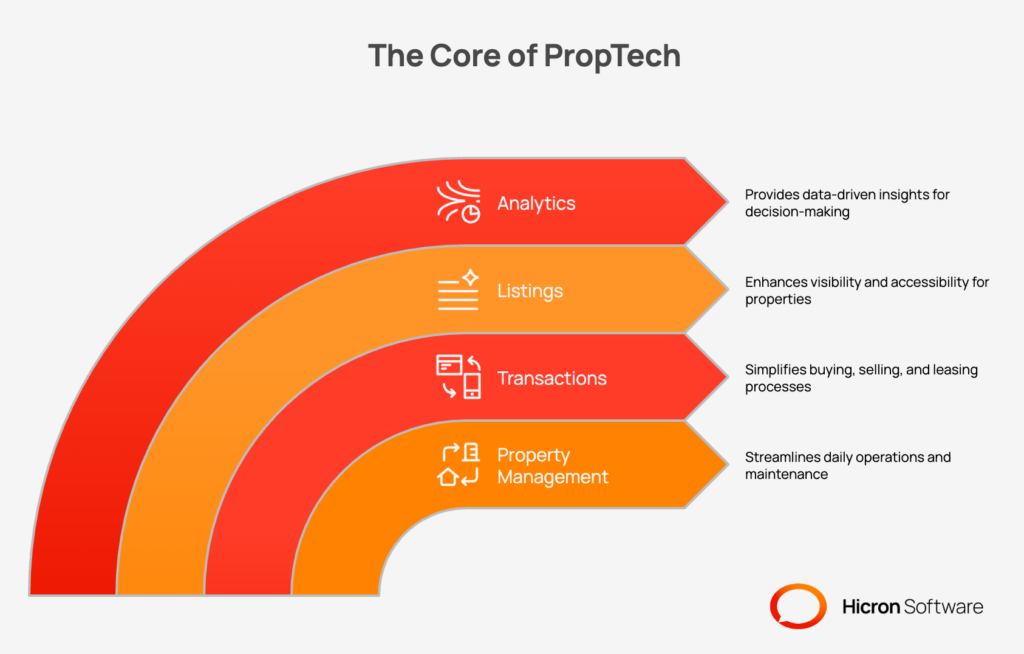
There are three distinct platform archetypes, each with very different data requirements:
Attempting to merge these archetypes from the start leads to bloated, unscalable proptech systems. A platform that tries to be a high-traffic marketplace and a secure transaction hub simultaneously without clear architectural separation will fail at both.
The real estate industry presents an unusually high regulatory surface area. Rules change based on city, state, and country. Add the complex web of relationships between agents, tenants, landlords, buyers, and institutional investors, and you have a domain that punishes generic software development approaches. This is where a Domain-Driven Design (DDD) framework is essential.
Applying DDD means identifying “bounded contexts” within your proptech platform. These are explicit boundaries within your system where a specific domain model applies. For a proptech project, these contexts are clear:
Architecting these as separate services or modules from day one is critical. Failing to do so creates deep-rooted problems. Data becomes siloed and inconsistent, making a unified view of a customer or property impossible. Integrating with legacy systems becomes a nightmare of data mapping. Most dangerously, compliance gaps appear when data from different contexts is mixed improperly, creating risks around data protection.
User archetype analysis is an architectural input, not just a user experience (UX) exercise. The needs of a tenant browsing for an apartment are fundamentally different from those of a landlord managing a portfolio. These differences must be reflected in the system’s architecture.
Consider the divergent requirements:
A company that skips this analysis often over-engineers for one persona while under-building for another. For example, they might build a globally distributed, low-latency system for a landlord analytics tool that is only used once a month, while their tenant payment portal crashes under peak load. Mapping each user’s needs to system boundaries helps you allocate resources effectively and build a platform that truly serves its target audience.
Choosing the right development approach is a strategic decision that impacts your entire proptech platform development journey. There are three credible options for building proptech software.
The decision framework rests on three variables: IP sensitivity, time-to-market pressure, and internal domain expertise. If your competitive edge is a proprietary algorithm, an in-house or hybrid model might be best. If speed is the top priority for entering the real estate market, a specialist partner is often the wisest choice. The goal of “fastest to MVP” is often in direct conflict with the “right architecture for scale.” A good partner or an experienced internal architect can help you resolve this tension by making smart, scalable choices from the start.
There is a major difference between a generic software development company and a partner with true real estate industry depth. A generic firm can build an app; a specialist understands why a property data schema needs to support multiple listing service (MLS) formats. A tech partner is worth the investment when they reduce your project risk and accelerate your path to revenue. They offer a competitive edge through experience.
When evaluating potential proptech software development services, ask these five questions:
A red flag is any potential partner who leads with discussions about UI mockups and user-friendly design before asking detailed questions about your data model, user archetypes, and business needs. The user interface is the top layer; the foundation is data.
Certain architectural features are non-negotiable. They must be designed into the platform’s foundation, as retrofitting them later is disproportionately expensive and often impossible without a complete rebuild. This is a core tenet of real estate software development best practices.
The non-negotiable architectural key features are:
A simple framework for feature prioritization is to categorize them as Core, Competitive Edge, or Differentiator. Core features are table stakes. Your competitive edge is what makes you better than others. Differentiators, like advanced AI, are what make you unique. Architect for all three from the start.
Choosing the right tech stack is not a matter of personal preference. It’s about aligning the technology with your platform’s dominant data patterns and your team’s capabilities. A poor choice here creates friction throughout the software development lifecycle.
Here is how common stacks map to PropTech use cases:
The decision should be a conscious one. If your platform is centered on AI-driven analytics, Django’s ecosystem gives you a head start. If you’re building a fast-moving marketplace, MERN might be the right tech.
|
Tech Stack |
Best Use Case |
Key Features |
|
MERN (MongoDB, Express, React, Node.js) |
Dynamic listing platforms requiring real-time updates and rapid development. |
Flexible unstructured database (MongoDB) for varied listing content. High-throughput, real-time APIs via Node.js. Ideal for fast startup velocity. |
|
MEAN (MongoDB, Express, Angular, Node.js) |
Enterprise-grade real estate platforms with complex user interfaces. |
Structured framework (Angular) for long-term maintainability in large teams. Suitable for large-scale, feature-rich operations. |
|
Django + React |
AI-integrated property management and analytics platforms. |
Direct access to Python’s AI/ML libraries. Strong server-side admin tools for property managers. Flexible UI with React. |
|
LAMP (Linux, Apache, MySQL, PHP) |
High-traffic, listing-heavy platforms focused on structured data and proven scalability. |
Robust performance for structured data management (MySQL). Proven track record for scalability and stability in high-traffic scenarios. |
The unique demands of real estate technology solutions guide your component choices within the stack.
|
Component |
Options |
Best Use Case |
Key Considerations |
|
Frontend |
React & Angular (Web) |
Building web-based platform interfaces. |
React offers flexibility; Angular provides a more structured framework for large teams. |
|
React Native (Mobile) |
Cross-platform mobile app development with code reuse. |
Ideal when seamless cross-platform consistency is a primary product requirement. |
|
|
Flutter (Mobile) |
Mobile apps requiring a high-fidelity, native-like user experience. |
Superior for visually intensive features like property tours and visual searches. |
|
|
Backend |
Node.js |
Handling real-time API throughput for high-concurrency tasks. |
Critical for responsive listing feeds and processing data streams from smart building IoT devices. |
|
Django |
Integrating AI/ML models and managing complex business logic. |
Excellent for property management workflows and platforms with heavy data processing needs. |
|
|
Database |
PostgreSQL |
Storing structured, relational data requiring high integrity. |
Best for transaction records, lease information, and compliance event logs. |
|
MongoDB |
Managing unstructured or semi-structured content with flexible schemas. |
Suited for varied listing content, images, and user-generated information. |
|
|
Hybrid (PostgreSQL + MongoDB) |
Platforms at scale that need to manage both structured and unstructured data effectively. |
Requires a clear, intentional architectural boundary between the two systems. Data protection (GDPR, CCPA) must be considered for storing PII across both. |
Your cloud provider is an architectural decision, not just an operational expense. The services offered by each provider can either accelerate your proptech platform development or create lock-in that limits future options. Using cloud computing is standard practice.
The best strategy for any PropTech company is to run a pilot project on the free tier of your top two choices. Validate your architectural assumptions before you commit your entire platform to a single provider. This simple step can prevent costly mistakes.
A proptech platform does not exist in a vacuum. It must integrate with a rich ecosystem of external services. Treating these integrations as afterthoughts is a recipe for disaster. They are first-class citizens in your architecture.
The multi-persona interface is a significant challenge. A tenant needs a simple, intuitive mobile experience. An institutional investor needs dense, data-rich dashboards. Both need to be served by a shared, consistent data layer. The key is to separate the presentation layer from the business logic and data access layers.
Adopting a mobile-first approach is an architectural constraint, not just a design preference. It forces you to design efficient APIs that send optimized, minimal data payloads. This benefits all users, not just those on mobile devices.
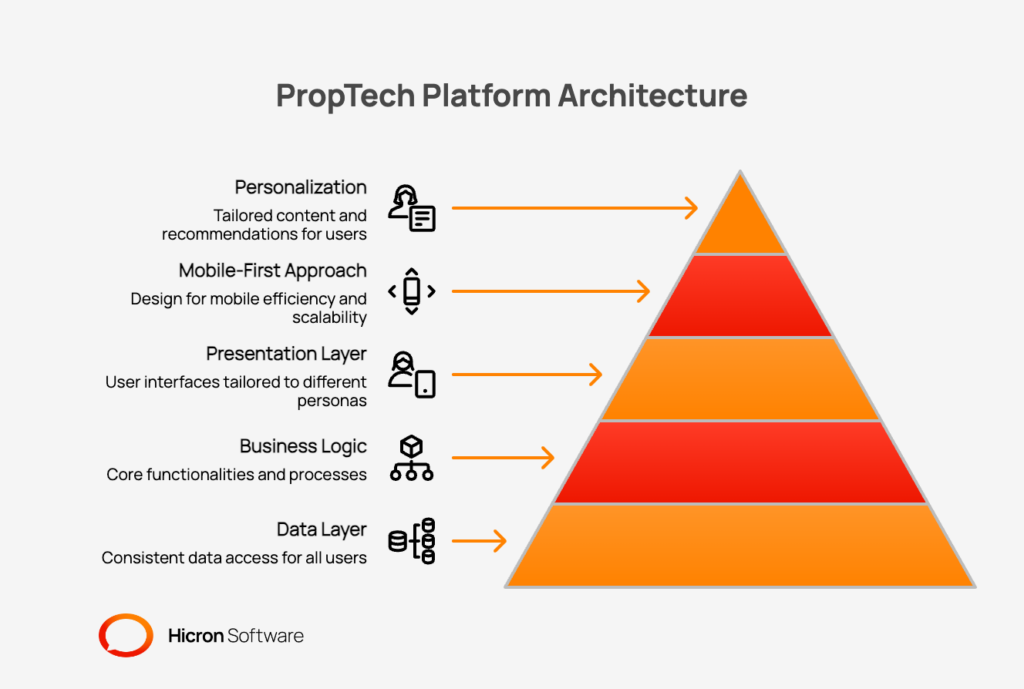
Personalization at scale is another critical consideration. You should design the recommendation interface before choosing the specific AI layer. This means creating flexible UI components that can display personalized content and designing APIs that can accept parameters to tailor results for a specific user. Whether you use a simple algorithm or a complex neural network later, the interface will be ready. To personalize the experience, you need to collect the right data from the start.
Before the first line of code is written, a successful proptech platform architecture is a set of clear decisions. It’s a blueprint that provides clarity to the entire development team. This is one of the most important best practices for profitable proptech.
To consolidate the decisions from this guide, here is a pre-build architecture review checklist. Every architect should be able to answer these five questions before development begins:
Answering these questions provides the foundation for the next phase of your proptech platform development. Development best practices in this domain always point to the same conclusion: a successful proptech platform is not built in a sprint. It is built in the decisions that precede the sprint.
The architectural decisions documented here are not glamorous. They do not produce impressive demo screenshots or excite investors in the short term. However, they are the decisions that determine whether your proptech platform becomes essential infrastructure for the real estate industry or a costly rewrite project in three years. Make the right choice.
This is the first article in our Architecting PropTech at Scale series. Explore the full series index for the specific architecture layer your platform needs next.
Hicron Software proved to be a trusted partner with unmatched technical expertise, delivering a scalable and user-friendly web application that was pivotal to our successful U.S. market expansion.

Hicron’s contributions have been vital in making our product ready for commercialization. Their commitment to excellence, innovative solutions, and flexible approach were key factors in our successful collaboration.
I wholeheartedly recommend Hicron to any organization seeking a strategic long-term partnership, reliable and skilled partner for their technological needs.

After carefully evaluating suppliers, we decided to try a new approach and start working with a near-shore software house. Cooperation with Hicron Software House was something different, and it turned out to be a great success that brought added value to our company.
With HICRON’s creative ideas and fresh perspective, we reached a new level of our core platform and achieved our business goals.
Many thanks for what you did so far; we are looking forward to more in future!

Hicron is a partner who has provided excellent software development services. Their talented software engineers have a strong focus on collaboration and quality. They have helped us in achieving our goals across our cloud platforms at a good pace, without compromising on the quality of our services. Our partnership is professional and solution-focused!

The IT system supporting the work of retail outlets is the foundation of our business. The ability to optimize and adapt it to the needs of all entities in the PSA Group is of strategic importance and we consider it a step into the future. This project is a huge challenge: not only for us in terms of organization, but also for our partners – including Hicron – in terms of adapting the system to the needs and business models of PSA. Cooperation with Hicron consultants, taking into account their competences in the field of programming and processes specific to the automotive sector, gave us many reasons to be satisfied.