10 Real Estate Software Development Companies in 2026
- February 03
- 9 min


Proptech software development and compliance refers to the practice of building real estate technology solutions with data protection regulations embedded directly into the system architecture. This approach ensures platforms natively adhere to privacy laws rather than treating them as an afterthought.
This article is the fourth in our 6-part series, Architecting PropTech at Scale. This article covers the compliance obligations that PropTech platforms face and explains how to meet them through architectural decisions rather than policy documents. It is written for CTOs, solutions architects, compliance leads, and senior engineers who build or scale real estate technology platforms. The article covers four areas: privacy by design as a schema discipline, data sovereignty in hybrid cloud environments, GDPR tooling selection, and EU Data Act requirements for IoT integrations. Each section translates regulatory requirements into concrete engineering decisions. The goal is to help PropTech development companies build compliance into their platforms from day one.
PropTech platforms operate under a broader regulatory surface than most software categories. A single platform typically processes personal identity data from tenant profiles and buyer records, financial transaction data from payments and deposits, location data from property search activity, and in many cases occupancy or access data from building sensors. Each data category carries distinct obligations.
Three regulatory frameworks define the core requirements.
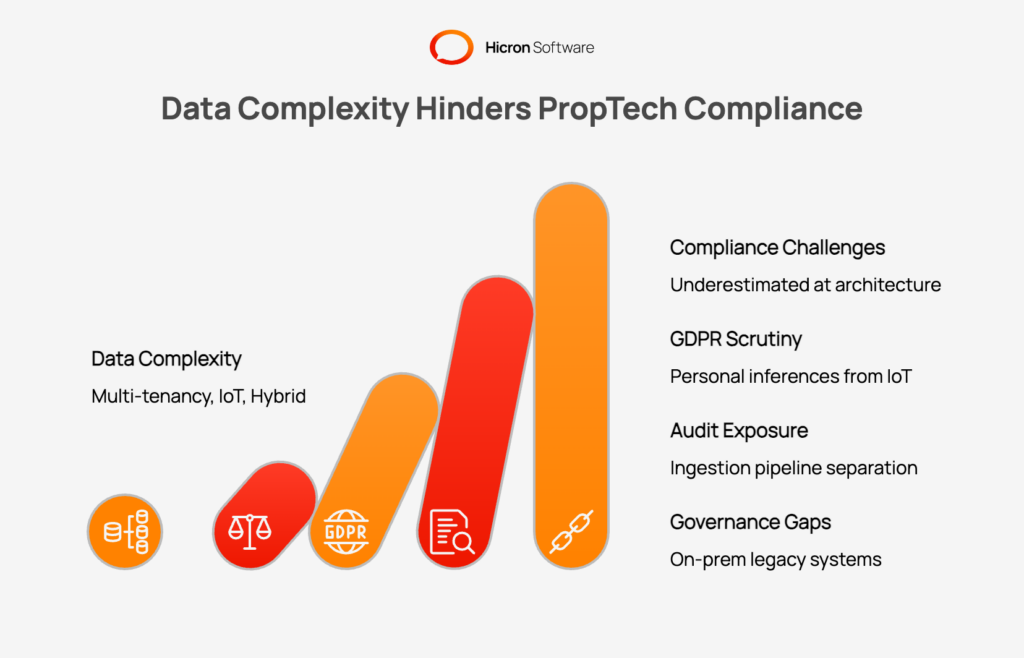
The multi-tenancy compliance problem is one that PropTech development companies underestimate at the architecture stage. A single PropTech platform often processes data under multiple regulatory frameworks at the same time. EU tenants fall under GDPR. US based buyers fall under CCPA. Cross border property investors may be subject to additional national rules. The data model, consent management layer, and API design need to account for this jurisdictional complexity from the schema outward.
IoT integrations add further complexity. Building sensor data that infers occupancy patterns or access behaviour creates GDPR scrutiny for personal inferences that many architecture teams do not anticipate during system design. Raw energy readings and derived occupancy analytics carry different retention requirements and different consent bases. Running both through the same ingestion pipeline without separation creates an audit exposure that is expensive to correct retrospectively.
Hybrid environments create data governance gaps. On premises legacy systems connected to cloud analytics pipelines often lack the audit trails that regulators expect. This is increasingly treated as evidence of inadequate governance rather than technical immaturity.
Privacy by design is a set of architectural constraints that shape schema decisions and API contracts before the first line of code is written. The difference between a platform that embeds these constraints early and one that retrofits them at scale is the difference between a routine compliance exercise and a platform rebuild.
The seven principles of privacy by design translate into specific engineering decisions for PropTech teams.
Privacy by design is a schema discipline. The schema decisions made in sprint one determine whether a platform can satisfy a regulatory audit three years later.
Three architectural failures appear consistently in PropTech platforms that were not designed with privacy controls in place.
A PropTech platform with hundreds of thousands of tenant records that cannot programmatically execute an erasure request across all data stores. Including Redis caches, Elasticsearch indexes, and cold storage archives, is non compliant regardless of its privacy policy wording. GDPR allows one month to respond to erasure requests. At that volume, that timeline requires programmatic infrastructure.
A compliant PropTech data architecture requires four structural components.
Data Protection Impact Assessments serve as an architectural gate for high risk features. Conducting a DPIA before deploying geolocation recommendations, AI driven tenant matching, or IoT occupancy analytics means the assessment informs the architecture rather than documenting a system already in production.
Data sovereignty requires that specific categories of real estate data be stored and processed within defined geographic jurisdictions. EU tenant PII, financial transaction records, and IoT derived personal inferences all fall into this category.
Public cloud only architectures struggle to meet sovereignty requirements without added operational complexity. This is one of the primary reasons PropTech development companies adopt hybrid infrastructure. An on premises or edge deployment holds sovereign data while the public cloud handles non personal workloads.
The jurisdiction classification model for PropTech data works as follows. EU tenant PII stays within EU data centres. MLS feed and listing data is generally non personal and can be processed in any region. IoT sensor data requires classification by inference risk, with raw readings and derived analytics separated at ingestion. Payment transaction data falls under PCI DSS requirements and is processed in certified environments.
|
Data Category |
Residency / Processing Requirements |
Compliance Notes |
|
EU Tenant PII |
Must remain in EU data centres (e.g., Azure Stack HCI, AWS Local Zones in EU regions, or on-premises private cloud). |
Cross-border transfer requires a legal basis under GDPR Article 46. |
|
MLS Feed & Listing Data |
Can be processed in any region optimized for performance. |
Generally considered non-personal data and not subject to residency requirements. |
|
IoT Sensor Data |
Requires separation at the ingestion layer based on risk. |
Raw energy readings and derived occupancy pattern analytics carry different sovereignty obligations and must be classified accordingly. |
|
Payment Transaction Data |
Must be processed in PCI-DSS certified environments, regardless of geography. |
PCI-DSS compliance requirements overlay any applicable GDPR rules. |
This table outlines the jurisdiction classification model for PropTech data, providing a schema to guide infrastructure topology decisions.
Four components form the sovereignty stack for PropTech hybrid environments.
A common architecture error is MLS feed aggregation pipelines that route EU tenant search behaviour through US region processing nodes. This has direct implications under GDPR Article 46 and typically surfaces only during a detailed data flow audit.
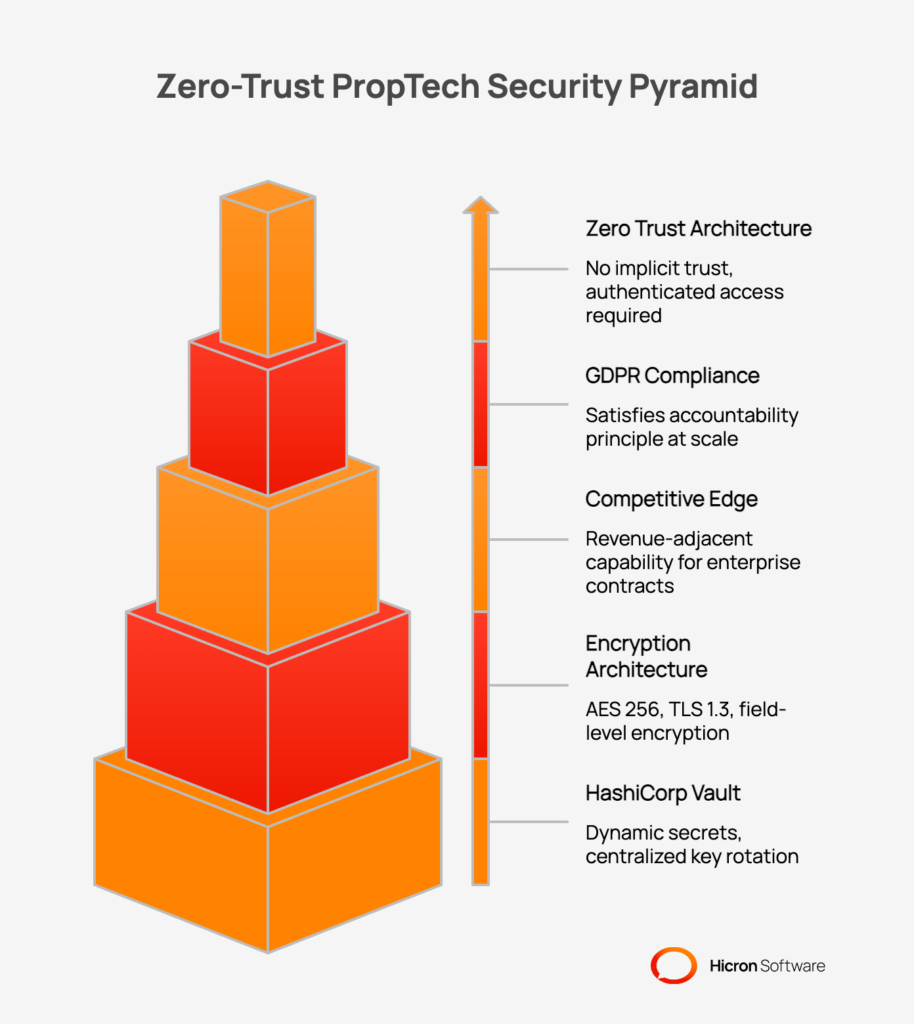
Zero trust architecture means that no internal service or pipeline is granted implicit trust. Every data access requires authenticated, authorised, and logged requests regardless of network origin. This is what makes GDPR’s accountability principle operationally satisfiable at scale.
Institutional real estate clients and regulated tenancy platforms increasingly require evidence of zero trust architecture as a procurement condition. For PropTech platforms competing for enterprise contracts, architectural compliance is becoming a revenue adjacent capability.
The encryption architecture for PropTech platforms uses AES 256 at rest, TLS 1.3 in transit, and field level encryption for PII fields. HashiCorp Vault provides dynamic secrets, short lived credentials, and centralised key rotation. This removes the manual key management debt that accumulates in fast moving engineering teams.
Generic GDPR compliance tools fail PropTech platforms because they do not account for hybrid infrastructure topology, IoT data complexity, or MLS feed data lineage requirements. A consent management tool that works correctly for a marketing SaaS does not provide the programmatic DSAR execution across Redis caches and Elasticsearch indexes that a large PropTech platform requires.
A PropTech compliance architecture requires four tooling categories:
|
Tool |
Hybrid Infra Fit |
GDPR Focus |
PropTech Suitability |
Pricing Tier |
|
Sprinto |
Deep cloud and IAM integrations, AI governance |
Automation, AI Act readiness |
Growth stage PropTech |
From USD 10k per year |
|
Drata |
Continuous hybrid infrastructure scanning |
DSARs, evidence collection |
Engineering led teams |
From USD 15k per year |
|
Vanta |
Vendor and policy automation |
Controls, audit trails |
From USD 8k per year |
|
|
OneTrust |
Enterprise workflow governance |
RoPA, consent, cross border flows |
Enterprise PropTech |
From USD 20k per year |
The right tool depends on platform stage and infrastructure complexity. Sprinto or Drata suit hybrid environments requiring Azure Arc integration and continuous monitoring. Vanta suits earlier stage PropTech platforms focused on audit readiness. OneTrust suits enterprise platforms with complex cross border data flows requiring detailed Records of Processing Activities management. DataGrail is worth considering as a complement for platforms with high volumes of data subject access requests where DSAR automation depth exceeds what primary tools provide.
Compliance can be a pipeline stage, producing a continuous quality signal rather than a periodic audit exercise.
Teams that instrument these checks report that audit preparation time drops because evidence artefacts are continuously generated rather than assembled retrospectively.
The EU Data Act applies to any connected product that generates data during use. For PropTech platforms, this covers smart meters, building access systems, HVAC sensors, and occupancy monitors. The Act requires that data from these devices be shareable with property owners and tenants under fair terms, with technical safeguards built into the platform architecture.
PropTech platforms that aggregate building sensor data cannot apply unfair contractual terms to data sharing with property owners or tenants. This is an architectural requirement, not a legal nicety. It demands technical data sharing safeguards built into the API design from the start.
The RealEstateCore standard provides a harmonised IoT data schema for the real estate sector. Designing to this standard reduces EU Data Act compliance friction and positions the platform for interoperability requirements that institutional clients are beginning to include in procurement criteria.
PropTech platforms with IoT integrations that have not conducted EU Data Act gap analyses are already operating in a compliance deficit. The 2025 enforcement timeline means this is no longer a future planning item.
The architecture that satisfies both GDPR and the EU Data Act separates raw telemetry from derived analytics at the ingestion layer.
In Kafka pipeline design, raw telemetry streams and personal inference streams occupy distinct topics with different consumer access policies, different retention settings, and different encryption key hierarchies. Applying this separation at ingestion is substantially cheaper than separating combined streams after analytics pipelines have been built on top of them.
The following checklist consolidates the architectural decisions covered in this article into seven binary gates. Each item represents a structural design decision, not a policy commitment.
|
Pillar |
Architecture Gate |
|
Consent State |
Is consent state a first class data entity with its own audit trail? |
|
Retention TTLs |
Are data retention TTLs enforced at the database layer rather than through operational processes? |
|
Erasure Capability |
Can the platform execute a right to erasure request across all data stores, including caches and search indexes, within the regulatory response window? |
|
Sovereignty |
Is EU tenant PII held in sovereign infrastructure with local key management? |
|
CI/CD Gates |
Are compliance controls integrated into CI/CD pipelines as automated deployment gates? |
|
EU Data Act |
Have IoT data pipelines been assessed against EU Data Act obligations and designed to the RealEstateCore schema? |
|
DPIA Gates |
Is a DPIA conducted before any high risk feature such as AI recommendations, geolocation processing, or IoT inference goes to production? |
Platforms that can answer yes to each of these questions have compliance built into their architecture. Those that cannot have identified the gaps that carry the greatest audit and remediation risk.
Platforms that demonstrate architectural compliance, through audit logs, CI/CD evidence dashboards, and programmatic erasure capability, win institutional clients that simpler platforms cannot access. They also build the tenant trust that supports long term retention in a market where data handling reputation is becoming a differentiating factor.
Compliance is not the cost PropTech pays for handling sensitive data. It is the architecture that makes handling sensitive data at real estate scale sustainable.
Platforms that build compliance in from the first sprint can satisfy regulatory requests programmatically, pass institutional procurement audits, and maintain tenant trust at scale. Platforms that retrofit compliance after scale is reached face engineering debt and audit exposure that come with that sequencing.
The compliance architecture is the competitive position. For the platforms that build it correctly from the start, it becomes the structural advantage that later stage competitors cannot retrofit their way across.
Sources:
This is the fourth in the Architecting PropTech at Scale series. Explore the full series index for the specific architecture layer your platform needs next.
Hicron Software proved to be a trusted partner with unmatched technical expertise, delivering a scalable and user-friendly web application that was pivotal to our successful U.S. market expansion.

Hicron’s contributions have been vital in making our product ready for commercialization. Their commitment to excellence, innovative solutions, and flexible approach were key factors in our successful collaboration.
I wholeheartedly recommend Hicron to any organization seeking a strategic long-term partnership, reliable and skilled partner for their technological needs.

After carefully evaluating suppliers, we decided to try a new approach and start working with a near-shore software house. Cooperation with Hicron Software House was something different, and it turned out to be a great success that brought added value to our company.
With HICRON’s creative ideas and fresh perspective, we reached a new level of our core platform and achieved our business goals.
Many thanks for what you did so far; we are looking forward to more in future!

Hicron is a partner who has provided excellent software development services. Their talented software engineers have a strong focus on collaboration and quality. They have helped us in achieving our goals across our cloud platforms at a good pace, without compromising on the quality of our services. Our partnership is professional and solution-focused!

The IT system supporting the work of retail outlets is the foundation of our business. The ability to optimize and adapt it to the needs of all entities in the PSA Group is of strategic importance and we consider it a step into the future. This project is a huge challenge: not only for us in terms of organization, but also for our partners – including Hicron – in terms of adapting the system to the needs and business models of PSA. Cooperation with Hicron consultants, taking into account their competences in the field of programming and processes specific to the automotive sector, gave us many reasons to be satisfied.