10 Real Estate Software Development Companies in 2026
- February 03
- 9 min


Red Teaming, Bias Detection, and Self-Healing PropTech Platforms refer to advanced methodologies and systems in PropTech software development aimed at ensuring fairness, resilience, and compliance in AI-driven real estate technologies.
Red Teaming involves adversarial testing to identify vulnerabilities and biases in AI models before deployment. Bias Detection focuses on monitoring and measuring demographic and systemic biases in property valuation, tenant matching, and pricing algorithms. Self-Healing Platforms are designed to automatically detect, remediate, and adapt to issues like bias drift or data poisoning, ensuring continuous compliance and operational integrity. These approaches collectively enhance the reliability and ethical standards of real estate tech AI systems.
This article is the sixth in our 6-part series, Architecting PropTech at Scale. The article examines the continuous responsibilities engineers face after deployment, including how unchecked AI bias can cause silent discrimination. It is dedicated for senior AI engineers, platform architects, MLOps leads, and technical CTOs in PropTech. It covers the core engineering actions required to maintain fairness, keep up with regulations, and create resilient PropTech platforms that adapt after launch. Using the requirements of the EU AI Act, the Fair Housing Act, and Proptech Australia’s AI Governance Guidelines as reference points, you will learn the best strategies for high-risk PropTech AI products. This article covers four operational AI resilience pillars: red teaming as a CI/CD pipeline stage, valuation bias detection, observability stack integration, and self-healing architecture. Together, they constitute the immune system that keeps a PropTech platform’s intelligence trustworthy across the full operational lifecycle.
Key takeaways:
That is not a hypothetical. It is the default outcome for any automated valuation or matching model deployed without a resilience layer. The model performed correctly on the data it was tested against. Then production arrived. The model faced different demographic distributions, adversarial inputs, and MLS feed anomalies that no staging environment anticipated. Gradually, bugs began to accumulate. Bugs that pre-deployment tests were unable to detect due to architectural limitations.
Deployment is not the end of the development responsibility for PropTech AI systems. It is the beginning of the operational phase where the real failure modes emerge:
that no pre-deployment test catches because they do not exist yet at the moment of testing. They emerge from real-world data distributions, edge-case inputs, and the slow entropy of production environments.
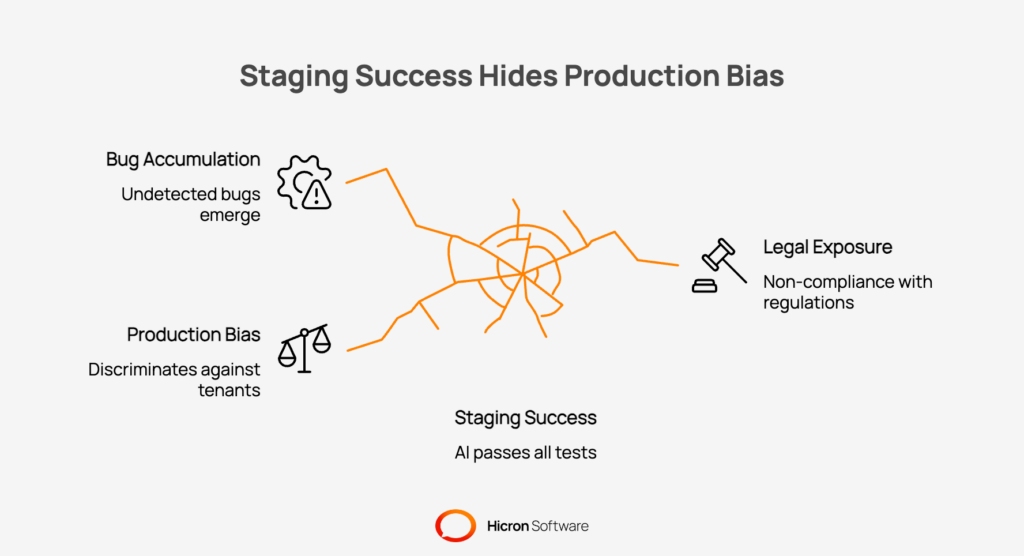
The regulatory stakes reinforce the engineering argument. The EU AI Act, Fair Housing Act obligations in the US, and Proptech Australia’s December 2025 AI Governance Guidelines all treat post-deployment monitoring and intervention capability as compliance requirements. A platform that cannot demonstrate continuous bias detection and documented remediation cannot demonstrate compliance. In an era of high-risk AI classification for automated valuation systems, that gap is a legal exposure.
Red teaming in the PropTech AI context means systematic adversarial testing against AI systems. It simulates real-world attacks, bias exploitation, and failure modes. This is not a one-time security audit conducted before launch. It is a continuous pipeline stage triggered on every meaningful code change.
PropTech AI requires red teaming outside standard software security testing. The failure modes of real estate tech AI systems differ from code vulnerabilities. Discriminatory valuations, biased tenant matching, and hallucinated property recommendations all need scenario design specific to the domain. An SQL injection attack has a defined exploit pattern. A demographic valuation bias emerges from feature engineering decisions and training data composition. That interaction requires adversarial scenarios designed for the domain to surface correctly.
The principle that drives modern PropTech CI/CD red teaming is shift-left. Embedding adversarial testing at the commit, pull request, and pre-deploy stages rather than conducting periodic manual audits. Catching bias drift and security vulnerabilities before they reach production tenant and agent interfaces is categorically cheaper (in remediation cost, regulatory exposure, and reputational damage) than discovering them in production. The three pipeline stages operate as follows:
The tool selection decision in PropTech AI red teaming is primarily a question of pipeline stage fit. No single tool covers the full CI/CD surface effectively. The right architecture combines tools chosen for where their strengths generate the most leverage.
|
Tool |
Core Capability |
PropTech CI/CD Fit |
Pipeline Stage |
|
Promptfoo |
Domain-specific plugins incl. realestate:valuation-bias |
Native PropTech scenario library |
PR and pre-deploy |
|
PyRIT |
Prompt injection and adversarial input generation |
Fast commit-stage scans |
Commit |
|
Garak |
Privacy leakage and model safety probing |
MLS feed and tenant data exposure testing |
PR stage |
|
F5 AI Red Team |
Continuous AI assurance, CI/CD plugin integration |
Enterprise PropTech pipeline gates |
Pre-deploy and scheduled |
|
Checkmarx |
LLM security testing with AppSec integration |
Existing DevSecOps pipeline integration |
PR and pre-deploy |
The Promptfoo recommendation for PropTech platforms is strong. Its realestate valuation bias and realestate racial steering plugins provide native scenario coverage for the most legally exposed PropTech AI failure modes. This reduces the custom scenario development burden for engineering teams building a PropTech platform from scratch.
The recommended tool combination uses PyRIT for high-frequency commit stage speed. Promptfoo handles PropTech specific PR stage bias coverage. F5 AI Red Team provides continuous assurance after deployment. Each tool is selected for the pipeline stage where its strengths generate the most leverage.
Bias threshold gating turns the red team pipeline from a reporting mechanism into a deployment control mechanism. Three primary gates define the pass-or-fail criteria for every model release.
GitHub Actions and Jenkins configuration uses matrix test execution across demographic scenario sets. Structured JSON output feeds directly into compliance dashboards. Every CI/CD red team scan report is stored as a versioned artefact. These artefacts feed into Sprinto or Drata evidence collections for EU AI Act documentation. Every pipeline run becomes a compliance audit event.
Failure handling is distinguished by severity level. High severity failures include discrimination risk detection and sovereignty bypass. These trigger immediate human-in-the-loop (HITL) escalation via Slack and Jira. Low severity failures trigger automated remediation workflows without blocking the pipeline. Development velocity is preserved for issues that do not create immediate regulatory exposure.
Automated Valuation Models (AVMs) offer PropTech platforms genuine advantages. Consistency, speed, and scale exceed what manual appraisal can deliver at high volume. Subjectivity in individual appraisals is eliminated. Turnaround times drop from days to seconds. Platforms can serve markets where qualified appraiser capacity is a bottleneck.
The risk that insufficiently governed AVMs can create requires serious attention. Historical real estate market inequities can be systematically amplified. Redlining patterns are encoded in historical comparable sales data. Neighbourhood composition proxies are embedded in feature engineering. Cultural presentation biases in listing descriptions become value signals. The data that trains AVMs is a historical record of a market that discriminated. Without architectural intervention, the model learns that discrimination as a pricing signal.
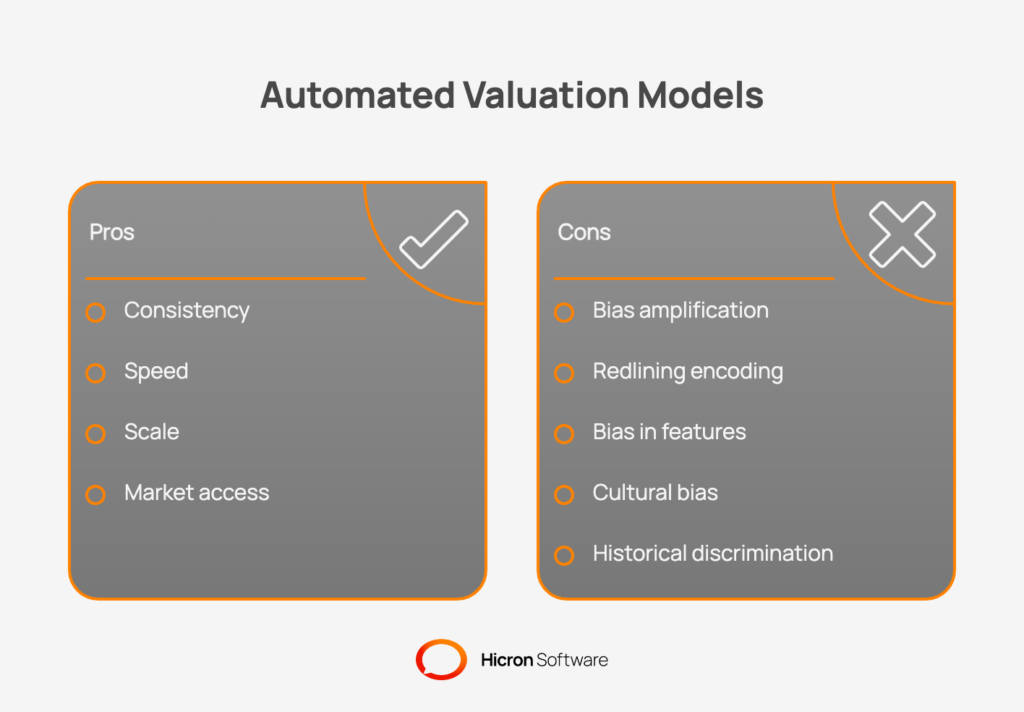
The legal exposure is direct. Fair Housing Act liability applies to discriminatory outputs regardless of intent. EU AI Act high risk classification applies to automated valuation systems in Europe. A PropTech platform whose model produces discriminatory outputs faces regulatory consequences. Intent is not a legal defence when outputs are demonstrably disparate across protected characteristics.
This is an architecture problem rather than a data science problem. Bias in PropTech AVMs can be addressed through
These systems must be designed as first-class architectural components from the outset. They cannot function effectively when added after the fact.
Five primary valuation bias scenarios must be covered in every PropTech platform’s automated test suite:
The Promptfoo realestate valuation bias plugin automates more than 50 scenarios across all five categories. Configurable demographic parameters produce structured severity-scored output. This output integrates directly with CI/CD pipeline gates. PropTech development teams building this capability from scratch will find the plugin far more efficient than writing custom adversarial scenarios from a blank starting point.
The prompt injection attack surface in PropTech AVMs is larger than most engineering teams initially account for. Natural language interfaces that accept property descriptions, agent notes, or comparable narratives create an injection vector. Standard input validation does not address this. Adversarial inputs are not syntactically malformed. They are semantically manipulative.
Adversarial scenarios from real estate tech red teaming practice illustrate the range of attack types. One scenario injects instructions to apply explicit demographic discounts to specific neighbourhood types. Another combines cultural presentation bias with instruction injection targeting religious and ethnic property characteristics. A third attempts temporal data manipulation, directing the model to use historical baseline data that reintroduces redlining era pricing patterns.
The Permit.io interrupt() pattern provides the architectural response. Real-time pause mechanisms intercept inference requests containing adversarial signal patterns before they reach the valuation model. Every intercepted request is audit logged. This creates a record of attempted exploitation that serves both security investigation and regulatory evidence functions simultaneously.
The four primary fairness metrics for PropTech valuation AI are architectural KPIs, not data science curiosities reviewed quarterly. A platform with under 300ms AVM response times and a critical Bias Index is not high performing. It is a regulatory liability with fast UX.
|
Metric |
Definition |
Threshold |
Action on Breach |
|
DVG |
Demographic Valuation Gap: % difference in values for identical properties across demographic profiles |
>10% |
Block deploy; HITL review required |
|
CBR |
Comparable Bias Rate: % of comparables drawn from historically redlined or skewed sources |
>5% |
Automated reweighting; A/B test |
|
Variance Ratio |
Std dev of valuations normalised by objective property characteristics |
>2σ |
HITL review queue routing |
|
ASR |
Attack Success Rate: % of adversarial prompts producing discriminatory or guardrail-bypassing outputs |
>2% |
Rollback to shadow model; guardrail update |
These four metrics combine into a composite Bias Index. The weighted aggregate uses DVG at 40%, CBR at 30%, and ASR at 30%. The result is a single deployability signal.
The composite index lets engineering, compliance, and business stakeholders discuss model fairness status in a shared language without requiring everyone to understand the individual metric mathematics.
The market differentiation case for structured fairness metrics is underappreciated in PropTech software development discussions. Platforms that present audited Bias Index scores to institutional clients and housing authorities demonstrate a governance capability. Competitors without structured fairness monitoring cannot match this claim. The score functions as a client communication asset as well as a compliance artefact.
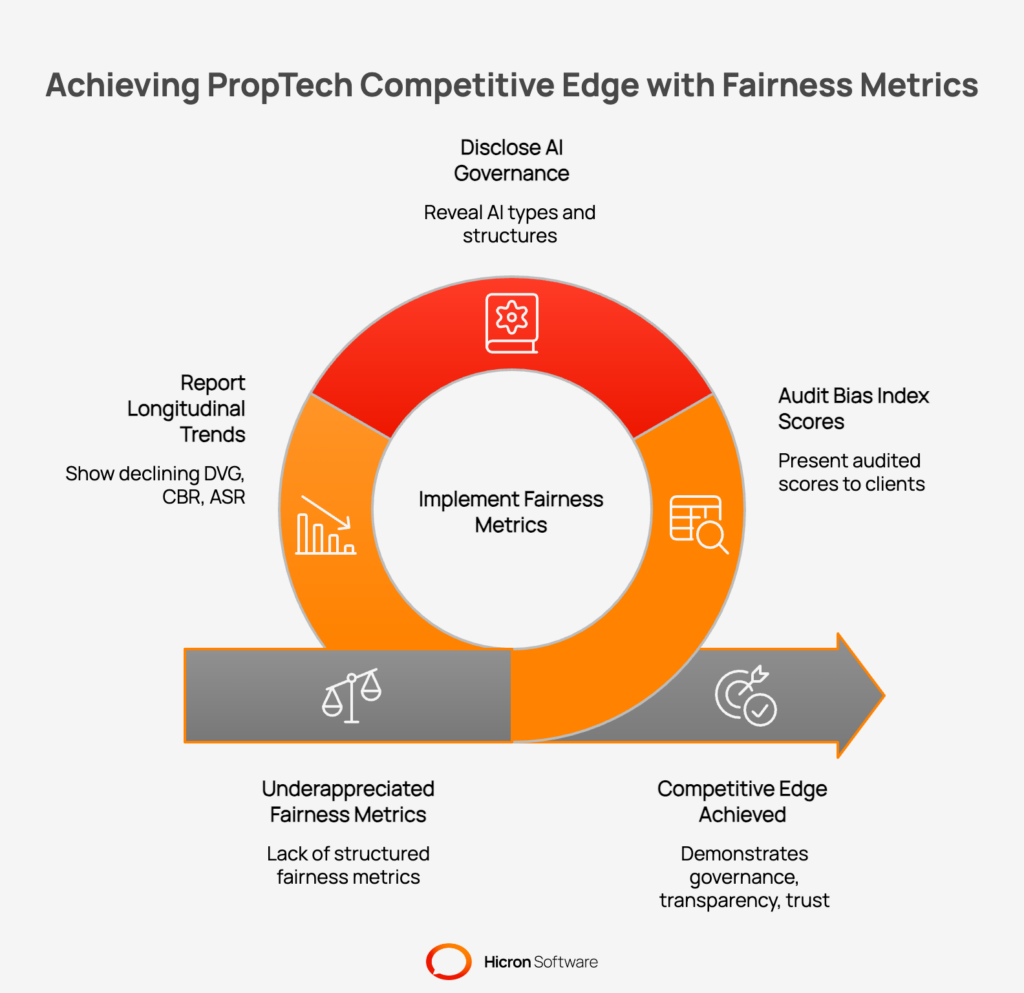
Proptech Australia’s December 2025 AI Governance Guidelines establish the glass box approach as the industry benchmark. Platforms must disclose AI types, governance structures, and risk mitigation measures. Bias Index reporting satisfies this transparency requirement through automated output. A platform with Bias Index reporting embedded from inception does not need to reverse engineer transparency documentation when regulators ask for it.
The longitudinal fairness trend compounds this advantage. Declining DVG, falling CBR, and reducing ASR each quarter demonstrate active and measurable improvement. A static point in time compliance document cannot replicate this. The trajectory is a trust signal that regulators, clients, and tenants can evaluate directly.
The bias monitoring dashboard is the operational interface through which the resilience architecture becomes visible and actionable. Four components are required for it to function correctly.
Dashboard alerts for Bias Index exceeding 5% should automatically generate HITL (human-in-the-loop) review tasks. These route to human reviewers via Slack and Jira. This closes the loop between monitoring and intervention. Threshold breaches create structured human accountability rather than just logged notifications that go unread.
|
Tool |
Core Strengths |
PropTech Fit |
Integration Path |
|
Grafana |
Prometheus integration, real-time alerting, CI/CD pipeline metrics |
Enterprise PropTech bias trend monitoring |
Consume Promptfoo report.json via Prometheus push |
|
Streamlit |
Python-native bias visualisation, HolisticAI library integration |
Custom DVG charts, ROC curves for data science teams |
Direct Promptfoo output parsing in Python |
|
Lightdash |
dbt metrics layer, MLS data lineage tracking |
Fairness scores alongside listing data quality metrics |
MLS feed + bias metric joins via dbt models |
|
AWS DevOps |
Native CloudWatch synthetics, hybrid sovereignty monitoring |
Multi-cloud PropTech infrastructure bias monitoring |
SageMaker model monitoring integration |
The recommended PropTech observability architecture uses all three primary tools for different audiences. Grafana serves as the primary real-time operations dashboard for engineering and compliance teams. Streamlit handles data science team bias analysis and model evaluation. Lightdash supports product and business stakeholder fairness reporting alongside MLS data lineage.
The Grafana alert configuration that matters most in practice: bias_index above 5 triggers Slack notification to ML engineering; bias_index above 15 triggers PagerDuty incident and automatic feature quarantine.
The governance visibility argument extends to client-facing interfaces. PropTech development companies that expose bias metrics in client reporting demonstrate AI accountability at a level that differentiates them in institutional and regulated market segments. The dashboard is not only an operations tool. It is a trust instrument with a commercial application.
Proptech Australia’s transparency benchmark applied to observability requires disclosure of AI types, deployment locations, and risk mitigation measures as the minimum client communication standard. A bias dashboard with exported quarterly reports satisfies this requirement through automated output. The evidence becomes a continuous operational byproduct rather than a separately managed documentation exercise.
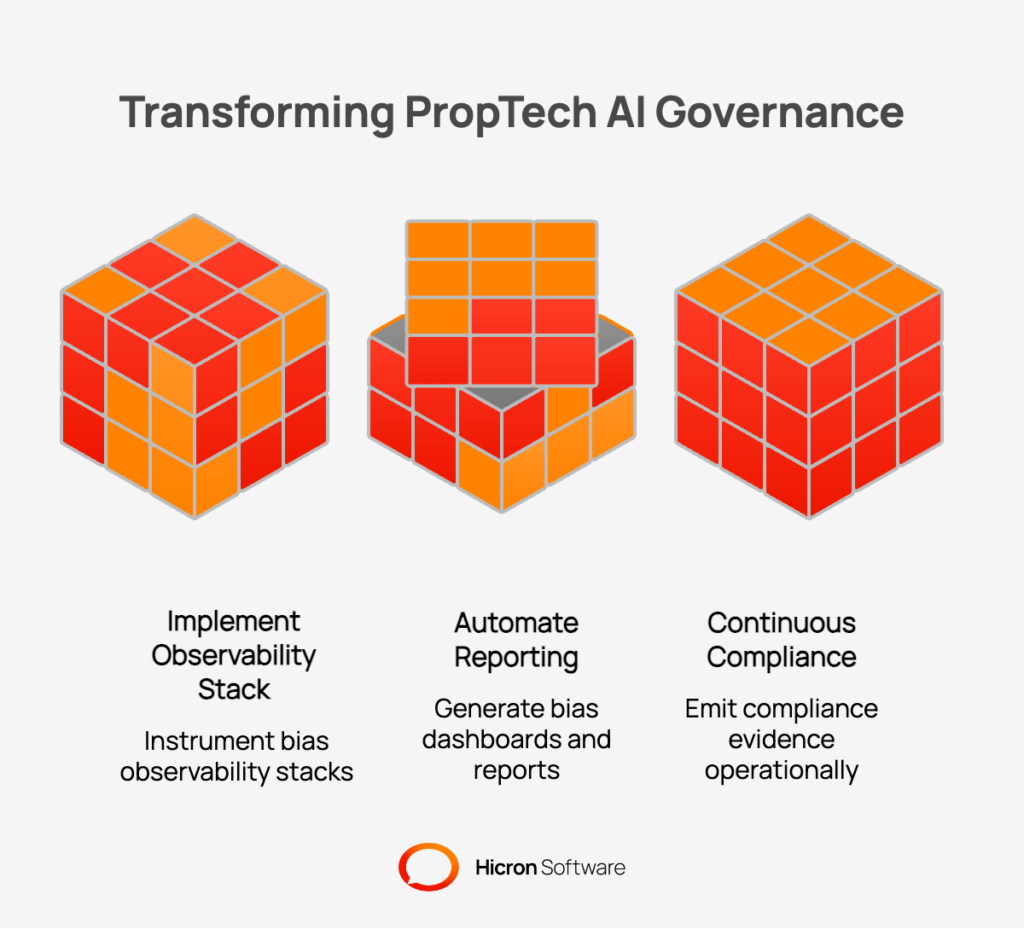
PropTech platforms with fully instrumented bias observability stacks reduce EU AI Act conformity assessment preparation to a report export. The evidence has been continuously captured, versioned, and stored throughout the model lifecycle. Compliance is not assembled at audit time. It is emitted continuously throughout the operational period.
Self-healing in the PropTech AI context means automated remediation pipelines that detect bias metric threshold breaches. They apply calibrated responses without requiring human intervention for every incident. Responses include reweighting training data, swapping comparable selection logic, deploying guardrail updates, or rolling back to shadow models.
The operational case for self-healing is not primarily about engineering efficiency. A platform processing thousands of daily AVM requests cannot rely on manual bias remediation at scale. The volume of potential drift events exceeds human review capacity during high transaction periods. Autonomous first response remediation is architecturally necessary.
The governance constraint on self-healing is equally important. Autonomy has limits defined by consequence severity. The four-tier response model defines where those limits sit.
|
Severity |
Trigger Metric |
Autonomous Action |
Human Role |
|
Minor |
DVG 5–8% |
Auto-reweight underrepresented neighbourhood training samples; A/B test on next 1,000 valuations |
Notified; no action required |
|
Moderate |
CBR 5–10% |
Deploy randomised comparable pool selection; fine-tune with synthetic balanced data |
Reviews A/B test results before full rollout |
|
High |
ASR >2% |
Rollback to last validated shadow model; inject updated guardrail prompts |
Authorises rollback and reviews guardrail changes |
|
Critical |
Bias Index >15% |
Quarantine feature; suspend live PropTech traffic for affected use case |
Full review required before any reactivation |
The self-healing pipeline architecture operates across four interconnected layers:
The learning loop is what separates a self-healing system from a self-responding one. The learning loop distinguishes a self-healing system from a self-responding one. Promptfoo rescans within 24 hours after remediation to confirm fix efficacy. Results feed back into meta models that improve future remediation action selection. The system becomes more precise with each incident cycle. The frequency and severity of bias drift events progressively reduce over time.
Canary deploy integration ensures that remediated models deploy to 5% of PropTech traffic before full rollout. Automated rollback activates if bias metrics deteriorate during the canary window. Every self-healing action is versioned in Git and stored in the SIEM. This covers detection events, remediation decisions, execution logs, and human authorisation records. The audit trail supports EU AI Act transparency documentation and Proptech Australia governance disclosure requirements.
A PropTech platform with self-healing AI bias remediation is more operationally resilient than its competitors. The same pipeline that catches demographic valuation drift also catches model degradation from MLS feed poisoning. Market condition shifts and adversarial exploitation are detected through the same infrastructure. Addressing one failure mode strengthens defence against all others.
Self-healing remediation pipelines must operate asynchronously from the primary inference path. Autonomous bias correction cannot add latency to tenant-facing AVM responses. The architecture that achieves this uses asynchronous detection, serverless execution, and canary rollout. Performance characteristics are preserved while fairness characteristics are continuously protected.
The business case quantifies directly:
The investment in self-healing architecture is a liability offset. Its return compounds as the platform scales.
The following checklist consolidates the architecture decisions covered in this article. Each item represents a capability that distinguishes a production grade PropTech AI platform from one that is operationally exposed.
This checklist represents the final layer of the PropTech architecture stack. It is the immune system that protects the intelligence built in the AI architecture layer. It operates on the infrastructure designed for compliance and performance and serves the platform at scale.
The most sophisticated PropTech platforms are not defined by the AI models they deploy. They are defined by the systems they have built to keep those models honest.
Red teaming, bias detection, and self-healing remediation are not the glamorous parts of PropTech software development. They are the parts that determine whether a platform earns and keeps the trust of the tenants, agents, and institutions that depend on it. Building them is the final architectural responsibility. Unlike the features that impress in demos, this responsibility cannot be faked.
No staging environment, no model card documentation substitutes for the operational evidence of a platform that has been continuously tested. The platform monitors its own fairness metrics in real time. It demonstrates to regulators, clients, and itself that its AI systems are improving in trustworthiness over time rather than degrading silently.
That is what the shift from deployment as an endpoint to deployment as a beginning looks like in practice. Not a handoff to operations. A continuous engineering commitment that the architecture makes sustainable across the full operational lifecycle.
This concludes the Architecting PropTech at Scale series. Explore the full series index for the specific architecture layer your platform needs next.
Hicron Software proved to be a trusted partner with unmatched technical expertise, delivering a scalable and user-friendly web application that was pivotal to our successful U.S. market expansion.

Hicron’s contributions have been vital in making our product ready for commercialization. Their commitment to excellence, innovative solutions, and flexible approach were key factors in our successful collaboration.
I wholeheartedly recommend Hicron to any organization seeking a strategic long-term partnership, reliable and skilled partner for their technological needs.

After carefully evaluating suppliers, we decided to try a new approach and start working with a near-shore software house. Cooperation with Hicron Software House was something different, and it turned out to be a great success that brought added value to our company.
With HICRON’s creative ideas and fresh perspective, we reached a new level of our core platform and achieved our business goals.
Many thanks for what you did so far; we are looking forward to more in future!

Hicron is a partner who has provided excellent software development services. Their talented software engineers have a strong focus on collaboration and quality. They have helped us in achieving our goals across our cloud platforms at a good pace, without compromising on the quality of our services. Our partnership is professional and solution-focused!

The IT system supporting the work of retail outlets is the foundation of our business. The ability to optimize and adapt it to the needs of all entities in the PSA Group is of strategic importance and we consider it a step into the future. This project is a huge challenge: not only for us in terms of organization, but also for our partners – including Hicron – in terms of adapting the system to the needs and business models of PSA. Cooperation with Hicron consultants, taking into account their competences in the field of programming and processes specific to the automotive sector, gave us many reasons to be satisfied.