Blog

AI-enhanced OCR for Property Management

Monika Stando
Monika Stando
Marketing Campaigns Team Leader
Table of Contents

AI-enhanced Optical Character Recognition (OCR) is a technology that uses artificial intelligence to automatically extract text and data from documents like invoices, receipts, and leases. For property management, this tool converts unstructured information from paper or digital files into organized, usable data within your software systems. It reduces the need for manual data entry and improves operational efficiency.

This article explains how AI-backed OCR works and why it is becoming essential for modern property management. We will cover its core functions, from data extraction to automated processing, and its practical benefits for handling documents like invoices. You will learn how this technology saves time, reduces errors, and helps your team focus on more valuable work.

Key Takeaways:

  • AI-backed OCR automatically reads and extracts key information from documents, removing the need for manual data entry.
  • By using artificial intelligence to understand document context, the technology reduces human errors common in manual data input and provides the foundation for automated variance notes.
  • It accelerates document-heavy processes like invoice approval and record-keeping by automating data entry and categorization.
  • The technology converts paper and PDF documents into searchable, digital formats, making information easier to find and use.

What is AI-enhanced OCR?

Optical Character Recognition, or OCR, is a technology that converts different types of documents, such as scanned paper files or PDFs, into editable and searchable data. Traditional OCR could identify letters and words but often struggled with complex layouts or handwritten notes. AI-backed OCR is a more advanced version of this technology. It uses artificial intelligence and machine learning to read the text and to understand its context.

For property managers, this means the system can identify

  • what an invoice is,
  • who the vendor is,
  • the total amount due, and
  • the invoice date

without being manually told where to look. The AI models are trained on thousands of document examples, allowing them to recognize patterns and layouts with high precision. This intelligent data extraction capability is what makes AI-backed OCR a powerful tool for automating administrative tasks.
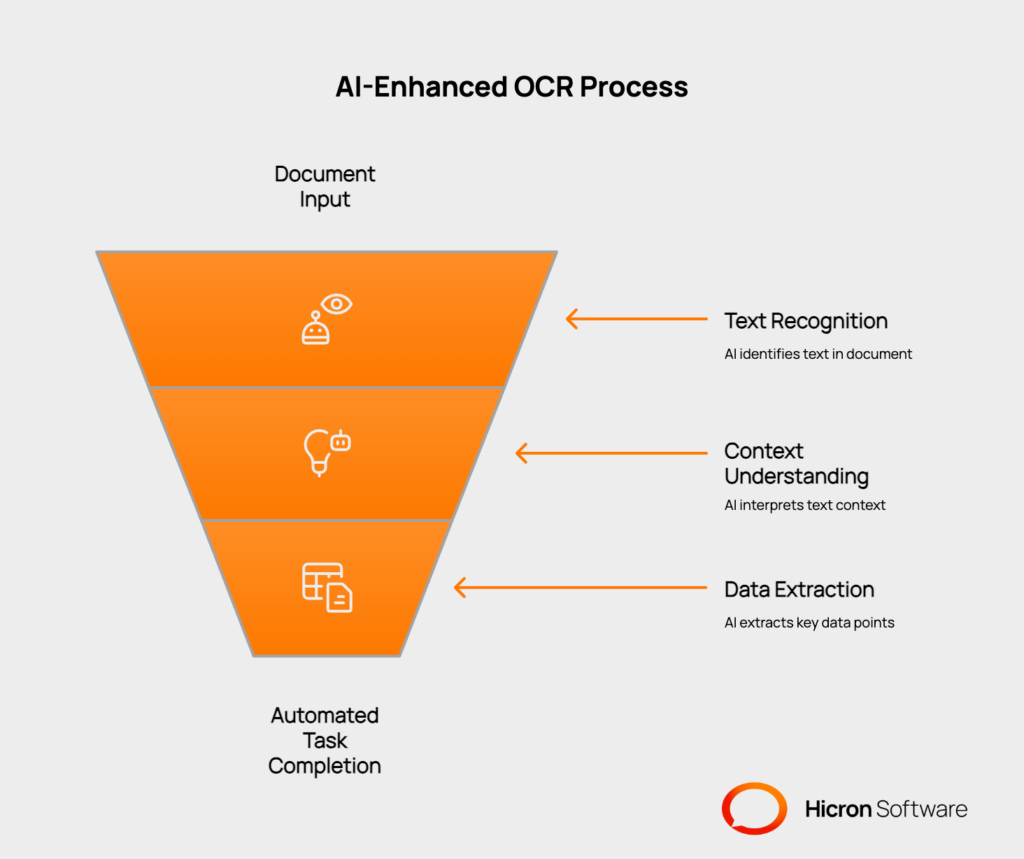
An infographic titled "What is AI-enhanced OCR?" explaining how AI-powered Optical Character Recognition improves upon traditional OCR. The visual highlights its ability to convert scanned documents and PDFs into editable, searchable data while understanding context. It showcases examples like identifying invoices, vendors, amounts due, and dates automatically. The infographic emphasizes how AI models, trained on thousands of documents, enable precise pattern recognition and intelligent data extraction, making it a valuable tool for automating administrative tasks in property management.

The Role of OCR in Automating Document Processing

In property management, teams handle a high volume of documents every day. These include

  • vendor invoices,
  • utility bills,
  • resident applications, and
  • lease agreements.

Manually entering information from these documents into property management software is a slow and repetitive process that is also susceptible to human error. A misplaced decimal or an incorrect vendor name can cause payment delays and accounting problems.

AI-backed OCR automates this entire workflow. When a document is received, it is scanned and processed by the OCR system. The technology identifies the document type and extracts the relevant data points. This extracted information can then be automatically entered into the correct fields in your accounting or property management software. The process is not only faster but also more accurate, freeing up your team to concentrate on tasks that require human judgment, such as vendor negotiations or resident relations.

Key Features of AI-enhanced OCR for Property Management

Modern OCR solutions offer several features designed to address the specific challenges of property management document workflows.
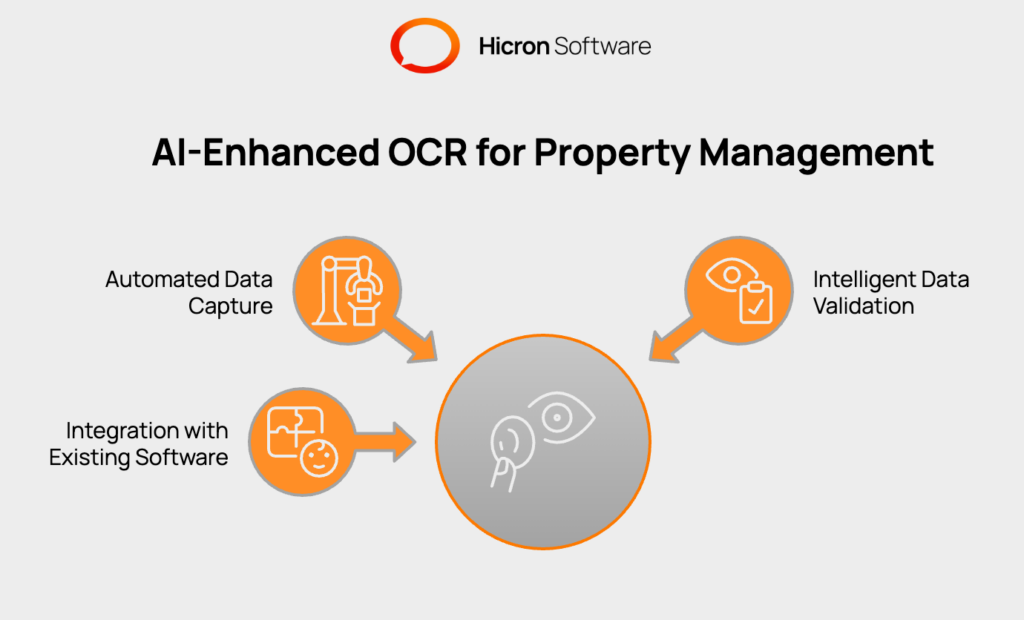
  • Automated Data Capture: The core function of AI-backed OCR is its ability to automatically capture information. It can read line items from an invoice, identify the name and address on a lease application, and extract due dates from utility bills. This feature works with both structured and unstructured documents, adapting to various layouts.
  • Intelligent Data Validation: AI systems can validate data. For instance, the system can cross-reference an invoice with an existing purchase order to check for inconsistencies. It can also flag duplicate invoices, preventing accidental double payments. This validation step adds another layer of control to financial operations.
  • Integration with Existing Software: To be truly effective, AI-backed OCR platforms must connect with the software you already use. These tools are built to integrate with popular property management and accounting systems like Yardi, AppFolio, and QuickBooks. This allows for the smooth flow of information from the document to your central database without manual intervention.
An infographic titled "Key Features of AI-enhanced OCR for Property Management" highlighting three main capabilities: Automated Data Capture: Demonstrates how AI-backed OCR extracts information like line items from invoices, names and addresses from lease applications, and due dates from utility bills, handling both structured and unstructured documents. Intelligent Data Validation: Showcases the system's ability to cross-reference invoices with purchase orders, flag duplicates, and ensure data accuracy, adding control to financial workflows. Integration with Existing Software: Emphasizes seamless integration with property management and accounting tools like Yardi, AppFolio, and QuickBooks, enabling automated data flow into central databases without manual effort. The focus is on streamlining document workflows and improving efficiency.

The Technology Behind AI-backed OCR

AI-backed OCR combines several advanced technologies to deliver accurate and reliable results. These components work together to read, understand, and process information from various document types.

  • Machine Learning Algorithms: At its core, AI-backed OCR uses advanced algorithms to recognize patterns in document layouts. These systems are trained on vast datasets of documents, which allows them to learn how to identify specific information regardless of the format. They adapt to different invoice templates or lease structures and improve their accuracy over time as they are exposed to new data.
  • Natural Language Processing (NLP): NLP enables these systems to interpret human language. This technology helps the OCR software understand the meaning behind the words it reads. For property management, this means it can identify specific clauses in a lease agreement or pull out line-item details from a complex vendor invoice, extracting critical information with greater precision.
  • Integration with Existing Systems: Modern AI OCR platforms are designed to connect directly with other business software. They can link with property management systems, accounting solutions, and cloud storage platforms. This ensures a smooth flow of structured data across the organization, from document capture to final record-keeping, without manual effort.

How AI OCR Works for Leases and Invoices

Invoice processing is one of the most time-consuming administrative tasks in property management. The typical workflow involves receiving an invoice, manually entering its details for approval, coding it to the correct general ledger account, and finally processing the payment.

The process of converting a paper document into structured data involves several automated steps. This workflow is designed to be fast and accurate, turning manual tasks into an efficient, hands-off operation.
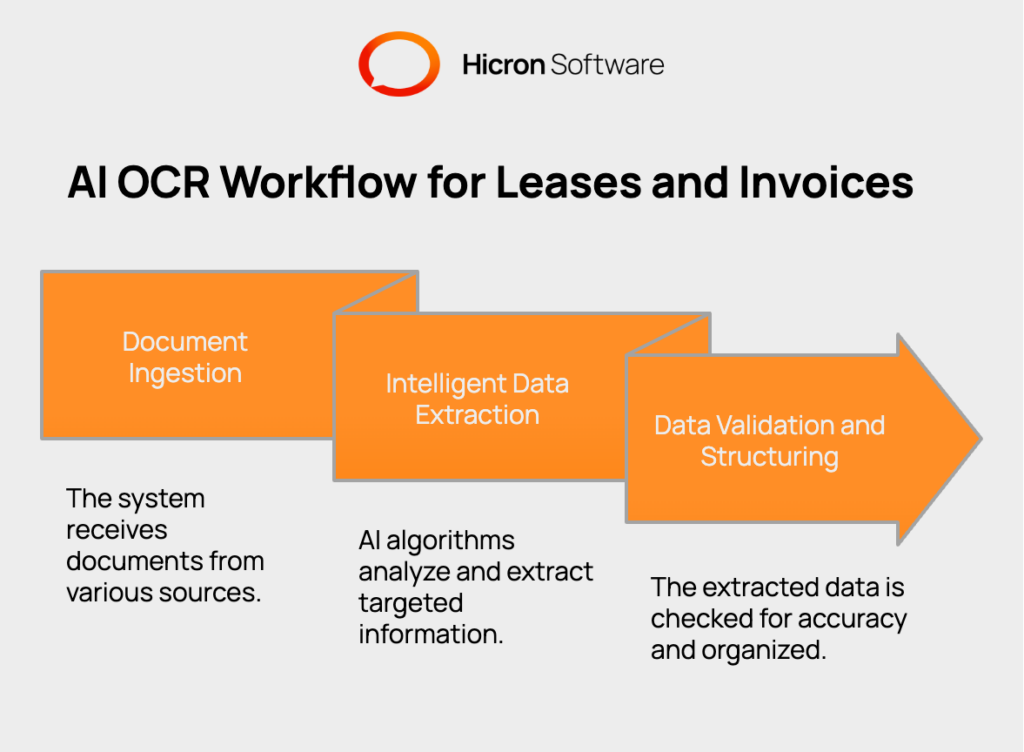
  • Step 1: Document Ingestion: The process begins when the system receives a document. This could be a PDF of an invoice attached to an email or a scanned image of a signed lease. The platform accepts documents from various sources to fit into existing workflows.
  • Step 2: Intelligent Data Extraction: Once ingested, AI algorithms analyze the document. They identify and pull out targeted information based on what the system has learned. This includes vendor details, invoice numbers, rent amounts, important dates, and specific lease clauses.
  • Step 3: Data Validation and Structuring: The extracted data is automatically checked for accuracy. For instance, the system might confirm that the total amount on an invoice matches the sum of its line items. The validated data is then formatted and organized for clean integration with accounting or property management platforms.
An infographic titled "How AI OCR Works for Leases and Invoices" explaining the automated workflow for processing documents in property management. It highlights three key steps: Document Ingestion: The system accepts documents like PDF invoices or scanned leases from various sources, integrating seamlessly into existing workflows. Intelligent Data Extraction: AI algorithms analyze the document to extract key details such as vendor information, invoice numbers, rent amounts, dates, and lease clauses. Data Validation and Structuring: Extracted data is checked for accuracy (e.g., ensuring invoice totals match line items) and formatted for smooth integration with accounting or property management systems. The focus is on transforming manual tasks into efficient, automated processes.

OCR Invoice Processing for Property Managers

Invoice processing is a core function in property management. It is often manual and time-consuming, requiring teams to spend hours on data entry, invoice coding, and approvals. These steps can lead to payment delays and mistakes. AI-backed Optical Character Recognition (OCR) technology is transforming invoice processing area by automating accounts payable processes.

Section

Key Points

Benefits

Automating Accounts Payable Workflows

AI OCR eliminates manual data entry from invoices and automates the coding and routing of invoices for approval.

Increases speed and precision in handling high volumes of invoices, reducing the administrative burden on AP teams.

Reducing Errors and Ensuring Compliance

Automated data extraction minimizes costly mistakes like incorrect entries and duplicate payments. It also creates a clear, searchable digital audit trail.

Improves accuracy of financial data, prevents accidental double payments, and enhances transparency and accountability for audits.

Accelerating Vendor Payments and Improving Relationships

Faster invoice processing leads to consistent, on-time payments to vendors and contractors.

Builds trust and reliability with vendors, which can result in better service, priority scheduling, and more favorable terms.

Automating Accounts Payable Workflows

AI-backed OCR removes manual steps and speeds up invoice processing. Key improvements include:

  • Automatic Data Entry: The system reads invoices (paper or digital), extracts vendor names, dates, due dates, and total amounts, and enters the data in the accounting system with no manual typing.
  • Invoice Coding and Routing for Approval: It identifies invoice types, assigns them to general ledger accounts, and routes them to the right manager or department head for approval. This setup ensures an efficient workflow from receipt to approval.

Reducing Errors and Ensuring Compliance

Automation limits the risk of mistakes and strengthens financial controls:

  • Minimized Manual Errors: Direct extraction from source documents reduces incorrect amount entries.
  • Duplicate Payment Prevention: The system checks invoice numbers and vendor details against records, which helps flag duplicates before payments are made.
  • Searchable Audit Trail:
    • Every step, from capture to approval, is logged in the system.
    • Managers can easily track invoice status and access a full history for audits or compliance checks.
    • Centralized records improve transparency and accountability.

Accelerating Vendor Payments and Improving Relationships

Timely payments matter for vendor satisfaction and business reputation. Automation helps ensure prompt payments through:

  • Faster Processing: Automated entry and routing cut processing time, which reduces late fees and can give access to early payment discounts.
  • Stronger Vendor Relationships:
    • Paying on time builds trust and reliability.
    • Reliable payments may result in better service, priority scheduling, and competitive pricing for property managers.

Enhancing Lease Management Automation with OCR

Managing lease agreements is a detailed process for any property management company. Each document is filled with critical dates, clauses, and tenant information that must be tracked accurately. Manually abstracting this information is slow and can lead to errors, while finding specific details later often requires searching through dense paper files.
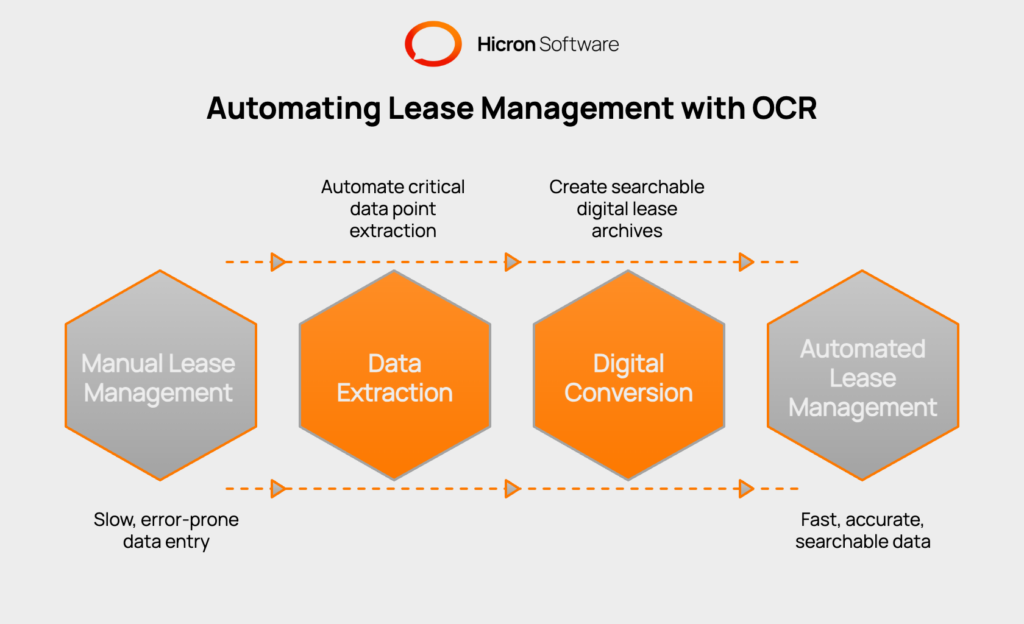
An infographic titled "Enhancing Lease Management Automation with OCR" highlighting two key benefits: Streamlining Lease Abstraction and Onboarding: Showcases how AI-backed OCR automates the extraction of critical lease details like start/end dates, renewal options, rent amounts, and tenant names. It emphasizes faster tenant onboarding by automatically populating property management systems with accurate data, regardless of lease format. Creating Searchable, Digital Lease Archives: Illustrates how OCR converts static lease documents into searchable digital files, enabling quick access to specific clauses or details. For example, managers can instantly locate pet policy clauses across leases, improving compliance, tenant support, and operational efficiency. The focus is on reducing manual effort and enhancing document accessibility.

Streamlining Lease Abstraction and Onboarding

AI-backed OCR automates lease abstraction task, turning a lengthy manual process into a fast, digital workflow that accelerates tenant onboarding.

This technology can quickly extract critical data points from complex lease agreements. When a new lease is signed, the AI OCR system scans the document and identifies important information such as

  • start and end dates,
  • renewal options,
  • rent amounts,
  • security deposit details, and
  • tenant names.

The system is trained to recognize these fields regardless of the lease format, ensuring all necessary data is captured consistently.

This automated extraction speeds up the process of setting up new tenants in a property management system. Instead of someone manually typing information from the lease into the software, the AI OCR tool populates the required fields automatically.

Creating Searchable, Digital Lease Archives

Over time, larger collection of lease documents files can become difficult to manage, especially when you need to find specific information quickly. AI-backed OCR helps solve this challenge by converting entire lease portfolios into fully searchable digital files.

OCR transforms static documents into a dynamic, accessible database of lease information. Property managers no longer need to manually sift through paper files or non-searchable PDFs. Instead, they can use a simple search function to locate documents or specific details within them instantly.

This capability allows teams to quickly find specific clauses or information without reading through entire documents.

For example, if a manager needs to review the pet policy clause across all leases for a particular building, they can perform a quick search and get the results in seconds. This level of accessibility makes it easier to manage compliance, answer tenant questions, and make informed operational decisions.

Implementation Process: Bringing AI OCR Into Property Management

Adopting an AI-backed OCR solution involves a structured approach to ensure it meets the specific needs of a property management business. A thoughtful implementation helps the system deliver value from the start.
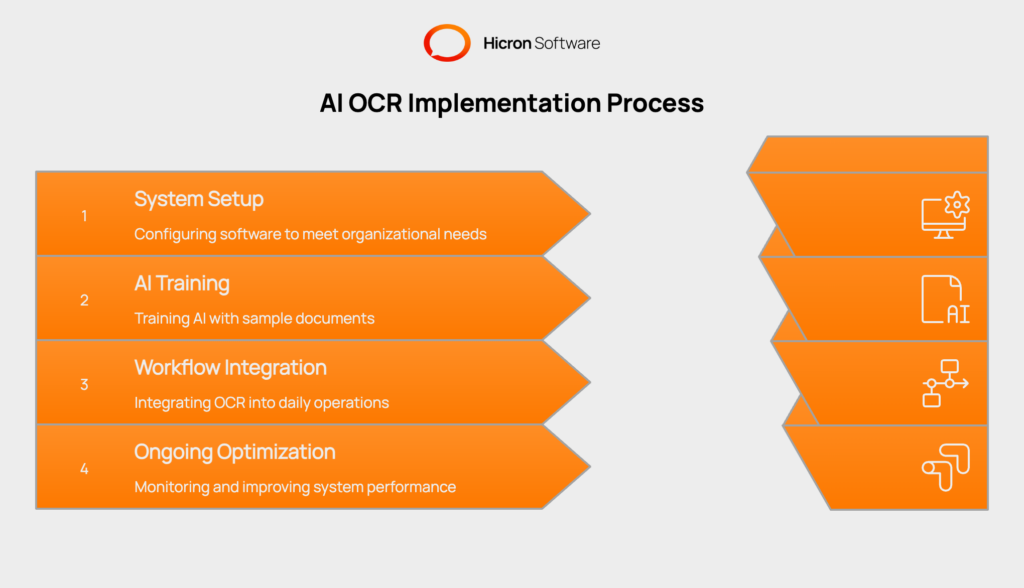
  • System Setup: The initial step is deploying the AI-backed OCR system. This begins with selecting a suitable vendor and configuring the software to align with organizational requirements. Key settings may include defining user permissions and establishing connections to other software.
  • Training the AI: The technology is then trained using sample documents from the business. By processing your typical invoices, leases, and other forms, the AI learns industry-specific terminology and formats. This training phase is critical for achieving high accuracy.
  • Integration with Workflows: Next, the OCR solution is integrated into existing workflows. This ensures that incoming leases and invoices are automatically captured and processed by the system. The goal is to make the technology a natural part of daily operations.
  • Ongoing Optimization: After deployment, the system’s performance is monitored. Routine updates, regular performance checks, and reviewing user feedback help maintain optimal accuracy and efficiency. As the system continues to learn from new documents, it becomes even more effective over time.
An infographic titled "Implementation Process: Bringing AI OCR Into Property Management" outlining the four key steps for successful adoption: System Setup: Highlights selecting a vendor, configuring the software, defining user permissions, and connecting the OCR system to existing tools. Training the AI: Explains how the system is trained using sample documents like invoices and leases to learn industry-specific terminology and formats, ensuring high accuracy. Integration with Workflows: Showcases how the OCR solution is embedded into daily operations, automating the capture and processing of leases and invoices. Ongoing Optimization: Emphasizes monitoring performance, applying updates, and using feedback to improve accuracy and efficiency as the system learns from new documents. The focus is on creating a seamless, evolving solution for property management tasks.

Conclusion: The Future of Document Management is Automated

AI-backed OCR is changing how property management companies handle their document-heavy workflows. By automating data extraction and processing, this technology offers a direct path to greater efficiency, improved accuracy, and better data management. It allows teams to move away from tedious manual entry and focus on strategic activities that add more value to the business. Adopting AI-backed OCR is a practical step toward creating more streamlined and scalable property management operations. Contact us to discuss your needs.

Monika Stando
Monika Stando
Marketing Campaigns Team Leader
  • follow the expert:

FAQ

What is the difference between traditional OCR and AI-backed OCR?

Traditional OCR recognizes characters and words but often struggles with different document layouts. AI-backed OCR uses machine learning to understand the context of a document, allowing it to accurately identify and extract specific data points like invoice numbers and due dates, regardless of their location on the page.

What types of documents can AI-backed OCR process?

AI-backed OCR can process a wide variety of documents relevant to property management, including vendor invoices, utility bills, bank statements, purchase orders, and lease agreements. It works with both digital files like PDFs and scanned paper documents.

How accurate is AI-backed OCR?

With the help of artificial intelligence, modern OCR systems achieve very high accuracy rates. The technology continuously learns from new documents, improving its ability to correctly read and interpret information over time and minimizing the errors associated with manual data entry.

Yes, leading AI-backed OCR solutions are designed to integrate with major property management and accounting platforms such as Yardi, QuickBooks, AppFolio, and others. This connection allows for the automatic transfer of extracted data into your existing systems.

What are the main benefits of using AI-backed OCR for invoice processing?

The main benefits include a large reduction in manual data entry, faster approval cycles, fewer payment errors, and improved visibility into spending. By automating the process, teams can handle a larger volume of invoices with greater speed and precision.

Testimonials

What our partners say about us

Hicron Software proved to be a trusted partner with unmatched technical expertise, delivering a scalable and user-friendly web application that was pivotal to our successful U.S. market expansion.

Mikko Hyvärinen
Director of Software Portfolio at iLOQ

Hicron’s contributions have been vital in making our product ready for commercialization. Their commitment to excellence, innovative solutions, and flexible approach were key factors in our successful collaboration.
I wholeheartedly recommend Hicron to any organization seeking a strategic long-term partnership, reliable and skilled partner for their technological needs.

tantum sana logo transparent
Günther Kalka
Managing Director, tantum sana GmbH

After carefully evaluating suppliers, we decided to try a new approach and start working with a near-shore software house. Cooperation with Hicron Software House was something different, and it turned out to be a great success that brought added value to our company.

With HICRON’s creative ideas and fresh perspective, we reached a new level of our core platform and achieved our business goals.

Many thanks for what you did so far; we are looking forward to more in future!

hdi logo
Jan-Henrik Schulze
Head of Industrial Lines Development at HDI Group

Hicron is a partner who has provided excellent software development services. Their talented software engineers have a strong focus on collaboration and quality. They have helped us in achieving our goals across our cloud platforms at a good pace, without compromising on the quality of our services. Our partnership is professional and solution-focused!

NBS logo
Phil Scott
Director of Software Delivery at NBS

The IT system supporting the work of retail outlets is the foundation of our business. The ability to optimize and adapt it to the needs of all entities in the PSA Group is of strategic importance and we consider it a step into the future. This project is a huge challenge: not only for us in terms of organization, but also for our partners – including Hicron – in terms of adapting the system to the needs and business models of PSA. Cooperation with Hicron consultants, taking into account their competences in the field of programming and processes specific to the automotive sector, gave us many reasons to be satisfied.
 

PSA Group - Wikipedia
Peter Windhöfel
IT Director At PSA Group Germany

Get in touch

Say Hi!cron

This site uses cookies. By continuing to use this website, you agree to our Privacy Policy.

OK, I agree