10 Real Estate Software Development Companies in 2026
- February 03
- 9 min


Data accuracy in property management refers to the correctness and reliability of information used for operations and reporting. The principle of “Garbage In, Garbage Out” (GIGO) applies directly here. If you feed your systems incorrect or poor-quality information, you will get flawed reports and make poor decisions. This article explains why clean data is foundational to effective property management and how modern PropTech tools can ensure its quality.
Key Takeaways:
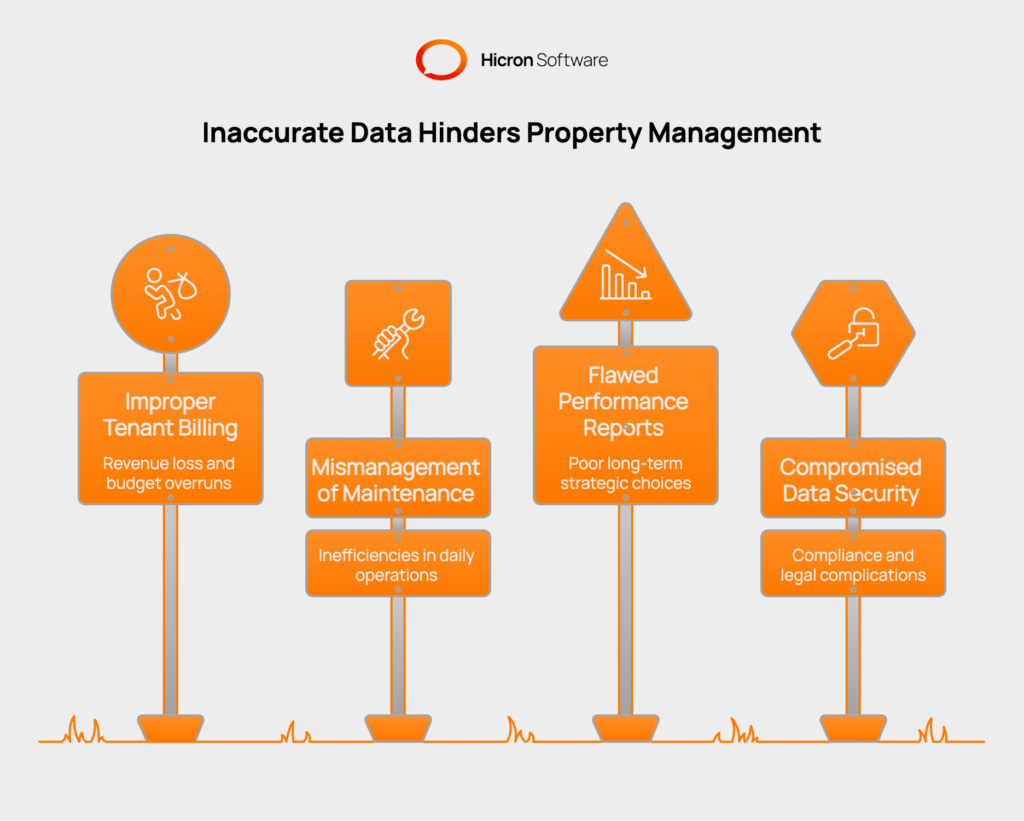
In property management, even small data errors can cause large problems. Flawed information creates financial, operational, and strategic challenges.
Financially, incorrect data can lead to improper tenant billing and revenue loss. It can also cause budget overruns due to poor expense tracking. These mistakes hurt your bottom line and make financial planning difficult.
Operationally, bad data causes daily inefficiencies. It can lead to the mismanagement of maintenance schedules and work orders. Poor data affects tenant communication, resulting in lower satisfaction. It also makes it hard to track vendor performance, leading to accountability issues. These problems create more work for your team and damage your reputation.
Strategically, unreliable information leads to poor long term choices. Flawed performance reports can point your business in the wrong direction. You might miss growth opportunities or fail to see developing risks. Compromised data can also create compliance and legal issues. Ultimately, inaccurate data prevents you from making informed decisions to grow your portfolio.
Data validation tools are essential for maintaining data accuracy. They act as an automated checkpoint for information entering your systems. These tools use a set of rules to ensure all data is complete, correct, and in a standard format. For example, they can check that a phone number has the right number of digits or that a lease date is formatted properly. This simple step prevents many common errors from the start.
In property management, these tools have key functions. They can verify new tenant information and confirm lease details are entered correctly. They also validate vendor invoices and payment data to prevent billing mistakes. By enforcing consistency in maintenance logs and expense categorization, they create uniformity across your records. This standardization is crucial for reliable reporting.
Implementing data validation offers clear benefits. It drastically reduces the manual errors that happen during data entry. It also creates consistency across your entire property portfolio, making comparisons and analysis easier. Most importantly, it builds a foundation of trustworthy information. With clean data from the start, you can depend on your reports and analytics.
|
Tool Type |
Functionality |
How it Supports Validation |
|
These platforms (e.g., Yardi, AppFolio) have built-in data validation, using predefined rules and required fields for entering tenant, lease, and financial data. |
Enforces standardized formats for dates, currency, and contact details at the point of entry, preventing common human errors before data is saved. |
|
|
AI-Powered Data Entry & Extraction Tools |
These tools use AI and optical character recognition (OCR) to scan documents like invoices and leases, automatically extracting and populating data into your system. |
Cross-references extracted data against existing records to flag discrepancies, such as duplicate invoice numbers or mismatched vendor names, reducing errors and potential fraud. |
|
Custom API and System Integrators |
Middleware platforms (e.g., Zapier) or custom APIs connect different software systems and automate workflows that include validation steps. |
Checks data as it moves between systems. For example, an API can verify a tenant’s lease is active in the PMS before adding them to a communications app. |
|
Standalone Data Cleansing & Auditing Software |
Specialized tools designed to analyze existing databases to find and correct errors, identify duplicate records, fix formatting issues, and flag incomplete information. |
Performs ongoing data hygiene by auditing the entire portfolio database. This ensures that tenant, property, and financial data remains accurate over time, rather than just at entry. |
|
Business Intelligence (BI) & Reporting Platforms |
Tools like Tableau or Power BI connect to databases to create data visualizations and run analytics, which helps in spotting anomalies and outliers. |
Visualizes data to make outliers obvious. A graph might show one unit with unusually high costs, prompting a review of the underlying data for a typo or error. |
While data validation provides a strong foundation, AI-driven quality control takes accuracy to the next level. Artificial intelligence moves beyond the simple, rule-based checks of traditional tools. It uses machine learning to analyze your data, identify complex patterns, and spot anomalies that rule-based systems might miss. This technology helps find and fix deeper data quality issues.
AI-driven quality control works in several ways. It can intelligently analyze unstructured information, such as text from emails or details from photos. For instance, it might review a maintenance request email to pull out key details and check them for consistency. AI can also predictively flag potential errors before they affect your reports, allowing you to be proactive. It learns over time, continuously improving its ability to spot and even correct data inconsistencies automatically.
The advantage of using AI provides proactive error detection, stopping problems before they start. It can also enrich your data by adding context or filling in missing pieces, which leads to deeper insights. Over time, AI-driven quality control helps you build a system of data management that constantly improves, ensuring your information becomes more reliable.
Here are the key technologies and methods that enhance data quality control, providing deeper and more proactive accuracy for property management.
|
Technology/Method |
How it Works |
Role in Quality Control |
|
Machine Learning (ML) for Anomaly Detection |
Algorithms are trained on historical data to learn normal operational patterns for things like utility costs, maintenance expenses, and vacancy periods. |
Automatically flags new data that deviates from established patterns, allowing managers to instantly spot potential data entry errors or real-world issues. |
|
Natural Language Processing (NLP) |
This AI interprets and extracts information from human language in sources like emails, technician notes, or online reviews. |
Converts unstructured text from informal communications into structured, usable data, reducing manual entry and ensuring key details are captured accurately. |
|
Predictive Analytics |
Uses statistical algorithms and ML to analyze current and historical data, identify trends, and forecast future outcomes or likely values. |
Flags data entries that are logically inconsistent, such as a move-out date that precedes a lease end date, catching errors that basic validation rules would miss. |
|
Computer Vision |
This technology enables AI to interpret and analyze information from images and documents, often combined with Optical Character Recognition (OCR) to read text. |
Automates and verifies document-based information by scanning invoices or leases, extracting key data, and comparing it against records in the PMS to flag discrepancies. |
|
Data Enrichment Services |
AI-powered services connect to external public and private databases to verify, correct, and append a company’s existing data records. |
Automatically corrects incomplete or misspelled information (e.g., addresses, names) by cross-referencing it with external sources, ensuring data is accurate and complete. |
The ultimate benefit of maintaining high data accuracy is the ability to generate trustworthy reports and make confident decisions. When your data is reliable, your financial statements and occupancy reports reflect the true state of your portfolio. You can track Key Performance Indicators (KPIs) with certainty. This accuracy also allows for transparent communication with stakeholders and investors, building trust and credibility.
Accurate data empowers strategic property management decision-making. You can make informed choices about rent pricing and lease renewals based on real trends. It allows you to optimize budgets and forecast future expenses with greater precision. With a clear view of your portfolio’s performance, you can identify trends that guide growth strategies and operational improvements.
Better data also enhances your relationships with tenants and vendors. Accurate and timely billing reduces tenant disputes and improves satisfaction. Reliable data ensures that vendors are paid promptly and correctly, strengthening those partnerships. Clean data simplifies operations and supports a healthier, more profitable business. Start making better, data-driven decisions. Get in touch!
It means that if you use inaccurate, incomplete, or flawed data (garbage in), your reports, analytics, and resulting business decisions will also be flawed (garbage out).
They use predefined rules to automatically check data at the point of entry. They ensure information is complete, formatted correctly, and meets specific criteria, which prevents common errors.
Data validation checks for basic errors based on set rules. AI-driven quality control uses machine learning to find complex patterns, predict potential errors, and analyze unstructured data that rule-based systems cannot.
Yes. Inaccurate data can lead to incorrect billing, delays in maintenance responses, and poor communication, all of which directly frustrate tenants and harm their experience.
Modern property management software often includes built-in data validation and AI features. Implementing them is becoming easier, especially with cloud-based platforms that integrate with your existing systems.
Hicron Software proved to be a trusted partner with unmatched technical expertise, delivering a scalable and user-friendly web application that was pivotal to our successful U.S. market expansion.

Hicron’s contributions have been vital in making our product ready for commercialization. Their commitment to excellence, innovative solutions, and flexible approach were key factors in our successful collaboration.
I wholeheartedly recommend Hicron to any organization seeking a strategic long-term partnership, reliable and skilled partner for their technological needs.

After carefully evaluating suppliers, we decided to try a new approach and start working with a near-shore software house. Cooperation with Hicron Software House was something different, and it turned out to be a great success that brought added value to our company.
With HICRON’s creative ideas and fresh perspective, we reached a new level of our core platform and achieved our business goals.
Many thanks for what you did so far; we are looking forward to more in future!

Hicron is a partner who has provided excellent software development services. Their talented software engineers have a strong focus on collaboration and quality. They have helped us in achieving our goals across our cloud platforms at a good pace, without compromising on the quality of our services. Our partnership is professional and solution-focused!

The IT system supporting the work of retail outlets is the foundation of our business. The ability to optimize and adapt it to the needs of all entities in the PSA Group is of strategic importance and we consider it a step into the future. This project is a huge challenge: not only for us in terms of organization, but also for our partners – including Hicron – in terms of adapting the system to the needs and business models of PSA. Cooperation with Hicron consultants, taking into account their competences in the field of programming and processes specific to the automotive sector, gave us many reasons to be satisfied.