10 Real Estate Software Development Companies in 2026
- February 03
- 9 min



TL;DR: RESO Standards provide an open data language for the property industry. The Real Estate Standards Organization created the Data Dictionary and Web API protocols. These tools replace older RETS systems. They normalize property data across multiple listing services. Standardized data helps developers build reliable real estate applications and train advanced artificial intelligence models.
Real estate data often suffers from deep fragmentation. Every multiple listing service defines property details differently. This fragmentation creates massive integration headaches for software developers. The Real Estate Standards Organization solves this problem definitively. They created universal guidelines for property data. These guidelines standardize how information flows between brokers and technology platforms.
Data consistency forms the absolute foundation for modern real estate applications. Artificial intelligence systems require clean inputs to generate accurate outputs. Inconsistent property fields cause massive errors in automated valuations. RESO Standards normalize these inputs across all participating markets. This normalization eliminates custom mapping requirements for every new market.
In this guide, we explore the exact mechanics of these protocols. Readers will learn how the Data Dictionary normalizes field values. The text compares modern application programming interfaces against legacy batch downloads. Developers will discover practical steps for migrating legacy systems. AI professionals will see exactly how standardized inputs power predictive models.
RESO Standards represent open technology protocols created by the Real Estate Standards Organization. These protocols ensure property data remains consistent and interoperable across different markets.
The Real Estate Standards Organization operates as an independent nonprofit body. Multiple listing services and brokerages formed this group to solve integration problems. Realtor associations and technology vendors also participate actively with a primary goal of standardizing how professionals define and share property data. This standardization cuts integration costs and reduces system errors globally.
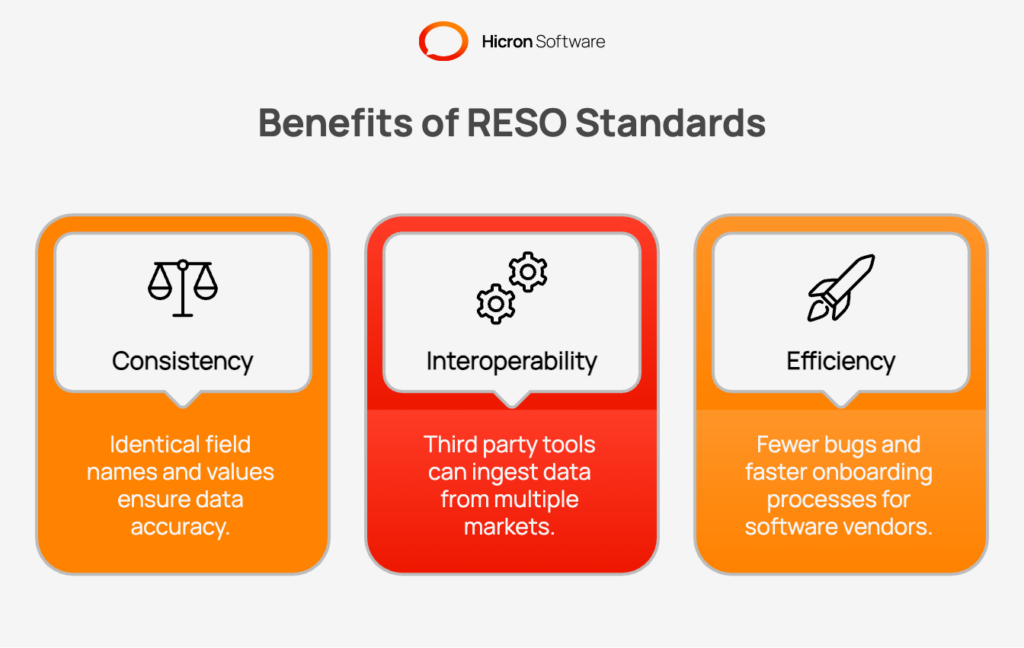
Consistency represents the biggest benefit of these protocols. Every multiple listing service uses identical field names and values. Applications never need to reconcile custom variables like “Beds” and “NumBeds” separately. Interoperability provides another advantage for technology companies. Third party tools can ingest data from hundreds of markets using one schema. Efficiency naturally follows this deep standardization. Software vendors experience fewer bugs and faster onboarding processes.
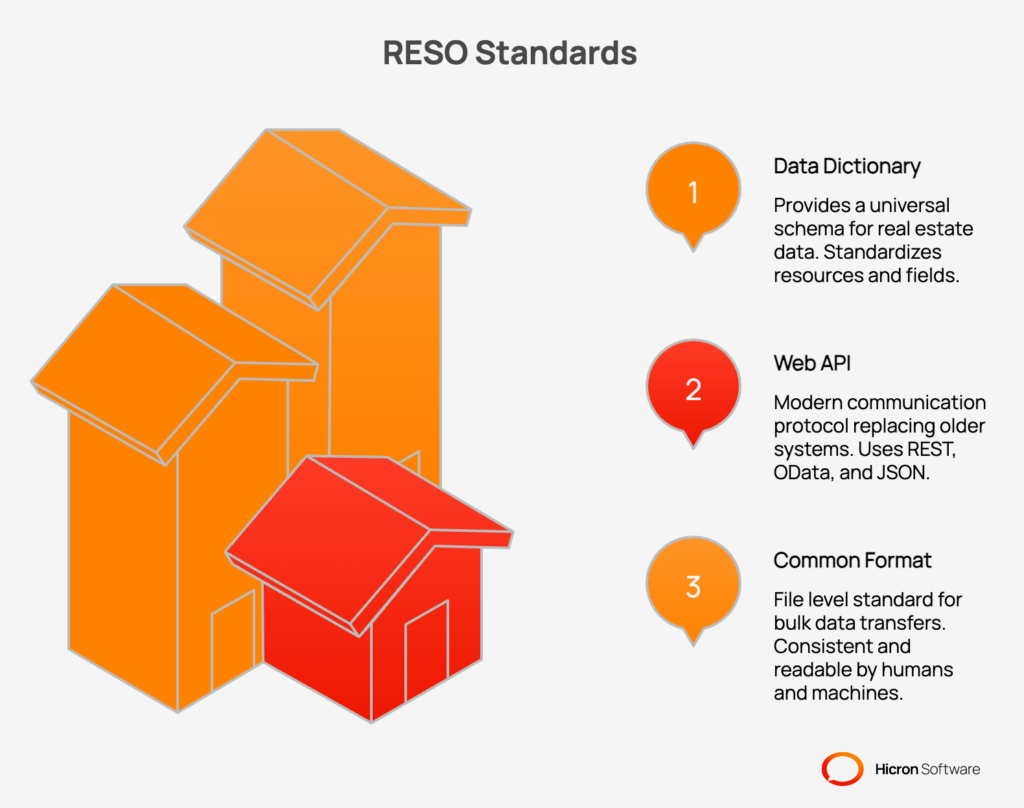
The industry relies primarily on the RESO Data Dictionary and the RESO Web API. The Data Dictionary provides a universal schema. The Web API provides a modern communication protocol.
The Data Dictionary acts as a universal foundational schema. It defines standard resources like Property and Member categories. It also standardizes specific fields like ListPrice and Bedrooms. The dictionary specifies exact names and allowed values for each field. This specification uses controlled picklists for absolute consistency everywhere. Status codes like “Active” or “Pending” mean the exact same thing universally. This eliminates ad hoc variants completely across all databases.
The RESO Web API serves as a modern communication protocol. It replaces older systems used for pulling property feeds. The protocol utilizes a REST style structure built on OData and JSON formats. Developers can reuse identical client code across many different markets. They do not need to write custom connectors for each individual region. The system includes enhanced security features like OAuth protocols and secure HTTP connections.
The industry also utilizes the RESO Common Format for bulk transfers. This file level standard exchanges data in a highly consistent manner. Both humans and machines can read this format easily. Organizations use this specific format primarily during massive system migrations. It provides a reliable bridge between legacy databases and modern platforms.
The RESO Web API uses modern JSON formats and live queries. The legacy RETS system relies on XML formats and bulk data downloads. The Web API provides better developer experiences and lower storage costs.
RETS utilizes older XML formatting combined with rigid local fields. Clients must download enormous XML data dumps directly. They then parse and store this information in local databases. The Web API utilizes modern JSON payloads over HTTP methods. JSON payloads are much easier to consume in web applications. The fields remain human readable and strictly standardized.
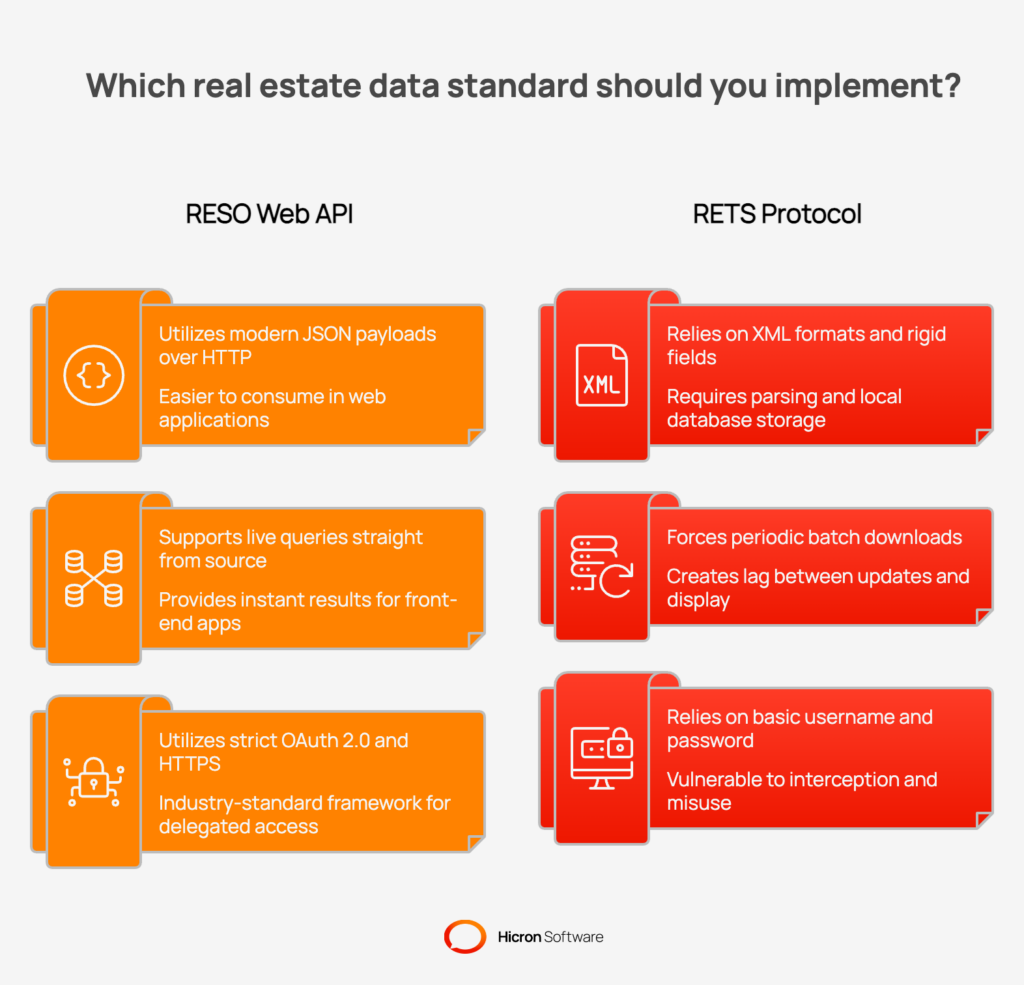
RETS forces brokers to pull periodic batch downloads. This method creates a lag between original updates and public display. The Web API supports live queries straight from the source. Front end applications call the service directly to get instant results. Organizations avoid maintaining massive replica databases locally. Organizations should choose the Web API if live data access matters more than maintaining historical batch records.
Legacy protocols, like those found in older RETS systems, typically rely on basic username and password combinations for authentication. While simple to implement, this method is increasingly seen as insecure. Some older systems might use simple, often perpetual, tokens with limited security controls, making them vulnerable to interception and misuse. These fragile security methods were not designed for the modern internet and can struggle under the weight of massive, frequent data transfers, creating potential security gaps.
In stark contrast, the modern RESO Web API utilizes the much stricter OAuth 2.0 protocol for authentication and authorization. This is the same industry-standard framework used by tech giants like Google and Facebook. Instead of just a simple username and password, OAuth provides secure, delegated access. The newer system also mandates the use of secure HTTPS connections (TLS/SSL) for every single request, ensuring that all data transmitted between the client and the server is encrypted and protected from eavesdropping. Developers receive distinct API keys and secrets, which are managed through secure, modern workflows. This allows for granular control over data access, including the ability to easily revoke access, set expiration times for tokens, and monitor API usage, providing a far more robust and secure environment for handling sensitive real estate data.
According to official real estate documentation [NAR], the industry introduced RETS back in 1999. Support for this older standard is being actively phased out, and many organizations have already shut down their legacy endpoints entirely. The Real Estate Standards Organization formally adopted the Web API as the official successor. All new features are now built exclusively on this modern stack, and real-time change notifications are only available on the new protocols.
RESO standards provide a shared data language. They eliminate local field variants and enforce controlled picklists. Validation expressions ensure all incoming data follows strict logical rules.
Previously, every local market used its own unique field names, creating ambiguity for software developers. With the Data Dictionary, resources are defined with a standard name. This means that software applications only have to map a field like “bedrooms” once. Reusing that mapping across every market creates a shared data language that reduces integration effort.
The standards specify controlled lookups for all property statuses. Property types like “Condo” or “Townhouse” follow strict predefined lists. Normalized values ensure consistent search filtering across all regions, eliminating the need for custom translation logic. A single search query works perfectly across multiple interconnected databases.
The API, application programming interface, embeds strict business rules directly. These validation expressions enforce required fields and valid numerical ranges. Systems block impossible constraints like negative prices or illogical dates. Webhooks allow external systems to receive instant change notifications, ensuring consumers always see correct and verified information without delay.
Regional groups can maintain specific local fields when necessary. The standards allow for explicit mappings to standard fields, preserving regional flexibility for local brokers. National tools can still rely on the stable core schema.
Artificial intelligence requires clean inputs to function properly. Standardized schemas provide predictable feature engineering. This clean data powers reliable automated valuations and predictive analytics.
Why do AI models need standardized real estate data?
Machine learning algorithms fail when fed inconsistent data structures. AI models require one canonical schema instead of dozens of variants. Standardized inputs create cleaner feature engineering processes. Metrics like square footage and bathroom counts remain totally predictable. If a model is trained on data where “square footage” is sometimes labeled “SqFt,” “sq.ft.,” or “total living area,” it can’t process the information reliably. Predictable metrics reduce mapping bugs during model training phases.
Clean data enables highly accurate automated property valuations. With standardized data, models can analyze historical transactions using normalized pricing fields, match potential buyers to properties using consistent feature lists, and predict market trends across multiple regions. AI filters enhance property search functions by understanding standard property types accurately. Standardized inputs streamline automated compliance reporting for large brokerages.
Clean RESO data enables several key AI applications in real estate:
First, organizations must inventory their current data feeds. Then, developers can set up secure test environments and map existing RETS fields to the RESO Data Dictionary. Teams run parallel ingestion systems to verify data quality before shutting down old feeds.
Here’s a step-by-step guide to migrating from RETS to the RESO Web API:
| Step | Actions |
| 1. Inventory Current Data Usage |
|
| 2. Set Up a Secure Test Environment |
|
| 3. Align Schemas and Map Fields |
|
| 4. Translate Property Identifiers |
|
| 5. Map Property Features |
|
| 6. Standardize Location Data |
|
| 7. Test the Integration |
|
| 8. Decommission the Old System |
|
Organizations must carefully inventory all current data usage. Teams list every active feed powering their analytics or search tools. They must confirm which regional services offer certified modern endpoints. Developers should never point production systems at production interfaces during testing. They must utilize sandbox instances for every connected service.
Engineers must inspect the new dictionary for every connected region. They create a master mapping table for all variables. A custom field like “RETSLISTPRICE” maps directly to “ListPrice”. Status codes like numbers map to words like “Active” or “Sold”. Unmapped local fields go into a generic storage blob temporarily.
Basic listing identifiers require careful translation during system migrations. A legacy field like “ML_NUM” translates directly to “ListingId” automatically. Older date fields like “MODTIME” become “ModificationTimestamp” in the new system. These standardized timestamps power the incremental synchronization processes perfectly. They ensure that local databases remain perfectly aligned with primary sources.
Regional systems often use highly abbreviated terms for property features. Terms like “SFLA” translate into the universally understood “LivingArea” field. Older boolean flags like “POOLYN” simply become the standard “PoolYN” variable. This structural consistency keeps feature engineering totally predictable for predictive models. Software tools simply read the “LivingArea” variable across every single market.
Location details also follow strict formatting rules globally. The dictionary maps regional street descriptions to standard variables. A field like CITYNAME becomes City universally. Zip codes translate into the PostalCode variable exactly. The schema stores complete and normalized address components consistently. This allows geocoding logic to function perfectly across all participating markets.
Teams build parallel ingestion layers during the transition period. The system ingests both older XML and newer JSON formats simultaneously. Dual ingestion allows teams to compare property prices directly. They can evaluate photo counts across both sets simultaneously. Teams must measure differences in system latency thoroughly. The modern protocol tends to be less forgiving of improperly shaped requests. Organizations must track application errors during this parallel testing phase. Once all critical regions operate perfectly on the new protocol, developers delete the older code completely.
The transition to modern standards makes the industry much more efficient. Clean data removes historical barriers to technological progress. Standardized information ultimately creates better experiences for all market participants.
Modern APIs provide operational advantages, helping organizations reduce their integration costs when expanding into new regions. Standardized JSON layers make quality control processes extremely simple. Clean input streams allow predictive models to operate with unprecedented accuracy.
Standardized information ultimately creates better experiences for all market participants. Buyers receive accurate property details without confusing regional abbreviations. Sellers know their property features appear correctly across every digital portal. Technology vendors build innovative tools without wrestling with broken data connections. The entire property ecosystem operates with much higher efficiency levels overall.
The property sector continues to adopt these universal protocols. Developers spend less time parsing broken data feeds. They spend more time building valuable analytical tools. Artificial intelligence will transform property transactions using this exact foundation. To stay competitive, organizations should complete their system migrations promptly. Professionals can refer to the official documentation and contact software experts to start planning their transition today.
Sources:
AI models struggle greatly when processing older XML feeds. The inconsistent field names confuse the training algorithms. Standardized JSON feeds provide the exact predictability that neural networks require.
The industry created RETS over two decades ago. It lacks modern security features and requires heavy local data storage. The new Web API provides better efficiency and live data access.
Hicron Software proved to be a trusted partner with unmatched technical expertise, delivering a scalable and user-friendly web application that was pivotal to our successful U.S. market expansion.

Hicron’s contributions have been vital in making our product ready for commercialization. Their commitment to excellence, innovative solutions, and flexible approach were key factors in our successful collaboration.
I wholeheartedly recommend Hicron to any organization seeking a strategic long-term partnership, reliable and skilled partner for their technological needs.

After carefully evaluating suppliers, we decided to try a new approach and start working with a near-shore software house. Cooperation with Hicron Software House was something different, and it turned out to be a great success that brought added value to our company.
With HICRON’s creative ideas and fresh perspective, we reached a new level of our core platform and achieved our business goals.
Many thanks for what you did so far; we are looking forward to more in future!

Hicron is a partner who has provided excellent software development services. Their talented software engineers have a strong focus on collaboration and quality. They have helped us in achieving our goals across our cloud platforms at a good pace, without compromising on the quality of our services. Our partnership is professional and solution-focused!

The IT system supporting the work of retail outlets is the foundation of our business. The ability to optimize and adapt it to the needs of all entities in the PSA Group is of strategic importance and we consider it a step into the future. This project is a huge challenge: not only for us in terms of organization, but also for our partners – including Hicron – in terms of adapting the system to the needs and business models of PSA. Cooperation with Hicron consultants, taking into account their competences in the field of programming and processes specific to the automotive sector, gave us many reasons to be satisfied.