10 Real Estate Software Development Companies in 2026
- February 03
- 9 min

Developing a powerful real estate web application is a new opportunity for any modern real estate business. As the market shifts online, having a dynamic web app is no longer an option but a necessity to compete with popular real estate platforms like Zillow.
This article will guide you through the complete process of real estate website development. We will explore the essential features, technology stacks, and monetization strategies needed to build a real estate web platform that attracts both buyers and sellers. Reading this will give you a clear roadmap for creating a successful online property portal.
Key takeaways:
Investing in a web app for your real estate business is crucial for staying relevant and competitive. Today’s homebuyer and renter use apps to surf for properties on their smartphones, demanding instant access to comprehensive listing information. A dedicated real estate web app meets this demand by providing a centralized platform where users can easily find a suitable property. This not only enhances the user experience but also helps streamline internal operations, from property management to client communication.
Developing a real estate web platform can expand your market reach and open up new revenue streams. Beyond agent commissions, a custom web app allows for monetization through premium listing features, advertising for third-party services, and subscription models for a realtor or broker seeking advanced analytics and market insights. This digital transformation positions your real estate business as a forward-thinking player in the competitive real estate market.
A successful real estate web app must offer a robust set of features to serve all user types.
|
Feature |
Description |
Details/Examples |
|
Property Search & Filtering |
Allows users to find properties based on specific criteria, forming the core of the user experience. |
Search by location, price, size, and property type. Advanced filters include school districts, amenities, and crime rate data. |
|
Detailed Property Listings |
Provides comprehensive information for each property to help users make informed decisions. |
Includes high-resolution images, virtual tours, floor plans, and a full list of property specifications and features. |
|
Listing Management Dashboard |
An interface for agents and property owners to create, manage, and monitor their listings. |
User-friendly tools to upload property information, edit listing details, and track performance metrics. |
|
Performance Analytics |
Offers insights into how a property listing is performing with potential buyers. |
Tracks metrics such as listing views, user engagement, number of inquiries, and time on the market. |
|
Communication Tools |
Facilitates direct interaction between buyers, sellers, and real estate agents within the platform. |
Features include secure messaging systems, scheduling for viewings, and contact forms for inquiries. |
|
Financial Resources |
Provides tools to help potential buyers understand their financial capacity and affordability. |
Includes a mortgage calculator to estimate monthly payments and tools to assess budget and pre-qualification status. |
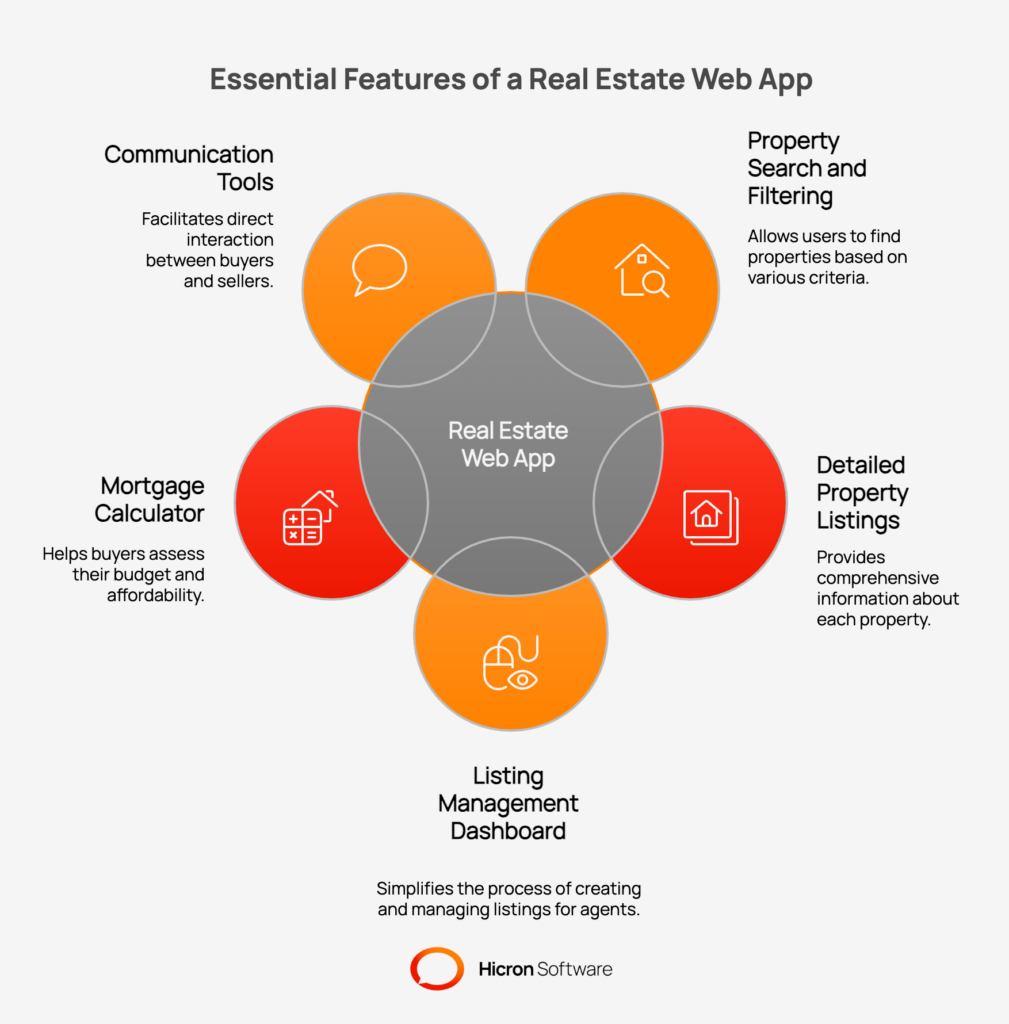
The cornerstone of the platform is a property search and filtering system. This essential feature of a real estate web app must allow users to search for a property listing by location, price, size, and type, with advanced filters for amenities, school districts, and even crime rate data. Each listing needs to be detailed, featuring high-resolution images, property details, and ideally, a virtual tour.
For real estate agents and a property owner, the platform should simplify the process of creating and managing a listing. A user-friendly dashboard is necessary to upload information about the property, track listing performance through analytics, and communicate with potential buyers. The platform provides tools like a mortgage calculator to help a homebuyer assess their budget, making the web app an all-in-one resource for buying and selling. Communication tools are vital to connect buyers and sellers directly.
A comprehensive database of properties is the backbone of any real estate web app. The most critical integration is with the Multiple Listing Services (MLS), a massive database of property listings maintained by real estate professionals and sanctioned by the National Association of Realtors. To pull real-time data from the MLS, your development team will need to integrate using a RETS feed or the more modern RESO Web API. This integration ensures your listing data is always current.
In addition to MLS integration, you can enrich your platform by allowing agents and homeowners to post their own listings. This strategy is employed by top real estate portals like Zillow. You may also want to integrate data sources for commercial real estate or exclusive off-market properties. When developing a real estate web platform, it’s vital to have a solid plan for sourcing and displaying varied listing data to provide maximum value to users. This involves creating a flexible database structure and a process to manage data on property locations and specifics.
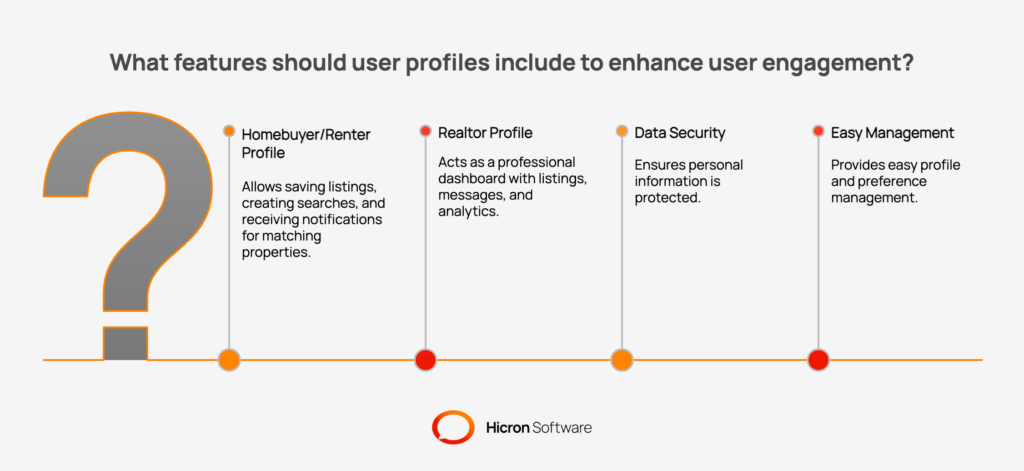
Personalization is key to keeping users engaged. Your real estate web app must allow users to create their profiles, catering to their specific needs, whether they are buyers, sellers, or renters. For a homebuyer or someone who wants to rent, their profile should let them save favorite listings, create saved searches, and receive notifications when a new property is added that matches their criteria. This functionality helps users find the best property for their needs.
For a realtor, the profile should act as a professional dashboard, showcasing their active listings, client messages, and performance analytics. You can integrate with CRM plugins to help agents manage their leads more effectively. Data security is paramount when designing the user management system to protect personal information. The system should be easy, allowing users to manage their profiles and preferences easily. The ability for users to create their profiles is a fundamental feature of a real estate platform.
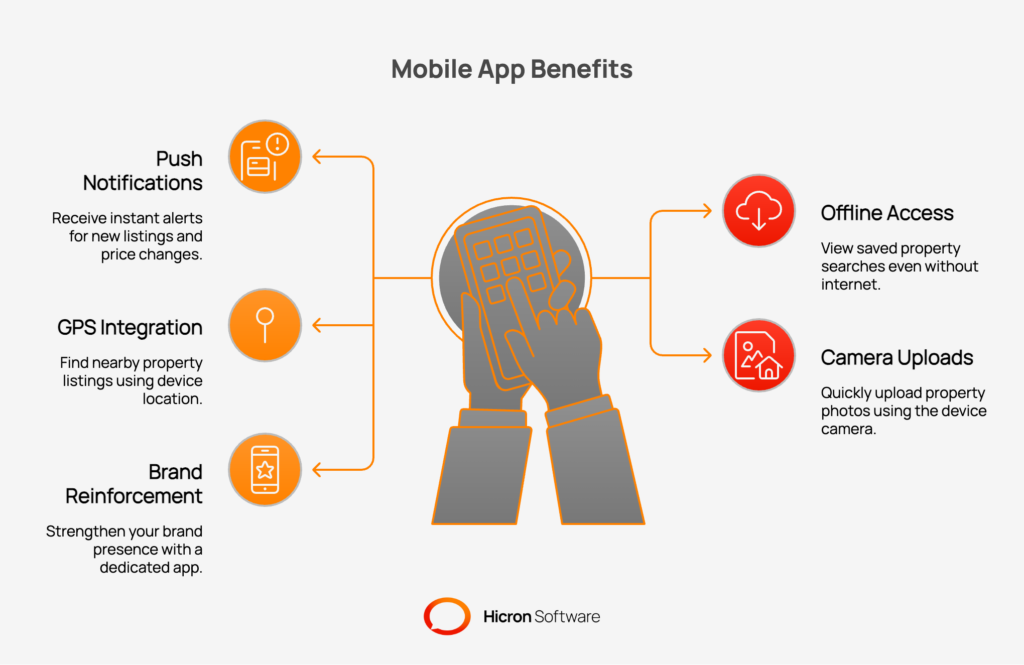
While a responsive real estate web platform is a must, a dedicated mobile app can boost user engagement. Modern consumers are constantly on the move, browsing listings on their smartphones. A mobile app offers conveniences a web browser can’t, like push notifications for new listings or price drops, and offline access to saved property searches. This real-time interaction is a powerful tool.
App development for iOS and Android allows you to utilize device-specific features. For example, GPS can show users nearby property listings, and the camera can be used by an agent to quickly upload photos for a new listing. While building a mobile app requires additional investment, the benefits are substantial. The app offers another touchpoint with your audience, reinforces your brand, and provides a more accessible platform for buying or selling.
Choosing the right technology is a critical decision that affects the performance and scalability of your real estate web application.
For the front-end (client-side), modern JavaScript frameworks like React, Angular, or Vue.js are excellent choices. They enable developers to add dynamic and interactive user interfaces, ensuring a smooth user experience.
For the back-end (server-side), you need a robust framework to handle business logic, database operations, and API integrations. Common choices include Node.js, Python with Django, or Ruby on Rails.
Your database must efficiently handle a large property database and user data; PostgreSQL and MySQL are reliable options. The final tech stack decision should be made with an experienced app development company that understands your specific business needs. Web app development requires careful planning of these components.
From the outset of developing a real estate web app, you must plan for future growth. A successful app will attract more users and listings, and your infrastructure must handle the increased load without slowing down. This means designing a scalable server architecture. Cloud services like AWS or Google Cloud Platform allow you to scale resources on demand, ensuring your platform remains fast during peak traffic.
Performance optimization is an ongoing task. Regularly monitor server response times, optimize database queries, and use Content Delivery Networks (CDNs) to deliver images and other assets quickly. The code, from back-end logic to front-end JavaScript, must be written efficiently to minimize load times. A slow real estate web platform will frustrate users, so ensuring your application is fast and reliable is crucial for long-term success.
A real estate web app can generate revenue in several ways. A popular model, used by platforms like Zillow, is charging a real estate agent for premium placement and lead generation. This “freemium” model offers basic listing features for free but provides paid upgrades for increased visibility and direct connections to buyers. You can create subscription tiers for an individual realtor or entire real estate agencies, offering advanced analytics and marketing tools.
Another strategy is offering featured listings, where a seller or broker pays to have their property listing highlighted. You can also incorporate advertising from relevant third-party services, such as mortgage lenders or insurance companies. For a platform that facilitates rentals, you can integrate payment gateways and charge a small service fee on each transaction. A real estate marketplace can also take a commission on sales originating from the platform.
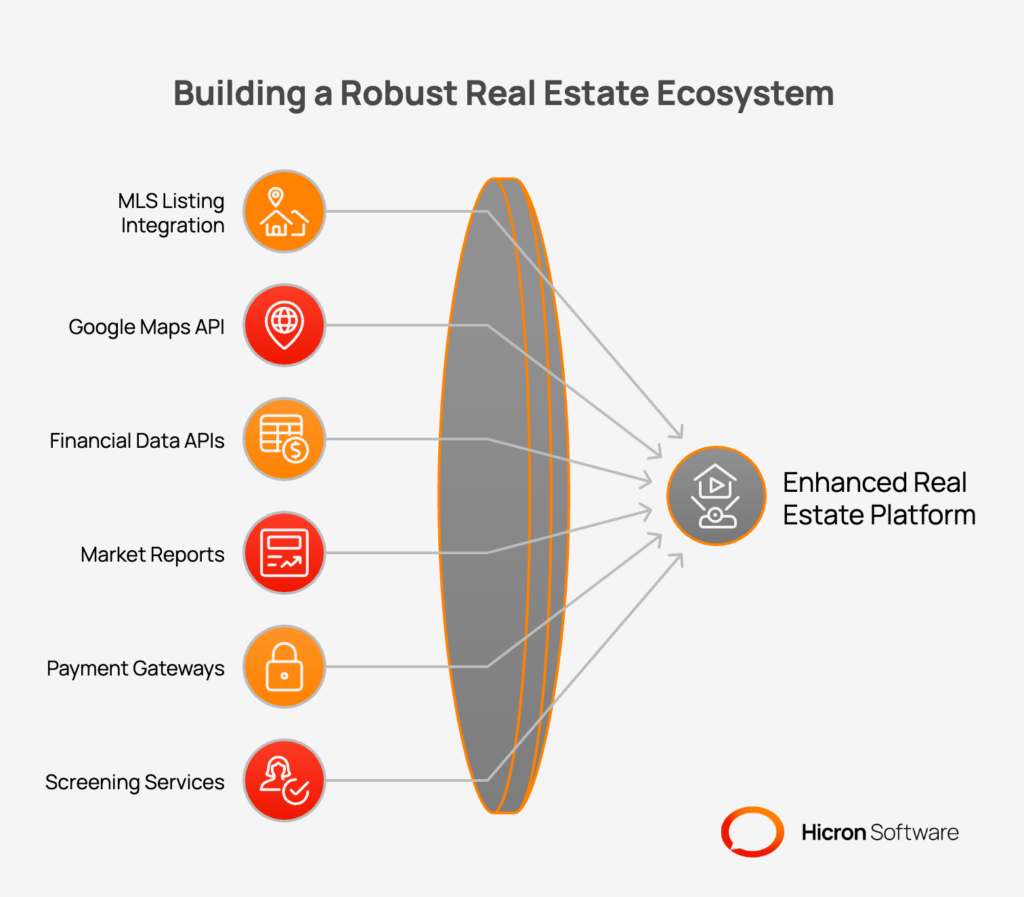
A real estate web app cannot operate in isolation. Integrating third-party services through APIs is essential for providing a rich user experience. We’ve discussed MLS listing integration, but many other APIs add value. For example, you need to integrate Google Maps API to display property locations, offer Street View, and calculate commute times, which is a key feature of a real estate web app.
Other valuable integrations include APIs for financial data. A mortgage calculator is a must-have, and it can be enhanced by pulling real-time interest rates. You can also integrate services that provide market reports and data on neighborhood demographics. For property management, you can integrate with payment gateways to process rent or with screening services for a potential renter. Integration of these third-party services makes your real estate platform more powerful.
Developing a great real estate web app is only half the journey; you also need a strong marketing plan to attract users. Your efforts should target both sides of the market: real estate professionals and consumers. For agents, run targeted ad campaigns, attend real estate industry events, and offer promotions to encourage them to list their commercial properties and residential homes on your new web platform.
To attract buyers and renters, Search Engine Optimization (SEO) is critical. Optimize your content and property listing pages to rank high in search results. Content marketing, such as blogging about the home buying process or local market trends, can also drive organic traffic. Social media marketing can help you reach a broad audience of potential buyers and sellers. Building a trusted brand for your online property portal is essential for long-term success in the global real estate industry.

Features like property search with filters, high-quality images, virtual tours, messaging, mortgage calculators, and user profiles are essential.
Yes. Design your database and search tools to handle both residential and commercial property listings.
You can add listings by integrating MLS data feeds or allowing agents and property owners to submit their own listings through user dashboards.
A real estate web app is an online platform where users can search for, list, and manage properties for sale or rent.
Latest concepts include AI recommendations, AR for virtual staging, blockchain for transactions, chatbots, and IoT integration for smart homes.
Choose a development approach, design responsive layouts, add features like notifications and property alerts, use APIs, and ensure scalability and security.
Hicron Software proved to be a trusted partner with unmatched technical expertise, delivering a scalable and user-friendly web application that was pivotal to our successful U.S. market expansion.

Hicron’s contributions have been vital in making our product ready for commercialization. Their commitment to excellence, innovative solutions, and flexible approach were key factors in our successful collaboration.
I wholeheartedly recommend Hicron to any organization seeking a strategic long-term partnership, reliable and skilled partner for their technological needs.

After carefully evaluating suppliers, we decided to try a new approach and start working with a near-shore software house. Cooperation with Hicron Software House was something different, and it turned out to be a great success that brought added value to our company.
With HICRON’s creative ideas and fresh perspective, we reached a new level of our core platform and achieved our business goals.
Many thanks for what you did so far; we are looking forward to more in future!

Hicron is a partner who has provided excellent software development services. Their talented software engineers have a strong focus on collaboration and quality. They have helped us in achieving our goals across our cloud platforms at a good pace, without compromising on the quality of our services. Our partnership is professional and solution-focused!

The IT system supporting the work of retail outlets is the foundation of our business. The ability to optimize and adapt it to the needs of all entities in the PSA Group is of strategic importance and we consider it a step into the future. This project is a huge challenge: not only for us in terms of organization, but also for our partners – including Hicron – in terms of adapting the system to the needs and business models of PSA. Cooperation with Hicron consultants, taking into account their competences in the field of programming and processes specific to the automotive sector, gave us many reasons to be satisfied.