10 Real Estate Software Development Companies in 2026
- February 03
- 9 min


A scalable PropTech platform is designed to handle the unique, spiky traffic patterns of the real estate industry, such as property launches and market events, without performance degradation. It achieves this through scalable architecture, including geo-sharding to partition data by market, multi-layer caching to offload traffic, and event-driven pipelines to process updates efficiently. These scaling strategies ensure the platform remains reliable, fast, and cost-effective during peak demand, providing a competitive edge in the real estate market.
This article is the second in our 6-part series, Architecting PropTech at Scale. It covers the performance and scaling layer of the proptech platform development. It is written for senior engineers, platform architects, and technical CTOs who have already committed to a tech stack and are now designing for growth, traffic spikes, and cost efficiency. We’ll guide you through four pillars: traffic architecture, geo sharding, multi-layer caching, and infrastructure cost modelling. This is an end-to-end guide to developing a proptech platform that performs under real conditions, not just test environments. If your platform held up in staging but struggled in production, the answers are likely in these four areas.
The “thundering herd” problem is a well-known challenge in software development, but it takes on a new dimension in PropTech. Property launches, market events like interest rate announcements, and even viral listings create simultaneous demand spikes that have no equivalent in most other verticals. Every PropTech architect must design for three distinct traffic profiles: the sustained baseline of daily user activity, the predictable peak of a scheduled property launch, and the unpredictable surge from market news.
Standard load testing often fails to simulate these real estate traffic patterns. It typically models steady, distributed load increases. Stress testing against event-driven spikes requires a different approach, one that simulates thousands of users hammering the same regional indexes simultaneously. The problem is compounded by geo-concentrated demand. When a new property in Austin goes live, the traffic spike isn’t distributed globally. It hammers the Austin-specific data shards, APIs, and servers all at once. The platform that helps tenants and agents must be built for this reality.
Studies from the proptech industry show a repeated failure sequence.
These are the three most common architecture mistakes in real estate software development. Each one is manageable under a moderate load. Together, under a traffic surge, they produce cascading failures.
The sequence runs like this. Search index overload leads to API timeouts. Timeouts lead to frontend degradation. Tenant and agent trust erodes. A landlord asks why their new listing is not showing. A seller loses hours of peak market visibility. Proptech software solves problems in a business where timing matters.
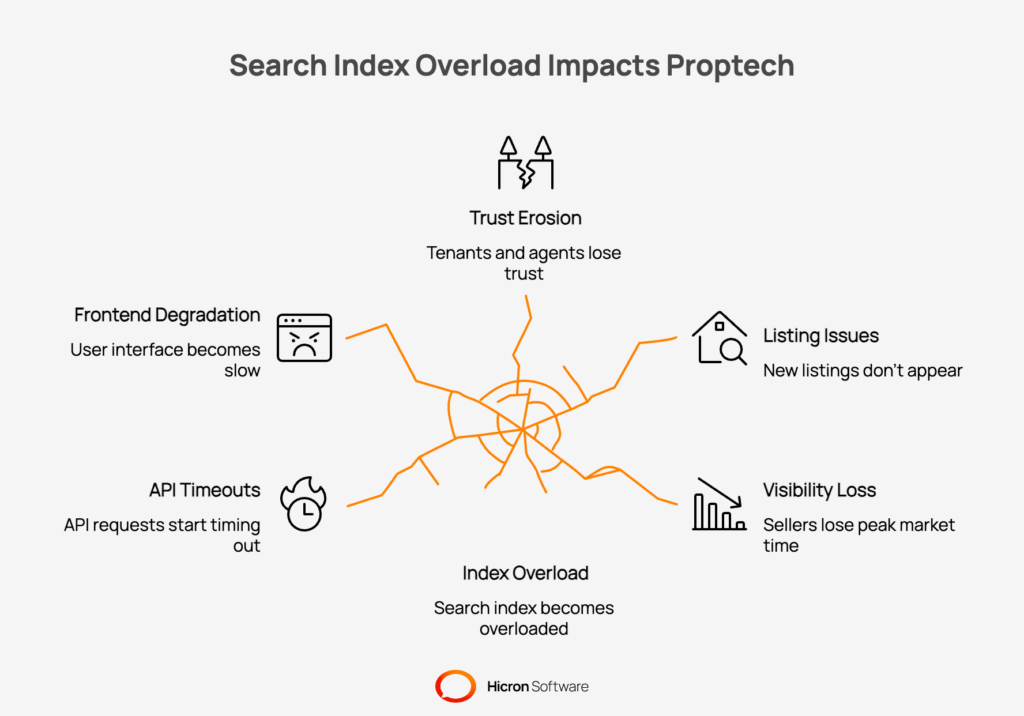
Development companies that build for current load rather than peak load end up rebuilding at the worst possible moment. Scalability built in from the start costs far less than rebuilding under pressure. This is one of the core development best practices for profitable proptech.
Treating property search as a standard text search problem produces search indexes that degrade under geographic query concentration.
Geo-sharding, in the PropTech context, is the practice of partitioning your search indexes (like Elasticsearch) by city, region, or market boundary, rather than maintaining a single, massive global index. Property search is fundamentally a geo-spatial problem. Treating it as a standard text search across a global dataset is the single most common performance mistake in real estate tech. The goal of this software development approach is to ensure a search for a lease in Austin never has to sift through London data.
The sub-300ms latency benchmark is a critical revenue metric, not a vanity one. 200ms improvements in search speed can measurably lift conversion rates by 1–2%. A correctly partitioned index, like an “Austin shard,” contains only data relevant to that market. This drastically reduces the search space, making queries incredibly fast and improving the user experience for every tenant. Building a proptech platform with this framework from the start is key.
An effective sharding strategy aligns partition boundaries with how the real estate business actually operates. By market, not by arbitrary technical keys. The primary architectural goal is to eliminate cross-region queries. A search for listings in one city should never touch a database shard for another. This requires careful planning of your tech stack.
Your partition logic must be designed to accommodate expansion. As the proptech platform grows into new geographies, you should be able to add new shards without a complete re-architecture. This scalability is vital. It’s also important to recognize that you need two separate sharding strategies that coexist: PostgreSQL sharding for transactional data (like user accounts and lease agreements) and Elasticsearch sharding for search indexes.
Geo-sharding alone does not protect the platform under peak load. Successful proptech platforms run a three-layer caching model: CDN, Redis, and request coalescing. Each layer solves a different problem. Implementing only two leaves the platform exposed.
A single caching layer is not enough. A robust proptech platform development strategy requires a three-layer caching model to handle the diverse traffic patterns.
The CDN layer handles prerendered static listing pages. During peak events, this layer can offload a large share of traffic from origin servers. Real estate platforms that route every session through origin servers are exposed during high-demand events. Edge caching serves prerendered pages from nodes closest to the searching tenant, which supports faster performance under load.
The Redis layer manages dynamic search results using intelligent TTL management. Frequently queried property data stays warm. Query frequency data drives cache prioritisation. AI can assist by predicting which property data is likely to be queried next, based on usage patterns, and adjusting cache priority accordingly.
Request coalescing is the layer software development teams most often skip. During a traffic spike, many users execute identical queries simultaneously. Without coalescing, each query is processed independently, amplifying demand at the cache layer rather than absorbing it.
Fixed TTL expiry times are a hidden danger. If many cached items expire at once, it can create a synchronized stampede of requests to your database. The solution is a jittered TTL strategy, where a small, random amount of time is added to each TTL. This staggers cache expirations and smooths out the load on your backend.
You also need to consider different user needs. A prospective tenant can tolerate slightly stale listing data (e.g., a few minutes old). However, an agent working on a live transaction needs near real-time information. Your caching logic should reflect these different trade-offs. For predictable events, like a scheduled property launch, employ cache warming strategies to pre-populate Redis before the event, rather than letting it warm up under heavy load. Using AI can help predict which listings to warm.
For a geo-distributed real estate tech platform, edge caching is essential. This means serving pre-rendered listing pages from CDN edge nodes closest to the searching tenant or buyer. A 90% traffic offload is a realistic benchmark, and in practice, it means your origin server load barely flinches during a major traffic event.
Cache invalidation is the hidden complexity in CDN architecture. When a property sells or a lease status changes, stale listing data is not only a user experience problem. It is also a data protection concern under GDPR and CCPA. Ensure your platform has automated invalidation pipelines that reflect status changes promptly. When evaluating CDN providers, assess edge density, integration with your existing tech stack, and support for real-time invalidation. Cloudflare, AWS CloudFront, and GCP Cloud CDN each present different trade-offs, and the right choice depends on your platform architecture and geographic distribution.
This is a core pattern in proptech software development services for platforms handling high-volume listing updates.
Many proptech platforms initially integrate with Multiple Listing Service (MLS) feeds using synchronous data ingestion. This breaks under scale. The right development approach is to use an asynchronous ingestion pipeline with tools like Apache Kafka or AWS Kinesis. This decouples the ingestion process from the rest of your application.
This architectural pattern allows you to keep search indexes as read-optimized caches, separate from your transactional databases. MLS ingestion can then proceed without degrading search performance for users. In the competitive real estate market, real-time listing updates provide a significant edge. The platforms that show property status changes in seconds, rather than minutes, win the trust of both tenants and agents. Automation in this pipeline is key.
Building for scale means planning for failure. Backpressure should be a first-class architectural concern, meaning you design systems that degrade gracefully under load rather than failing catastrophically. One key technique is implementing circuit breaker patterns for your APIs. This prevents a failing downstream service (e.g., a third-party payment gateway or a slow MLS feed) from causing a cascading failure across your entire platform.
Another crucial pattern is queue-based load leveling. Instead of allowing traffic spikes to overwhelm your synchronous processing chains, you can absorb them into managed queues. This allows you to process the load at a sustainable rate. For scheduled high-traffic events, software development companies should use pre-warming strategies to prepare the infrastructure, rather than reacting after performance has already started to degrade.
Scaling a proptech platform requires honest cost modelling. Costs vary by architecture choices, geographic scale, and AI feature set. The main cost areas are cloud computing, database infrastructure, CDN and caching, DevOps and monitoring, and AI feature compute.
Understanding development costs is crucial. For a mid-scale proptech platform, here are some realistic monthly cost ranges by component:
An initial scaling investment for a robust proptech platform setup can range from $80,000–$160,000. Enterprise scale is typically reached when ongoing monthly infrastructure costs exceed $50,000.
For a startup or a new project dealing with highly variable real estate traffic, a serverless architecture using services like AWS Lambda can be an effective cost-capping strategy. You pay for execution time rather than for provisioned capacity that sits idle most of the time.
The trade-off with serverless is potential cold start latency versus cost efficiency. For some functions, a slight delay is acceptable; for others, it’s not. Stress testing becomes a powerful cost modeling tool. You can project your spend at different user levels: 1K users (baseline), 10K users (growth), and a 10x surge event, before you commit to more expensive provisioned infrastructure.
No capacity model can fully anticipate the unpredictability of the real estate market. Regulatory announcements or a single viral listing can create traffic patterns no one foresaw. This is why every proptech development company needs a 20% budget buffer.
In practice, this buffer is allocated across compute headroom for unexpected spikes, CDN burst capacity, and an expanded database connection pool. You should also project feature scaling costs, such as the $20,000–$50,000 annually it might take to expand geo-sharding into new markets. Building a monthly infrastructure spend review into the proptech platform development cycle should be a standard architectural practice, not just a finance team afterthought.
Before going live under production load, a pre-scale architecture review reduces the risk of outage at peak demand. These are the key features and structural questions that matter.
Developing a successful proptech platform is an ongoing architectural discipline. Successful proptech is defined not by launch day functionality but by what the platform delivers on its hundredth high-traffic day.
The platforms that lead the real estate market do not win on features alone. They win because their architecture makes them reliably fast when others go down. In proptech, reliability during peak demand is the most defensible competitive edge there is.
Real estate technology solutions need to serve every stakeholder. A proptech platform that helps a tenant submit a maintenance request through a user-friendly mobile app, gives a property manager tools to automate lease renewals, and gives a landlord AI-driven insight into portfolio analytics, delivers real value across the real estate business. Innovative solutions that streamline these workflows transform how real estate companies operate.
Building a platform at this level requires honest architecture decisions, a sound architecture, and a development process that treats scalability as a core concern from the start. Find the right tech partner, integrate the right tools, and build for peak demand. That is how you develop a proptech platform that lasts.
This is the second in the Architecting PropTech at Scale series. Explore the full series index for the specific architecture layer your platform needs next.
Hicron Software proved to be a trusted partner with unmatched technical expertise, delivering a scalable and user-friendly web application that was pivotal to our successful U.S. market expansion.

Hicron’s contributions have been vital in making our product ready for commercialization. Their commitment to excellence, innovative solutions, and flexible approach were key factors in our successful collaboration.
I wholeheartedly recommend Hicron to any organization seeking a strategic long-term partnership, reliable and skilled partner for their technological needs.

After carefully evaluating suppliers, we decided to try a new approach and start working with a near-shore software house. Cooperation with Hicron Software House was something different, and it turned out to be a great success that brought added value to our company.
With HICRON’s creative ideas and fresh perspective, we reached a new level of our core platform and achieved our business goals.
Many thanks for what you did so far; we are looking forward to more in future!

Hicron is a partner who has provided excellent software development services. Their talented software engineers have a strong focus on collaboration and quality. They have helped us in achieving our goals across our cloud platforms at a good pace, without compromising on the quality of our services. Our partnership is professional and solution-focused!

The IT system supporting the work of retail outlets is the foundation of our business. The ability to optimize and adapt it to the needs of all entities in the PSA Group is of strategic importance and we consider it a step into the future. This project is a huge challenge: not only for us in terms of organization, but also for our partners – including Hicron – in terms of adapting the system to the needs and business models of PSA. Cooperation with Hicron consultants, taking into account their competences in the field of programming and processes specific to the automotive sector, gave us many reasons to be satisfied.