10 Real Estate Software Development Companies in 2026
- February 03
- 9 min


Proptech platform development using multi-cloud and hybrid architecture represents the evolution of real estate tech infrastructure from simple applications to highly resilient, compliant enterprise systems. Building a proptech platform across multiple providers eliminates single points of failure. It enables development companies to meet stringent data sovereignty requirements while optimizing compute costs.
This article is the third in our 6-part series, Architecting PropTech at Scale. This guide covers the core infrastructure decisions required for building a proptech platform at scale. Single cloud proptech platforms often reach a ceiling defined by resilience, data sovereignty, and cost constraints. This article serves as the infrastructure layer that sits above standard performance decisions. It highlights the moment your platform stops being a product and starts becoming critical real estate industry infrastructure. We will cover the case for multiple clouds, migration phases, pitfall avoidance, and hybrid cloud as the mature end state. We will guide you through the best practices for profitable proptech.
Key Takeaways:
Single cloud architecture is not a mistake at launch. AWS, Azure, and GCP each offer a comprehensive tech stack with enough functionality to build a production ready platform without evaluating alternatives. The problem is not capability. It is exposure.
Three failure modes define where single cloud proptech platform development reaches its ceiling.
PropTech downtime is not the same as downtime in other software verticals. A lease that cannot be signed, a payment gateway that cannot process a deposit, or a listing feed that goes dark during a campaign creates real financial and legal exposure for every participant in the transaction. That is the insight that makes resilience an infrastructure priority rather than a product feature.
Successful proptech platforms assign each cloud provider based on workload performance, not preference. A principled cloud pairing model uses AWS for core compute and geo sharded search, GCP for AI analytics and BigQuery integration, and Azure for compliance heavy EU data and hybrid connectivity. Each provider earns its place by outperforming alternatives on a specific workload class.
Cost is part of the calculation. GCP delivers lower AI compute rates for machine learning workloads. AWS provides superior CDN and edge performance for listing delivery. Azure brings enterprise IAM and Arc capabilities that make it the right choice for sovereignty constrained tenant data. This approach to proptech software development means paying the lowest viable rate for each workload class rather than accepting a single provider’s pricing across the board.
The vendor lock in trade off deserves honest attention. Proprietary managed services like AWS Aurora or GCP Spanner accelerate app development. They also create migration debt. The right framework for evaluating that trade off is straightforward: if a service cannot be abstracted behind an interface that runs on Kubernetes, its adoption should be deliberate, documented, and scoped to workloads where the performance benefit clearly justifies the architectural dependency.
|
Cloud Provider |
Workload Assignment |
Key Benefits |
|
AWS |
Core compute and geo-sharded search |
Superior CDN and edge performance for listing delivery. |
|
GCP |
AI analytics and BigQuery integration |
Lower AI compute rates for machine learning workloads. |
|
Azure |
Compliance-heavy EU data and hybrid connectivity |
Enterprise IAM and Arc capabilities for sovereignty-constrained tenant data. |
Note on Vendor Lock-In: Proprietary managed services (e.g., AWS Aurora, GCP Spanner) can accelerate app development but also create migration debt. The adoption of these services should be a deliberate decision, ideally for workloads where the performance benefits clearly justify the architectural dependency, especially if the service cannot be easily abstracted.
Geo replication across providers acts as a strong trust signal. Institutional real estate clients and regulated tenancy platforms increasingly require demonstrated resilience evidence instead of basic SLA documents. A successful proptech platform proves its reliability.
Data residency flexibility allows EU tenant data to remain on Azure European infrastructure while US listing analytics run on GCP. Single cloud setups cannot replicate this compliance capability cleanly. This flexibility helps secure property data under GDPR and CCPA regulations.
Proptech startups use Oracle Cloud ARM compute and low egress fees as a cost sensitive complement to AWS or GCP for non critical workloads. This strategy reduces monthly expenses while supporting new features. It helps find the right balance between performance and budget.
The most common and costly mistake in multi-cloud migrations is skipping the audit phase. Every downstream decision depends on a complete map of current infrastructure: databases, MLS feed APIs, caching layers, payment gateways, and third-party integrations. Attempting to assess or migrate workloads without that foundation produces configuration drift, missed dependencies, and rollback failures that are expensive to diagnose under production pressure.
|
Stage |
Description |
Key Actions |
|
Stage 1: Audit |
Map current infrastructure to understand all business processes before initiating changes. |
Map databases, MLS feed APIs, caching layers, and third-party integrations. |
|
Stage 2: Assess and Plan |
Classify workloads by cloud readiness and criticality to simplify the development process. |
Prioritize search indexes and tenant data as high-priority; schedule internal analytics tooling for initial migration. |
|
Stage 3: Deploy Landing Zones |
Establish and test infrastructure across target cloud providers with non-critical workloads. |
Set up infrastructure on target providers; validate with pilot workloads before moving production traffic. |
|
Stage 4: Validate |
Run parallel environments to confirm performance and execute a phased cutover. |
Confirm sub-300ms search latency across providers; execute phased traffic cutover. |
The four-stage migration framework for proptech platform development works as follows. Stage one is the audit: map every infrastructure component before making any changes. Stage two is assessment and planning: classify workloads by cloud readiness and criticality. Stage three is deploying landing zones: establish infrastructure across target providers and validate with pilot workloads before production traffic moves. Stage four is validation: run parallel environments, confirm performance targets are met, then execute phased traffic cutover with a tested rollback path for every phase.
Kubernetes serves as the portability prerequisite. Containerised workloads that run identically on AWS EKS, GCP GKE, and Azure AKS can be migrated without rewriting application logic. This framework ensures custom software remains flexible.
The challenge specific to PropTech is stateful services. PostgreSQL and Redis require persistent volume management that demands careful Kubernetes configuration across provider boundaries. Terraform as the infrastructure as code layer makes multi cloud deployments reproducible and auditable. That matters for proptech software development services operating under GDPR or CCPA requirements, where configuration decisions need to be traceable.
For teams deciding whether to containerise a legacy PropTech monolith or refactor to microservices first: if the migration timeline is under 12 months and the team lacks microservices operational experience, containerise and migrate first. Refactor after the foundation is stable. Server-side development that tries to do both at once typically delivers neither on schedule.
The workload prioritisation matrix dictates migrating low risk items first. Internal analytics dashboards, reporting tools, and non production environments move early. This allows you to explore proptech integrations safely.
Workload sequencing by risk is the clearest insight from real estate tech migration case studies. Internal analytics dashboards and reporting tools migrate first. They validate the target environment under real workloads without exposing production. AI and ML pipelines, recommendation engines, and batch processing jobs migrate second. Live search indexes, tenant payment processing, and MLS feed ingestion pipelines migrate last.
Piloting GCP BigQuery for property analytics before migrating core AWS search infrastructure is the lowest risk sequence. It tests the target environment under real analytics workloads, builds team confidence, and keeps production critical systems stable while the migration matures. Every stage should include performance validation: sub 300ms search latency is the baseline expectation for PropTech platforms, and migration phases that cannot confirm that target should not proceed to the next stage.
The complexity assumption trap is the most damaging misconception in multi-cloud proptech platform development. Distributing workloads across providers does not automatically improve uptime. Without disciplined orchestration, multi-cloud introduces API mismatches, configuration drift, and inconsistent IAM policies that increase failure risk rather than reduce it. Proptech platforms often discover this only after a cross provider incident exposes gaps that single cloud monitoring never made visible.
MLS feed APIs, payment gateways, and identity verification services built for a single cloud network topology behave unpredictably when traffic routes across provider boundaries. These integrations were designed to automate workflows end-to-end within a single network context. Moving them across providers without explicit testing produces outages that are harder to diagnose than the single cloud failures they were intended to replace.
Kubernetes and Terraform as the unified orchestration layer reduce configuration drift from a constant risk to a managed one. Consistent policy enforcement across providers is the technical requirement that separates a resilient proptech platform from one that only appears resilient until a cross-provider event tests it.
During provider failover, TTL caching causes DNS propagation delays. For PropTech platforms where sub 300ms search latency is the baseline user expectation, a multi minute routing gap is a functional outage even if the underlying infrastructure is available. Anycast IP and global load balancers resolve this by routing traffic based on network proximity rather than DNS resolution. That eliminates propagation delay as a failover bottleneck.
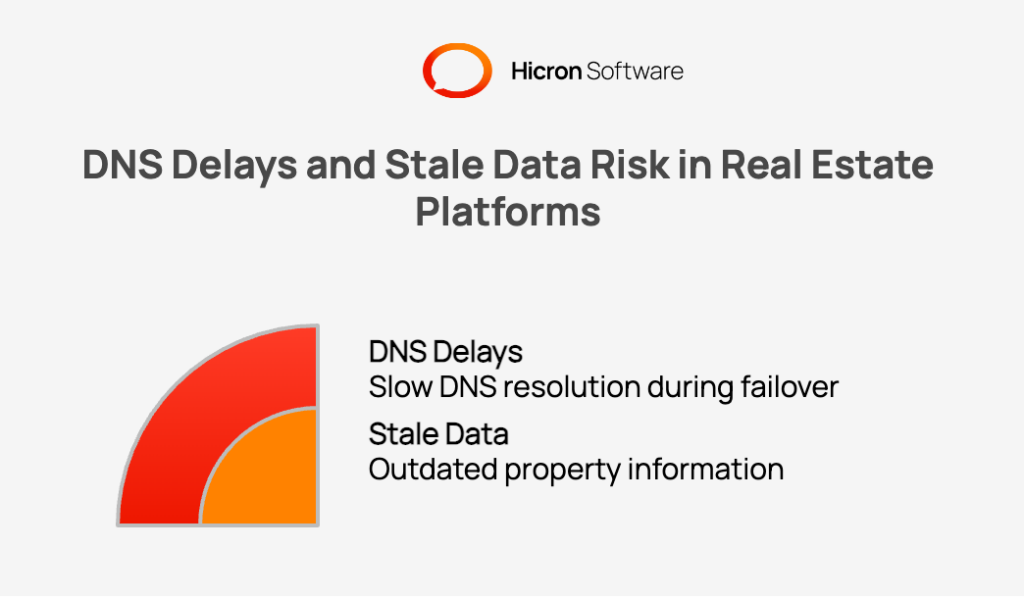
Stale property listing data during failover creates a different kind of risk. When replication lag between providers means a tenant sees a lease listing that closed 20 minutes ago, the trust damage extends well beyond a single session. Strong consistency models are appropriate for transaction-critical data: lease signings, payment processing, and listing status visible to buyers and renters. Eventual consistency is acceptable for analytics pipelines and non-transactional AI recommendation engines, but not where real estate transaction state is the data in question.
AWS CloudWatch, GCP Cloud Monitoring, and Azure Monitor each provide partial visibility into a distributed PropTech platform. Without a unified observability layer, there is no correlated incident timeline when failures span providers. Every minute of diagnostic ambiguity during a PropTech outage extends the impact window for tenants, property managers, landlords, and agents who depend on the platform to automate transaction workflows.
Centralised observability, through Datadog or Prometheus as the cross-provider monitoring layer, is a prerequisite for production readiness in a multi-cloud environment. This is one of the development best practices most consistently underinvested in, and most consistently damaging when absent. Deploying this layer before any migration phase touches production traffic is the practical requirement that this architecture checklist places above all others.
Hybrid cloud combines on-premises, or private cloud infrastructure for latency-sensitive and sovereignty-constrained workloads with public cloud for scalable compute, AI analytics, and listing delivery. It is the architectural end state for PropTech platforms that have outgrown the answers that multi-cloud provides to multi-cloud problems.
Three scenarios make hybrid cloud the right end state.
Developing a successful proptech platform that reaches hybrid architecture typically means the scaling and multi-cloud distribution problems are already solved. Hybrid cloud is the answer to regulatory and institutional complexity. It is not a shortcut past the proptech platform development work that precedes it.
The workload distribution strategy for a hybrid PropTech architecture assigns each layer to the environment in which it performs best. On-premises or Azure Stack HCI handles real-time listing transactions, tenant PII, and latency-sensitive property searches. GCP BigQuery runs AI-driven pricing analytics and recommendation engine training. AWS handles core compute, CDN, and MLS feed ingestion pipelines.
Kafka provides the event-driven replication pipeline between on-premises systems and cloud analytics layers. It maintains data consistency without centralising sovereignty-constrained data. Azure Arc and Google Anthos function as unified control planes, enforcing consistent policy, IAM, and monitoring across on-premises and multi-cloud environments from a single management interface.
Using AI to surface market insight and automate property valuation requires that the AI models training on property data operate within the correct data boundary. Hybrid architecture makes that possible without forcing a compromise between analytical capability and regulatory compliance.
Active-active failover’s apparent resilience advantage is outweighed by its data-consistency risks in real-estate transaction contexts. When two providers can simultaneously accept write operations against transaction critical data, conflict resolution becomes a source of correctness failures that are harder to detect than a brief failover window. Active passive failover with a recovery time objective under 15 minutes is the right target for transaction critical PropTech services.
Chaos engineering is the validation methodology that makes RTO targets credible. Simulating provider failures, network partitions, and database failover events in controlled conditions is the only way to verify that a disaster recovery architecture performs to specification. Case studies from mature real estate platforms consistently show that untested failover procedures fail under realistic traffic loads in ways that tested procedures do not.
Before you migrate production traffic, you evaluate your infrastructure architecture checklist. The data residency and cross-provider replication decisions made at this stage directly determine the compliance architecture complexity that follows. Getting them right is among the development best practices that separate a resilient proptech platform from one that simply looks resilient on paper.
These infrastructure decisions directly determine your compliance architecture complexity. Proper planning helps simplify the user experience. You ensure your platform integrates effectively with existing traditional real estate workflows.
Multi-cloud and hybrid architecture are not signs that a PropTech platform has grown complicated. They are signs that it has grown consequential. A platform that handles lease signings, property management workflows, and real-time listing data for buyers and renters is real estate industry infrastructure. It carries regulatory weight, financial consequences, and institutional trust that a single provider’s SLA cannot fully address.
Proptech software solves real problems in traditional real estate. The infrastructure layer is where those solutions become reliable enough to build a real estate business on. Build a proptech platform with these architecture decisions in place, and resilience becomes a property of the platform itself.
This is the third in the Architecting PropTech at Scale series. Explore the full series index for the specific architecture layer your platform needs next.
Hicron Software proved to be a trusted partner with unmatched technical expertise, delivering a scalable and user-friendly web application that was pivotal to our successful U.S. market expansion.

Hicron’s contributions have been vital in making our product ready for commercialization. Their commitment to excellence, innovative solutions, and flexible approach were key factors in our successful collaboration.
I wholeheartedly recommend Hicron to any organization seeking a strategic long-term partnership, reliable and skilled partner for their technological needs.

After carefully evaluating suppliers, we decided to try a new approach and start working with a near-shore software house. Cooperation with Hicron Software House was something different, and it turned out to be a great success that brought added value to our company.
With HICRON’s creative ideas and fresh perspective, we reached a new level of our core platform and achieved our business goals.
Many thanks for what you did so far; we are looking forward to more in future!

Hicron is a partner who has provided excellent software development services. Their talented software engineers have a strong focus on collaboration and quality. They have helped us in achieving our goals across our cloud platforms at a good pace, without compromising on the quality of our services. Our partnership is professional and solution-focused!

The IT system supporting the work of retail outlets is the foundation of our business. The ability to optimize and adapt it to the needs of all entities in the PSA Group is of strategic importance and we consider it a step into the future. This project is a huge challenge: not only for us in terms of organization, but also for our partners – including Hicron – in terms of adapting the system to the needs and business models of PSA. Cooperation with Hicron consultants, taking into account their competences in the field of programming and processes specific to the automotive sector, gave us many reasons to be satisfied.