Business Cybersecurity: Key Focus To Protect Your Company
- January 26
- 6 min


An effective enterprise framework for DevSecOps implementation integrates security practices throughout the software development lifecycle (SDLC) at scale. Replacing traditional, end-of-cycle testing, this approach embeds continuous security directly into the SDLC. Organizations achieve this transition by applying shift-left security principles and automating security within the CI/CD pipeline. Building a security-centric culture establishes shared responsibility among development, operations, and security teams, which breaks down the walls between teams and enhances overall risk management.
Scalable DevSecOps helps legacy modernization by aligning strict security protocols with agile methodologies. Teams deploy secure applications faster by running vulnerability checks concurrently with code development. To make this happen, teams typically rely on a mix of SAST, dynamic analysis, and SCA tools. I’ve found that getting this tooling mix right early on saves countless headaches down the road.
|
Core Component |
Description |
Key Methodologies & Tools |
|
Security Frameworks |
Integrates continuous security into the software development lifecycle (SDLC) and enforces strict identity-centric access control across the network. |
|
|
Automated Security Testing |
Replaces slow manual security reviews with continuous checks in the CI/CD pipeline to maintain deployment velocity without human intervention. |
|
|
Cloud-Native Infrastructure |
Secures dynamic environments, containerized workloads, and distributed microservices at scale using machine-readable definition files. |
|
|
DevSecOps Toolchain |
A connected ecosystem that handles orchestration, scanning, configuration, and provides real-time visibility for incident response. |
|
|
Organizational Culture |
Overcomes institutional inertia, outdated rules, and isolated departments to establish a unified, security-centric approach. |
|
Zero Trust architecture builds its security framework on the core principle of “never trust, always verify” for all users and devices. This model replaces traditional perimeter defenses with continuous security across the entire network. To pull this off, the architecture demands strict identity verification, least privilege access, and the assumption that a breach is already underway.
Administrators enforce these tenets using role-based access control (RBAC) to limit user permissions based on exact job functions. By using threat modeling, proactive risk management identifies potential access vulnerabilities before deployment. Continuous verification requires security automation to process thousands of authentication requests instantly without human intervention. When you build a mature DevSecOps framework, you’re embedding these verification protocols right into the infrastructure, applying these Zero Trust policies consistently across all application environments.
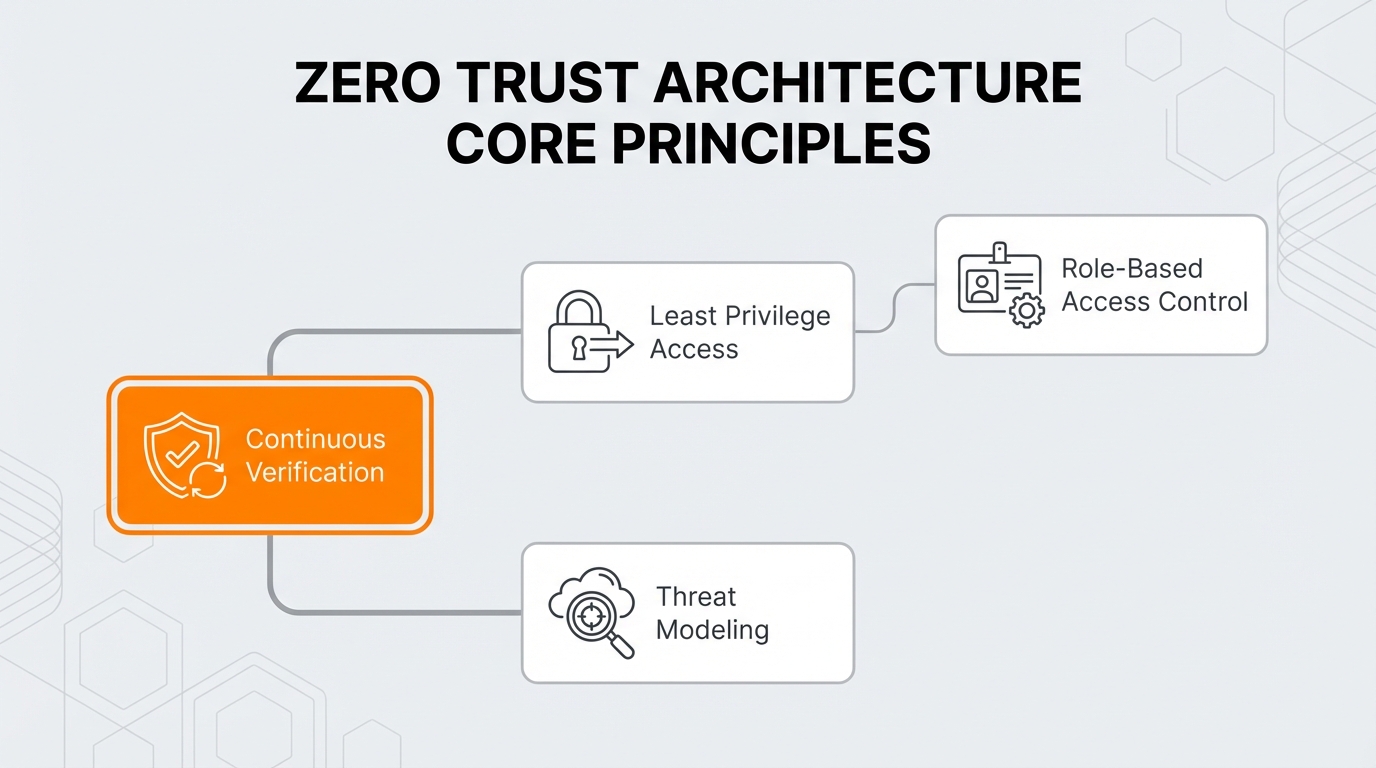
An effective enterprise DevSecOps implementation framework incorporates Zero Trust principles to ensure secure access across complex infrastructures. This integration creates a tight alignment between continuous security in the CI/CD pipeline and continuous verification for system access. Automated pipelines enforce Zero Trust policies before code reaches production environments. Integrating Zero Trust architecture enhances an enterprise DevSecOps strategy by applying the principle of least privilege across non-human identities, service accounts, and microservices.
Security automation maintains strict access mandates during rapid deployments without slowing down release cycles. To stay ahead of threats, security teams use threat modeling as part of proactive risk management to automatically define secure access boundaries for new code. Development teams use role-based access control to restrict infrastructure modifications during the build process, and this alignment makes security a natural part of the team’s daily routine when organizations apply mandatory identity verification to every deployment stage.
Getting DevSecOps off the ground usually hits three main roadblocks: stubborn company habits, outdated rules, and teams that refuse to talk to each other. These legacy mindsets are hard to break, causing significant resistance to change across large organizations. If you’ve ever tried to push a major process change through a massive corporation, you know exactly how frustrating this can be. The “frozen middle” management often blocks progress by enforcing outdated operational rules. Shifting from traditional gated security to continuous security requires a complete restructuring of the software development lifecycle (SDLC).
When departments isolate themselves, they can’t communicate well enough to make shift-left security work. A lack of leadership buy-in prevents the formation of a unified, security-centric culture. Teams will struggle to implement security automation if they maintain rigid, legacy risk management protocols.
Organizational silos increase cybersecurity risk by functioning independently. This isolation obstructs communication and increases the likelihood of unpatched vulnerabilities. Collaboration usually breaks down between three specific groups: developers, operations staff, and security personnel. A lack of teamwork creates severe security gaps throughout the SDLC.
When teams work in isolation, two things usually happen: vulnerability fixes get delayed, and threat modeling data gets ignored. These disconnected groups fail to use vulnerability scanning and security automation effectively. A shared responsibility model breaks down these barriers to establish a unified, security-centric culture.
Active leadership buy-in overcomes institutional inertia by driving cultural change and allocating resources for an enterprise DevSecOps implementation framework. Executive commitment breaks through the “frozen middle” and legacy policies to establish continuous security throughout the SDLC. Top-level support builds a security-centric culture based on shared responsibility.
Leadership mandates enforce cross-functional collaboration and ensure funding for necessary security automation tools. Teams adopt shift-left security faster when executives prioritize proactive risk management.
How do you actually make this work at scale? A successful enterprise DevSecOps implementation framework uses a strategic roadmap that integrates continuous security practices throughout the SDLC. Organizations execute this transformation through agile methodologies, security automation, and fundamental cultural shifts. Establishing a shared responsibility model is the first foundational step for building cross-functional teams. This structure unites developers, operations, and security experts into cohesive units.
A strong security-centric culture emerges when enterprises secure active leadership buy-in for these structural changes. Engineers embed automated security gates directly into the CI/CD pipeline to enable shift-left security. These controls enhance overall risk management without disrupting agile workflows. Legacy system modernization shows this success in action: when enterprises break down outdated monolithic architectures into secure microservices, automated gates ensure that every new microservice is tested for vulnerabilities before it ever connects to the broader network.
Shift-left security integrates continuous security checks into the earliest planning and design stages rather than treating them as an afterthought. This approach changes the SDLC by significantly lowering financial remediation costs—after all, fixing a bug in production costs 100 times more than catching it during the design phase. This operational impact requires a security-centric culture where developers take ownership of secure coding.
To manage risk proactively, teams generally rely on threat modeling and vulnerability scanning.
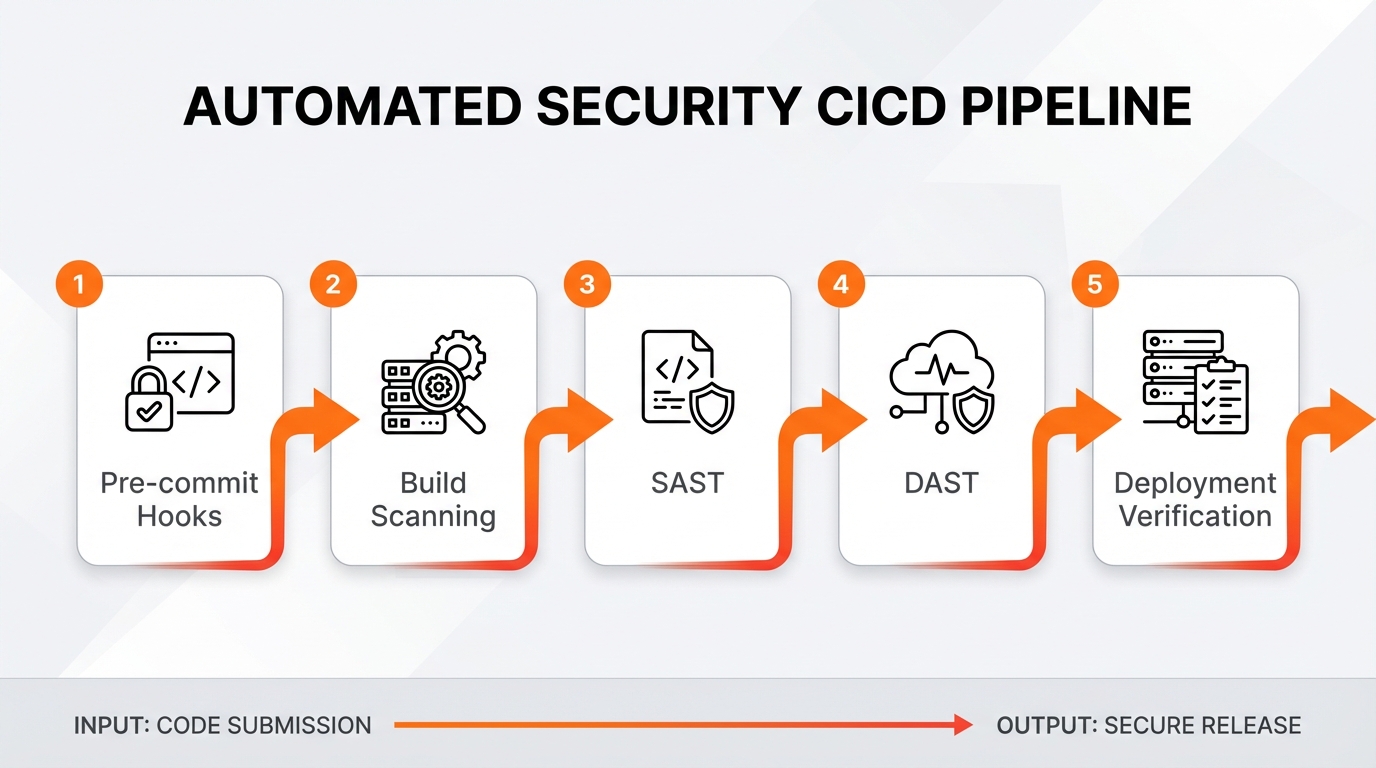
Embedding automated security gates that trigger on commit is a great start, but it requires careful tuning. If these gates constantly break builds over false positives, developers quickly lose trust in the process. Here’s a hard-learned pro-tip: start with your gates set to ‘audit-only’ mode before enforcing hard blocks to build developer confidence. The goal is to balance strict security rigor with rapid execution times across pre-commit hooks, build scanning, and deployment verification.
During the build and test phases, you’ll mostly rely on SAST and DAST for vulnerability scanning. When properly tuned to minimize false positives, these continuous security mechanisms eliminate the need for slow, manual code reviews, preventing pipeline bottlenecks across the SDLC. Configuring these tools to analyze code automatically keeps agile teams moving fast.
Threat modeling is a proactive process that identifies potential vulnerabilities during the design phase before developers write any code. This practice serves as a foundational element of shift-left security within an enterprise DevSecOps implementation framework. Mapping potential exploits early in the SDLC helps you establish secure coding standards and define continuous security requirements.
The insights you gather from threat models directly dictate the exact security tests configured in the pipeline. Teams predict and mitigate risks before deployment by using these blueprints to guide vulnerability scanning and security automation. This proactive approach keeps security top-of-mind for everyone on the team.
Applying Zero Trust principles to enterprise access management marks a core shift from traditional perimeter-based defenses to strict, identity-centric access control. Organizations establish continuous security by implementing strict identity verification and continuous authorization for every person and device accessing enterprise resources. This approach relies on continuous verification checks powered by security automation. The goal? Authenticate credentials dynamically without human intervention. Zero Trust architecture secures access across complex, hybrid cloud infrastructures by treating every network request as potentially hostile, regardless of its origin.
Administrators manage user and system access by enforcing the principle of least privilege through role-based access control (RBAC). The system evaluates access requests based on verified user identity, validated device posture, and contextual network location. A mature enterprise DevSecOps implementation strategy integrates these precise access policies directly into the infrastructure code to enhance overall risk management. Cross-functional teams work across departments to build a unified, security-centric culture by collaborating on these granular authorization rules.
Role-based access control (RBAC) acts as the fundamental mechanism for restricting network access and ensuring users possess only the minimum necessary permissions. This framework enforces the principle of least privilege by assigning exact access rights based on job functions. Defining strict roles minimizes the attack surface and limits lateral movement across the network. Integrating RBAC within a Zero Trust architecture not only enhances risk management but also streamlines compliance automation.
If malicious actors steal credentials, this integration prevents a compromised developer account from accessing production databases. Embedding these controls allows security automation to instantly block unauthorized requests and neutralize threats.
Automated testing methodologies act as the primary techniques required for enterprise DevSecOps to replace slow manual security reviews. These automated methods maintain deployment velocity within the CI/CD pipeline by executing continuous security checks without human intervention. Teams typically integrate four main automated testing methods into the SDLC: SAST, DAST, SCA, and IAST. A combination of these tools provides full-spectrum coverage from initial code commit to final runtime execution.
SAST uses a white-box approach to analyze raw source code for structural flaws during the initial build phase, before compilation. Conversely, DAST operates as a black-box method, evaluating the running application from the outside during staging to identify runtime exploits. Both methodologies are necessary to achieve thorough vulnerability scanning across the SDLC. These tools target distinct security flaws: SAST exposes hardcoded secrets, while DAST uncovers runtime misconfigurations.
Software composition analysis (SCA) automatically identifies open-source components and third-party dependencies within a codebase, cross-referencing them against known vulnerability databases. By integrating this scanning directly into the CI/CD pipeline, enterprises eliminate the need to manually track these specific security risks. This combats the growing risk of software supply chain attacks via third-party libraries. These SCA tools primarily help you prioritize fixing vulnerable dependencies and stop outdated packages from being deployed.
Moving to the cloud gives you massive scale and flexibility, but it also means you need specialized, automated security to keep up. The transition from monolithic architectures to distributed microservices expands the overall attack surface significantly. Organizations maintain continuous security across dynamic environments by relying heavily on infrastructure as code (IaC) for consistent configuration management. Cloud-native transitions require engineers to bake security protocols directly into container images and orchestration layers like Kubernetes. These modern environments introduce unique security challenges and operational opportunities. This architectural shift involves distinct challenges, such as managing ephemeral workloads and securing complex microservice communications. But it also offers unique ways to enhance protection, like deploying immutable infrastructure and dynamically scaling security automation. Teams enforce strict container security within the CI/CD pipeline to prevent compromised images from reaching production.
Securing containerized workloads and the Kubernetes orchestration platform is a fundamental requirement for protecting distributed microservices. To secure these environments, you should focus on enforcing container image scanning, implementing runtime protection, and applying secure cluster configurations. Automated container security tools scan for vulnerabilities like outdated base images and exposed application secrets before deployment to a Kubernetes cluster. Trust me, tracking down a leaked secret in a running pod is an emergency drill you want to avoid at all costs. Administrators secure Kubernetes clusters by configuring role-based access control (RBAC) and strict network policies. These access restrictions help isolate individual microservices and prevent unauthorized administrative actions. Teams standardize these secure configurations using infrastructure as code when operating within a mature enterprise DevSecOps implementation framework.
Infrastructure as code (IaC) is a key tool for maintaining continuous security at scale. It manages environments through machine-readable definition files to enable consistent, repeatable deployments. This approach eliminates manual configuration errors that introduce severe security vulnerabilities into production systems. Engineering teams execute vulnerability scanning directly on infrastructure code as a fundamental component of the CI/CD pipeline. Organizations achieve reliable compliance automation and policy-as-code enforcement by integrating these checks before resource provisioning. For example, scanning an IaC template can block the provisioning of a publicly accessible storage bucket or reject unauthorized network port openings. Security automation analyzes these infrastructure templates instantly to support rapid cloud-native technology deployments.
Policy-as-code translates governance rules into automated scripts that transform manual compliance checks into automated pipeline gates. This compliance automation prevents non-compliant infrastructure as code (IaC) from reaching production. For instance, the pipeline will automatically block deployments if they fail data residency mandates or lack database encryption. By continuously collecting real-time evidence, automated policies reduce audit burdens.
Scaling DevSecOps requires a connected toolchain that handles orchestration, scanning, configuration, and observability without creating bottlenecks. Integrated platforms provide a unified view of the security posture across the entire software development lifecycle. Tool integration creates a smooth, automated workflow to maintain deployment velocity. Teams maintain continuous security and reliable security automation by synchronizing these distinct systems effectively.
Large-scale platforms and templating engines govern and standardize software delivery pipelines across multiple enterprise projects. GitLab and the Jenkins Templating Engine act as orchestration platforms that manage the automated workflow. These enterprise platforms enforce consistent security workflows across disparate teams by bringing teams together and applying unified configurations throughout the SDLC. GitLab provides an all-in-one environment for centralized repository management and automated security gates. The Jenkins Templating Engine creates repeatable, maintainable pipeline templates to prevent configuration drift. Using these standardized templates ensures every team runs the same mandatory security scans while enabling strict compliance automation.
Specialized tools like Snyk automatically detect vulnerabilities across source code, dependencies, and container images via SCA. Once the tool finds a flaw, automation engines like Ansible can step in to execute remote patching and enforce consistent infrastructure configurations. For example, if Snyk detects an outdated library, it triggers a remediation workflow that prompts Ansible to deploy the updated configuration automatically.
Security observability provides the real-time visibility and context necessary to execute a rapid and effective incident response plan. This real-time observability is critical for complex environments because it delivers the immediate insights required to stop lateral movement across distributed architectures. To detect anomalies instantly, security teams rely on system logs, performance metrics, and distributed traces. Deep system visibility accelerates the identification of root causes during a security event by pinpointing the exact origin of a breach. When you’re staring down an active alert at 2 AM, having that granular context is an absolute lifesaver. Real-time alerts trigger automated incident response workflows to isolate compromised systems instantly within a cloud-native technology ecosystem. Platforms like New Relic provide the continuous monitoring you need to keep a DevSecOps framework running smoothly. Security teams contain active threats without manual delays by relying on security automation to process these real-time alerts.
New Relic is an observability platform that delivers application performance monitoring alongside deep security insights to support an active incident response plan. This system surfaces actionable intelligence in real-time by integrating security telemetry directly with broader application performance data. The platform provides continuous security by using code-level visibility to detect vulnerabilities in running applications. It achieves this automated runtime analysis using DAST and continuous vulnerability scanning. Security teams and operations staff use New Relic’s unified dashboards to monitor live threats collaboratively. By integrating this kind of observability, organizations can spot and fix risks much faster.
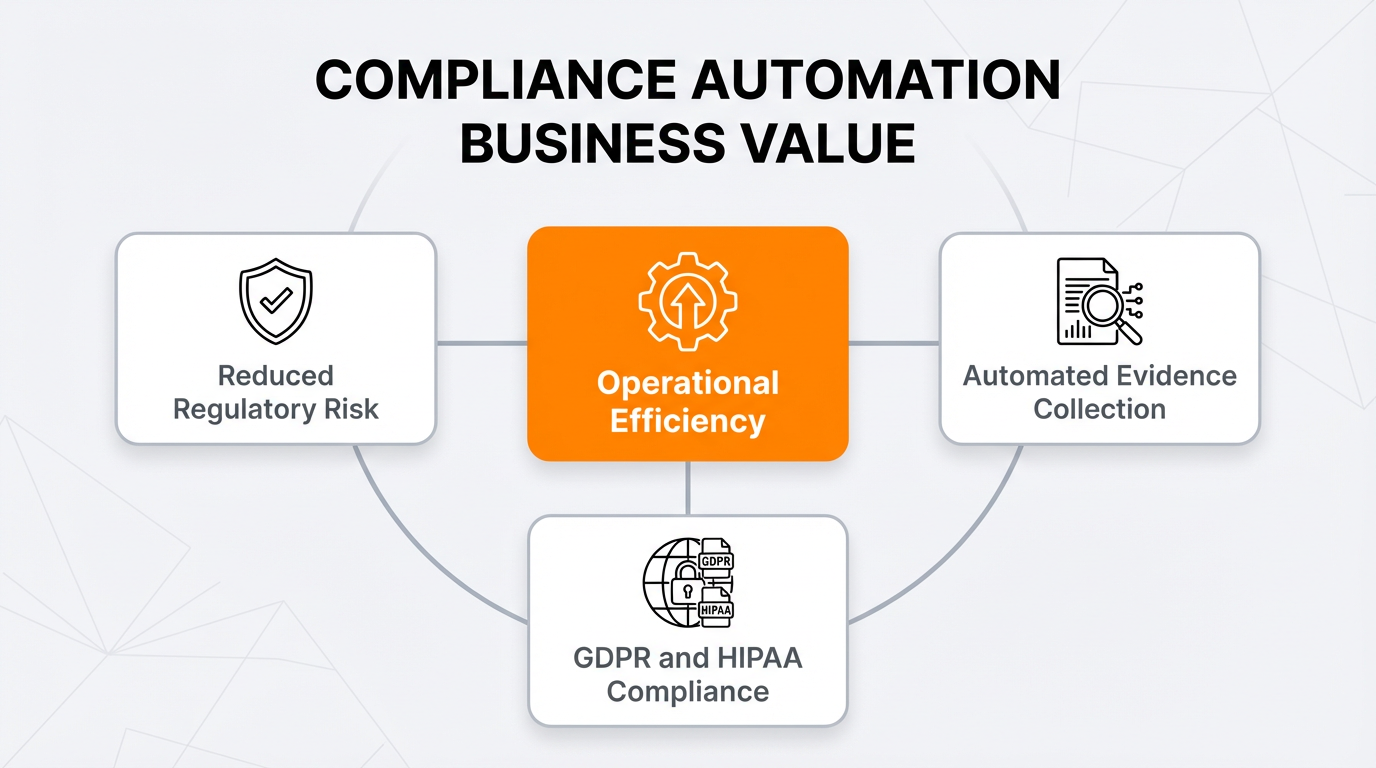
Compliance automation is a software-driven process that continuously monitors systems, generates documentation, and ensures adherence to regulatory standards without manual overhead. This strategy improves operational efficiency and reduces regulatory risk by replacing manual reviews with continuous security controls. Organizations guarantee every software release meets strict governance requirements by baking automated compliance checks directly into the CI/CD pipeline, which enforces policy-as-code throughout the entire SDLC, eliminating the need for manual compliance checks. Automated evidence collection significantly reduces the audit burden for large organizations by gathering necessary data instantly. For example, automated reporting can instantly generate GDPR data privacy reports or HIPAA security logs to prove compliance in real-time. Security automation analyzes infrastructure as code templates to prevent non-compliant resource provisioning.
Hicron Software proved to be a trusted partner with unmatched technical expertise, delivering a scalable and user-friendly web application that was pivotal to our successful U.S. market expansion.

Hicron’s contributions have been vital in making our product ready for commercialization. Their commitment to excellence, innovative solutions, and flexible approach were key factors in our successful collaboration.
I wholeheartedly recommend Hicron to any organization seeking a strategic long-term partnership, reliable and skilled partner for their technological needs.
After carefully evaluating suppliers, we decided to try a new approach and start working with a near-shore software house. Cooperation with Hicron Software House was something different, and it turned out to be a great success that brought added value to our company.
With HICRON’s creative ideas and fresh perspective, we reached a new level of our core platform and achieved our business goals.
Many thanks for what you did so far; we are looking forward to more in future!

Hicron is a partner who has provided excellent software development services. Their talented software engineers have a strong focus on collaboration and quality. They have helped us in achieving our goals across our cloud platforms at a good pace, without compromising on the quality of our services. Our partnership is professional and solution-focused!

The IT system supporting the work of retail outlets is the foundation of our business. The ability to optimize and adapt it to the needs of all entities in the PSA Group is of strategic importance and we consider it a step into the future. This project is a huge challenge: not only for us in terms of organization, but also for our partners – including Hicron – in terms of adapting the system to the needs and business models of PSA. Cooperation with Hicron consultants, taking into account their competences in the field of programming and processes specific to the automotive sector, gave us many reasons to be satisfied.